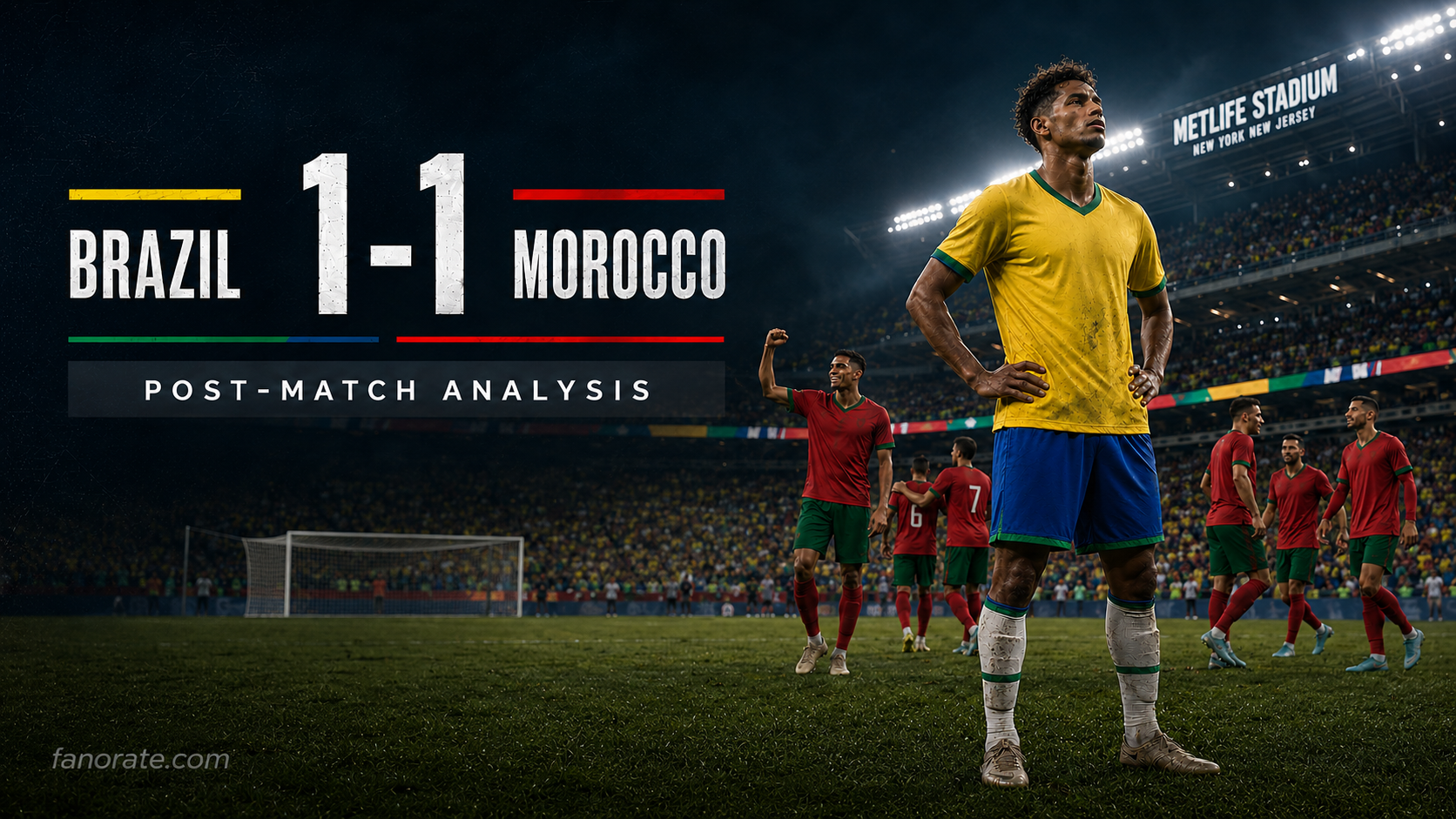
Brazil vs Morocco 1-1 Draw: FIFA World Cup 2026 Group Stage Tactical Breakdown
A pulsating Group Stage encounter at New York’s MetLife Stadium ended all square as Morocco’s Ismael Saibari stunned Brazil with a 21st-minute opener, only for Vinícius Júnior to level before halftime. Despite heavy second-half pressure and a flurry of substitutions, neither side could find a winner in a result that reverberates across Group standings.
What happened
Under the vast canopy of the New York New Jersey Stadium, two of world football’s most tactically sophisticated nations served up a gripping Group Stage stalemate that felt bigger than a single point. Morocco, the Atlas Lions who captivated the planet at Qatar 2022, showed they have lost none of their organizational menace. Brazil, the five-time champions burdened by expectation and galáctico talent, were made to sweat, equalized through their most dangerous weapon, and ultimately had to settle for a share of the spoils. A 1-1 draw on a clear June night in New Jersey — flat on paper, electric in reality.
How it was won and lost
Morocco’s Disciplined Defensive Block Suffocates Brazil Early
Morocco set up in a compact mid-low block, funneling Brazil’s wide attacks into congested central channels and denying Vinícius Júnior the diagonal runs he thrives on. With Sofyan Amrabat anchoring deep and Azzedine Ounahi pressing intelligently in the half-spaces, Walid Regragui’s side made Brazil’s build-up laborious. The Atlas Lions’ defensive shape forced Brazil into longer possession cycles — evidenced by Brazil’s 512 passes attempted — without the verticality to unlock Morocco’s lines in the opening twenty minutes.
Morocco Strike First on the Counter: Saibari’s Clinical Finish
Morocco’s goal at the 21-minute mark was a masterclass in transition football. Brahim Diaz, operating as a free-roaming No.10 between the lines, located Ismael Saibari on a sharp diagonal run behind Brazil’s high defensive line. Saibari composed himself and drove a right-footed finish past Alisson Becker. The goal encapsulated Morocco’s counter-attacking philosophy — patient in shape, devastating in transition. Brazil’s high line, which produced an xG allowance of 0.74 for Morocco, was exposed at the precise moment it mattered.
Vinicius Jr Restores Parity — Brazil’s Individual Brilliance Cuts Through
Brazil’s equalizer on 32 minutes arrived through a combination of Bruno Guimarães’ intelligent distribution and the irresistible instincts of Vinícius Júnior. Picking up the ball in a central-left corridor, Vinicius used his explosive acceleration to turn his marker before slotting a right-footed finish. Brazil’s xG of 1.19 across the 90 minutes — higher than Morocco’s 0.74 — reflected their greater volume of attacking threat, but Morocco’s defensive solidity prevented the Seleção from translating that advantage into a winning goal.
Halftime Substitutions Signal Urgency — Brazil Reshuffle Their Deck
The tactical story of the second half began before it even kicked off. Brazil manager made two substitutions at halftime — Danilo replaced Roger Ibañez at right back, stabilizing an area that had been exposed for Morocco’s opening goal, while Fabinho came off in exchange for a more dynamic midfield option. These changes signaled a clear intent: more aggression, greater pressing intensity, and a shift in Brazil’s defensive line organization.
Second-Half Pressing Wave Fails to Produce — Morocco Absorb and Frustrate
Brazil dominated ball retention in the second half — their 88% pass accuracy and 448 successful passes underline their technical fluency — but Morocco’s resilience was formidable. The Atlas Lions absorbed pressure with 16 clearances and 29 defensive actions in their own box, frustrating a Seleção that increasingly looked for the decisive moment through substitute Matheus Cunha, who was involved in a VAR review on 82 minutes that ultimately came to nothing. Morocco’s 52% possession in the first half gave way to a more reactive second half, but their defensive organization never cracked.
A VAR Moment and Late Urgency — But the Scoresheet Wouldn’t Move
The 82nd-minute VAR review involving Matheus Cunha injected late drama without altering the outcome. Both managers exhausted their substitute allowances — nine changes across both benches — as the final stages became increasingly frantic. Morocco’s late introduction of Soufiane Rahimi offered a fresh counter-attacking outlet in the 89th minute, while Brazil pushed numbers forward seeking a winner that ultimately proved elusive. The 0-0 scoreline in the second half alone confirmed that both defenses ultimately held firm.
Who decided it
Ismael Saibari Ben El Basra
MoroccoThe Moroccan midfielder was the game’s most decisive individual in the opening half. His intelligent movement off the ball, clinical right-footed finish from Brahim Diaz’s assist, and continuous threat on the counter made him the Atlas Lions’ standout performer before being withdrawn for Soufiane Rahimi on 89 minutes.
Saibari’s goal exploited Brazil’s high defensive line precisely at the moment of maximum vulnerability, validating Morocco’s counter-pressing blueprint. His ability to time runs behind the last defender gave Brazil’s backline a problem they never fully resolved.
Vinícius José Paixão de Oliveira Júnior
BrazilVinicius Jr was Brazil’s most dangerous attacking force, converting Bruno Guimarães’ assist on 32 minutes to level the match and repeatedly causing Morocco’s defensive structure discomfort with his directness, pace, and unpredictability on the left flank.
His equalizer was a statement of individual quality — the kind of moment that separates elite forwards from merely good ones. Vinicius’ pressing and recovering runs also contributed to Brazil’s defensive transitions, making him effective in both phases of play.
Brahim Abdelkader Diaz
MoroccoOperating as Morocco’s creative fulcrum in the No.10 role, Brahim Diaz was central to everything dangerous the Atlas Lions produced in the first half. His assist for Saibari’s opener showcased his vision and technical precision, and his movement between the lines consistently drew Brazilian midfielders out of position.
Diaz’s ability to operate in tight spaces and link midfield with attack gave Morocco a level of technical quality to complement their tactical discipline, representing a significant evolution in their attacking identity since Qatar 2022.
Bruno Guimarães Rodriguez Moura
BrazilThe Newcastle United midfielder was Brazil’s engine in the center of the park, completing passes at a high volume, driving forward with purpose, and providing the assist that set up Vinicius Jr’s equalizer. His press resistance and positional intelligence helped Brazil maintain control even when Morocco threatened on the break.
Guimarães acted as the connective tissue between Brazil’s deep defensive shape and their attacking transitions, with his assist for the equalizer demonstrating his quality in the final third as well as his industriousness throughout.
Sofyan Amrabat
MoroccoThe midfield anchor was imperious in his defensive duties, breaking up Brazilian attacks and winning key aerial and ground duels throughout the 90 minutes. His positioning shielded Morocco’s back line and gave the Atlas Lions the platform to launch their decisive counter-attack for the opening goal.
Amrabat’s presence as a defensive midfielder effectively neutralized Brazil’s attempts to play through the middle, forcing the Seleção wide and reducing the central cutting combinations that Brazil prefer in their build-up play.
Where it sits in history
This draw carries genuine historical weight. Brazil have now failed to win their opening World Cup group match — a result that echoes the uncertainty that has surrounded the Seleção in recent tournament cycles. Morocco, meanwhile, continue to build on their extraordinary Qatar 2022 run where they became the first African nation to reach a World Cup semi-final, proving that result was not an anomaly but the foundation of something sustained. A draw between these two sides in a North American World Cup represents a seismic statement of the shifting balance of global football power. Morocco’s ability to hold — and actually lead — a Brazil side packed with Premier League, La Liga, and Champions League talent is a reminder that tactical organization and collective identity can neutralize even the most gilded individual rosters.
Inside the ground
The New York New Jersey Stadium — an 82,566-capacity cathedral of American sport better known as MetLife — was a cauldron of noise and color. A significant Brazilian diaspora, one of the largest in the United States, turned East Rutherford into a sea of yellow and green, with samba drums and passionate chanting reverberating from the lower tiers. But Morocco’s Atlas Lions supporters — vocal, organized, and deeply proud — matched them decibel for decibel. When Saibari opened the scoring, a roar went up from the Moroccan sections that silenced the Samba faithful momentarily. Vinicius’ equalizer flipped the energy back instantly. The clear summer sky above New Jersey framed a night that reminded the world why the FIFA World Cup remains the greatest show on earth.
Looking ahead
Both Brazil and Morocco will return to Group Stage action with their qualification paths now requiring careful management. Brazil — with an xG of 1.19 and the talent to overwhelm any opponent — will be expected to win their remaining group games, but this draw serves as a tactical warning that their defensive structure, particularly the high line, needs refinement. Morocco, buoyed by a point against one of the tournament’s favorites, will approach their next fixture with confidence and belief. Every point in a 48-team World Cup group carries amplified weight, and neither side can afford a second slip if they harbor ambitions of deep tournament runs. The Atlas Lions have proven once again they belong among the elite; Brazil must now prove they can deliver on their perennial promise.
The bottom line
-
Morocco led Brazil 1-0 at halftime through Ismael Saibari’s 21st-minute counter-attack goal assisted by Brahim Diaz
-
Vinícius Júnior equalized for Brazil on 32 minutes with Bruno Guimarães providing the assist
-
The second half ended goalless despite nine substitutions across both sides and a VAR review involving Matheus Cunha on 82 minutes
-
Brazil registered a higher xG (1.19) than Morocco (0.74), suggesting they created the better quality chances despite failing to win
-
Morocco’s defensive structure — anchored by Sofyan Amrabat — successfully neutralized Brazil’s attacking talent for long stretches
-
Both teams split the first-half scoring; neither could find a decisive moment in a goalless second half
-
The result continues Morocco’s emergence as a genuine World Cup force following their historic Qatar 2022 semi-final run
-
Brazil’s high defensive line was exposed for Morocco’s opening goal, a vulnerability the Seleção’s coaching staff must address
