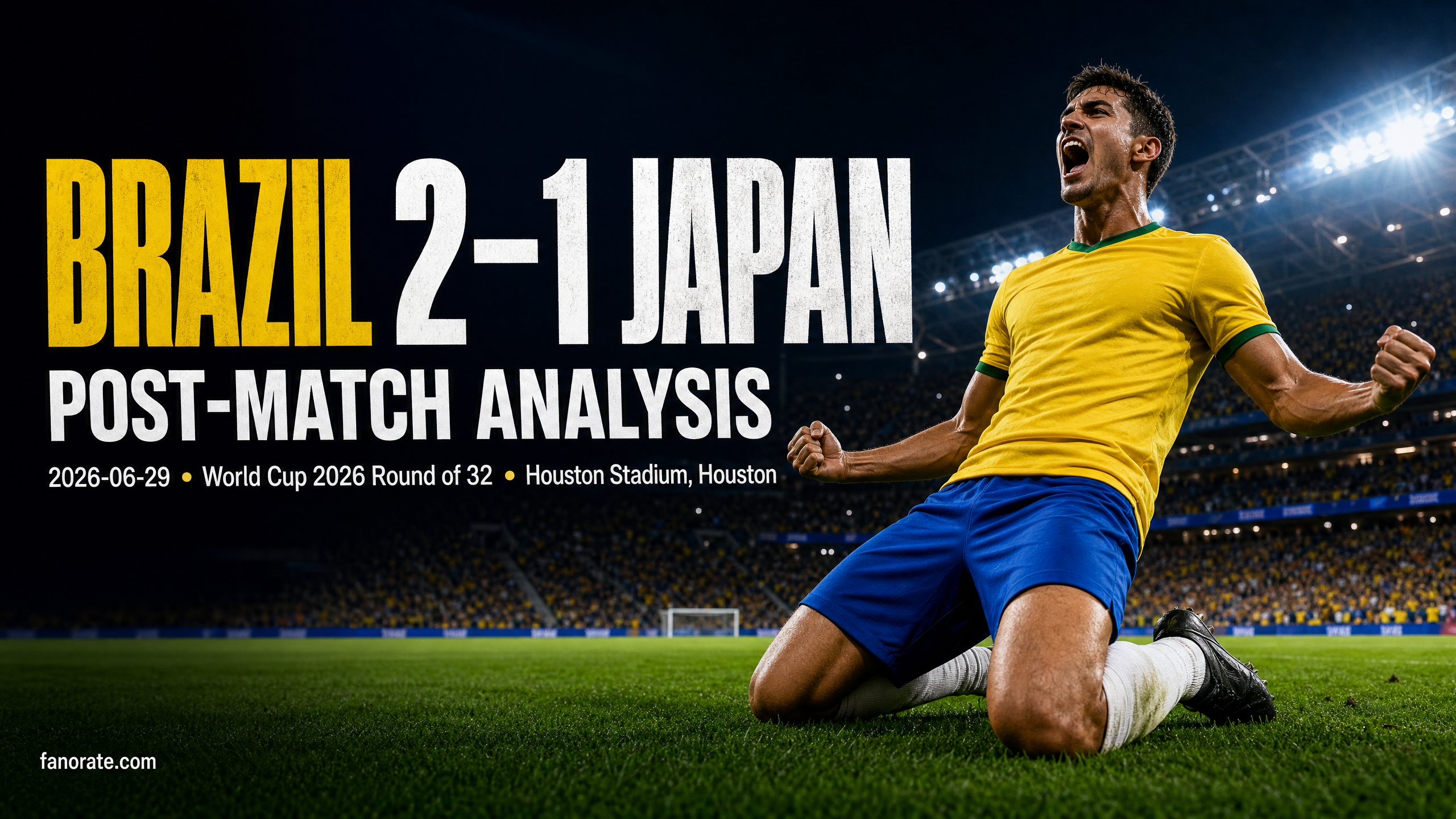
Brazil vs Japan 2-1: Martinelli’s Stoppage-Time Winner Sends Seleção Into World Cup 2026 Last 16
Gabriel Martinelli struck in the sixth minute of stoppage time to complete a thrilling Brazil comeback at Houston Stadium, overturning Kaishu Sano’s first-half sucker punch and sending the Seleção into the Round of 16 of FIFA World Cup 2026.
Brazil win 2-1. Casimiro equalised on 56', Martinelli struck in 90+6' to complete comeback.
What happened
Brazil were made to sweat for every second of it. For 56 minutes at a roaring Houston Stadium, Japan’s disciplined, low-block defensive structure held firm — and for a long stretch, the Samurai Blue were winning. Kaishu Sano’s composed 29th-minute finish sent shockwaves through the stadium, silencing the yellow-and-green tide that packed the 68,777-seat venue. But Brazil, as they so often do on the grandest stages, found a way. Casimiro’s powerful equaliser just before the hour reset the contest, and when substitute Gabriel Martinelli stabbed home in the 96th minute from Bruno Guimarães’ delivery, the Seleção had their passage to the Round of 16 — earned the hard way, against a Japanese side that refused to make it easy.
How it was won and lost
Japan’s Low Block Suffocated Brazil in the First Half
Japan set up in a compact 4-4-2 defensive shape designed to deny Brazil any space between the lines. With just 31% possession, the Samurai Blue were never in this to dominate — they were here to frustrate and punish on the counter. Their 45 long passes reflect a deliberate strategy of clearing lines quickly and transitioning through Daizen Maeda and Junya Ito’s pace in wide channels. For 45 minutes, it worked. Brazil’s 19 shots and 40 crosses tell the story of a team that had volume but struggled for penetration against a resolute Japanese backline that blocked six attempts and kept the Seleção at arm’s length.
Brazil’s Crossing Game: High Volume, Mixed Returns
With 40 total crosses — of which only 9 were accurate — Brazil leaned heavily on wide overloads, particularly through Vinícius Júnior and the overlapping runs of their full-backs. The 92% pass completion rate reflects domestic comfort in building phases, but the final third delivery was inconsistent until the second half. Brazil created four big chances across 90 minutes, missing two, which underlines an underlying efficiency problem that could concern the coaching staff heading into the knockout rounds.
The Casimiro Equaliser: Set-Piece Intelligence Flips the Game
The turning point arrived in the 56th minute when Casimiro powered home from a move assisted by Gabriel Magalhães. The goal carried enormous tactical significance — Japan had set up to withstand Brazilian creativity in open play but were undone by Brazil’s physical superiority at set pieces. Casimiro’s presence in the box as a box-to-box midfielder arriving late is a classic Brazilian tactical weapon. The goal immediately shifted momentum and forced Japan to reassess their defensive compactness.
Second-Half Substitutions Unlocked the Game
Brazil’s coaching staff acted decisively at half-time, bringing on Endrick for Lucas at the break. The move injected pace and directness into Brazil’s forward line. In the 66th minute, Martinelli replaced Matheus Cunha, adding another dynamic wide option. It was Martinelli who would ultimately settle the tie — a substitution that paid maximum dividends. Japan also made their own double substitution at 66′, introducing Sugawara and Junnosuke Suzuki, but the momentum had already shifted irreversibly toward Brazil by the time Martinelli struck.
Japan’s Defensive Resilience Cracked Only Under Sustained Pressure
Japan conceded just 1 goal in open play and were largely well-organised, recording 10 successful tackles, 4 interceptions, and blocking 6 shots. However, the sheer weight of Brazil’s attacks — 88 dangerous attacks to Japan’s 30 — was always going to be difficult to sustain for a full 90+ minutes. Japan’s goalkeeper Zion Suzuki made 4 saves, often keeping his side in the contest, but the eventual concession of two goals reflected the inevitable arithmetic of a side defending 69% possession over an extended period.
Who decided it
Gabriel Martinelli
BrazilCame off the bench in the 66th minute and immediately changed the texture of Brazil’s attacking play with his directness, energy, and willingness to take on defenders. Delivered the defining moment of the match in the 96th minute, converting from Bruno Guimarães’ delivery to send Brazil through.
Martinelli’s introduction gave Brazil a different attacking profile — more vertical, more explosive. His movement stretched Japan’s defensive shape at a moment when the opposition were beginning to tire and their lines were dropping deeper. The winning goal embodied exactly why impact substitutions matter so profoundly in knockout football.
Carlos Henrique Casimiro
BrazilA match defined by extremes for the veteran midfielder. Booked in the 14th minute in a feisty opening phase, Casimiro rose above the controversy to deliver the equaliser in the 56th minute — a goal that completely flipped the complexion of the contest. He was substituted off in the 90th minute, having played his key role.
Casimiro’s late run into the box to convert from Gabriel Magalhães’ assist demonstrated his unique ability to function as both a midfield shield and a clinical goalscoring threat. His equaliser transformed the match’s psychological dynamic, deflating Japan’s belief while reinvigorating a Brazil side that had looked uncomfortable for much of the first half.
Kaishu Sano
JapanThe midfielder produced the standout individual contribution for Japan, earning a yellow card in the 12th minute in a combative early exchange before scoring a composed 29th-minute goal that put the Samurai Blue in front. Sano embodied Japan’s determination to upset the footballing hierarchy on the world stage.
Sano’s goal — converted from inside the box — was the product of Japan’s counter-attacking design. His willingness to carry the ball forward and arrive in dangerous areas gave Japan a genuine threat beyond their defensive shape. The goal forced Brazil to reassess their approach and raise their intensity, ultimately forcing the comeback.
Bruno Guimarães
BrazilThe Newcastle United midfielder was Brazil’s most influential figure in the engine room over the full 90 minutes, completing passes at a high rate and registering the assist for Martinelli’s dramatic winner in stoppage time. His delivery into the box with the last meaningful action of the game showcased his vision and composure under pressure.
Guimarães operated as the creative fulcrum of Brazil’s midfield, combining with Casimiro to manage possession and transition. His 17 key passes (team statistic) reflects a team that created consistently through his zone. The assist for the winner was the perfect summary of his influence — calm, precise, and decisive when it mattered most.
Zion Suzuki
JapanJapan’s goalkeeper produced a composed and technically impressive performance, making 4 saves to keep the Samurai Blue in contention for long periods. He was ultimately beaten by Casimiro’s power and Martinelli’s clinical finish, but Suzuki gave Japan every chance of causing a major upset.
Suzuki’s shot-stopping was a significant factor in keeping Japan competitive against a Brazilian side that generated 19 shots and 7 on-target efforts. His command of his box and ability to deny Brazil’s crossing game in the second half prolonged the contest well into stoppage time.
Where it sits in history
This result adds another chapter to Brazil’s rich World Cup knockout tradition — the Seleção have now navigated the Round of 32 in the expanded 48-team FIFA World Cup 2026 format, keeping alive their eternal dream of a sixth World Cup title. Japan, meanwhile, have once again demonstrated that Asian football commands deep respect at the global level. The Samurai Blue’s willingness to lead against the five-time world champions for 56 minutes reflects the remarkable strides Japanese football has made since their first World Cup appearance in 1998. Brazil’s comeback nature — twice required to overturn a deficit — echoes historical moments of Seleção resilience, though the performance will draw scrutiny from pundits questioning whether the traditional powerhouse can sustain this level of vulnerability as the tournament intensifies.
Inside the ground
Houston Stadium crackled with Latin American energy, with the 68,777-capacity venue packed predominantly by Brazil supporters whose samba drums and green-and-yellow flags created an almost Copa América-level atmosphere in deep Texas. When Sano’s goal silenced the majority, the moment was palpable — a rare stillness inside a stadium that had been a wall of noise. Japan’s travelling supporters, a compact but fervent group known for their passionate and respectful football culture, created their own pockets of noise throughout. When Martinelli struck in the 96th minute, the eruption was seismic — a release of tension that had been building throughout an unexpectedly gripping 90+ minutes in Houston.
Looking ahead
Brazil advance to the Round of 16 of FIFA World Cup 2026, where they will face a sterner test as the tournament enters its most consequential phase. The coaching staff will study this performance carefully — the first-half defensive vulnerability to Japan’s counter and the over-reliance on crossing volume without conversion accuracy are areas that elite opponents in the next round will look to exploit. Japan exit the tournament with their heads held high, their performance cementing the view that the Samurai Blue are no longer a side content to simply participate at World Cups — they arrive to compete, and occasionally to lead.
The bottom line
-
Brazil came from behind to win 2-1, with Martinelli’s 96th-minute winner completing the comeback
-
Japan took a shock lead through Kaishu Sano in the 29th minute, holding on until the 56th minute
-
Casimiro’s equaliser from a set-piece move was the tactical turning point of the contest
-
Brazil dominated possession 69%-31% but struggled to break Japan down in the first half
-
Martinelli’s impact as a substitute encapsulates the importance of Brazil’s attacking depth
-
Japan recorded only 5 total shots but defended with remarkable discipline, blocking 6 Brazilian attempts
-
Brazil advance to the Round of 16 of FIFA World Cup 2026
-
The result maintains Brazil’s record of never having been eliminated before the Round of 16 in a World Cup they qualified for
