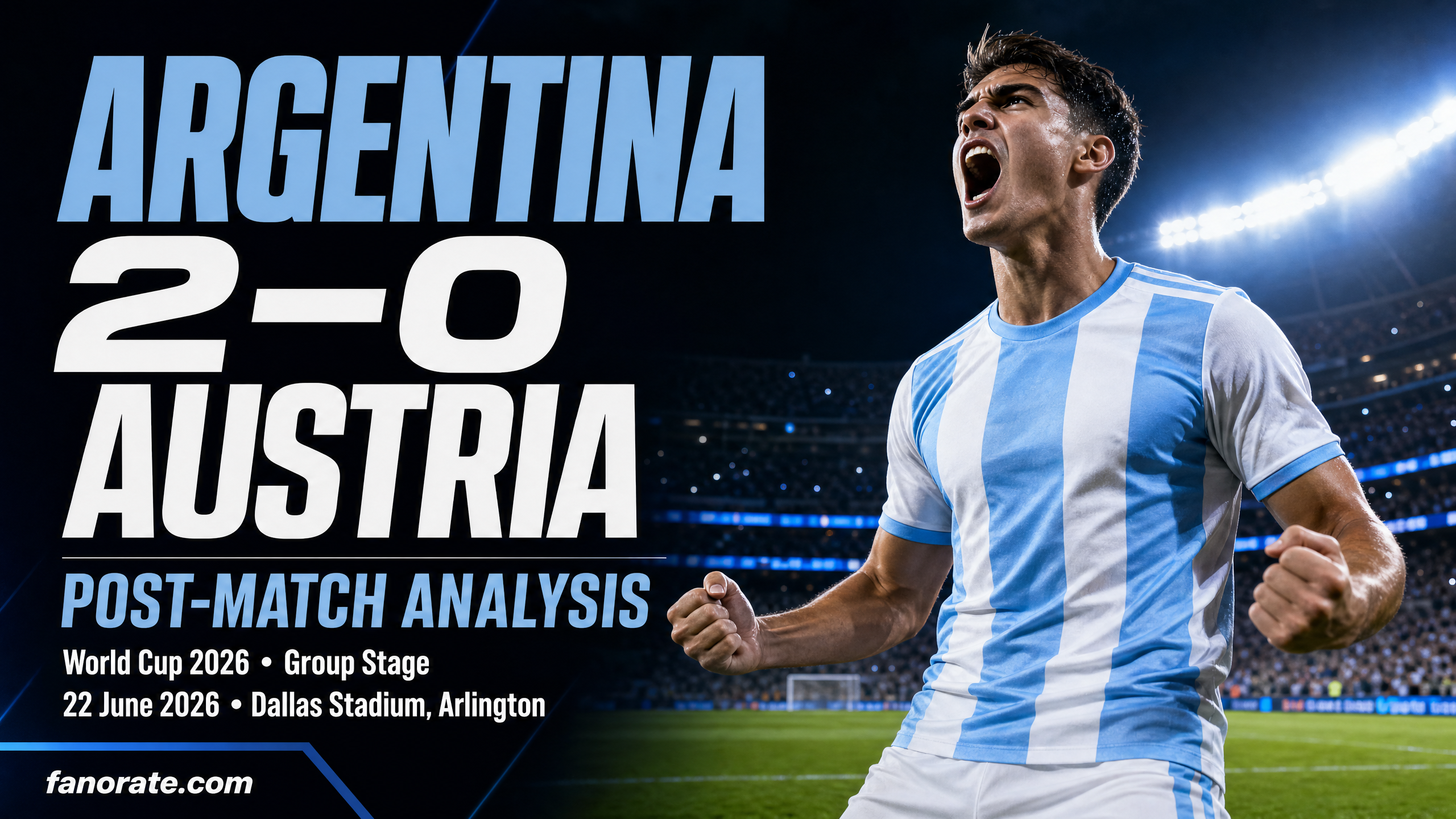
Argentina 2-0 Austria: Messi Masterclass Sends Albiceleste Into World Cup 2026 Knockout Stage
Lionel Messi conjured a vintage left-footed finish and a tireless Lautaro Martínez won an early penalty as Argentina secured a commanding 2-0 victory over Austria at Dallas Stadium in Arlington, Texas. The defending World Cup champions were largely dominant, clinical in key moments, and typically resolute at the back — a statement performance deep in the heart of Texas.
What happened
Under the Arlington sky at a sold-out Dallas Stadium, Argentina sent an emphatic message to the rest of the World Cup 2026 field. Lionel Scaloni’s side were sharp, purposeful, and clinical against a disciplined Austrian outfit, winning 2-0 courtesy of first-half dominance that the second half never threatened to unravel. Lautaro Martínez drew an early penalty in the seventh minute, and while the spot kick went unscored in the timeline of events, it was Messi who delivered the decisive blow — a composed left-footed finish in the 38th minute, assisted by the energetic Facundo Medina. A second goal before half-time reflected the gap in quality, and although Austria rallied with a wave of second-half substitutions, Argentina’s structural discipline ensured their clean sheet remained intact. The defending champions march on with maximum control.
How it was won and lost
Argentina’s Structured Dominance: Possession With Purpose
Argentina set up in their familiar 4-3-3 / 4-2-3-1 hybrid, dictating tempo from the first whistle. With 553 passes completed at an 89% accuracy rate compared to Austria’s 468 at 86%, Scaloni’s side controlled the game through patient build-up play and intelligent positional rotations. Rodrigo De Paul and Giovani Lo Celso operated as interior midfielders, pressing high and recycling possession quickly, while Leandro Paredes provided the base from deep. The structure gave Messi the freedom to drift into pockets between Austria’s midfield and defensive line — a freedom Austria simply could not afford to grant.
Early Penalty Pressure Sets the Tone
As early as the seventh minute, Lautaro Martínez’s relentless movement and pressing intensity forced a penalty, immediately putting Austria on the back foot. The psychological impact of conceding such an early infringement — a foul born directly from Argentina’s high-press trigger — disrupted Austria’s defensive shape and compelled them to defend deeper than they had intended. Argentina’s 42 sprints compared to Austria’s 24 underlined a physical intensity that Austria struggled to match for extended periods.
Messi’s 38th-Minute Masterpiece
The opening goal arrived through a move of trademark Argentine elegance. Facundo Medina’s assist demonstrated the wide full-back’s aggressive overlapping runs as a structural weapon, stretching Austria’s defensive line and creating the space for Messi to arrive onto the ball and dispatch a clinical left-footed finish. Messi’s xG contribution of 2.86 across the match — compared to Austria’s team total of just 0.62 — illustrates just how thoroughly Argentina’s attacking platform outperformed their opponents. A second goal before the interval compounded Austria’s misery and effectively ended the match as a meaningful contest.
Austria’s Second-Half Triple Substitution Gamble
Austria manager Ralf Rangnick responded to the scoreline by making six substitutions between the 64th and 85th minutes, introducing Marko Arnautović, Alexander Prass, Marco Friedl, Patrick Wimmer, and Carney Chukwuemeka in an attempt to inject urgency and directness. The changes briefly destabilised Argentina’s rhythm — reflected in a flurry of bookings and fouls around the 76th minute — but Scaloni’s side adapted well, sitting deeper and controlling the game through intelligent ball circulation and foul-based game management. Austria managed only 10 shots with 4 on target despite their late pressure, and their xG of 0.62 tells the story of a team that never truly tested Musso’s goal.
Argentina’s Defensive Solidity Under Pressure
With Lisandro Martínez and Marcos Senesi operating as central defenders — and the experienced Nicolás Otamendi introduced from the bench in the 57th minute to replace Cristian Romero — Argentina demonstrated tactical flexibility in managing game state. The shift brought experience and aerial authority to deal with Austria’s late long-ball tactics. Argentina conceded just 4 shots on target across the full match and kept a clean sheet, extending their formidable defensive record at this tournament.
Who decided it
Lionel Andrés Messi
ArgentinaMessi was at his orchestrating, decisive best. He won an off-target attempt in the 9th minute as he probed early, before delivering the match-defining goal in the 38th minute with a composed left-footed finish assisted by Medina. He continued to threaten deep into stoppage time, registering another right-footed attempt in the 90+5th minute. His xG figures of 2.86 were simply in a different galaxy to anyone else on the pitch.
Messi’s movement between the lines drew Austria’s midfield out of shape repeatedly, creating passing lanes for De Paul and Lo Celso to exploit. His gravity as a ball-carrier forced Austria to double-up defensively, leaving space in wide areas for Medina and Barco to exploit with overlapping runs.
Lautaro Javier Martínez
ArgentinaThe Inter Milan striker was a constant menace to the Austrian backline from the opening whistle. His pressing intensity earned Argentina a penalty inside the first seven minutes, and his clever link-up play and movement provided the attacking frame around which Messi could operate freely.
Martínez’s relentless high press forced Austria’s centre-backs into hurried decisions and won the penalty that set the match’s early tone. His industry allowed Messi the luxury of a free creative role, functioning as a pressing trigger that defined Argentina’s attacking press structure.
Facundo Axel Medina
ArgentinaThe young full-back was one of the match’s most dynamic performers. His marauding run and assist for Messi’s 38th-minute goal highlighted his threat as an overlapping attacking presence. His aggressive movement down the left channel was a key part of Argentina’s goal, stretching Austria’s defensive structure to breaking point.
Medina’s willingness to burst beyond Austria’s defensive line created width overloads that the Austrian right side consistently struggled to contain. His direct assist for the opening goal cemented his status as a significant tactical weapon in Scaloni’s system.
Rodrigo Javier De Paul
ArgentinaDe Paul brought his trademark energy, box-to-box intensity, and passing range to Arlington, operating as the connective tissue between Argentina’s midfield and attack. His 82nd-minute substitution by Paredes reflected excellent squad management from Scaloni.
De Paul’s pressing actions, particularly in transitions, disrupted Austria’s ability to build from the back. His partnerships with Paredes and Lo Celso gave Argentina a midfield unit that Austria could rarely bypass with fluid play.
Where it sits in history
Argentina arrive at FIFA World Cup 2026 as defending champions, having lifted the trophy in Qatar in 2022 — ending a 36-year wait for the nation’s third World Cup crown. This victory over Austria echoes a long tradition of Argentine tournament authority in Group Stage football, where Scaloni’s side have now developed a formidable record of controlling games through positional discipline and individual brilliance. Austria, competing under Ralf Rangnick’s progressive pressing philosophy, had entered this tournament as one of Europe’s most tactically evolved nations — but found the gulf in class between a developing European side and the world’s reigning champions to be a sobering reality check. For Messi personally, each World Cup goal only deepens an already unparalleled legacy, and his performance in Arlington added another chapter to the greatest international football career the sport has ever witnessed.
Inside the ground
Dallas Stadium in Arlington was a cauldron of blue and white. The Argentine diaspora across North America descended on the 80,000-capacity venue in extraordinary numbers, transforming the Texan arena into a South American fortress draped in Albiceleste colours. Messi’s name resonated from the stands in waves before kick-off, and the roar that greeted his 38th-minute finish was seismic — the kind of visceral, communal celebration that only the World Cup can generate. Even the scattered clouds overhead seemed to part momentarily as Argentina’s greatest ever player did what he always does on the world’s biggest stage. Austrian supporters, though significantly outnumbered, were vocal and present, making their voices heard particularly during the frenetic substitute-driven finale — a testament to European football culture’s growing global presence at this expanded FIFA World Cup.
Looking ahead
With three points secured in dominant fashion, Argentina now look ahead to their remaining Group Stage fixtures with enormous confidence. A 2-0 win, a clean sheet, and a largely controlled performance will delight Lionel Scaloni, who will now rotate his squad strategically to maintain freshness for the knockout rounds. Austria, meanwhile, must regroup urgently. Rangnick’s side need a positive result in their next fixture to remain in contention for progression. Their xG of just 0.62 against a World Cup-winning nation suggests attacking output must increase dramatically if they are to advance from a competitive group. Keep an eye on Carney Chukwuemeka, whose late introduction impressed, as a potential wild card option for Austria’s must-win upcoming matches.
The bottom line
-
Argentina secured a convincing 2-0 victory over Austria in their FIFA World Cup 2026 Group Stage opener at Dallas Stadium, Arlington.
-
Lionel Messi scored the opening goal in the 38th minute with a trademark left-footed finish, assisted by Facundo Medina.
-
Lautaro Martínez’s relentless pressing earned an early penalty, setting the physical and tactical tone for the entire match.
-
Argentina’s xG of 2.86 dwarfed Austria’s 0.62 — an Opta-level illustration of total attacking supremacy.
-
Scaloni’s side demonstrated impressive tactical flexibility, shifting defensively in the second half to protect their clean sheet through ten combined substitutions.
-
Austria’s second-half triple substitution gamble failed to unlock Argentina’s resolute backline, with Musso rarely tested seriously.
-
Argentina’s possession dominance — 553 passes at 89% accuracy — reflected a team in complete control of game tempo throughout.
-
The result maintains Argentina’s formidable World Cup Group Stage record under Scaloni and strengthens their status as tournament favourites.
