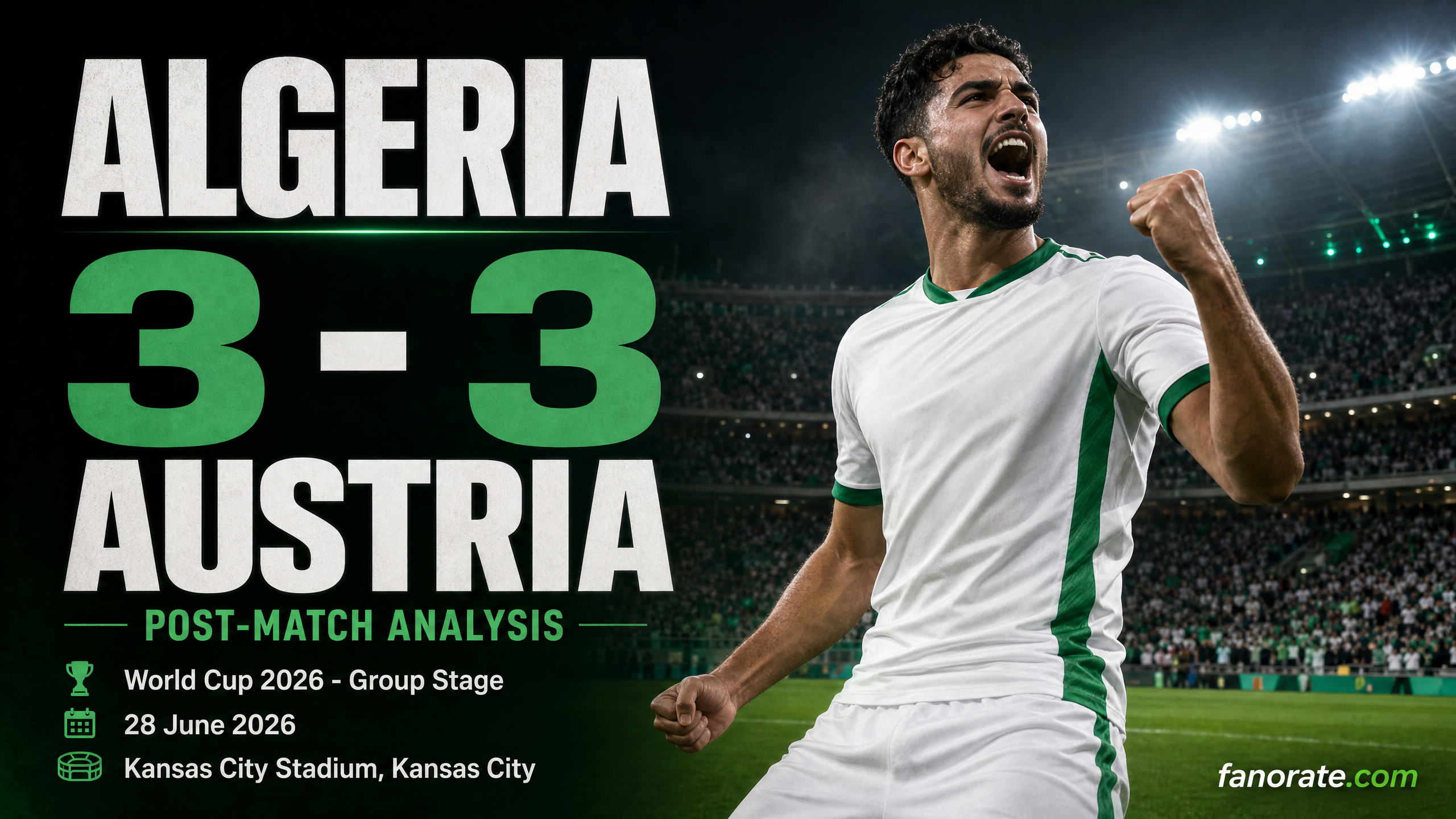
Algeria 3-3 Austria: Mahrez Brace and Late Drama Define Thrilling World Cup Group Stage Draw
Six goals, two stunning stoppage-time strikes, and a Riyad Mahrez masterclass. Algeria and Austria served up one of the most dramatic moments of FIFA World Cup 2026 in a breathless 3-3 Group Stage draw at Kansas City Stadium.
3-3 Draw after 90+ minutes — both teams split points in a pulsating Group Stage encounter
What happened
Kansas City Stadium was the setting for one of the most enthralling matches of FIFA World Cup 2026 so far, as Algeria and Austria shared a dramatic 3-3 draw that left both sets of supporters emotionally spent. Riyad Mahrez dragged Algeria level in the 90th+3 minute only for substitute Sasa Kalajdzic to equalise for Austria just moments later, ensuring neither side could claim a decisive advantage in what was a relentless, tactically fascinating Group Stage encounter under the scattered clouds of Missouri.
How it was won and lost
Austria’s Early Control and Arnautović’s Clinical Edge
Austria established their presence early, working the ball intelligently despite carrying just 35% of possession across the match. Marko Arnautović, operating as a focal point in a compact attacking structure, drew a yellow card in the 11th minute before producing the game’s opening goal on 28 minutes, finishing cleanly from a David Alaba assist. Austria’s low-block approach invited Algeria to build possession — finishing with a remarkable 94% passing accuracy on 755 attempts — while looking to expose space on the counter through direct balls and sharp combination play. Their 87% pass success rate on 397 passes reflected an efficient rather than expansive approach.
Algeria’s Possession Dominance Without Penetration
Algeria controlled the ball with authority, owning 65% of possession and registering 139 attacks to Austria’s 81. Yet that statistical dominance told only part of the story. With zero accurate crosses from five attempts and only five shots on target from 12 total, Algeria struggled to convert their territorial supremacy into genuine danger. Their 63% dribble success rate — the highest of any side in this match — and 12 key passes highlighted individual quality, particularly from Mahrez and Houssem Aouar, but the final third too often became congested. The Rafik Belghali equaliser on 45 minutes, assisted by Mahrez, was a moment of individual brilliance rather than structured build-up play.
Half-Time Triple Substitution Changes the Game’s Rhythm
Austria’s coaching staff made a bold and decisive intervention at the break, introducing Michael Gregoritsch, Florian Grillitsch, and Paul Wanner simultaneously — replacing Arnautović, Xaver Schlager, and Romano Schmid. The reshuffle immediately paid dividends. The fresh legs and altered positional structure destabilised Algeria’s rhythm, and Marcel Sabitzer capitalised in the 55th minute with a composed finish assisted by Konrad Laimer. Austria’s willingness to sacrifice their captain in search of greater dynamism was a tactical masterstroke that briefly looked like it might define the match.
Mahrez’s Magic and the Chaos of Stoppage Time
Just when Austria appeared to be managing the game towards a narrow victory, Riyad Mahrez produced a moment of genuine World Cup brilliance. His 60th-minute goal, again assisted by the excellent Houssem Aouar, restored parity before his 90+3 strike — once more set up by Aouar — appeared to have won the tie for Algeria in sensational fashion. However, substitute Sasa Kalajdzic, introduced in the 90+5 minute, somehow produced an almost immediate header from a Michael Gregoritsch assist in the 90+6 to ensure Austria did not leave empty-handed. The closing minutes were pure World Cup theatre, with both managers unable to influence the chaos unfolding on the pitch.
Defensive Vulnerabilities on Both Sides
Neither defence emerged with significant credit. Algeria’s backline, anchored by Aïssa Mandi and Ramy Bensebaini, was repeatedly exposed by Austria’s direct counter-attacking, conceding three goals from just three shots on target. Austria, despite strong aerial work — nine successful headers — and 10 interceptions, allowed Algeria to create three big chances and were undone by Mahrez’s ability to find space in transition. Kevin Danso’s introduction at left centre-back in the 62nd minute reflected Austrian concerns about their defensive shape.
Who decided it
Riyad Mahrez
AlgeriaThe captain was Algeria’s standout performer by some distance, scoring twice and assisting the team’s first goal. His 60th-minute equaliser demonstrated cool composure under pressure, and his 90+3 strike in stoppage time was a moment of pure, instinctive quality that temporarily looked like winning the match for the Desert Foxes.
Mahrez drifted intelligently between the lines throughout the match, exploiting the half-spaces that Austria’s compact midfield occasionally vacated during their counter-press. His combination with Houssem Aouar — who assisted all three of Algeria’s goals — was the most dangerous partnership on the pitch, generating overloads in wide-to-central transition zones.
Houssem Aouar
AlgeriaArguably the most consistent performer across the full 90 minutes, Aouar was involved in every Algeria goal, registering three assists in a display of creativity and technical precision that belied the pressure of a high-stakes World Cup fixture.
Operating as a free-roaming number eight, Aouar was central to Algeria’s possession structure. His ability to receive under pressure, turn quickly, and deliver incisive final passes repeatedly unlocked Austria’s defensive block. With Algeria registering 10 key passes in total, a significant proportion traced back to the Lyon midfielder’s involvement.
Marko Arnautović
AustriaThe veteran striker was Austria’s most dangerous presence before his half-time withdrawal. He scored a composed opener, drew a foul that earned his yellow card, and linked Austria’s attack effectively before his replacement allowed a tactical shift that ultimately reshaped the match.
Arnautović’s physical presence and sharp movement in behind Algeria’s high defensive line created constant uncertainty. His goal from an Alaba assist demonstrated his finishing quality and his ability to make intelligent runs into the penalty area.
Marcel Sabitzer
AustriaThe midfielder’s 55th-minute goal, shortly after the half-time substitutions, gave Austria what looked like a decisive lead. Calm and intelligent in his movement, Sabitzer exploited the temporary disorganisation in Algeria’s midfield structure following Austria’s wholesale changes.
Sabitzer’s goal came from a sharp central run that Algeria’s midfield failed to track, highlighting his off-ball intelligence. He was central to Austria’s pressing structure in the second half, working intelligently alongside the freshly introduced Grillitsch and Wanner.
Sasa Kalajdzic
AustriaIntroduced in the dying seconds of the match, Kalajdzic produced an extraordinary cameo, heading home a Michael Gregoritsch cross in the 90+6 minute to rescue an unlikely point for Austria in one of the most dramatic conclusions of the tournament so far.
His introduction exemplified the use of targeted substitutions to exploit aerial threats in the final moments of matches. Algeria’s defensive organisation had been disrupted by the constant pressure of the final minutes, and Kalajdzic’s movement in the box punished that disorganisation.
Where it sits in history
Algeria reaching the FIFA World Cup 2026 Group Stage represents a return to the global stage for the Desert Foxes, who memorably advanced to the Round of 16 at the 2014 World Cup in Brazil — their finest World Cup performance to date. Austria, meanwhile, are continuing to build on a renaissance under their current setup, featuring a generation of technically gifted players developed across Europe’s top leagues. A 3-3 draw in a World Cup Group Stage fixture is a genuinely rare outcome, and this result’s late drama adds it immediately to the pantheon of memorable North African performances at major international tournaments. Riyad Mahrez, already a legend of Algerian football, further enhanced his World Cup legacy with a brace in one of the competition’s most breathless matches.
Inside the ground
Kansas City Stadium, with a capacity of 76,416, provided a spectacular setting as one of North America’s premier World Cup venues. A significant Algerian diaspora presence in the United States ensured a vocal and passionate support base for the Desert Foxes, whose green-and-white colours filled sections of the stands throughout. The Austrian supporters, though smaller in number, were animated throughout, especially during the sustained pressure of the second half. When Kalajdzic’s 90+6 equaliser hit the net, the stadium erupted in a collective surge of disbelief — a moment of pure World Cup theatre that the 76,000-plus crowd inside Kansas City will not forget quickly. The atmosphere throughout reflected the match itself: pulsating, emotional, and utterly unpredictable.
Looking ahead
Both sides leave Kansas City with a point but with the knowledge that this Group Stage tie represents a significant opportunity — and a warning. Algeria’s possession game is functioning at an elite technical level, but their finishing and crossing accuracy need urgent improvement if they are to progress deep into the tournament. Mahrez and Aouar’s partnership is dangerous enough to unlock any defence, but Algeria will need greater efficiency in the final third. Austria, meanwhile, will be encouraged by their clinical edge — three goals from just three shots on target is a remarkable conversion rate — but their defensive fragility against quality opposition will concern Ralf Rangnick’s coaching structure. With both teams sharing points, the race for Group Stage progression intensifies, and their next matches carry enormous weight in determining World Cup 2026 advancement.
The bottom line
-
Algeria dominated possession with 65% and a 94% passing accuracy but needed Mahrez’s individual brilliance to rescue a point
-
Austria’s half-time triple substitution changed the match’s momentum, leading directly to Sabitzer’s 55th-minute goal
-
Houssem Aouar’s three assists were the creative heartbeat of Algeria’s attack
-
Sasa Kalajdzic’s 90+6 equaliser, seconds after being introduced as a substitute, was one of the most dramatic moments of FIFA World Cup 2026 so far
-
Riyad Mahrez scored twice, underlining his status as Algeria’s most dangerous and decisive player
-
Neither defence performed convincingly, with both sides conceding three goals in a high-stakes Group Stage encounter
-
The 3-3 draw leaves both teams needing strong results in subsequent Group Stage fixtures to advance
