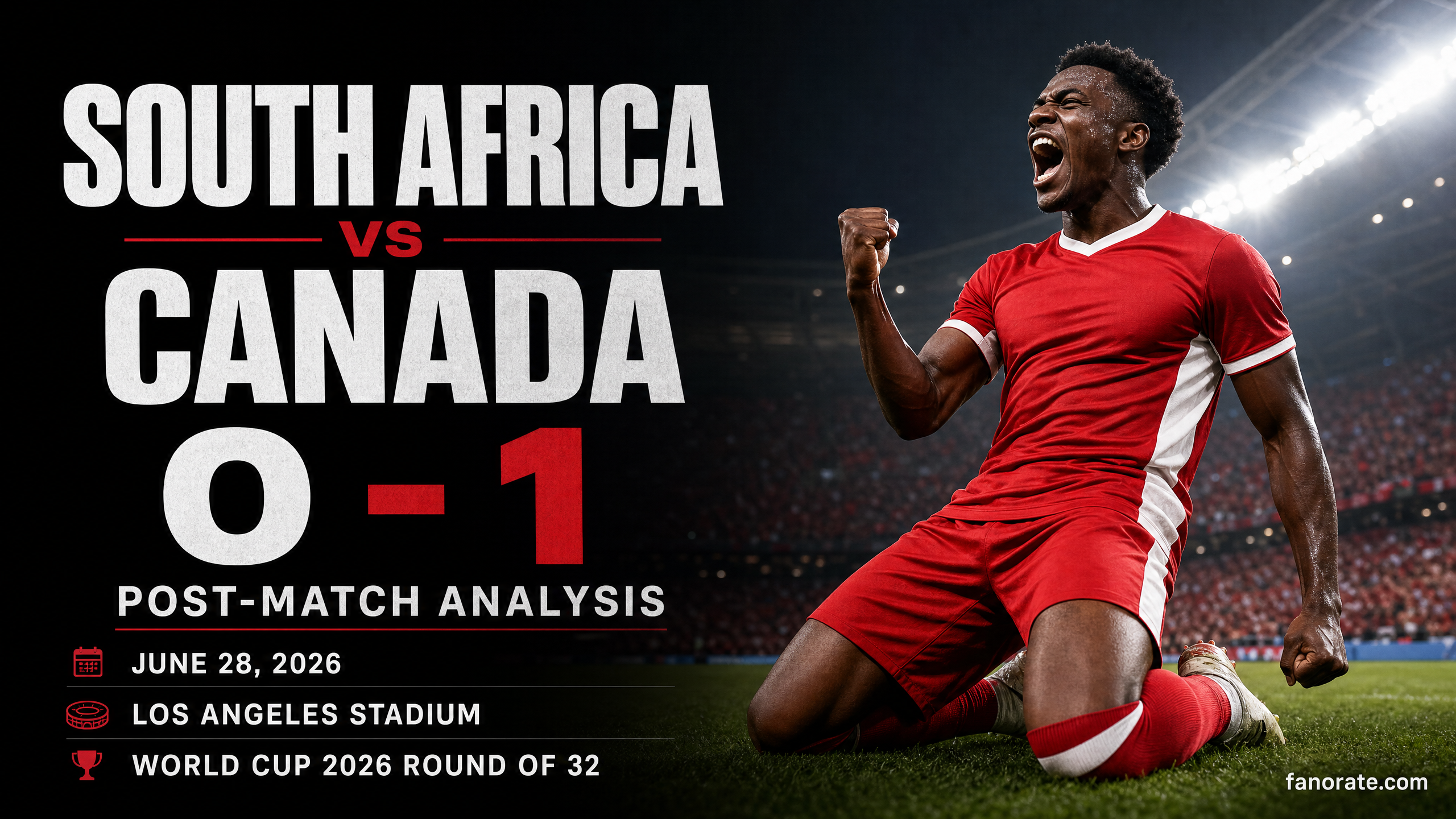
Canada Edge South Africa 1-0 at FIFA World Cup 2026: Eustáquio’s Last-Gasp Goal Sends Canucks Into Round of 16
Stephen Eustáquio broke South African hearts in stoppage time, delivering Canada a hard-fought 1-0 victory at Los Angeles Stadium and a place in the FIFA World Cup 2026 Round of 16.
Canada won after full-time via a 90+2' Stephen Eustáquio goal
What happened
It took until the dying embers of stoppage time, but Canada found their way. Stephen Eustáquio’s goal in the 92nd minute, the kind of strike that writes tournament legends, broke a resolute South Africa side and delivered the Canucks a tense 1-0 victory at Los Angeles Stadium on June 28th. South Africa had absorbed wave after wave of Canadian pressure across 90 minutes, defended with enormous discipline, and fashioned a game plan that came agonisingly close to forcing extra time. But football’s cruelest clock ran out on Bafana Bafana, and Canada march on into the FIFA World Cup 2026 knockout rounds.
How it was won and lost
South Africa’s Defensive Masterclass — Almost Perfect
South Africa set up with a deep, compact defensive shape designed to absorb Canada’s attacking threat and exploit space on the counter. Possessing 58% of the ball, Bafana Bafana actually controlled the tempo in possession terms, cycling the ball patiently through 554 passes at an 84% success rate. But the intent was conservative — 72 long passes deployed, largely to relieve pressure rather than build attacks. Their back line held firm for 91 minutes, limiting Canada to just nine shots inside the box and forcing goalkeeper Ronwen Williams into only one genuine save. The problem? They never really threatened at the other end, recording just one shot on target and creating zero big chances. The defensive organization was admirable, but the absence of any offensive ambition ultimately left them with no margin for error when Eustáquio struck.
Canada’s Relentless Pressure Finally Pays Off
Jesse Marsch’s Canada pressed high and relentlessly throughout, generating 124 attacks and 50 dangerous attacks compared to South Africa’s 85 and 20 respectively. With 42% possession, Canada were the team that sacrificed the ball to play in transitions and vertical channels. Their 12 shots total — nine inside the box — told the story of a team that constantly sought the spaces in behind South Africa’s disciplined block. Four big chances created underscored the quality of their approach play, even if those same four big chances were missed before Eustáquio finally delivered. The wide areas were a particular weapon, with 13 crosses attempted and key passes accumulating to 10 across the match.
The Alphonso Davies Effect — A Game-Changing Introduction
With the match goalless and tension mounting, Canada introduced Alphonso Davies in the 75th minute in place of Tajon Buchanan. The Bayern Munich left-back immediately injected pace, directness and menace into Canada’s wide play. His presence stretched South Africa’s defensive shape and created the kind of instability that eventually led to the decisive moment. Davies’ arrival visibly shifted momentum, forcing Bafana Bafana into deeper positions and more desperate defensive decisions in the closing stages.
South Africa’s Substitutions Couldn’t Change the Game
Hugo Broos made three changes for South Africa, with Thalente Mbatha coming off at half-time, and Tshepang Moremi and Iqraam Rayners entering in the 86th minute. The late attacking additions of Moremi and Rayners suggested an intent to push forward in the final stages, but arriving so late in the match gave them little time to alter the tactical picture. With just one corner won all match and no big chances created at any point, South Africa’s offensive output remained critically insufficient regardless of personnel changes.
Set-Piece Discipline and Midfield Battles
South Africa won 15 free kicks and successfully intercepted 15 Canadian moves, demonstrating their discipline and organisation off the ball. Canada committed 16 fouls and received two yellow cards — N. Saliba caution in the 54th minute and Niko Sigur’s booking in the 67th. The midfield battle was closely contested, with both sides competing aerially — Canada winning 22 headers to South Africa’s 11 — reflecting the physical nature of the contest and South Africa’s long-ball strategy to relieve pressure.
Who decided it
Stephen Antunes Eustáquio
CanadaThe Porto midfielder was the heartbeat of Canada’s midfield engine throughout, contributing to the pressing structure, linking play between defence and attack, and ultimately delivering the moment of the match with a decisive goal in the 92nd minute.
Eustáquio’s goal was not just a moment of quality — it was the culmination of a relentless pressing and attacking performance that embodied Canada’s tournament identity. His ability to arrive late into dangerous positions is a recurring threat that South Africa could not neutralize when it mattered most.
Ronwen Williams
South AfricaThe Mamelodi Sundowns goalkeeper was South Africa’s standout performer, making five saves across the match to single-handedly preserve the clean sheet scoreline for as long as he could. His reflexes and positioning denied Canada on multiple occasions.
Williams was the last line of a disciplined defensive structure, and his five-save haul kept South Africa competitive in a match where Canada’s attacking volume and quality repeatedly tested the backline. His performance was ultimately not enough, but he gave Bafana Bafana every chance.
Alphonso Davies
CanadaIntroduced in the 75th minute as a game-changing substitution, Davies brought immediate energy, width and directness to Canada’s left flank at a moment when South Africa appeared to be successfully containing the match.
Davies’ introduction stretched South Africa’s defensive shape and disrupted their well-drilled compactness in the crucial final quarter. His pace and willingness to drive at defenders created the kind of chaos that loosened Bafana Bafana’s structure ahead of the winning goal.
Jonathan David
CanadaThe Lille striker worked tirelessly as Canada’s focal point, holding up play, drawing defenders and creating space for runners in behind. His link-up play generated several of Canada’s 10 key passes and he was central to the team’s sustained attacking pressure.
David’s intelligent movement and ability to play in tight spaces forced South Africa’s centre-backs into uncomfortable decisions throughout the match, creating the disorganization that Canada’s midfield runners looked to exploit.
Where it sits in history
Canada’s appearance in the FIFA World Cup 2026 Round of 32 represents a continuation of their remarkable footballing resurrection. As co-hosts of this tournament, the Canucks carry the hopes of a nation that has waited decades to see its men’s national team compete at this level. Their previous World Cup appearance before 2022 came in 1986, making every step in this tournament a piece of history. South Africa, appearing in their second World Cup, arrived as a team that had shocked expectations in qualifying but ultimately found the step up to knockout football brutally unforgiving. A stoppage-time defeat after defending so valiantly will sting, but Bafana Bafana’s performance demonstrated that African football’s quality on the world stage continues to grow.
Inside the ground
Los Angeles Stadium, with a capacity of 70,242, provided the iconic backdrop for a tense and absorbing knockout clash. The heavily mixed crowd — South African supporters bringing their distinctive drums and vuvuzela tradition, Canadian fans draped in red and white — created an atmosphere that belied the cagey tactical nature of the contest. As the clock ticked into stoppage time with the scores level, the tension inside the stadium became almost unbearable. When Eustáquio’s goal rippled the net in the 92nd minute, the Canadian end erupted in scenes of pure relief and elation, while the South African contingent fell into stunned silence. It was the kind of World Cup moment that Los Angeles was built to host.
Looking ahead
Canada advance to the FIFA World Cup 2026 Round of 16, where they will continue their pursuit of a historic deep tournament run on home soil. The performance against South Africa will provide both encouragement and concern — the attacking volume was impressive but the conversion rate must improve if the Canucks are to overcome stronger opponents ahead. South Africa, meanwhile, exit the tournament with heads held high. Their defensive resolve and tactical discipline gave them every chance, and the experience of competing in the knockout rounds of a World Cup will be invaluable for the generation of players involved. Bafana Bafana’s future looks brighter than their exit suggests.
The bottom line
-
Stephen Eustáquio’s 92nd-minute goal was the difference in a tense 1-0 Canada victory
-
South Africa’s goalkeeper Ronwen Williams made five saves in a heroic individual display
-
Canada generated 124 attacks and 50 dangerous attacks but struggled to convert their dominance
-
Alphonso Davies’ 75th-minute introduction as a substitute visibly changed the momentum of the match
-
South Africa’s 58% possession was deployed conservatively, with 72 long passes and zero big chances created
-
Canada advance to the FIFA World Cup 2026 Round of 16 as South Africa exit with credit
-
The result continues Canada’s historic World Cup journey as co-hosts of the 2026 tournament
