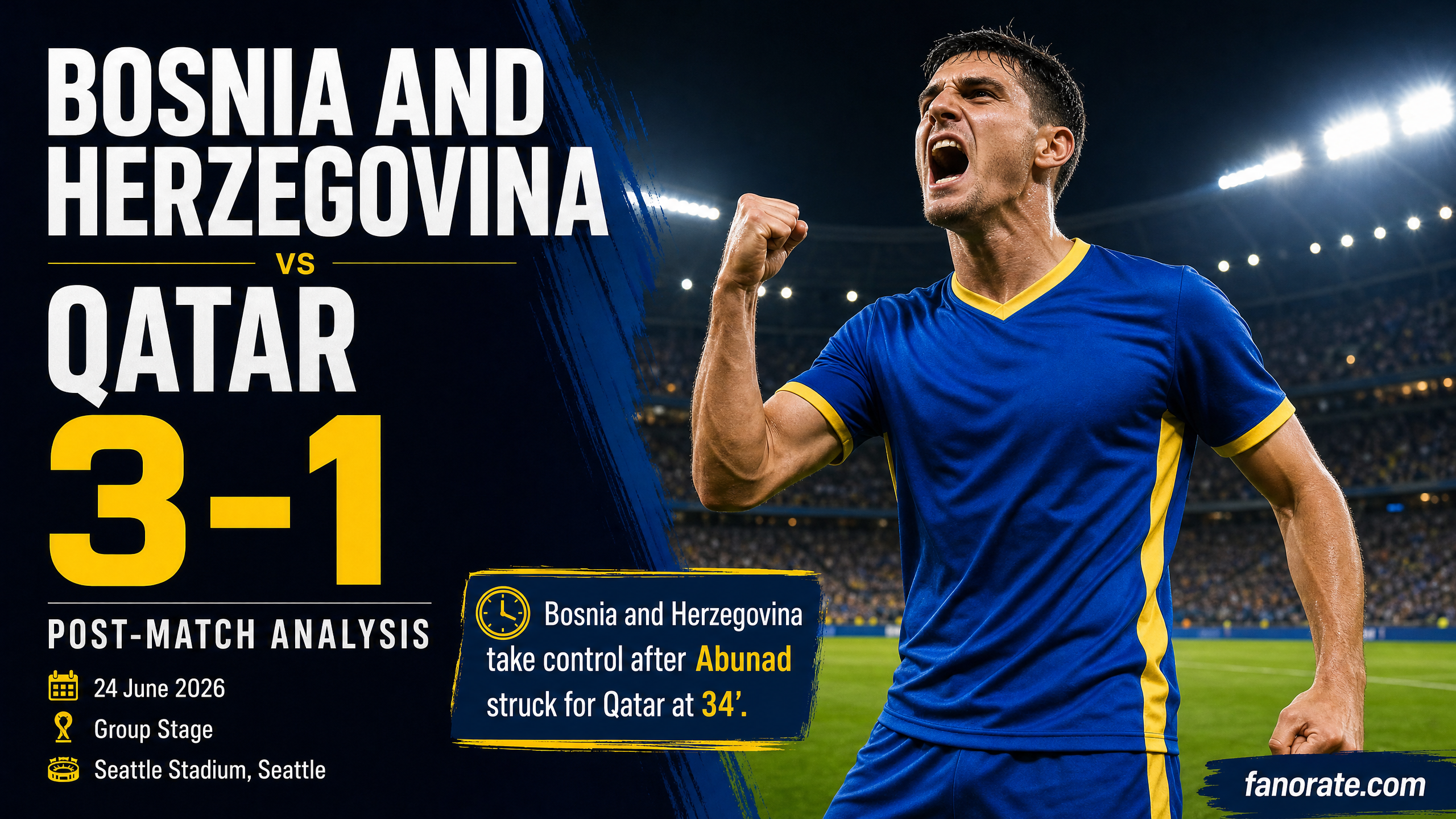
Bosnia and Herzegovina 3-1 Qatar: Dragons Dominate in Seattle | FIFA World Cup 2026 Group Stage
Bosnia and Herzegovina delivered a commanding Group Stage performance at Seattle Stadium, defeating Qatar 3-1 with goals from Alajbegović, an own goal, and a late Mahmić strike to assert their World Cup credentials.
Bosnia and Herzegovina won after full-time
What happened
Under the broken clouds of Seattle, Bosnia and Herzegovina announced their FIFA World Cup 2026 intentions with a dominant 3-1 victory over Qatar at a raucous Seattle Stadium. A Kerim-Sam Alajbegović opener, a Qatar own goal, and a clinical late finish from substitute Ermin Mahmić gave the Dragons a result that was both emphatic and deserved. Qatar’s Hassan Al Heidos pulled one back just before the break to make it a nervy halftime, but Bosnia’s second-half control was near-total, ultimately proving too much for the Gulf nation’s organized but limited defensive structure.
How it was won and lost
Bosnia’s Possession Dominance Suffocated Qatar’s Midfield
Bosnia and Herzegovina controlled 55% of possession and completed 453 of 517 passes at an 88% success rate, systematically starving Qatar of the ball and dictating rhythm throughout the game. Their midfield trio pressed high and compacted the central channels, making it nearly impossible for Qatar’s playmakers — particularly Edmilson Junior and Al Heidos — to link play comfortably. Bosnia’s 96 attacks versus Qatar’s 75 underlined a sustained territorial superiority.
Alajbegović’s Movement Unlocked Qatar’s High Line
The opening goal on 29 minutes was a product of intelligent off-ball movement. Kerim-Sam Alajbegović exploited space behind Qatar’s defensive line, latching onto Ivan Bašić’s assist in a sequence that exposed Qatar’s high defensive shape. Bosnia repeatedly targeted this vulnerability in behind, generating 46 dangerous attacks across the 90 minutes and registering 14 total shots.
Qatar’s Own Goal Momentum Shift
The second goal — an own goal by Mahmud Ibrahim Abunad on 34 minutes — was the critical blow. Delivering under pressure from Bosnia’s cross-heavy approach (22 total crosses), Abunad’s misfortune doubled the deficit and visibly disrupted Qatar’s defensive organization. Bosnia had been exploiting wide overloads through Amar Dedić and Ivan Bašić, creating crossing opportunities that forced defensive errors.
Al Heidos Gave Qatar a Lifeline Before the Break
Qatar’s sole genuine moment of quality came on 42 minutes when Hassan Khalid Al Heidos — assisted by Edmilson Junior — pulled one back to make it 2-1 heading into halftime. Qatar had created 3 big chances across the match and Al Heidos threatened consistently in pockets, but was largely isolated after the interval following the tactical substitution of Ahmed Alganehi at 56 minutes.
Second-Half Bosnia Closed the Game Clinically
Manager’s halftime adjustments — including the introduction of Benjamin Tahirovic and Amar Memić at the break — shifted Bosnia’s midfield dynamic toward greater control and pressing intensity. Qatar registered zero second-half goals and only managed to keep 45% possession. Bosnia’s dribble success rate of 63% (10 from 16 attempts) illustrated their ability to carry the ball and relieve pressure in transition, with Ermin Mahmić’s 80th-minute goal from a Dennis Hadzikadunic assist sealing the points comprehensively.
Set-Piece Threat and Aerial Dominance
Bosnia won 10 successful headers compared to Qatar’s 4, and their aerial dominance from set pieces created consistent pressure. With 5 corners each, Bosnia converted their dead-ball situations into genuine threats — particularly after Hadzikadunic’s introduction from the bench added height and physicality at both ends of the pitch. Bosnia’s 5 blocked shots and 4 interceptions also highlighted a disciplined defensive structure when out of possession.
Who decided it
Kerim-Sam Alajbegović
Bosnia and HerzegovinaThe opener on 29 minutes set the tone for Bosnia’s evening. Alajbegović made intelligent runs in behind Qatar’s defensive line, finishing calmly from Ivan Bašić’s assist, and remained a constant threat throughout the first half before making way for Dzenis Burnic at 82 minutes.
His movement stretched Qatar’s back line and created the space that allowed Bosnia’s midfielders to drive forward. He was central to the team’s pressing triggers and helped initiate Bosnia’s transition from defense to attack.
Ermin Mahmić
Bosnia and HerzegovinaThe substitute came off the bench at 64 minutes in place of Edin Džeko and immediately impacted the game, scoring the decisive third goal on 80 minutes with an assured finish from Dennis Hadzikadunic’s assist. Despite picking up a yellow card just two minutes later, his contribution was match-defining.
Mahmić’s introduction added direct running and penalty box presence that Bosnia had been missing in the second half after Džeko — a veteran leader — was managed carefully. His goal killed the contest and gave the Dragons a comfortable cushion.
Hassan Khalid Al Heidos
QatarQatar’s most dangerous player, Al Heidos scored a fine goal on 42 minutes assisted by Edmilson Junior to keep Qatar in the game heading into halftime. He generated moments of genuine quality in tight spaces and was difficult to contain one-on-one.
Al Heidos operated as Qatar’s primary creative outlet in the number ten role, regularly dropping deep to receive and turning defense into attack. His substitution off at 56 minutes effectively ended Qatar’s attacking threat, signaling a shift toward damage limitation.
Ivan Bašić
Bosnia and HerzegovinaThe midfielder delivered the assist for the opening goal and was a consistent presence in Bosnia’s build-up play. Operating with intelligence in the half-spaces, Bašić helped circulate possession and contributed to Bosnia’s high successful passing percentage.
His ability to switch play and release runners in behind was central to Bosnia’s game model. He gave the team a reliable technical axis in the center of the pitch and was instrumental in the team’s ability to sustain pressure.
Dennis Hadzikadunic
Bosnia and HerzegovinaIntroduced as a substitute at 63 minutes, Hadzikadunic immediately brought composure to Bosnia’s defensive structure and contributed the assist for Mahmić’s 80th-minute goal — an excellent delivery that sealed the three points.
His arrival added defensive solidity and set-piece threat in equal measure. Hadzikadunic’s ball-playing ability from the back allowed Bosnia to build from deep more confidently in the closing stages.
Where it sits in history
Bosnia and Herzegovina’s road to the FIFA World Cup has been one of football’s more compelling journeys. The nation made its debut at the 2014 World Cup in Brazil, exiting the group stage but leaving a lasting impression with a squad featuring Džeko and Pjanić. The 2026 edition marks a significant return to the grandest stage, and this 3-1 victory over Qatar carries extra weight — it is the kind of confident, controlled performance that suggests genuine tournament ambition. Qatar, as the 2022 World Cup hosts, became the first host nation in history to exit a World Cup in the group stage on home soil. Carrying the weight of that narrative into 2026 as a competing nation, they continue to struggle to translate their domestic league quality onto the international stage against top European opposition.
Inside the ground
Seattle Stadium hummed with a rich multinational energy, as the Bosnian diaspora — numerous across the Pacific Northwest — created pockets of noise that swelled to a crescendo with each goal. The stadium’s 68,740-capacity venue provided the World Cup spectacle it promised, with the Seattle faithful embracing both sets of supporters. The Bosnian contingent’s flags and chants filled the night air, while Qatar’s traveling fans remained dignified despite the mounting scoreline. The atmosphere peaked at the 80th-minute Mahmić goal, which triggered wild scenes in the stands and confirmed what the performance had been building toward all evening.
Looking ahead
This victory places Bosnia and Herzegovina in a strong position in their FIFA World Cup 2026 Group Stage standings. Three points and a positive goal difference immediately establishes them as a legitimate contender for progression to the knockout rounds. Qatar, meanwhile, face a critical must-improve situation as they look to gather points and demonstrate that the gap to European opposition can be narrowed. Bosnia will be assessed against their next group opponents with renewed confidence, while Qatar’s coaching staff must address defensive vulnerabilities and their inability to sustain attacking pressure over 90 minutes.
The bottom line
-
Bosnia and Herzegovina secured a dominant 3-1 Group Stage victory at Seattle Stadium, their third goal coming via substitute Ermin Mahmić in the 80th minute.
-
Kerim-Sam Alajbegović opened the scoring on 29 minutes, with an own goal from Mahmud Ibrahim Abunad doubling the lead before halftime.
-
Qatar pulled one back through Hassan Al Heidos just before the break, but failed to threaten in the second half after his 56th-minute substitution.
-
Bosnia dominated with 55% possession, 88% passing accuracy, and 44 duels won — outclassing Qatar in nearly every statistical category.
-
Substitute Dennis Hadzikadunic’s assist for Mahmić’s goal showcased the depth and tactical flexibility in Bosnia’s squad.
-
Qatar’s attacking output of 9 total shots and just 1 goal underlines the gap in quality when facing organized European opposition.
-
Bosnia’s 63% successful dribble rate and 46 dangerous attacks highlighted a team in confident, attacking form on the world stage.
