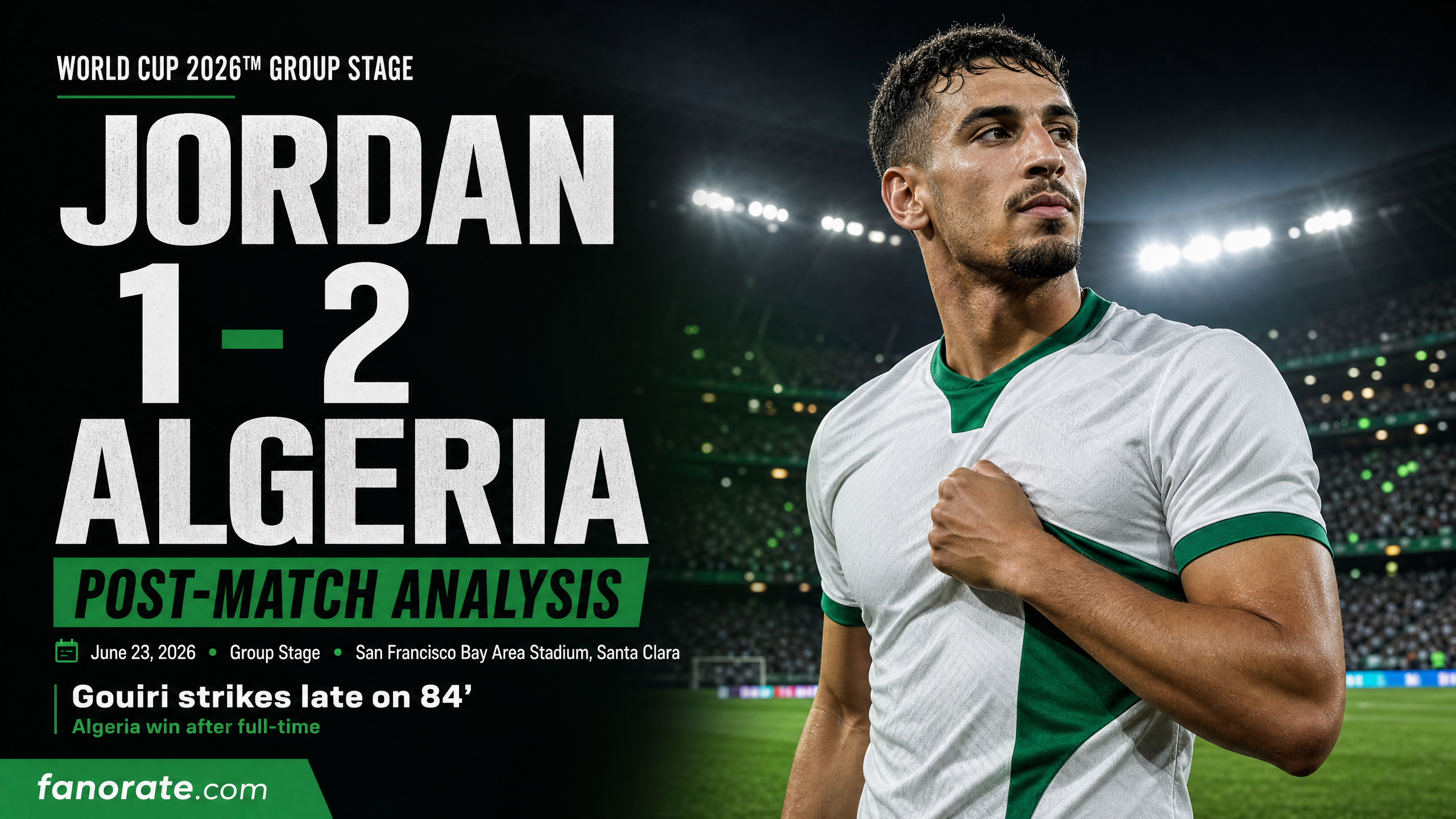
Algeria Stun Jordan With Second-Half Comeback at FIFA World Cup 2026 | Match Analysis
Algeria produced a composed and clinical second-half display to overturn a halftime deficit against Jordan, with Benbouali and Gouiri securing a vital 2-1 Group Stage victory at San Francisco Bay Area Stadium.
Algeria win
What happened
Under the clear California skies of Santa Clara, Algeria delivered one of the more compelling comeback stories of the FIFA World Cup 2026 Group Stage. Jordan, playing with fearless ambition and disciplined defensive shape, took a first-half lead through Nizar Mahmoud Al-Rashdan’s right-footed strike — a goal that briefly silenced Algeria’s sizeable support and sent a genuine shockwave through the tournament. But Algeria’s coaching staff moved decisively at the break, introducing Ahmed Nadir Benbouali for Hichem Boudaoui, and the impact was immediate. Benbouali equalized on 69 minutes with a composed right-foot finish from a Riyad Mahrez assist, before Amine Gouiri sealed the turnaround with a clinical effort on 82 minutes — confirmed by the VAR check on 84. Algeria leave Santa Clara with three points and a statement: this side has the character to absorb pressure and the quality to punish it.
How it was won and lost
Algeria’s Halftime Reset Changes the Game
Algeria entered the second half as a transformed side. Head coach made a double substitution at the interval — Benbouali replacing Boudaoui and Nabil Bentaleb coming on for Zerrouki — restructuring the midfield engine room entirely. The changes brought greater dynamism in transition and sharper pressing triggers in the middle third. Algeria’s pass volume surged in the second half, with their total of 636 completed passes (type_80) compared to Jordan’s 251 telling the story of territorial control. The refreshed midfield allowed Mahrez to receive in more advanced positions, becoming the catalyst for both second-half goals.
Mahrez as the Architect
Riyad Mahrez operated as Algeria’s creative fulcrum throughout, providing the assist for Benbouali’s equalizer and directly influencing the third substitution — Hadj Moussa coming on to replace him at 76 minutes, suggesting he had completed his tactical work for the evening. Algeria’s width was predominantly generated through Mahrez’s right-sided movements and Rayan Aït Nouri’s overlapping runs from left-back. This created the overloads in the final third that consistently stretched Jordan’s defensive block.
Jordan’s First-Half Defensive Discipline
Jordan were not simply passengers. Their defensive structure in the first half was organized and physically committed, sitting in a compact mid-block that forced Algeria to circulate possession laterally. The lone bright moment became a decisive one — Al-Rashdan’s 36th-minute goal, assisted by Moussa Al Tamari, was a moment of genuine quality against the run of play. Jordan’s 7 blocked shots (type_57) compared to Algeria’s 3 illustrates just how hard they worked to restrict their opponents at the back. However, their attacking output was limited, with only 8 shots in total versus Algeria’s 17, and a considerably lower xG of approximately 0.49 compared to Algeria’s 1.75.
Press and Transition Differential
Algeria’s pressing intensity was noticeably higher across the full match. With 152 ball recoveries (type_43) to Jordan’s 66, they won the ball back faster and in more dangerous areas as the match progressed. Their counter-attacking structure — funneling through Mahrez centrally and releasing runners in behind — exposed Jordan’s high defensive line particularly in the second half, once fatigue and the equalizer had disrupted Jordan’s shape. Jordan, by contrast, relied more heavily on direct play, with only 251 completed passes compared to Algeria’s 636, reflecting a pragmatic rather than possession-based approach.
Set Pieces and Dead Ball Moments
While neither side scored from a set piece, Algeria’s delivery from dead-ball situations created additional pressure during the second half. Jordan conceded fouls in dangerous areas — including the 64th-minute free-kick situation — which Algeria used to pin their opponents back. Algeria’s corner count and attacking set-piece delivery contributed to the sustained siege mentality that ultimately produced Gouiri’s decisive strike.
Who decided it
Amine Gouiri
AlgeriaGouiri’s 82nd-minute right-foot shot proved the decisive moment of the match, confirmed as a goal on 84 minutes. The striker brought relentless movement and sharp positional instincts throughout his time on the pitch, and his goal — arriving when Jordan were hanging on for a dramatic draw — demonstrated composure at the highest level.
Gouiri’s goal effectively ended Jordan’s resistance and sealed Algeria’s comeback. His movement in behind disrupted Jordan’s defensive shape in the final third and his clinical finish reflected the kind of big-game mentality Algeria needed on this stage.
Ahmed Nadir Benbouali
AlgeriaIntroduced at halftime for Hichem Boudaoui, Benbouali was one of the most impactful substitutes of the early World Cup 2026 round. He equalized on 69 minutes with a right-foot finish from a Riyad Mahrez assist, injecting the immediate energy Algeria’s attack had been missing.
Benbouali’s introduction at the interval was the managerial masterstroke of the match. His directness in running in behind and ability to combine with Mahrez in tight spaces gave Algeria’s attack a completely different threat profile compared to the first half.
Riyad Mahrez
AlgeriaThe veteran Algerian captain controlled the tempo of Algeria’s attack from the right flank, providing the assist for Benbouali’s equalizer and remaining a constant threat through his dribbling, link-up play, and set-piece delivery. Substituted at 76 minutes after completing his most critical contributions.
Mahrez was the engine behind Algeria’s second-half resurgence. His ability to draw defenders and release teammates in central areas unlocked Jordan’s block repeatedly in the second half, and his assist for the equalizer was the pivot point of the entire match.
Nizar Mahmoud Al-Rashdan
JordanAl-Rashdan’s 36th-minute right-foot strike — assisted by the inventive Moussa Al Tamari — gave Jordan a stunning lead against the tournament favorites. His goal was one of the finest moments of Jordan’s World Cup campaign and demonstrated genuine quality at the highest level.
Al-Rashdan’s goal forced Algeria into tactical disruption and injected belief into Jordan’s compact defensive setup. His ability to finish cleanly in a tight window showed the technical quality that Jordan possess in their attacking third, even while operating primarily on the counter.
Moussa Al Tamari
JordanAl Tamari was Jordan’s most creative presence, providing the assist for Al-Rashdan’s opener and consistently driving at Algeria’s backline. He was eventually substituted on 85 minutes after a tireless performance that threatened Algeria throughout.
Al Tamari’s directness and pace caused Algeria genuine problems, particularly in the first half. His ability to carry the ball forward under pressure gave Jordan their most dangerous moments in transition and his assist for the opener underlined his creative importance to this team.
Where it sits in history
Algeria’s World Cup history has been defined by moments of extraordinary drama. This result carries echoes of their iconic 1982 group stage win over West Germany — a moment etched into football folklore — and their 2014 Brazil campaign where they reached the Round of 16 before a memorable extra-time defeat to Germany. For the Fennec Foxes, overcoming first-half deficits on the World Cup stage is not new territory, but doing it with this level of composure and tactical intelligence speaks to the maturity of this current generation. Jordan, meanwhile, are writing their own history at FIFA World Cup 2026, competing in what is one of their deepest-ever runs in global qualification and demonstrating to the world that Asian football’s evolution is no longer a story of the future — it is a story of now. A first-half lead against Algeria at a World Cup is a moment that Jordanian football will not forget.
Inside the ground
Santa Clara’s San Francisco Bay Area Stadium provided a spectacular backdrop for this Group Stage clash, with the 68,500-capacity venue generating an atmosphere that reflected the tournament’s growing global footprint. Algeria’s supporters — vocal, passionate, and draped in the green and white of the Fennec Foxes — created a wall of noise that grew louder as Benbouali’s equalizer rippled into the net, before reaching a crescendo when Gouiri sealed the comeback. Jordan’s supporters, a smaller but equally passionate contingent, had lived every moment of the first-half lead with joy, their songs echoing around the lower tiers of the stadium. The diversity of the crowd — with large North African and Middle Eastern diaspora communities turning the Bay Area venue into something closer to a continental derby — was testament to FIFA World Cup 2026’s ambition to bring the tournament closer to communities historically underrepresented in host nation culture.
Looking ahead
Algeria advance in the FIFA World Cup 2026 Group Stage with three crucial points, placing themselves in a strong position to qualify for the knockout rounds. Their next assignment will demand even greater tactical discipline, but this comeback win will have reinforced belief across the squad. For Jordan, the defeat stings, but the performance — particularly in the first half — proved they belong on the world stage. They will need to regroup quickly, as another Group Stage fixture approaches with their tournament survival very much still in the balance. A positive result in their next match remains achievable, and the character they showed in Santa Clara suggests they will not go quietly.
The bottom line
-
Algeria mounted a decisive second-half comeback, overturning a 1-0 halftime deficit to win 2-1 in the FIFA World Cup 2026 Group Stage.
-
Halftime double substitution proved the tactical turning point, with Benbouali scoring the equalizer shortly after coming on.
-
Riyad Mahrez provided assists for both second-half goals, cementing his role as Algeria’s creative heartbeat.
-
Jordan’s first-half display was disciplined and courageous, with Al-Rashdan’s goal demonstrating genuine World Cup quality.
-
Algeria’s statistical dominance was overwhelming — 636 completed passes to Jordan’s 251 and an xG of 1.75 vs 0.49 underline the gulf in class.
-
Amine Gouiri’s 82nd-minute winner was the decisive moment in an emotionally charged Group Stage encounter.
-
The result keeps Algeria on course for progression in the FIFA World Cup 2026, while Jordan must now fight for points to stay alive in the tournament.
-
San Francisco Bay Area Stadium delivered a world-class atmosphere befitting a FIFA World Cup 2026 Group Stage spectacle.
