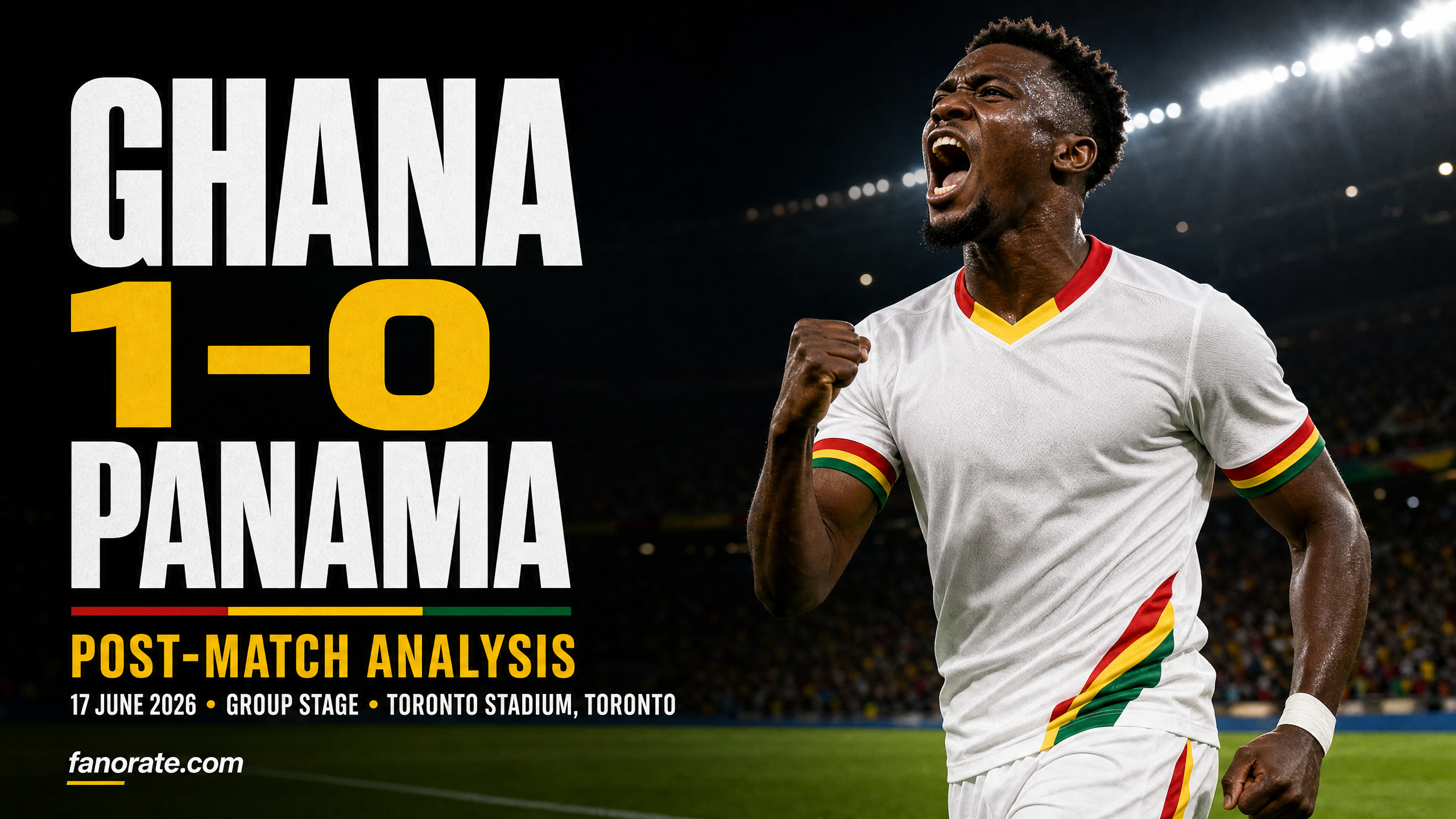
Ghana 1-0 Panama: Late Yirenkyi Strike Seals World Cup 2026 Group Stage Win in Toronto
Caleb Marfo Yirenkyi’s stunning injury-time strike deep into stoppage time handed Ghana a nervy but ultimately deserved 1-0 victory over Panama in their FIFA World Cup 2026 Group Stage opener at Toronto Stadium. A tightly contested affair played under light rain in Canada saw the Black Stars grind out a crucial three points after a match defined by tactical discipline, double substitution waves, and one moment of clinical finishing when it mattered most.
What happened
Under grey Toronto skies and a persistent light drizzle, Ghana and Panama served up a tense, attritional Group Stage encounter that looked destined for a goalless draw until Caleb Marfo Yirenkyi broke Panamanian hearts in the 90th+5 minute. Assisted by second-half substitute Brandon Thomas-Asante, Yirenkyi — who had earlier picked up a yellow card in the 16th minute — capped a resilient Black Stars performance with a composed right-footed finish that sent the Ghana supporters inside Toronto Stadium into raptures. Panama, who dominated possession and registered more shots overall, were undone by their inability to convert pressure into genuine clear-cut chances, leaving their World Cup 2026 campaign with zero points from the opening match.
How it was won and lost
Panama’s Possession Dominance Without End Product
Panama controlled the ball for large portions of the match, completing 498 passes to Ghana’s 289 and generating 8 shots on target compared to Ghana’s 5. Yet their possession was largely peripheral — circulating across the backline and through midfield without the incisive vertical passes required to breach a disciplined Ghanaian defensive block. Their 62% territorial presence in the attacking half never translated into the clinical moments their dominance deserved, and Ghana’s compact mid-block repeatedly funnelled Panama’s buildup into harmless wide areas.
Ghana’s Counter-Attacking Threat and Transition Quality
Ghana were content to sit in a low-to-mid defensive structure and invite Panama onto them, trusting their pace in transition to create danger on the break. With players like Antoine Semenyo, Kamal Deen Sulemana, and eventually Brandon Thomas-Asante offering genuine speed and directness, the Black Stars posed consistent transition threats. Ghana completed fewer passes but registered more ball recoveries in advanced zones, and their defensive shape — anchored by Abdul Mumin and the fullbacks — maintained its structure even as Panama pushed numbers forward late on.
The Double Substitution Pivot That Changed the Game
Ghana head coach made the decisive call at the 58th minute, introducing Brandon Thomas-Asante for Kamal Deen Sulemana and Abdul Fatawu Issahaku for Ernest Appiah Nuamah simultaneously. This twin change injected fresh energy and directness into the attacking third at a stage when the match appeared to be drifting. Thomas-Asante’s direct running immediately stretched Panama’s backline and it was his assist that ultimately unlocked the game in the dying moments, vindicating the tactical gamble entirely.
Panama’s Late Pressing Gamble Exposed by Ghana’s Composure
As the clock ticked into the final ten minutes with the score still level, Panama threw bodies forward in increasing desperation, with substitutes Ismael Díaz De León and Azarias Londoño providing additional attacking threat. However, this left gaps in behind, and Ghana’s tactical intelligence in managing the ball under pressure — illustrated by their 83% pass completion rate in the second half — allowed them to exploit the space at precisely the right moment. Carlos Harvey Cesneros was shown a card for dangerous play in the 90+9 minute as Panama’s frustration boiled over after the goal had already been conceded.
Set-Piece and Foul Discipline as a Tactical Tool
Ghana committed fewer fouls overall but were disciplined in their cynical interventions — Caleb Marfo Yirenkyi’s early yellow card aside. Panama racked up 9 fouls compared to Ghana’s 10, and both teams used dead-ball situations as reset mechanisms. Ghana’s set-piece delivery improved markedly in the second half following their substitutions, creating dangerous situations from wide areas that kept Panama’s defense occupied and created the type of second-ball chaos that often precedes late goals in tightly contested World Cup encounters.
Who decided it
Caleb Marfo Yirenkyi
GhanaThe match-winner and one of the most dramatic individual narratives of the night. Yirenkyi was booked early in the 16th minute which threatened to curtail his influence, but he managed his game intelligently thereafter. His composure in the 90+5 minute to finish with his right foot from Brandon Thomas-Asante’s assist — with the weight of a tight, goalless contest on his shoulders — showed the mentality of a player ready for the World Cup stage.
Operating in a left-sided defensive or midfield role, Yirenkyi contributed to Ghana’s press resistance and transition structure throughout. His late run into the box to meet Thomas-Asante’s delivery demonstrated his understanding of when to time attacking runs — a critical component of Ghana’s counter-attacking game plan that paid off at the decisive moment.
Brandon Thomas-Asante
GhanaIntroduced as a 58th-minute substitute, Thomas-Asante immediately altered the dynamic of the match with his direct running, physicality, and willingness to take on Panama’s backline. His assist for the winning goal was a fitting reward for an impactful cameo that provided Ghana with the attacking dimension they had lacked in the opening hour.
Thomas-Asante’s introduction gave Ghana a genuine target to play off in transition and a physical presence to occupy Panama’s central defenders. His ability to hold the ball under pressure and drive at defenders stretched Panama’s defensive shape and created the space and moment for Yirenkyi’s winning run.
Lawrence Ati-Zigi
GhanaThe goalkeeper was replaced at half-time by Benjamin Asare in what appeared to be a tactical or fitness-related decision, having kept Ghana level during a first half in which Panama enjoyed the better of possession. His shot-stopping in the opening 45 minutes was composed and authoritative.
Ati-Zigi’s command of his penalty area and ability to organize Ghana’s defensive line during Panama’s first-half pressure was essential in keeping the scoreline level at the interval. His distribution helped Ghana launch the transitions that were central to their tactical approach.
Adalberto Carrasquilla
PanamaPanama’s midfield general was their most technically accomplished player throughout, acting as the engine of their possession game. He consistently received the ball in tight spaces, linked midfield to attack, and attempted to create overloads in central zones — though the final ball too often let him down.
Carrasquilla’s ability to control the tempo of possession made Panama a difficult team to press. However, his inability to consistently penetrate Ghana’s defensive block with incisive through balls meant that Panama’s dominance remained largely superficial. His influence waned in the final quarter as Ghana’s defensive discipline held firm.
Where it sits in history
Ghana’s victory carries significant weight in the context of African football at the World Cup. The Black Stars have a storied history at the tournament — most memorably their 2010 quarter-final run that ended in heartbreak against Uruguay — and this win marks another step in their ambition to go deeper in 2026 as one of Africa’s leading forces. For Panama, who made their World Cup debut in Russia 2018, the defeat continues a difficult journey on the global stage. Their 2018 campaign ended without a win across three group matches, and an opening-game loss to Ghana leaves their 2026 group stage challenge already precarious. Ghana’s late winner echoes the tournament’s recurring theme that World Cup matches are rarely decided until the final whistle — a truth that makes every injury-time moment feel seismic.
Inside the ground
Toronto Stadium provided an electric backdrop despite the light rain that fell across the match. The 45,700-capacity venue — one of the tournament’s Canadian hosts for FIFA World Cup 2026 — was animated throughout by a passionate Ghanaian diaspora community that has made Canada home in significant numbers, turning large sections of the stands into a sea of red, gold, and green. When Yirenkyi’s 95th-minute winner hit the net, the noise was deafening — a release of tension accumulated across 90 minutes of patient, tense waiting. Panamanian supporters, vocal and colourful throughout, fell silent in stunned disbelief as the final whistle confirmed the result.
Looking ahead
Ghana will now advance into their next FIFA World Cup 2026 Group Stage fixture with three crucial points already banked, putting them in a strong early position within the group standings. The win provides both tactical confidence and tournament momentum — two commodities that prove decisive as the group stage tightens. Panama, meanwhile, face an immediate must-respond situation. With zero points from their opener, Thomas Christiansen’s side will need to regroup tactically and find the clinical edge that eluded them in Toronto. Their remaining group fixtures now take on the weight of near-elimination pressure, making their next match a defining test of character and tactical adaptability.
The bottom line
-
Caleb Marfo Yirenkyi scored a stunning 90+5-minute winner to give Ghana a 1-0 victory over Panama in the FIFA World Cup 2026 Group Stage.
-
Brandon Thomas-Asante’s 58th-minute introduction proved to be the decisive tactical intervention of the match, with his assist setting up the winner.
-
Panama dominated possession — completing 498 passes to Ghana’s 289 — but failed to convert their territorial advantage into clear-cut chances.
-
Ghana’s compact defensive block and disciplined transition structure frustrated Panama throughout and preserved the platform for a late winner.
-
Lawrence Ati-Zigi was substituted at half-time, with Benjamin Asare taking over in goal for the second half.
-
The match was played under light rain at Toronto Stadium in front of a 45,700-capacity crowd with significant Ghanaian diaspora support.
-
Ghana bank three crucial opening points; Panama face early elimination pressure heading into their next group fixture.
-
Carlos Harvey Cesneros was shown a card for dangerous play deep into stoppage time as Panama’s frustration boiled over.
