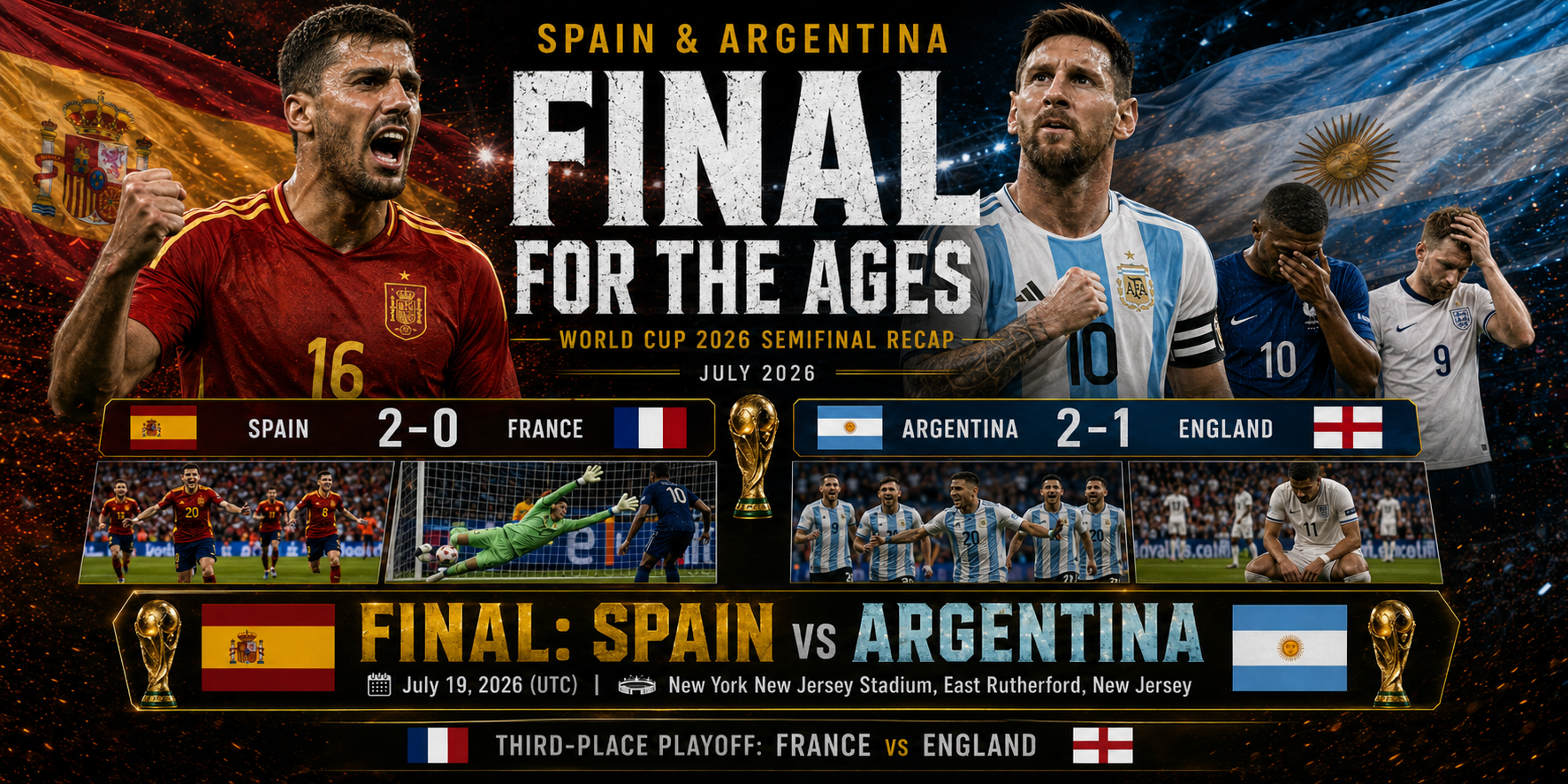
FIFA World Cup 2026 Semifinal Recap: Spain and Argentina Set Up a Final for the Ages
Fanorate is an AI-assisted, research-driven publication. This recap is compiled from official FIFA results, verified match reports and reputable statistical providers. Facts, interpretation and projection are labeled throughout.
Opening Hook
One semifinal was over long before the final whistle. The other was decided entirely after the 84th minute. Together they told you everything about how World Cups are actually won.
In Dallas on Bastille Day, Spain did not merely beat France 2-0 — they held the tournament’s most feared attack to 0.3 expected goals, the lowest figure France have ever recorded at a World Cup, and did not allow a shot on target until the 81st minute. Mikel Oyarzabal’s penalty and Pedro Porro’s crisp one-two finish were the scoreline; the substance was 90 minutes of suffocation. Kylian Mbappé, held to two duels won from eleven, walked off having lost a World Cup semifinal for the first time in his career, and Didier Deschamps’ 14-year reign now ends in Saturday’s third-place game in Miami rather than Sunday’s final.
Twenty-four hours later in Atlanta, England did almost everything their manager asked. They dragged a brutal, foul-strewn contest into the second half scoreless, struck first through Anthony Gordon, and defended their lead with discipline for half an hour. Then Thomas Tuchel’s bus met the one man who has spent two decades dismantling buses. Lionel Messi, 39 years old and playing England for the first time in his life, created the 85th-minute equalizer for Enzo Fernández off a short corner and, in the second minute of stoppage time, lofted the cross that Lautaro Martínez headed into an open goal. Argentina 2, England 1. The defending champions have still never lost a World Cup semifinal; England have still never reached a final away from Wembley.
So the final is set: Spain vs Argentina, Sunday, July 19, at New York New Jersey Stadium — the European champions on a 37-match unbeaten run against the world champions who keep escaping the grave. Messi against Lamine Yamal, who turned 19 the day before he won the penalty that broke France. One legacy seeking a perfect ending; another seeking its beginning. France and England, meanwhile, meet in Miami Gardens on Saturday with only pride, minutes for the next generation and a Golden Boot subplot to play for.
At a glance
Dallas Stadium (AT&T Stadium), Arlington, TX — Tuesday, July 14, 2026
Spain won 2-0 (HT 0-1). Goalscorers: Oyarzabal 22′ (pen), Porro 58′. Man of the Match: Pedro Porro (official). Main tactical turning point: Spain’s 22′ penalty forced France to chase a game they couldn’t control. Spain advance to the final on July 19; France go to the third-place playoff vs England, July 18, Miami Gardens.
Atlanta Stadium (Mercedes-Benz Stadium), Atlanta, GA — Wednesday, July 15, 2026
Argentina won 2-1 (HT 0-0). Goalscorers: Gordon 55′; E. Fernández 85′, L. Martínez 90+2′. Man of the Match: Lionel Messi (media consensus; official FIFA award unconfirmed at publication). Main tactical turning point: England’s retreat after 55′ invited a 30-minute Argentine siege. Argentina advance to the final on July 19; England go to the third-place playoff vs France, July 18, Miami Gardens.
Round-Wide Numbers
Verified where sourced; see Source List.
- Total goals
- **5** across two matches (average 2.5 per match).
- Goals after the 75th minute
- **2** — both Argentina’s, both assisted by Messi.
- Lead changes
- 0 (one comeback win from behind; Spain never relinquished their lead).
- Substitutes directly involved in goals
- **1** (Lautaro Martínez, on in the 81st, scored the winner in the 90+2′).
- Shots
- Argentina 15, England 5 (Sofascore); France 10 (Opta); Spain’s total was not published in our verified sources.
- Expected goals
- Argentina 1.80 – England 0.54 (Sofascore); France 0.3 (Opta — NPR reported 0.26); Spain’s full xG figure not verified.
- Cards
- 5 verified yellows across the round (Rabiot 8′, Cucurella 33′, Mbappé 86′; Anderson 38′, L. Martínez 42′); no reds.
- VAR interventions
- **0 overturns** in either match. One penalty check (possible Yamal handball) upheld the on-field decision in Dallas; social-media claims of offside before Argentina’s equalizer produced no review-based overturn in Atlanta.
Both semifinals were won by the team that controlled the middle of the pitch and lost by the team that surrendered it — France by never establishing it, England by voluntarily abandoning it.
Spain’s midfield trio strangled France from minute one; England’s retreat after taking the lead handed Argentina the exact territorial dominance (64% possession, 590 passes to 324) that Messi needed to produce two moments of genius. The round’s theme was not talent — all four squads had it — but the willingness and ability to keep playing football for 90 minutes.
Match One: France 0-2 Spain — The Suffocation
The tone was set inside eight minutes. Adrien Rabiot stood on Dani Olmo’s foot and took the round’s first booking; referee Iván Barton then discovered he had forgotten his vanishing spray, and Sweden’s Glenn Nyberg had to jog it onto the pitch — a moment of farce that turned out to be France’s most memorable contribution to the first half hour.
France’s plan was visible early: sit compact, spring Mbappé, Dembélé, Olise and Barcola in transition. Their best early moment came in the 18th minute when Michael Olise’s shot was blocked behind for a corner. It was as close as they came before halftime.
The match broke in the 22nd minute. Marc Cucurella’s deep cross found Lucas Digne in trouble; his heavy first touch let Lamine Yamal — who had turned 19 the previous day — dart in behind him, and Digne kicked the teenager as he tried to recover. Barton pointed to the spot immediately. French players protested that the ball had brushed Yamal’s arm an instant earlier; the VAR check judged the contact near the shoulder with the arm in a natural position, and the penalty stood. Oyarzabal buried it high past Mike Maignan — his fifth goal of the tournament, and the first time either finalist-to-be had trailed in the entire competition. It lasted the rest of the match.
France’s afternoon unraveled from there. William Saliba pulled up with a back injury in the 30th minute and was replaced by Lacroix, winning just his sixth cap in a World Cup semifinal. Spain nearly doubled the lead in the 38th when Maignan’s clearance went straight to Álex Baena, and a one-touch combination through Olmo’s backheel and Yamal’s cross ended with Fabián Ruiz’s close-range shot blocked by a last-ditch Upamecano intervention. France reached halftime with two shots, none on target, and 0.04 xG — statistically the worst half they have produced at a World Cup.
Deschamps sent on Manu Koné for the booked Rabiot at the break and Désiré Doué for Barcola before the hour, but the second goal arrived first. In the 58th minute Pedro Porro drove infield from right back, exchanged a give-and-go with Olmo — who returned the pass a beat before Upamecano flattened him — and side-footed first-time into the bottom corner. 2-0. Three minutes later Yamal had the ball in the net again, ruled out by a tight offside flag that survived review.
The rest was procession. Ferran Torres headed a fine chance wide in the 79th; France’s first shot on target arrived in the 81st minute, a weak Doué effort after Unai Simón’s headed clearance fell to him. Mbappé was booked in the 86th for clattering into Simón. Two late French shots on target after the 94th minute changed nothing. Spanish fans chanted “olé” through the closing exchanges as Spain passed out the clock — on Bastille Day.
How Spain Won
Ranked, with evidence:
-
Off-ball intensity that broke France’s build-up. The defining number is not possession (Spain’s 50.9% was their lowest in a World Cup match since 2002) but duels: Spain won 55.9% of them, France’s worst rate in a World Cup game since 1978. Spain attempted 22 tackles and won 14 to France’s 14/8. This was a pressing and counterpressing victory, not a sterile passing one. (Opta)
-
Midfield control through Rodri and Fabián Ruiz. Rodri won 11 of 15 duels; Fabián Ruiz won 5 of 6 and led the team with 7 possession regains while also arriving in the box. Mbappé’s own diagnosis — “we were three against two in midfield” — is the loser’s confirmation of the winner’s plan.
-
The early lead changed the game’s physics. Going ahead in the 22nd minute forced a team built for transition to become a team of possession, which France demonstrably are not: 152 attacking-third touches produced just 10 shots and 0.3 xG.
-
Fullbacks as attacking weapons. Cucurella’s cross initiated the penalty sequence; Porro scored the second and was named official Player of the Match. Spain’s fullbacks created while Rodri’s positioning insured against the counter — the rest-defense structure never cracked.
-
Defensive discipline and a near-invisible goalkeeper’s tournament. Cubarsí and Laporte gave Mbappé and Dembélé nothing between the lines. Unai Simón now has six clean sheets in seven matches and has conceded once all tournament — the most clean sheets ever recorded in a single World Cup.
Game management deserves an honorable mention: de la Fuente’s 73′-85′ substitutions (Ferran, Pedri, Merino, Nico Williams’s late cameo replacement wave) refreshed legs without altering structure, and Spain killed the final quarter-hour with the ball.
Why France Lost
Separate the structural from the incidental.
Structural problems.
A midfield outnumbered by design. Deschamps’ double pivot of Tchouaméni and Rabiot faced Rodri, Fabián Ruiz and Olmo, with Baena and Yamal collapsing inside. Mbappé said it plainly afterward: three against two, and no agreed pressing scheme — “there was a lack of communication on the press.”
A front four that didn’t connect. Olise and Mbappé exchanged zero passes in the first half (ESPN/Opta). Four transition forwards without possession structure behind them meant France couldn’t sustain attacks: Dembélé’s first shot came in second-half stoppage time; Mbappé’s first in the 67th.
No Plan B against a set defense. France won just 32% of aerial duels and contested only 8 all match — the fewest by any team in a World Cup game in 40 years. When transition was removed, nothing replaced it.
Incidental/compounding factors.
The Digne moment. A poor first touch and a rash recovery challenge gifted the penalty that forced France out of their game plan. An individual error, not a systemic one — but it interacted fatally with the structural issues above.
Saliba’s 30th-minute injury removed France’s best progressive defender and disrupted the back line’s rhythm.
Fatigue and sloppiness. Mbappé lost possession 20 times in his first 70 minutes; his own verdict — “we were too sloppy technically” — was echoed by Cherki: “they were better than us in every part of the game and they were hungrier than us.”
Tactical Analysis: Spain vs France
- Shapes (reported, not officially confirmed)
- Spain in their familiar 4-3-3 — Simón; Porro, Cubarsí, Laporte, Cucurella; Rodri anchoring Fabián Ruiz and Olmo; Yamal right, Baena left, Oyarzabal central. France in a 4-2-3-1 that often looked like a 4-2-4 — Maignan; Koundé, Upamecano, Saliba, Digne; Tchouaméni-Rabiot; Olise, Dembélé, Barcola around Mbappé.
- Spain's build-up vs France's press
- France pressed in uncoordinated waves; Spain’s press resistance (Rodri and Ruiz receiving on the half-turn, Cubarsí’s distribution) turned each failed French press into field position. Mbappé’s post-match wish for a man-to-man press was an admission France never settled on triggers.
- The half-spaces
- Olmo and Baena occupied the pockets either side of Tchouaméni; Yamal stayed high and wide to pin Digne, which is precisely the matchup that produced the penalty.
- France's counterattacking plan
- required winning first-phase duels — and France lost the duel battle worse than any French team since 1978. The plan died at its first link.
- Fullback positioning
- Porro’s inverted runs (culminating in the goal) against Barcola’s reluctance to track was arguably the game’s quietest decisive mismatch. On the other side, Cucurella pinned Olise back.
- Set pieces and second balls
- Spain won the second-ball war through Ruiz’s 7 regains; France’s set-piece threat was nullified by their historic aerial-duel futility.
- Match-state effect
- at 0-0 France could wait; at 0-1 they had to hold the ball, and Spain’s counterpress fed on their attempts; at 0-2 the game was effectively over — France’s first shot on target came 23 minutes after Porro’s goal.
The decisive tactical battle: central midfield, three versus two. Everything else — the penalty, the fullback goals, the xG humiliation — flowed downstream from it.
Spain’s Best Performers
Pedro Porro
official Player of the Match. Attacking fullback in an inverted role; scored the clinching goal off a give-and-go, defended Barcola’s side into irrelevance, and was part of a defensive unit (with Rodri, Laporte, Cubarsí, Ruiz) that won 25 of 34 duels and made 44 defensive interventions. Importance for the final: his duel with Tagliafico/Nico González’s side will be a key channel.
Rodri
the game’s metronome and its enforcer: 11 of 15 duels won. Media consensus star of the match even where Porro took the official award. Against Argentina, his personal duel with Enzo Fernández and Mac Allister decides the final’s center of gravity.
Fabián Ruiz
5/6 duels, team-high 7 possession regains, and the near-goal in the 38th. The connective tissue between control and threat.
Lamine Yamal
won the penalty, had a goal narrowly disallowed, occupied two defenders all afternoon a day after turning 19. Statistically quiet, decisively influential.
Mikel Oyarzabal
ice from the spot under semifinal pressure and Spain’s constant pressing reference point; his 30th international goal in 60 caps. (His tournament tally: AP’s goal-event count makes the penalty his fifth of this World Cup; some trackers list six — flagged in the Golden Boot section.)
Álex Baena
the left-sided pocket player whose interception of Maignan’s clearance created Spain’s best open-play move of the first half.
Ferran Torres
15+ minutes of pressing and a headed chance; kept the machine’s intensity from dipping.
Pau Cubarsí
Mbappé and Dembélé generated 0.08 xG and a stoppage-time first shot between them through his zone.
Dani Olmo
the assist for Porro (a return pass delivered while being fouled) plus the backheel in the 38th-minute sequence.
France’s Best and Most Disappointing Performers
- Best player
- Mike Maignan — beaten only by a penalty and a clean one-two; his distribution was shaky (the 38′ gift to Baena) but he kept the scoreline respectable.
- Best attacking player
- by elimination, Michael Olise — France’s only first-half shot of note and 2 chances created before his 72nd-minute withdrawal. Faint praise on a day France’s attack recorded 0.3 xG.
- Best defensive performer
- Dayot Upamecano — the last-ditch block on Fabián Ruiz and a willingness to defend enormous spaces after Saliba departed.
- Best substitute
- Désiré Doué — France’s first shot on target (81′) and their only sustained spark. His omission from the XI, decided “on the morning of the game,” will be second-guessed.
- Player who struggled most
- Kylian Mbappé — 2 of 11 duels won, 3 shots for 0.08 xG, first shot in the 67th, 20 possessions lost in 70 minutes, and a late frustration booking. He took responsibility publicly, which deserves note — but the performance was far below his standard.
- Player whose role did not work tactically
- Bradley Barcola — chosen over Doué to run in behind, he touched the game only fleetingly (one 36′ shot over, one 50′ half-chance) before making way. The role, not the effort, failed: Spain’s rest defense removed the space he exists to attack. Lucas Digne’s afternoon (the error, the penalty foul, withdrawn 72′) sits between categories — a hard matchup against Yamal made worse by two individual mistakes.
Managerial Review: Spain vs France
- Luis de la Fuente (Spain) — A
- Kept faith with the XI and idea that have now gone 37 matches unbeaten (“We started almost four years ago with an idea and we’ve been faithful to that idea”). Benching Pedri and Nico Williams and starting Baena looked bold; it produced total midfield control. Substitutions (73′-85′) managed legs and tempo without conceding a single dangerous transition. The only quibble: Spain’s finishing left the game alive at 2-0 longer than the performance deserved.
- Didier Deschamps (France) — D
- The morning switch from Doué to Barcola backfired; the double pivot was outnumbered by design and no in-game structural fix arrived until the game was gone (Koné at half-time was personnel, not shape). His post-match dignity — “we were a notch below our usual level… It’s primarily our own fault” — was undercut by his swipe at the referee (“does this referee have the level to officiate a World Cup semifinal?”). A great managerial era, now confirmed to end after Saturday, closed with a tactical defeat as clear as any in his 14 years.
Match-Defining Moments — Spain vs France
-
22′ — The penalty. Digne’s touch, Yamal’s run, the foul, the upheld VAR check, Oyarzabal’s finish. Tactical and psychological: it forced France to hold the ball, the one thing they couldn’t do. Everything after flowed from this.
-
30′ — Saliba off injured. Physical. France lost their calmest defender and any hope of building cleanly from the back; Lacroix, on his sixth cap, was thrown into a semifinal.
-
38′ — Ruiz’s blocked chance from Maignan’s error. Technical. The moment that showed Spain could generate chances from France’s build-up as well as their own — France’s exit routes were gone.
-
58′ — Porro’s goal. Technical and tactical. A right back finishing a central one-two is the signature of Spain’s positional rotations; at 2-0 against this Spain, the match was over as a contest.
-
81′ — France’s first shot on target. Statistical moment as symbol: a Doué daisy-cutter, 81 minutes in. The Opta line — France’s lowest xG (0.3) ever recorded at a World Cup — crystallized here. Psychological confirmation for everyone watching, including Argentina’s analysts.
The officiating footnote: Barton’s penalty call was debated in France but supported by review; his forgotten vanishing spray was comedy, not controversy. No VAR intervention changed anything material.
Match Two: England 1-2 Argentina — The Heist in Atlanta
The first half was a fight, not a football match. Fueled by ninety years of history — the Falklands, the Hand of God, Beckham’s red card — the teams committed 19 fouls before the break and produced no shots on target between them; the opening 30 minutes contained no shots at all, reported by the Fox broadcast as the first World Cup half of its kind since 1966. Elliot Anderson, fouled three times in the opening ten minutes, was somehow the first man booked (38′, a hard tackle on Messi); Lisandro Martínez followed four minutes later for cynically ending a counter. American referee Ismail Elfath — the first US official to take charge of a men’s World Cup semifinal, leading an all-American crew — repeatedly stopped play to cool tempers. Halftime: 0-0, and honestly scoreless.
England struck first, and beautifully. In the 55th minute Harry Kane dropped deep and launched his trademark diagonal; Declan Rice flicked it wide to Morgan Rogers — making his first start of the tournament — whose first-time cross fizzed across the six-yard box for Anthony Gordon to convert at the back post. 1-0, against the run of nothing.
What followed decided the match. Tuchel’s England retreated almost immediately into a low block. At the hydration break around the 70th minute he withdrew his goalscorer, Gordon, for center back Ezri Konsa; Scaloni answered with a triple change — Montiel, Otamendi and De Paul on — and later Lautaro Martínez for left back Tagliafico, finishing the match with a front-loaded formation England had invited.
The siege had already begun. Djed Spence’s last-man tackle stopped Giuliano Simeone in the 58th; Emiliano Martínez saved from Rice in the 66th — England’s last real threat; Jordan Pickford clawed out Nico González’s header around the 69th; Alexis Mac Allister headed De Paul’s cross against the post in the 76th. England bent, and bent, and in the 85th minute broke: from a short corner routine Messi carried toward the box and slipped the ball to Enzo Fernández, whose rising right-footed strike from the top of the area beat Pickford toward the upper corner. 1-1, and everyone in Mercedes-Benz Stadium knew where the game was heading.
In stoppage time Mac Allister hit the woodwork again; Messi chased down the loose ball on the right, took two touches, and hung a cross to the far post. Lautaro Martínez — on the pitch barely ten minutes — powered the header in from five yards. 2-1, 90+2. England’s kitchen-sink response never produced a chance. At the whistle, Argentina’s players celebrated shirtless before their fans; England’s stood frozen; Messi embraced Kane and Pickford. “IT’S MESSI MAGIC AGAIN!” screamed the Fox broadcast, and for once the hyperbole was mere description.
How Argentina Won
Ranked, with evidence:
-
Messi’s late-game creation. Two assists (his 3rd and 4th of the tournament), 4 key passes, 2 big chances created, 9 crosses, 94 touches, 12 duels won, a match-high 0.76 xA (Sofascore). At 39, he no longer plays 90 minutes at full intensity — he plays the minutes that matter at an intensity nobody else can reach.
-
Total territorial control after the hour. 64% possession, 590 passes to England’s 324, 15 shots to 5, 1.80 xG to 0.54. Once England retreated, Argentina turned a knife-fight into a training exercise in box entries.
-
Scaloni’s bench. The hydration-break triple sub (Montiel, Otamendi, De Paul) stabilized and widened the attack — De Paul’s cross produced Mac Allister’s first post. The 81st-minute Lautaro-for-Tagliafico change was pure aggression, and Lautaro scored the winner. One sub scored, another assisted a post, a third shored up the box.
-
Mental resilience as an institutional trait. This was Argentina’s third knockout-round escape act of the tournament (3-2 in extra time vs Cape Verde, 3-2 from 2-0 down vs Egypt, 3-1 in extra time vs Switzerland). They have now, by every count, never lost a World Cup semifinal. Teams that have rehearsed the abyss do not panic at 0-1 in the 84th.
-
Box occupation and second balls late on. Both goals came from restart-adjacent chaos Argentina engineered: a short-corner routine, then a woodwork rebound. Mac Allister hit both posts; the pressure that preceded the goals made them statistically ordinary rather than miraculous — 1.80 xG earns two goals.
Why England Lost
What England did well. Survived a hostile first half without damage, took the lead with their only high-quality move, and defended heroically for half an hour — Spence’s tackle, Pickford’s saves, bodies on lines. The plan to keep it ugly worked for 84 minutes.
Where it went wrong.
The retreat was total, and it was voluntary. Tuchel’s own words: “we got too passive after we scored and conceded a lot of chances… We could not turn the ball possession around and then conceded so many crosses, chances and shots.” Withdrawing Gordon — the outlet — for Konsa at 1-0 with 20+ minutes to play converted defense from a phase into an identity.
No ball retention. 324 passes and 36% possession meant every clearance came straight back. England’s midfield of Rice, Anderson and Rogers had no rest-with-ball mechanism once Rogers’ role became purely defensive.
Counterattacking opportunities went unused because the personnel to run them had been substituted or pinned into the back line.
Fatigue and attrition: Rice had entered the match a fitness doubt; Reece James went off injured in the 80s; Kane and Bellingham, who had scored 12 of England’s 13 goals this tournament, were fed nothing after the 55th.
Individual mistakes were minimal — this was not a blunder defeat. Pickford made four saves and was beaten by an excellent strike and a free header his defense conceded, not that he spilled.
Tactical Analysis: Argentina vs England
- Shapes (reported, not officially confirmed)
- England ~4-3-3: Pickford; James, Stones, Guéhi, Spence; Rogers, Rice, Anderson; Gordon, Bellingham (floating), Kane. Tuchel made three changes — Rogers, James and Spence in for Madueke, Konsa and O’Reilly. Argentina ~4-4-2: E. Martínez; Molina, Romero, L. Martínez, Tagliafico; Simeone, Paredes, Fernández, Mac Allister; Messi free behind/beside Álvarez. Scaloni’s surprise was Giuliano Simeone over De Paul.
- England's press
- was really a mid-block with pressing moments; it aimed to deny Paredes and force play wide. For an hour it worked — Argentina’s first shot on target took 60+ minutes to arrive.
- Argentina's build-up
- answered by dropping Paredes deep and using Enzo Fernández as the carrier between lines; when Paredes was withdrawn (64′, González on), Fernández took full control of tempo.
- Messi's positioning
- nominally right-of-center, actually everywhere the ball was about to be. Both decisive contributions came in wide-right zones vacated when England’s block narrowed to protect the box — the structural cost of defending with a back six.
- Wide play and fullbacks
- Tagliafico and Molina provided width early with little penetration; the substitutes’ width (De Paul right, Montiel overlapping) was more dangerous, producing the Mac Allister post.
- Second balls
- England won them while the game was even; after the retreat, every second ball fell to blue-and-white shirts 30 yards from Pickford — both goals originated in exactly that territory.
- Set pieces
- the equalizer came off a short-corner routine — a designed play, not desperation.
When control shifted: the five minutes after England scored. From 55′ to 60′, England dropped 20 meters, Argentina advanced 20, and neither ever reversed the trade. Fanorate’s judgment: the goal England scored was, tactically, the worst thing that happened to them.
Argentina’s Best Performers
Lionel Messi
2 assists, 4 key passes, 2 big chances created, 94 touches, 0.76 xA, media man of the match. Best moment: the 90+2′ chase, gather and cross. For the final he is the entire tactical problem Spain must solve — and now leads the Golden Boot race on the assists tiebreaker (8 goals, 4 assists).
Enzo Fernández
the equalizing rocket plus complete control of tempo after Paredes departed. His duel with Rodri on Sunday is the final in miniature.
Alexis Mac Allister
hit both posts, pressed relentlessly, moved between lines all night. Zero goal involvement, maximum threat: the xG ledger’s biggest creditor.
Lautaro Martínez
one headed chance, one World Cup final booked. The definition of a super-sub performance.
Emiliano Martínez
barely worked (first save 66′, on Rice) but faultless on the Gordon goal’s aftermath and commanding late. Two clean sheets this tournament; his calm at 0-1 mattered.
Nicolás Tagliafico
81 disciplined minutes, then the sacrifice that enabled the winner.
Lautaro Martínez
(goal), with De Paul (post-assist cross, right-side control) a half-step behind.
Cristian Romero
managing a surgically-repaired knee through a bruising 90 against Kane and Bellingham without a single decisive error.
Messi
by the width of an era.
Lautaro
though the honest answer is Messi, again, as it has been since 2005.
England’s Best and Most Disappointing Performers
- Best England player
- Jordan Pickford — four saves including the reflex stop on González’s header; blameless on both goals; England’s semifinal record-keeper of dignity.
- Best attacking player
- Anthony Gordon — the goal, direct running, and the misfortune of being substituted while being his team’s only outlet.
- Best defensive player
- Djed Spence — the 58th-minute last-man tackle on Simeone was the save-equivalent of the night; composed throughout the siege.
- Best substitute
- hard to award honestly; Konsa defended stoutly but the substitution itself was the game’s most criticized decision. By elimination, Konsa.
- Player who faded
- Jude Bellingham — six goals this tournament, but starved after the 55th and increasingly drawn into scrapping rather than creating.
- Player whose tactical assignment became difficult
- Morgan Rogers — first start of the tournament, assisted the goal, then was asked to be a defensive winger against the world champions’ left overloads.
- Player who should not be judged by the result
- Harry Kane — the assist-originating diagonal was the pass of the match; he touched the ball in Argentina’s box barely at all after the goal because the team behind him stopped visiting. His tournament (6 goals) remains outstanding.
Managerial Review: Argentina vs England
- Lionel Scaloni (Argentina) — A-
- The Simeone-over-De Paul start was neutral-to-poor; everything after was excellent. The hydration-break triple change re-geared the attack, the Lautaro gamble won the match, and his team’s institutional calm at 0-1 is his creation as much as Messi’s. Most consequential decision: Lautaro for Tagliafico at 81′ — a striker for a left back, at 0-1, in a World Cup semifinal. It scored.
- Thomas Tuchel (England) — C-
- The game plan — deny rhythm, strike once — was legitimate and 84 minutes from working; grading it a failure outright would be results-bias. But the execution of protection was fatally overdone: subbing the goalscorer for a third center back at 1-0, conceding 64% possession, and offering no mechanism to hold the ball invited exactly what arrived. Most consequential decision: Konsa for Gordon at the hydration break — the moment England announced they would not play football again, with 20 minutes plus stoppage time still to survive. His own post-match admission (“too passive”) is the fairest one-line review. He remains one match from delivering England’s best finish since 1966 — third place — which is both consolation and epitaph.
Match-Defining Moments — Argentina vs England
-
55′ — Gordon’s goal. Technical brilliance (Kane’s diagonal, Rogers’ cross) with a tactical sting: it triggered the retreat that lost the match. Psychological high tide for England.
-
~70′ — The double substitution window. Tuchel: Konsa for Gordon. Scaloni: Montiel, Otamendi, De Paul. One bench surrendered territory; the other bought it. Tactical turning point of the round’s second match.
-
76′ — Mac Allister’s header off the post. Physical warning shot. The xG was piling up; England’s block was holding by paint.
-
85′ — Enzo Fernández’s equalizer. Technical (a rising strike from distance) born of tactical design (the short corner) and psychological inevitability. England’s resistance had a use-by time, and this was it.
-
90+2′ — Lautaro’s winner. The full Argentine sequence in one play: woodwork chaos, Messi’s recovery and cross, a substitute’s header. Emotional consequence: England have now lost their last three World Cup semifinal appearances (1990, 2018, 2026), with 1966 still their only win at this stage; Argentina are one win from back-to-back titles.
VAR footnote: no interventions. Post-match social-media claims of an offside in the equalizer’s build-up produced no evidence-based overturn and no formal controversy; Elfath’s proactive first-half management was widely praised. If an incident was handled correctly, we say so: this one was.
Semifinal Statistical Comparison
Verified figures only; blank cells indicate our sources did not publish a reliable number. (Sources: Opta via The Analyst; Sofascore; AP.)
- Goals
- Spain 2 · France 0 · Argentina 2 · England 1
- Possession
- Spain 50.9% · France ~49% · Argentina 64% · England 36%
- Shots
- Spain n/p · France 10 · Argentina 15 · England 5
- Shots on target
- Spain n/p · France 2-3 (sources conflict) · Argentina 5 · England 2
- Expected goals
- Spain n/p (0.99 by HT, Sofascore) · France 0.3 (Opta; NPR cited 0.26) · Argentina 1.80 · England 0.54
- Passes
- Spain n/p · France n/p · Argentina 590 · England 324
- Duels won
- Spain 55.9% · France 44.1% · Argentina n/p · England n/p
- Tackles (att/won)
- Spain 22/14 · France 14/8 · Argentina n/p · England n/p
- GK saves
- Spain ~3 (Simón) · France n/p · Argentina 1-2 (E. Martínez) · England 4 (Pickford)
- Yellow cards
- Spain 1 · France 2 · Argentina 1 · England 1
*n/p = not published in verified sources at press time. We will update when FIFA’s full post-match statistical reports circulate.*
Reading the Table Honestly
- Best chances created
- Argentina — 1.80 xG including two woodwork strikes and two big chances from Messi alone.
- Most effective ball control
- Spain — not the highest possession share of the round (Argentina’s 64% was), but the most *purposeful*: their control produced a lead, protected it and generated France’s statistical humiliation. Argentina’s dominance was partly gifted by England’s retreat.
- Best defensive performance
- Spain, unambiguously — 0.3 xG conceded to Mbappé, Dembélé, Olise and company is one of the great semifinal defensive displays on record.
- Most efficient
- Spain — two goals from moderate volume, zero conceded.
- Underperformed its underlying numbers
- England is tempting, but their numbers were poor too; the honest answer is **France**, whose talent-to-output gap (0.3 xG from that front four) was the round’s widest.
- Exceeded statistical expectations
- England for 84 minutes (a lead from 0.54 xG), which is precisely why the collapse stings.
Higher possession did not equal better performance: England’s 36% held a lead longer than France’s ~49% held anything.
Tactical Trends Across Both Semifinals
-
Midfield control mattered more than possession totals. Spain won it with 50.9% of the ball; Argentina won it with 64%; France and England lost it at both ends of the possession spectrum. The common denominator was who dictated where the game was played.
-
Narrow leads are held by playing, not hiding. England’s retreat and France’s inability to hold the ball at 0-1 both ended the same way. Spain, by contrast, defended their lead with possession.
-
Press resistance is the entry fee. Rodri, Ruiz, Enzo Fernández and Mac Allister all beat first pressure routinely; England and France’s build-up players did not.
-
Bench quality decided one match and padded the other. Scaloni’s substitutes produced a goal, an assist-adjacent cross and defensive stability; de la Fuente’s preserved intensity; Tuchel’s most influential sub was his most criticized.
-
The half-spaces and the back post are where blocks die. Both Argentina goals and Spain’s penalty sequence originated in wide zones that narrow defensive blocks conceded.
Additional trends worth a coach’s notebook: defensive substitutions carry a signaling cost (England visibly stopped believing they could keep the ball); second balls in front of a deep block are effectively possession for the attacker; and 39-year-old creators can decide matches in which they barely press — if their team controls territory for them (Messi’s 94 touches came disproportionately after England’s retreat).
Winners and Losers of the Semifinal Round
- Biggest winner
- Spain — a final reached while barely leaving second gear, plus a rest-day advantage over Argentina.
- Best player
- Lionel Messi — two assists in the last six minutes of a World Cup semifinal at 39.
- Best young player
- Lamine Yamal — penalty won, goal disallowed by centimeters, defenders occupied; with Pau Cubarsí’s quiet excellence just behind.
- Best manager
- Lionel Scaloni — every lever pulled after the 60th minute worked.
- Best substitute
- Lautaro Martínez.
- Best defensive performance
- Spain’s collective; individually, Pau Cubarsí and Djed Spence.
- Best goal
- Enzo Fernández’s rising equalizer — technique under maximum pressure.
- Best assist
- Messi’s stoppage-time cross for Lautaro; Rogers’ first-time ball for Gordon honorable mention.
- Best tactical adjustment
- Scaloni’s hydration-break triple substitution.
- Biggest missed opportunity
- France — a generational front four eliminated with 0.3 xG.
- Most painful defeat
- England — leading in the 85th minute of a World Cup semifinal is the cruelest place from which to lose.
- Reputation improved
- Pedro Porro (official MOTM in a semifinal), Morgan Rogers, Djed Spence, Ismail Elfath.
- Needs a response
- Kylian Mbappé — a Golden Boot to chase Saturday and a performance to answer for.
- Team whose future remains encouraging
- France — Doué, Cherki, Olise, Barcola and Lacroix all under 25, whatever Saturday brings; England’s core is similarly young, but France’s is deeper.
Team of the Semifinal Round
Formation: 4-3-3. Selection weighs performance, not results — though the results largely tracked performance this round.
- GK — Jordan Pickford (ENG)
- vs Argentina · 4 saves incl. González header — Best goalkeeping display of the round, in defeat
- RB — Pedro Porro (ESP)
- vs France · Goal, official MOTM — Two-way dominance of his flank
- CB — Pau Cubarsí (ESP)
- vs France · Front-line erasure — 0.3 xG conceded through his zone
- CB — Cristian Romero (ARG)
- vs England · Kane/Bellingham contained — 90 bruising minutes on a rebuilt knee
- LB — Marc Cucurella (ESP)
- vs France · Cross that began the penalty; Olise pinned — Aggression that stayed just legal
- CM — Rodri (ESP)
- vs France · 11/15 duels — The round’s best player in general play
- CM — Enzo Fernández (ARG)
- vs England · Equalizing goal, tempo control — Grew as the stakes did
- CM — Alexis Mac Allister (ARG)
- vs England · Two woodwork strikes — Unluckiest excellent performance of the round
- RW — Lamine Yamal (ESP)
- vs France · Penalty won, disallowed goal — Decisive at 19
- ST — Mikel Oyarzabal (ESP)
- vs France · Opening penalty, pressing — Spain’s reference point
- LF — Lionel Messi (ARG)
- vs England · 2 assists, 0.76 xA — The round’s decisive footballer
- Manager of the round
- Lionel Scaloni.
- Substitutes
- Lautaro Martínez (ARG), Fabián Ruiz (ESP — harshly benched here only by midfield congestion; effectively a co-starter), Rodrigo De Paul (ARG).
- Honorable mentions
- Unai Simón, Anthony Gordon, Djed Spence, Dani Olmo, Mike Maignan, Emiliano Martínez.
Player Ratings
Fanorate editorial ratings, informed by verified statistics and cross-referenced with published ratings (Chase Your Sport, Sofascore). Scale: 10 historic; 9 outstanding; 8 excellent; 7 strong; 6 adequate; 5 below expectations; ≤4 poor.
Spain: Unai Simón 7 (untested until 81′, flawless after; one risky rush); Porro 9 (goal, official MOTM); Cubarsí 8 (front-line erasure); Laporte 7.5 (calm, dominant in duels); Cucurella 8 (penalty-origin cross, Olise silenced; a booking); Rodri 9 (the game’s best player); Fabián Ruiz 8.5 (7 regains, constant threat); Olmo 8 (assist, fouled into it); Yamal 8 (penalty won, disallowed goal); Baena 7 (intercepted the clearance that nearly made 2-0 earlier); Oyarzabal 7.5 (converted the pressure moment). Subs: Ferran Torres 6.5 (headed chance wide, pressed well); Pedri 6.5 (control cameo); Merino 6; N. Williams 6; Llorente 6.
France: Maignan 6 (blameless on goals; one dangerous distribution error); Koundé 5.5; Upamecano 6.5 (heroic block; beaten by the one-two for the goal); Saliba 6 (injured off 30′); Digne 3.5 (the touch, the foul, the afternoon); Tchouaméni 5 (outnumbered, overrun); Rabiot 4.5 (booked 8′, withdrawn at half-time); Olise 5.5 (France’s only first-half threat; zero first-half passes with Mbappé); Dembélé 4 (first shot in stoppage time); Barcola 4.5 (role never functioned); Mbappé 4.5 (2/11 duels, 0.08 xG from 3 shots, late booking; accountability in the press room noted). Subs: Lacroix 6 (composed in impossible circumstances); Koné 6; Doué 6.5 (France’s only shot on target for most of the game); Cherki 5.5; T. Hernández 5.5.
England: Pickford 8 (four saves; blameless); James 6 (solid until injury); Stones 6.5; Guéhi 6.5 (organized the siege defense); Spence 7.5 (last-man tackle, composure); Rice 6.5 (the flick in the goal move; overwhelmed late); Anderson 6 (booked while being England’s most fouled player); Rogers 7 (assist on first tournament start); Gordon 7.5 (the goal; then removed); Bellingham 5.5 (starved, scrappy); Kane 6 (one world-class pass; isolated thereafter). Subs: Konsa 5.5 (defended adequately inside a doomed structure); Burn 5.5; O’Reilly 5.5.
Argentina: E. Martínez 7 (little to do, did it all); Molina 6; Romero 7.5 (immense); L. Martínez (CB) 6.5 (booked; uncompromising); Tagliafico 6.5; Simeone 5.5 (five first-half fouls, hooked at the break window); Paredes 6 (controlled early, tired); E. Fernández 8.5 (goal, tempo, temperament); Mac Allister 8 (two posts, endless running); Álvarez 6 (selfless, chanceless); Messi 9.5 (two assists in the last six minutes of a semifinal at 39 — as close to 10 as an assist-only night can be). Subs: N. González 6.5 (header forced Pickford’s best save); De Paul 7 (right-side control, the post-hitting cross); Otamendi 6.5; Montiel 6; Lautaro Martínez 8 (the winner).
Best Goals and Assists
Goals, ranked:
-
Enzo Fernández (ARG vs ENG, 85′) — a rising, bending strike from the top of the box with a semifinal dying; highest technical difficulty and maximum context.
-
Anthony Gordon (ENG vs ARG, 55′) — the round’s best team goal: Kane’s 50-yard diagonal, Rice’s flick, Rogers’ first-time cross, back-post finish.
-
Pedro Porro (ESP vs FRA, 58′) — a fullback’s give-and-go through the heart of France’s box; positional-play doctrine made flesh.
-
Lautaro Martínez (ARG vs ENG, 90+2′) — a simple header; an immortal moment.
-
Oyarzabal’s penalty (ESP vs FRA, 22′) — struck high and true under semifinal pressure; penalties rank last by rule, not disrespect.
Assists, ranked: 1. Messi’s stoppage-time recovery and far-post cross for Lautaro. 2. Rogers’ first-time cross for Gordon. 3. Messi’s short-corner lay-off for Fernández. 4. Olmo’s return pass for Porro, delivered while being fouled. Best build-up sequence: Spain’s 38th minute — Baena’s interception, Olmo’s backheel, Yamal’s cross, Ruiz denied by Upamecano. The best move of the round produced no goal. Best individual skill: Messi’s two-touch gather on the stoppage-time loose ball — the oldest player on the pitch, first to a 50-50 with a World Cup final at stake.
Goalkeeper Review
Ranked semifinal performances:
-
Jordan Pickford (England) — four saves, the best of them a reflex claw on González’s point-blank header; beaten only by an elite strike and a free header. Distribution under pressure remained his usual mixed bag, but this was the round’s most worked excellent performance.
-
Unai Simón (Spain) — one shot faced until the 81st minute tells the story of his defense, but his sweeping, distribution and the scrambled save on Doué (after his own risky rush) kept the shutout — his sixth in seven matches, a single-World-Cup record. Command of his area: untested but assured.
-
Emiliano Martínez (Argentina) — a spectator until the 66th, then decisive handling through England’s brief desperation phase. His penalty-theatre reputation went unneeded; his calm at 0-1 fed his team’s.
-
Mike Maignan (France) — blameless on both goals (a penalty and a clean-struck one-two), made routine stops, but his 38th-minute clearance directly to Baena nearly cost a goal and typified France’s technical fragility. Ranked last with sympathy.
Golden Glove implications: Simón’s six clean sheets and one goal conceded make him the overwhelming favorite (bookmakers had him at -280 on July 15); Pickford and Martínez can still influence their races Saturday and Sunday.
Referee and VAR Review
Semifinal One — Iván Barton (El Salvador). Cards: Rabiot 8′, Cucurella 33′, Mbappé 86′. The defining decision — the 22nd-minute penalty for Digne’s foul on Yamal — was checked for a prior handball by Yamal; the review judged contact near the shoulder with a natural arm position and upheld the call. Official decision: penalty. Laws basis: contact by the defender on an opponent moving toward goal; the handball protocol excludes natural-position shoulder contact. Reasonable debate: the tightness of the arm/shoulder distinction — Deschamps publicly questioned Barton’s level. Our read: correctly officiated, defensibly debated. The disallowed Yamal goal (61′) was a marginal offside that stood after review — again, correct process. The vanishing-spray delay was an embarrassment without consequence. Added time: 6 minutes in the first half (second-half figure unverified).
Semifinal Two — Ismail Elfath (USA), the first American man to referee a men’s World Cup semifinal, with the first all-US assistant crew (Parker, Atkins). Cards: Anderson 38′, L. Martínez 42′. His proactive first-half management of a 19-foul derby — repeatedly stopping play to cool confrontations — drew broad praise. Debatable margins: Anderson being booked first despite being the most-fouled player; Simeone accumulating five first-half fouls without a card; a claimed offside in the equalizer’s build-up that circulated on social media without producing any formal review or credible evidentiary support. Our read: a well-managed powder keg; no decision materially affected the result. No VAR overturns in either match.
Injuries, Suspensions and Fitness Consequences
Suspensions: none. WC 2026 is the first World Cup with two yellow-card amnesties (after the group stage and after the quarterfinals); no semifinalist carried a booking into the round and no red cards were shown, so all four squads are disciplinarily clean for their remaining match.
- William Saliba (France)
- back injury, off in the 30th vs Spain; doubtful for the third-place match. Tactical impact: France’s best ball-playing defender; his absence Saturday would likely mean Lacroix continuing in the XI.
- Reece James (England)
- went off in the 80s vs Argentina with a reported injury (described as “crocked” by Football365); severity unverified. England’s right side would fall to Spence/Konsa configurations Saturday.
- Nico Williams (Spain)
- right adductor injury from the group stage; has not played in the knockouts beyond a late cameo appearance vs France per lineup reports, and a full return this tournament was rated “highly unlikely” by ESPN earlier in July. His late substitute appearance in Dallas suggests partial availability; treat his final-day role as rotation-depth at most. *(Note: sources conflict mildly here — flagged rather than resolved.)*
- Cristian Romero (Argentina)
- playing on managed fitness after three months out with a knee injury; started and finished the semifinal. Workload, not availability, is the concern for Sunday.
- Declan Rice (England)
- passed fit before the semifinal after a doubt; played 80+ minutes.
- Squad-level
- Jarell Quansah completed his two-match ban (red card vs Mexico) during earlier rounds and is available Saturday; Jordan Henderson’s tournament ended earlier with a broken arm.
Tournament Award Race After the Semifinals
All award outcomes are decided by FIFA’s Technical Study Group after the final; everything below is verified statistics plus clearly-labeled projection.
- Golden Boot
- Verified standings: **Messi 8 goals, 4 assists** — his two semifinal assists moved him ahead of **Mbappé (8 goals, 3 assists)** on the tiebreaker. Chasing: Kane 6 and Bellingham 6 (both can add Saturday), Oyarzabal on 6 by most trackers (his semifinal penalty was his fifth goal by AP’s count — a discrepancy between goal-event counts and tracker tables we have not fully resolved), Dembélé 5, Haaland eliminated on 5 (7 by one outlier report — sources conflict; flagged). The race’s shape: Mbappé and Kane get one more match than the leaders’ final; third-place goals count.
- Golden Ball
- Projection, not standings: the pundit consensus is a two-man race — **Messi** (the only two-time winner, chasing a third) versus **Lamine Yamal** (the tournament’s breakout force, one goal but relentless influence). Kane’s case faded with England; Mbappé’s with France. Sunday effectively decides it.
- Golden Glove
- **Unai Simón** is the strong favorite on the verified numbers: six clean sheets (a single-tournament World Cup record), one goal conceded in seven matches, and a 649-minute shutout streak earlier in the tournament that was itself a World Cup record. Emiliano Martínez (2022 winner, two clean sheets) needs a shutout final plus voter sentiment; Pickford’s semifinal enhanced his reputation more than his candidacy.
- Best Young Player
- **Yamal** is the overwhelming frontrunner (bookmakers had him at +110 as early as July 9); **Pau Cubarsí** is the strongest internal challenger, with Doué, Bouaddi (Morocco) and Manzambi (Switzerland) also in the conversation. The final is a showcase for both Spaniards.
- Team of the Tournament (projection)
- Simón; Porro, Cubarsí, Romero; Rodri, Fabián Ruiz, Enzo Fernández, Mac Allister; Yamal, Messi, Mbappé or Oyarzabal — a plausible skeleton, not a standing.
- Ballon d'Or implications (projection)
- a Spain win likely crowns Yamal’s season; an Argentina win reopens the most sentimental Ballon d’Or debate ever staged. Rodri, the 2024 winner, quietly strengthens a case with every controlling semifinal-level performance.
Legacy After the Semifinals
- Spain's generation
- the 2008-2012 dynasty’s heirs are one match from holding the European Championship and World Cup simultaneously — the exact double the golden generation achieved. A 37-match unbeaten run (equaling Italy’s world record) and eight straight knockout wins across Euro and World Cup already constitute a legacy; Sunday decides whether it becomes *the* legacy.
- Argentina's defending champions
- one win from the first successful title defense since Brazil in 1962. Whatever happens Sunday, this squad’s four consecutive knockout escapes have added a mythology of resilience to 2022’s mythology of destiny.
- Lionel Messi
- at 39, in what is near-universally reported as his final World Cup, he has reached a third final (2014, 2022, 2026) and leads the Golden Boot. A second title would surpass Maradona’s one and end the last argument anyone still bothers having. Immediate celebration and long-term legacy have fully merged in his case.
- Spain's young stars
- Yamal (19) and Cubarsí have played a World Cup semifinal before either can rent a car in the host country. Yamal is set to become the third-youngest player ever to appear in a World Cup final, after Pelé and Bergomi. Their era is beginning regardless of Sunday’s result.
- France's senior players
- Mbappé’s tournament — 8 goals, then the round’s most anonymous big-match performance — encapsulates a career question he will now answer over the next cycle without Deschamps. Griezmann-era certainties are gone; the third-place match is a farewell parade for a 14-year regime.
- England's current generation
- another deep run without silverware — World Cup semifinals in 2018 and 2026 around two lost Euro finals — reframes “so close” as an identity. Kane (6 goals here) and Bellingham are established; the question passed to the federation is whether structure, not talent, is the recurring failure.
- The managers
- Deschamps departs confirmed, likely succeeded by Zidane (reported verbal agreement — unconfirmed). Scaloni cements a claim as the great tournament manager of his era. De la Fuente’s “faithful to an idea” project is one match from perfection. Tuchel’s future was not clarified before press time; a third-place win would deliver England’s best World Cup finish since 1966 — a strange, real consolation.
- Future tournaments
- the semifinals suggested the 2030 storylines already — France’s under-25 core, England’s unfinished project, Spain’s decade-defining youth, and Argentina’s inevitable succession question.
What Spain Learned Before the Final
- Strengths confirmed
- (1) the Rodri-Ruiz-Olmo midfield triangle can strangle even elite transition teams; (2) the defense travels — 0.3 xG conceded to France, one goal conceded all tournament; (3) they can win duels, not just passes — the 55.9% duel share was the round’s quiet statement.
- Vulnerabilities exposed
- (1) finishing — the game stayed at 2-0 when it should have been four; (2) Simón’s occasional rushes from goal (the 81′ scramble) offer a masterful opportunist exactly one mistake; (3) Yamal’s isolation dependence — when the disallowed goal and penalty are removed, open-play end product was thin.
- Selection dilemma
- Pedri vs Baena — control insurance or pocket aggression against Argentina’s 4-4-2 mid-block.
- Tactical adjustment needed
- a plan for direct crosses into their box late in games; Argentina’s two goals in Atlanta both came from wide deliveries after sustained pressure — the one stress test Spain haven’t faced.
- Player whose role may grow
- Ferran Torres as a pressing weapon against Argentina’s aging build-up spine.
- Risk Argentina may target
- the space behind Porro and Cucurella’s aggression — Messi drifting into a vacated right-back zone is the most predictable danger in football, and still the least solvable.
What Argentina Learned Before the Final
- Strengths confirmed
- (1) institutional composure at 0-1 — four straight knockout escapes; (2) Enzo Fernández can run a final’s tempo; (3) the bench wins matches — Lautaro, De Paul and González all materially changed the semifinal.
- Vulnerabilities exposed
- (1) 55 first-half minutes without a shot on target — slow starts are survivable against England’s 0.54 xG, not necessarily against Spain’s machine; (2) Simeone’s start failed, leaving the right-flank first-choice question open; (3) an aging spine (Otamendi cameos, Romero’s managed knee, Messi’s rationed intensity) against the youngest elite team on earth.
- Selection dilemma
- De Paul or Simeone from the start — experience and control versus pressing legs.
- Tactical adjustment needed
- they cannot cede Spain the territorial control England ceded them; Paredes (or his replacement) must beat Spain’s counterpress, or the match becomes 90 minutes of rearguard.
- Player whose role may grow
- Lautaro Martínez — a starting case after the winner, or the designated game-changer once more.
- Risk Spain may target
- Tagliafico/Molina against Yamal and Porro’s overloads — the fullback battle Spain won decisively in Dallas is the one Argentina barely faced in Atlanta.
What France Must Address Before the Third-Place Match
- Emotional recovery
- Deschamps called his squad “devastated”; four days separate humiliation in Dallas from a bronze medal in Miami. His farewell — 14 years, two finals, one title — is the frame that can give the match meaning.
- Rotation
- expect and forgive wholesale changes — Doué, Cherki, Koné and Lacroix earned starts; Saliba (back) should not be risked.
- Tactical issues
- the semifinal exposed the double pivot against three-man midfields and the absence of a possession Plan B; a dead rubber is the place to trial a three-man midfield built around Koné and Tchouaméni.
- Fitness and motivation
- Mbappé’s Golden Boot chase (level with Messi on 8, behind on assists) is the honest competitive stake — he gets one more match than Messi’s rivals for volume.
- Young-player opportunities
- France’s under-23 contingent playing for 2030 auditions is the game’s real content.
- Finishing positively
- France have won World Cup third-place matches in 1958 and 1986; a bronze would make this era’s ledger read final, final, third — failure only by the standard France created.
What England Must Address Before the Third-Place Match
- Emotional recovery
- losing an 85th-minute lead in a World Cup semifinal is a psychological injury with a four-day treatment window. Tuchel’s honesty (“too passive”) is a better foundation than deflection.
- Late-game management
- the match delivered the lesson in its cruelest form; Saturday is a low-stakes laboratory to practice holding a lead by playing.
- Rotation and opportunities
- Rogers earned another start; Madueke, Saka’s fitness permitting, and the fringe squad deserve minutes; James’s injury may force changes anyway.
- Tactical balance
- the Rice-Anderson axis needs a ball-retention partner, not another destroyer, when protecting leads.
- Motivation
- third place would be England’s best World Cup finish since 1966 — a fact worth saying out loud to a wounded dressing room. Kane and Bellingham (6 goals each) both retain Golden Boot mathematics, however remote.
- The trap to avoid
- consecutive defeats to close a tournament calcify narratives. France will likely rotate too; this is winnable, and winning it matters more than English discourse tends to admit.
Spain vs Argentina
Full Fanorate final preview to follow; first read below.
- Spain vs Argentina
the reigning European champions against the reigning world and Copa América champions — the first World Cup final between the two continental title-holders, in the first 48-team World Cup, with the sport’s past (Messi, 39) and future (Yamal, 19) sharing a pitch in what is reported as the former’s last World Cup match.
Spain want the ball as a weapon and a shield; Argentina have spent this tournament proving they can win without control, on moments, in chaos. Dallas showed what Spain do to teams that can’t hold possession; Atlanta showed what Argentina do to teams that stop trying to.
(1) Can Paredes and Fernández beat Spain’s counterpress where France’s pivot could not? (2) Who marks the space Messi doesn’t occupy — Rodri’s zone discipline or a designated shadow? (3) Does Scaloni start Lautaro after the winner? (4) Can Argentina press Cubarsí and Laporte without exposing an aging midfield to Yamal’s transitions? (5) Which team’s rest edge matters — Spain had an extra day and 20 fewer minutes of siege?
Yamal vs Tagliafico (with help arriving or not) — the matchup that produced Spain’s penalty in Dallas, against the fullback whose withdrawal changed Atlanta. Midfield battle: Rodri vs Enzo Fernández, the 2024 Ballon d’Or winner against the round’s fastest-growing final-stage player.
requires no adornment: a third final, a possible second title, first-ever meeting with Spain’s new generation, Golden Boot and a third Golden Ball live. Spain’s young generation counter-storyline: Yamal poised to become the third-youngest World Cup finalist ever, Cubarsí beside him.
Spain modest favorites — call it 55-45 — on the unbeaten run, the defensive record (1 goal conceded in 7), the rest edge and the semifinal performance gap. One reason Spain win: nobody has held the ball against them for 37 matches, and Argentina’s semifinal showed 55 scoreless first-half minutes. One reason Argentina win: the only statistic that has never failed them — they are undefeated in World Cup semifinals and finals in the Scaloni era, and Spain have never faced a fourth-quarter Messi siege.
France vs England
Two devastated squads, four days, one bronze medal. Expect rotation on both sides — France’s under-25 wave (Doué, Cherki, Koné) against England’s fringe (Madueke, O’Reilly, possibly a Rogers encore). Third-place games are historically open: no stakes, no blocks, tired legs and audition energy. The award subplot is real — Mbappé, Kane and Bellingham all remain in Golden Boot mathematics while Messi and Oyarzabal wait for Sunday. Motivation is the genuine uncertainty: Deschamps’ farewell gives France an emotional script; England’s best-finish-since-1966 incentive is historically real but psychologically abstract.
- France vs England
a high-scoring draw-shaped game France edge, unless England’s younger legs treat it as the audition it is.
which XI each manager actually fields — everything else is downstream of that.
Semifinal Round Power Rankings
-
Spain. The most complete performance of the round on both sides of the ball: a 2-0 that Opta’s numbers score as a rout (0.3 xG conceded, 55.9% duels won). Tactical execution: near-perfect. Game management: professional to the final “olé.” The only demerit is unconverted chances.
-
Argentina. Won the last half hour as thoroughly as Spain won 90 minutes. The slow start and reliance on late-game alchemy keep them second — 1.80 xG and two woodwork strikes say the comeback was earned, but champions would prefer not to keep needing one.
-
England. Defended with real quality for 84 minutes, scored the round’s best team goal, and lost to a strategic error compounded by a legend. Their performance ceiling was higher than their performance floor was low — but they chose the floor.
-
France. The round’s only non-performance. 0.3 xG with that attacking talent is not a defeat, it’s an abdication — structural, collective and, by their own captain’s account, avoidable.
Five Biggest Lessons From the Semifinals
-
Leads are held with the ball, not behind it. England’s 36%-possession lead lasted 30 minutes; Spain’s possession lead never wobbled. The evidence pair is the round’s thesis.
-
Midfield numbers beat midfield names. France’s Tchouaméni-Rabiot pivot contained more market value than Spain’s trio had peers — and was outnumbered into irrelevance. Mbappé said it himself.
-
Bench decisions are match decisions. Scaloni’s subs produced a winner; Tuchel’s most consequential sub produced a collapse; de la Fuente’s preserved a machine. Three benches, three verdicts, one final margin.
-
Elite creators decide matches without scoring. Messi: zero goals, two assists, total authorship. Yamal: zero goals, one penalty won, one disallowed, France’s defense bent all afternoon.
-
The moment you stop playing is visible to everyone — especially opponents. Both losers telegraphed their surrender of initiative (France by never taking it, England by handing it back), and both were punished within the game’s natural logic, not by luck.
Five Things Casual Fans May Have Missed
-
Olise and Mbappé exchanged zero passes in the entire first half (Opta) — the single stat that explains France’s attacking silence better than any highlight reel.
-
Spain’s aerial trap: France won 8 aerial duels all match, the fewest by any team at a World Cup in 40 years — Spain’s pressing funneled France into contested long balls their forwards were never going to win.
-
Argentina’s equalizer was a designed short-corner routine, not desperation — the corner was played short precisely to pull England’s zonal block one pass out of shape and free the top of the box for Fernández.
-
Tuchel’s substitution signaling: removing the goalscorer Gordon for a center back didn’t just change England’s shape — it told Argentina’s players, 20 minutes early, that no counterattack was coming. Pressure without fear is a different kind of pressure.
-
Fabián Ruiz’s seven possession regains led Spain — the “creative” midfielder was also the counterpressing trigger, which is why France could never build through the middle even after winning the ball.
Fascinating Facts and Records
- Five semifinal facts
- (1) France’s 0.3 xG was their lowest recorded in any World Cup match (Opta). (2) The Atlanta first half contained no shots in its first 30 minutes — reported by the Fox broadcast as the first such World Cup half since 1966. (3) Ismail Elfath led the first all-American officiating crew in a men’s World Cup semifinal. (4) Spain’s 50.9% possession was their lowest in a World Cup match since 2002 — and they dominated anyway. (5) The round’s five goals came from a penalty, a fullback’s one-two, a back-post transition finish, a short-corner strike and a stoppage-time header: five goal archetypes, no repeats.
- Five tournament records/milestones
- (1) Spain’s 37-match unbeaten run equals Italy’s all-time record (2018-21). (2) Unai Simón’s six clean sheets are the most in a single World Cup. (3) The tournament passed Qatar 2022’s total-goals record (172) back at goal 173 and stands at 294 through 101 matches. (4) Total attendance passed 6.5 million — nearly double the 1994 record. (5) Spain became the first team to win eight consecutive knockout matches across the Euros and World Cup.
- Five player milestones
- (1) Messi’s two assists made him the first player to lead a Golden Boot race via the assists tiebreaker at 39, and extended his record World Cup assist totals. (2) Messi reached a third World Cup final (2014, 2022, 2026). (3) Yamal, 19 years and 1 day, won a semifinal penalty a day after his birthday and is set to be the third-youngest World Cup finalist after Pelé and Bergomi. (4) Oyarzabal’s penalty was his 30th international goal in 60 caps. (5) Mbappé lost a World Cup semifinal for the first time (won 2018, 2022).
- Three historical comparisons
- (1) Spain 2026 vs Spain 2010 — both reached the final conceding just one goal through six/seven matches; the 2010 side won it. (2) Argentina’s late-comeback semifinal echoes 1990 (Italia ’90 penalties vs Italy) — the champions who advance on nerve. (3) France’s transition-heavy collapse against possession mirrors Brazil 1982’s inverse lesson: a team built for one game state dies in the other.
- Three possible records in the final
- (1) Argentina would be the first back-to-back champions since Brazil 1962. (2) Yamal, at 19, would rank among the youngest World Cup winners ever if Spain triumph, behind Pelé (17 in 1958) and Giuseppe Bergomi (18 in 1982). (3) Messi could become the first three-time Golden Ball winner.
- Two possible records in the third-place playoff
- (1) England’s best World Cup finish since 1966 is available with a win. (2) Mbappé can become the outright Golden Boot leader with a goal (9), forcing Messi to answer in the final.
Fan Reaction and Sentiment
Argentina
Buenos Aires erupted — the Obelisco filled within minutes of the final whistle, with celebrations reported across Palermo, Belgrano, Flores and Caballito (La Nación). The Atlanta crowd’s chant — “el que no salta es un inglés” — carried the fixture’s historical charge. Pre-match politics (Falklands-imagery flag restrictions, a government minister’s inflammatory framing) mercifully stayed outside the stadium.
Spain
celebration with a scheduled feel — Alcaraz, Nadal and Badosa led the celebrity chorus, and the traveling fans’ late “olé” chants said everything about the performance’s comfort. The mood is expectation, not relief.
France
French media called the defeat a “rude awakening” (TNT Sports); Deschamps’ confirmed departure dominated the aftermath alongside the reported (unconfirmed) Zidane succession. Mbappé’s accountability (“as the captain, I have to take all the responsibility”) was noted and appreciated; the performance was not.
England
the discourse converged on Tuchel with unusual speed and unanimity — Rooney on the BBC (“the decisions Thomas Tuchel made have cost us tonight”), Football365’s “smash Tuchel’s bus to pieces,” and broad agreement that this was the manager’s first lost gamble of the tournament. Sympathy flowed to Pickford, Gordon and Spence; the “it’s not coming home” resignation arrived within minutes. As always, fan reaction is context here, not evidence — the xG ledger, not the anger, is why England lost.
Anticipation
Messi vs Yamal sold itself before either federation posted a graphic. US broadcast momentum is real — England’s round-of-16 match had already set a US soccer viewership record (21.7M, Fox) — and Sunday’s final at MetLife is positioned as the biggest soccer broadcast in American history.
Fan Discussion Questions
-
Did the better team win each semifinal — and is the answer as obvious in Atlanta as it is in Dallas?
-
Would England have held on if Gordon had stayed on the pitch — or was the retreat inevitable with or without him?
-
Was there any XI Deschamps could have picked that beats this Spain — or was the gap structural months ago?
-
Which midfield performance impressed you more: Rodri’s 90 minutes of control or Enzo Fernández’s 30 minutes of authorship?
-
If Spain win Sunday, does Yamal deserve the Golden Ball over Messi even with fewer goal contributions?
-
Is Argentina’s escape-artistry a champion’s trait or a warning sign that finally gets punished in the final?
-
Who enters Sunday as favorite: the team that has not lost in 37 matches, or the team that has not lost a World Cup knockout tie in two tournaments?
Image Research Recommendations
Licensing reality check first: Getty Images is the Authorized Photographic Agency of the 2026 World Cup; virtually all quality match-action photography from these semifinals requires a paid Getty editorial license. Wikimedia Commons’ WC2026 category (64 files) is free-licensed but consists mostly of venues, logos and ceremony images — match-action shots are scarce. FIFA.com imagery is not reusable without permission. Do not assume any image found in search is reusable. Recommendations below give verified entry points; specific frames must be selected and licensed at production time.
- #1 — Hero: split-frame Spain and Argentina celebrations
- Placement: Top of article. Caption: Two roads to New Jersey: Spain’s control, Argentina’s chaos. Alt: Spain and Argentina players celebrating World Cup 2026 semifinal wins. Source: Getty editorial (paid license required): gettyimages.com/editorial-images/sport/events/world-cup-2026/776431182
- #2 — Oyarzabal converting the penalty
- Placement: narrative. Caption: The moment France’s tournament tilted: Oyarzabal beats Maignan from the spot, 22′. Alt: Mikel Oyarzabal scores penalty for Spain vs France World Cup 2026 semifinal. Source: Getty editorial; wire photographers at SF1 included Paul Ellis (AFP via Getty) and David Ramos (Getty)
- #3 — Porro's finish / celebration
- Placement: How Spain Won. Caption: A right back’s goal from a No.10’s move. Alt: Pedro Porro scores Spain’s second goal against France. Source: Getty editorial (license required)
- #4 — Mbappé dejected at full-time
- Placement: Why France Lost / France’s performers. Caption: Mbappé’s first World Cup semifinal defeat. Alt: Kylian Mbappé reacts after France lose to Spain World Cup 2026. Source: Getty editorial (license required)
- #5 — Yamal running at Digne
- Placement: tactical analysis. Caption: The matchup that produced the penalty. Alt: Lamine Yamal dribbles at Lucas Digne World Cup 2026 semifinal. Source: Getty editorial (license required)
- #6 — Gordon's back-post finish
- Placement: Match Two narrative. Caption: England’s one perfect move: Gordon converts Rogers’ cross, 55′. Alt: Anthony Gordon scores for England vs Argentina World Cup 2026 semifinal. Source: Getty editorial (license required)
- #7 — Enzo Fernández equalizer strike/celebration
- Placement: Match Two narrative / defining moments. Caption: The 85th-minute strike that broke the block. Alt: Enzo Fernández scores Argentina’s equalizer against England. Source: Getty editorial (license required)
- #8 — Lautaro header, 90+2
- Placement: Match Two narrative / defining moments. Caption: Ten minutes on the pitch, one World Cup final delivered. Alt: Lautaro Martínez heads Argentina’s stoppage-time winner vs England. Source: Getty editorial (license required)
- #9 — Messi celebration / embrace with Kane
- Placement: How Argentina Won & Fan Reaction. Caption: Messi consoles Kane after authoring England’s heartbreak. Alt: Lionel Messi embraces Harry Kane after World Cup 2026 semifinal. Source: Getty editorial (license required)
- #10 — Tuchel and Scaloni touchline
- Placement: Managerial Review. Caption: The benches decided it. Alt: Thomas Tuchel and Lionel Scaloni on touchline World Cup 2026 semifinal. Source: Getty editorial (license required)
- #11 — Obelisco celebrations, Buenos Aires
- Placement: Fan Reaction. Caption: Buenos Aires, again. Alt: Argentina fans celebrate at Obelisco after semifinal win. Source: La Nación photo desk (license) or Getty editorial; verify specific frame rights
- #12 — Stadium exteriors (AT&T / Mercedes-Benz)
- Placement: at-a-glance. Caption: The semifinal stages. Alt: AT&T Stadium Arlington and Mercedes-Benz Stadium Atlanta World Cup 2026. Source: Wikimedia Commons (commons.wikimedia.org/wiki/Category:2026_FIFA_World_Cup) — free licenses available for venue shots; check individual file licenses and attribution requirements
- #13 — Final matchup graphic (Spain v Argentina)
- Placement: The Final Is Set. Caption: —. Alt: Spain vs Argentina World Cup 2026 final matchup graphic. Source: Produce in-house (see below) — avoids licensing entirely
- #14 — Third-place matchup graphic (France v England)
- Placement: The Third-Place Playoff Is Set. Caption: —. Alt: France vs England World Cup 2026 third place playoff graphic. Source: Produce in-house
Photographer/agency, direct source-page link, publication date and commercial-reuse status must be recorded per selected frame at licensing time; none of the Getty items above permit commercial reuse without a license, and publication dates are July 14-15, 2026 for match imagery.
Original Fanorate Visual Recommendations
-
Semifinal round results graphic — Data: scores, scorers, venues. Message: the final is set. Title: “Two Paths to MetLife.” 1200×675 (social) + 800×1000 (in-article). Place under the opening hook. Mobile: stack the two match cards vertically.
-
Spain vs France momentum timeline — Data: goal times, shots, subs, xG accumulation (Opta/Sofascore). Message: France never arrived — first shot on target 81′. Title: “The Suffocation, Minute by Minute.” 1600×600, placed in the Match One narrative; mobile: horizontal scroll.
-
Argentina vs England momentum timeline — Data: same. Message: one England spike at 55′, then a rising blue tide. Title: “84 Minutes of Resistance, 6 Minutes of Collapse.” 1600×600 in the Match Two narrative.
-
Formation comparison (both matches) — Data: reported XIs/shapes (label as reported). Message: 3v2 in Dallas midfield; England’s back six vs Argentina’s front five late in Atlanta. Title: “Where Both Games Were Won.” 1080×1080 in the tactical-analysis sections.
-
Shot maps (four teams) — Data: Sofascore/Opta shot locations. Message: France’s emptiness, Argentina’s siege. 1080×1080 in the statistical comparison. Mobile: 2×2 grid becomes vertical.
-
Messi late-game influence map — Data: touches/key passes after 75′ (Sofascore: 94 touches, 9 crosses, 0.76 xA). Message: where the final six minutes were authored. Title: “The Messi Zone.” 1080×1350 in Argentina’s Best Performers.
-
Key substitutions graphic — Data: sub minutes + outcomes. Message: Lautaro on 81′ scores 90+2; Gordon off ~70′ precedes collapse. Title: “The Bench Decided It.” 1080×1080 in the tactical trends.
-
Team of the Semifinal Round XI — Data: the Team of the Round selections. 1080×1350 (pitch layout). Mobile: ensure name legibility at 400px width.
-
Player ratings cards (per team) — Data: the player ratings. Four 1080×1080 carousel slides.
-
Golden Boot race tracker — Data: Messi 8g/4a, Mbappé 8g/3a, Kane 6, Bellingham 6, Oyarzabal ~6, Dembélé 5 (flag Haaland discrepancy). Title: “Decided by Assists — For Now.” 1200×675 in the award race; mobile: bar chart, not table.
-
Golden Ball race update — Data: candidates + verified stat anchors; label as projection. 1200×675 in the award race.
-
Road to the final (bracket) — Data: both finalists’ six-match paths. 1600×900 in The Final Is Set; mobile: vertical bracket.
-
Final matchup graphic — Data: date/venue/kickoff, head-to-head storylines (Messi vs Yamal ages: 39 vs 19). Title: “20 Years Apart.” 1200×675, The Final Is Set and social.
-
Third-place matchup graphic — 1200×675, The Third-Place Playoff Is Set.
-
Semifinal tactical lessons infographic — Data: the five lessons with one stat each. 1080×1350. Mobile-first design.
Suggested Internal Links
(Anchor text → target; use actual Fanorate URLs at publication — none invented here.)
- "Spain's route through the knockouts"
- Spain team profile / tournament hub
- "France's perfect run ended in Dallas"
- France team profile
- "the defending champions' great escapes"
- Argentina team profile
- "England's semifinal history"
- England team profile
- "how the quarterfinals set up this round"
- Quarterfinal recap (existing: world-cup-2026-quarterfinal-recap)
- "our round-of-16 recap"
- Round of 16 recap (existing: world-cup-2026-round-of-16-recap)
- "our round-of-32 recap"
- Round of 32 recap (existing: world-cup-2026-round-of-32-recap)
- "our semifinal previews"
- Semifinal preview articles
- "full final preview: Spain vs Argentina"
- Final preview (publish before July 19)
- "France vs England: third-place preview"
- Third-place preview
- "MetLife Stadium guide" / "Hard Rock Stadium guide"
- Venue guides (existing: FIFA 2026 Venue Guides)
- "Golden Boot tracker"
- Award tracker page
- "the full 2026 bracket"
- World Cup 2026 Bracket page
- "Lionel Messi profile" / "Lamine Yamal profile"
- Player profiles
- "live match center"
- Live match hub
Source List
Official FIFA sources. FIFA — England v Argentina 1-2, Match Centre, fifa.com/en/match-centre/match/17/285023/289290/400021540?date=2026-07-15 (pub. Jul 15, 2026; accessed Jul 15, 2026); FIFA — France v Spain Match Centre, fifa.com/en/match-centre/match/17/285023/289290/400021541?gender=2&date=2026-07-14 (Jul 14; acc. Jul 15); FIFA — “Spain outplay France to reach final,” fifa.com/en/tournaments/mens/worldcup/canadamexicousa2026/articles/france-spain-match-report-highlights (Jul 14; acc. Jul 15); FIFA — England semifinal history, fifa.com/en/tournaments/mens/worldcup/canadamexicousa2026/articles/england-semi-final-history (acc. Jul 15); FIFA — Young Player Award tracker, fifa.com/en/tournaments/mens/worldcup/canadamexicousa2026/articles/young-player-award-round-of-16 (acc. Jul 15).
National federation sources. US Soccer — “All-American Referee Crew to Officiate Argentina-England FIFA World Cup Semifinal in Atlanta,” ussoccer.com/stories/2026/07/federation/all-american-referee-crew-argentina-england-fifa-world-cup-semifinal-atlanta (Jul 14; acc. Jul 15).
Match-data sources. Opta Analyst (Ryan Benson) — “Spain’s Off-Ball Intensity Crushes Hype of France Attack,” theanalyst.com/articles/spains-intensity-crushes-hype-france-attack-world-cup-stats (Jul 14; acc. Jul 15); Sofascore News — “England 1-2 Argentina: Messi delivers two assists in Atlanta,” sofascore.com/news/england-1-2-argentina-messi-delivers-two-assists-in-atlanta (Jul 15; acc. Jul 15); ESPN Gamecasts — espn.com/soccer/match/*/gameId/760514/spain-france and espn.com/soccer/match/*/gameId/760515/argentina-england (Jul 14-15; acc. Jul 15).
Match-report and news sources. AP via ABC News (Stephen Hawkins) — “Spain advances to World Cup final with 2-0 win over France,” abcnews.com/Sports/wireStory/kylian-mbapp-france-world-cup-semifinals-spain-after-134756674 (Jul 14; acc. Jul 15); AP — “The Latest: Messi rallies Argentina in 2-1 win over England in World Cup semifinal,” apnews.com/article/world-cup-semifinal-england-argentina-afa13ed9fa933f8b75bd56eb16546031 (Jul 15; acc. Jul 15); Sky Sports (Peter Smith) — “France 0-2 Spain,” skysports.com/football/news/12098/13562931 (Jul 14; acc. Jul 15); NPR (Becky Sullivan) — “Argentina is back in the World Cup final…,” npr.org/2026/07/15/nx-s1-5893895/2026-world-cup-fifa-argentina-england-semifinal (Jul 15; acc. Jul 15); NPR — Spain-France report, npr.org/2026/07/14/nx-s1-5893692/2026-world-cup-fifa-spain-france-semifinal (Jul 14; acc. Jul 15); Fox News (Ryan Canfield) — “Argentina stuns England with thrilling comeback…,” foxnews.com/sports/argentina-stuns-england-thrilling-comeback-advance-world-cup-final-against-spain (Jul 15; acc. Jul 15); MLSsoccer.com (Ari Liljenwall) — “Lionel Messi sparks stunning comeback…,” mlssoccer.com/competitions/fifa-world-cup/news/lionel-messi-sparks-stunning-comeback-as-argentina-reach-world-cup-final (Jul 15; acc. Jul 15); VAVEL USA — France 0-2 Spain minute-by-minute with confirmed lineups and officials, vavel.com/en-us/soccer/2026/07/14/1265761 (Jul 14; acc. Jul 15); Business Standard (Anish Kumar) — “Spain dismantle France in semis,” business-standard.com/sports/fifa-world-cup/spain-vs-france-world-cup-2026-semifinal-rodri-yamal-final-126071500093_1.html (Jul 15; acc. Jul 15); NBC News live blog — nbcnews.com/sports/soccer/live-blog/england-argentina-world-cup-2026-july-15-live-updates-rcna587325 (Jul 15; acc. Jul 15); Yahoo Sports live blogs — sports.yahoo.com/soccer/live/england-vs-argentina-world-cup-2026-score-result-schedule-live-updates-150000908.html and …/france-vs-spain-world-cup-2026-scores-results-schedule-live-updates-150000075.html (Jul 14-15; acc. Jul 15); Al Jazeera live blogs — aljazeera.com/sports/liveblog/2026/7/14/france-vs-spain-live-fifa-world-cup-2026-semifinal and …/2026/7/15/england-vs-argentina-live-fifa-world-cup-2026-semifinal (Jul 14-15; acc. Jul 15).
Team-news, quotes and analysis sources. ESPN (Julien Laurens) — “Mbappé critical of tactics by sloppy France,” espn.com/soccer/story/_/id/49362319 (Jul 14; acc. Jul 15); ESPN (Rob Dawson) — “De la Fuente hails ‘best team in the world’,” espn.com/soccer/story/_/id/49362211 (Jul 14; acc. Jul 15); ESPN — England-Argentina match report, espn.com/soccer/story/_/id/49369105 (Jul 15; acc. Jul 15); ESPN — Nico Williams injury, espn.com/soccer/story/_/id/49200729 (acc. Jul 15); Football365 (Jason Soutar) — “England bottle World Cup semi-final as Argentina smash Tuchel’s bus to pieces,” football365.com/news/opinion-thomas-tuchel-wrong-argentina-england-world-cup-semi-final (Jul 15; acc. Jul 15); RTE — Deschamps reaction, rte.ie/sport/world-cup-2026/2026/0714/1583391-deschamps-admits-off-day-for-france-as-final-dream-dashed (Jul 14; acc. Jul 15); Bolavip — Deschamps on referee Barton; Rooney on Tuchel; Zidane succession report, bolavip.com/en/world-cup/ (Jul 14-15; acc. Jul 15); Chase Your Sport — France vs Spain player ratings, chaseyoursport.com/football/france-vs-spain-player-ratings-fifa-world-cup-2026-semifinal/12735 (Jul 15; acc. Jul 15); Sky Sports — Rice fitness, skysports.com/football/news/11095/13563231 (acc. Jul 15); Sports Mole — Argentina injury list (Romero), sportsmole.co.uk/football/argentina/injury-news (acc. Jul 15).
Award-race sources. Yahoo Sports — Golden Boot tracker post-semifinals, sports.yahoo.com/soccer/article/world-cup-goal-leaders-golden-boot-lionel-messi-erling-haaland-kylian-mbappe-ousmane-dembele-010143798.html (Jul 15; acc. Jul 15); FOX Sports — Golden Boot / Golden Ball / Golden Glove / Young Player odds & trackers, foxsports.com/stories/soccer/ (acc. Jul 15); SI — Golden Ball odds (“Yamal looks to dethrone Messi”), si.com/soccer/2026-world-cup-golden-ball-winner-odds-predictions-yamal-messi (acc. Jul 15); Goal.com — Golden Boot standings, goal.com/en/lists/world-cup-2026-golden-boot-standings-fifa-award/blt29fdba0896b8fd09 (acc. Jul 15).
Historical and records sources. beIN Sports — Spain unbeaten record; Yamal birthday records, beinsports.com/en-us/soccer/fifa-world-cup-2026/articles/ (Jul 10-13; acc. Jul 15); Daily Star — tournament goals record, thedailystar.net (acc. Jul 15); amNY / Yahoo — attendance records, amny.com/sports/world-cup-attendance-record-all-time-6-25-26 (acc. Jul 15); Wikipedia — France at the FIFA World Cup (third-place history), en.wikipedia.org/wiki/France_at_the_FIFA_World_Cup (acc. Jul 15).
Referee sources. NBC DFW — SF1 referee crew, nbcdfw.com/world-cup/meet-the-referees-for-the-france-spain-2026-fifa-world-cup-semifinal-at-dallas-stadium/4048623 (Jul 14; acc. Jul 15); Al Jazeera — “Meet Ismail Elfath,” aljazeera.com/sports/2026/7/14/fifa-world-cup-meet-ismail-elfath-referee-for-england-argentina-semifinal (Jul 14; acc. Jul 15); Athlon Sports — penalty explainer (Barton/Yamal handball question), athlonsports.com/soccer/why-was-spain-awarded-penalty-vs-france-despite-lamine-yamal-handball-referee-ivan-barton (Jul 14; acc. Jul 15); The Independent via Yahoo — vanishing spray incident, sports.yahoo.com/articles/france-vs-spain-hit-unexpected-192838119.html (Jul 14; acc. Jul 15).
Fan and media reaction sources. La Nación — Obelisco celebrations, lanacion.com.ar/sociedad/argentina-a-la-final (Jul 15; acc. Jul 15); TNT Sports — French media reaction, tntsports.co.uk/football/world-cup/2026/kylian-mbappe-didier-deschamps-french-media-react-semi-final-exit-spain_sto23319743 (acc. Jul 15); Yahoo Sports — Spanish stars’ reactions (Alcaraz, Nadal, Badosa), sports.yahoo.com/articles/carlos-alcaraz-rafael-nadal-paula-012808145.html (Jul 14; acc. Jul 15).
Image sources. Getty Images — World Cup 2026 editorial event gallery, gettyimages.com/editorial-images/sport/events/world-cup-2026/776431182 (acc. Jul 15; paid editorial license required); Wikimedia Commons — Category: 2026 FIFA World Cup, commons.wikimedia.org/wiki/Category:2026_FIFA_World_Cup (acc. Jul 15; free licenses, per-file verification required).
Editorial Verification Notes
Editorial Verification Notes (internal — remove before publish or retain for transparency).
Facts cross-checked against two or more sources wherever possible. Items publishing with explicit flags: France shots on target (2 vs 3, sources conflict); Oyarzabal goal minute (22′ consensus; one ESPN story said 20′); Oyarzabal tournament goal tally (5 per AP goal-events vs 6 per trackers); Haaland’s final tally (5 vs 7, conflicting reports); SF1 attendance (~70,000 expected; 70,176 unconfirmed); SF2 attendance (68,239, single source); SF2 official FIFA Player of the Match (Messi per media consensus, official award unconfirmed); England’s Burn/O’Reilly substitution pairing (AP and Football365 conflict); formations (reported, not official); Spain’s full shot/xG totals (not published in verified sources); second-half added time both matches (unverified); Zidane succession (report only); Messi post-match quotes (none verified — none used). No quotes, statistics or injuries in this article are invented; all are traceable to the source list above.
Facts verified as of July 15, 2026. Award races remain open until FIFA’s post-final announcements. — Fanorate Editorial
