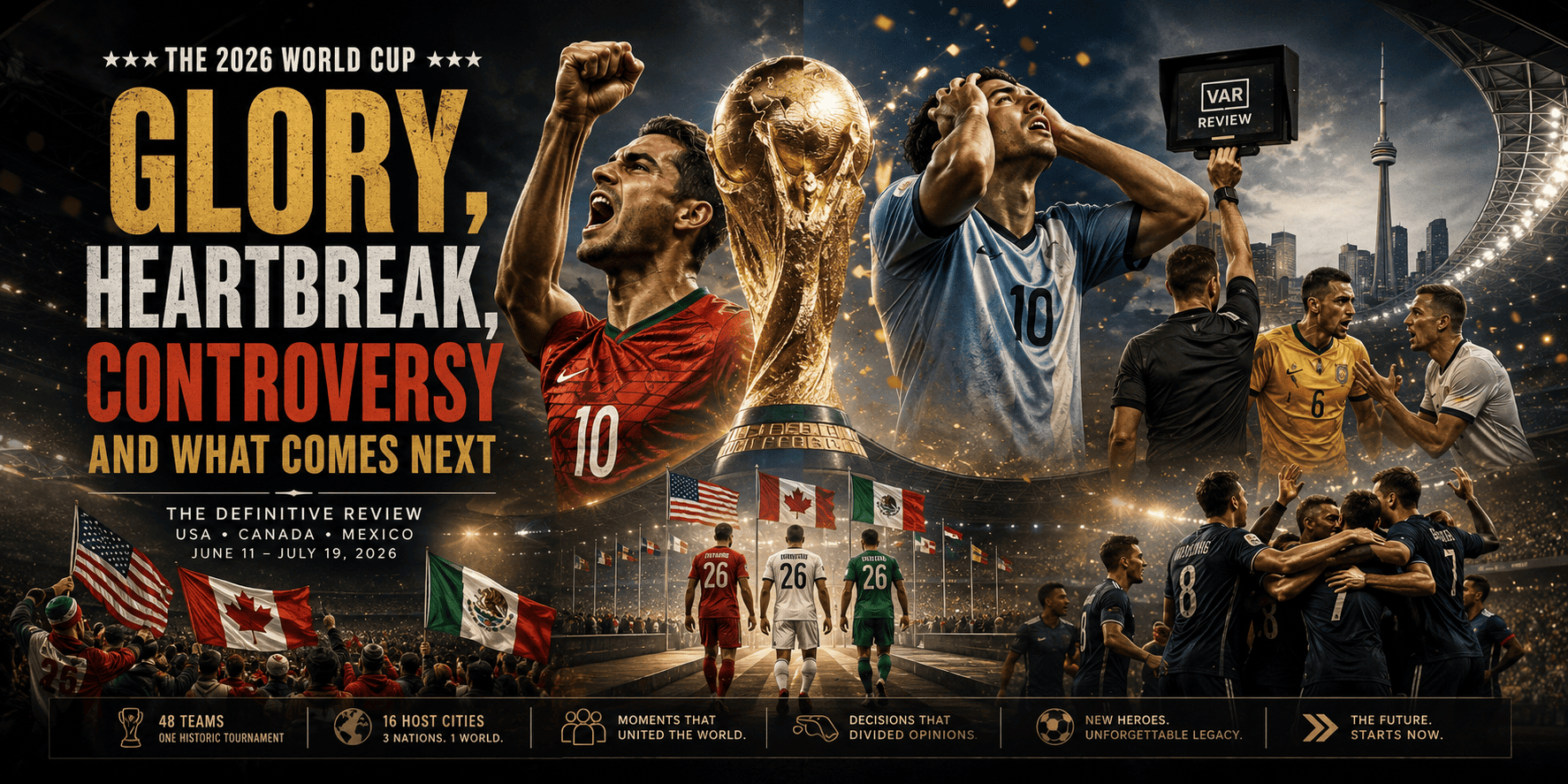
The 2026 World Cup: Glory, Heartbreak, Controversy and What Comes Next
A Fanorate tournament review. Research-based and AI-assisted; desk-verified against FIFA and independent reporting through the evening of 20 July 2026. Confidence labels — confirmed, reported, or analysis — are carried through the text where it matters.
How this World Cup will be remembered
For 105 minutes on a warm New Jersey night, the first 48-team World Cup threatened to end the way its critics feared — grudgingly, on penalties, decided by a goalkeeper rather than a team. Then Nico Williams nodded a ball back across the box, Ferran Torres arrived at a sprint, and Spain finally broke an Argentina side that had defended for its life with ten men. Torres’s 106th-minute strike settled a 1-0 final at MetLife Stadium and gave Spain its second world title, sixteen years after its first. It was the closing image of a tournament that will be argued over for a decade.
The 2026 World Cup was remembered, in the end, for all of it at once: for football that scored more freely than any tournament in nearly seventy years, for a champion of ruthless defensive control, and for a level of off-field noise — ticketing scandals, heat warnings, immigration fears, and a favoritism conspiracy that gathered ten million signatures — unlike anything the men’s game has seen. It was the biggest World Cup ever staged and, by attendance and broadcast reach, the most-watched. Whether it was the best is a harder question, and the honest answer is that its greatness and its problems came from the same source: sheer scale.
The expanded format mostly worked on the pitch and mostly strained everything around it. Forty-seven of forty-eight teams scored. The dreaded blowouts largely failed to materialize — the worst was a single 7-1 — while debutants like Cape Verde and Curaçao gave the tournament its most romantic subplots. But 104 matches across three enormous countries produced record travel inequality, a 39-day grind, and a governing body that captured most of the money while host cities absorbed most of the cost.
If a single thread runs through the tournament, it is the tension between the sport and the show. Spain answered it the only way a team can: by being unarguably the best side in the competition, conceding one goal in eight matches and beating France and Argentina back to back. The defining image is Torres wheeling away in extra time; the defining emotion is split between Spanish euphoria and the sight of a 39-year-old Lionel Messi in tears, denied at his sixth and almost certainly final World Cup. Where 2026 ranks among modern tournaments will depend on what a given fan values — the goals and the Cinderella runs, or the sense that the competition had become a commercial machine that occasionally remembered to play football. Both readings are defensible. This review makes the case for each.
From 48 teams to one champion: the tournament story
The World Cup opened on 11 June at the Estadio Azteca, where Mexico beat South Africa 2-0 — the ceremonial curtain-raiser for the first World Cup shared by the United States, Canada and Mexico. From there the group stage delivered the highest scoring rate since 1958 (2.99 goals per game, 215 goals across 72 group matches) and a run of stories the old 32-team format could never have held.
The headline of the group phase was Germany. A side that thrashed Curaçao 7-1 and beat Ivory Coast contrived to lose 2-1 to Ecuador, staggered into the knockouts, and was then dumped out in the Round of 32 by Paraguay on penalties — one of the great World Cup shocks. The Netherlands went the same way, eliminated by Morocco on penalties in a match Cody Gakpo played days after the death of his unborn son. And Cape Verde, a nation of roughly half a million people appearing at its first World Cup, drew all three group games — including a 0-0 against Spain in which goalkeeper Vozinha made seven saves — to reach the knockout rounds as one of nine African qualifiers, an unprecedented number.
The new Round of 32 did what FIFA hoped and what skeptics feared in equal measure: it added jeopardy and it added matches. From there the bracket tightened into a familiar shape. Spain ground through Austria, edged Portugal with a Mikel Merino stoppage-time winner in Cristiano Ronaldo’s final World Cup match, and conceded its only goal of the tournament while beating Belgium in the quarterfinal. Argentina survived Cape Verde in extra time, came from behind to beat Egypt 3-2 amid the tournament’s most disputed refereeing, won an extra-time quarterfinal over Switzerland, and produced a late 2-1 comeback against England in the semifinal — Messi assisting both goals.
The other half of the draw belonged to Spain’s coronation march and to England’s redemption-in-defeat. Spain dismantled France 2-0 in the semifinal; Argentina beat England 2-1 in the other; and in a third-place match that captured the tournament’s chaotic generosity, England beat France 6-4, Bukayo Saka scoring a hat-trick and Jude Bellingham adding a stoppage-time flourish. Then came the final, and the tears, and Torres.
Knockout results
- Round of 32
- Canada–South Africa 1-0; Brazil–Japan 2-1; Paraguay–Germany 1-1 (4-3 pens); Morocco–Netherlands 1-1 (3-2 pens); Norway–Ivory Coast 2-1; France–Sweden 3-0; Mexico–Ecuador 2-0; England–DR Congo 2-1; Belgium–Senegal 3-2; USA–Bosnia & Herzegovina 2-0; Spain–Austria 3-0; Portugal–Croatia 2-1; Switzerland–Algeria 2-0; Egypt–Australia 1-1 (4-2 pens); Argentina–Cape Verde 3-2 (AET); Colombia–Ghana 1-0
- Round of 16
- Morocco–Canada 3-0; France–Paraguay 1-0; Norway–Brazil 2-1; England–Mexico 3-2; Spain–Portugal 1-0; Belgium–USA 4-1; Argentina–Egypt 3-2; Switzerland–Colombia 0-0 (4-3 pens)
- Quarterfinals
- France–Morocco 2-0; Spain–Belgium 2-1; England–Norway 2-1; Argentina–Switzerland 3-1 (AET)
- Semifinals
- Spain–France 2-0; Argentina–England 2-1
- Third place
- England–France 6-4
- Final
- Spain–Argentina 1-0 (AET)
Scores compiled from Yahoo Sports, ESPN, Al Jazeera, Sky Sports and FIFA match pages; quarterfinal scorelines rest on strong media consensus rather than opened match reports and are labeled reported.
The champions’ journey: Spain
Spain arrived as European champions and co-favorites, and left as something rarer — a team that won a World Cup by making the tournament’s other giants look ordinary. Luis de la Fuente, at 65 the oldest coach ever to win the men’s World Cup, built the side on a possession-first 4-2-3-1: Unai Simón in goal; a back four of Pedro Porro, Pau Cubarsí, Aymeric Laporte and Marc Cucurella; a Rodri–Fabián Ruiz double pivot; and the teenage genius of Lamine Yamal ahead of them, with Mikel Oyarzabal leading the line.
The start was not smooth. A goalless opener against debutants Cape Verde — 27 Spanish shots repelled by an inspired Vozinha — prompted de la Fuente himself to admit his team had begun slowly. From the moment they beat Uruguay to win their group, they were relentless: Austria dispatched 3-0, Portugal edged by Merino’s late goal, Belgium beaten 2-1 in the only match all tournament in which Spain conceded, France taken apart 2-0 in the semifinal.
The defining number is that one goal in eight matches, the meanest defensive record of any World Cup champion (reported as a record; the historical comparison — 2010 Spain conceded two — supports the claim but has not been formally confirmed by FIFA). Unai Simón’s seven clean sheets and roughly 650 consecutive scoreless minutes won the Golden Glove. Rodri, back from a serious knee injury, ran the tournament from deep and took the Golden Ball without scoring a goal — a recognition of control rather than end product. Cubarsí, at nineteen, became the Best Young Player, reportedly the first defender to win the award.
The obvious comparison is to Spain’s 2008-2012 generation, and de la Fuente invited it, saying his team had “recaptured the 2010 spirit.” The parallel is real — a Euro-then-World Cup double, a Barcelona forward scoring the winner in extra time after a goalless ninety, echoing Iniesta in Johannesburg — but the spine is entirely new: Rodri where Xavi and Busquets stood, Yamal and Cubarsí where Iniesta and Puyol once were. Whether this side is historically great is analysis, not fact, and it is early to canonize a team one match past its triumph. But a European Championship and a World Cup, won with the tournament’s best defense and a seventeen-year-old as its creative hub, is the foundation of a claim that will only grow if this group stays together to 2030 — a tournament Spain will co-host.
The final: why it was won and lost
De la Fuente named an unchanged XI from the France semifinal. Lionel Scaloni made three changes, restoring Rodrigo De Paul, Nicolás González and Gonzalo Montiel and setting Argentina in a 4-4-2 built to contain rather than to create — a plan that told you how the ninety minutes would go.
They went almost entirely one way. Spain pressed, circulated and probed; Argentina defended deep and hunted the counter that never came. The most telling statistic of the whole tournament is this: Argentina finished the World Cup final without a single shot on target. Messi touched the ball 54 times. The only reason it remained goalless into extra time was Emiliano Martínez, whose eleven saves set a record for a men’s World Cup final — early stops from Yamal and Oyarzabal, a critical block from a Cubarsí header. If any goalkeeper has ever kept his team in a final it did not deserve to be in, it was Martínez that night.
The hinge came in stoppage time of normal time. Enzo Fernández, already booked for dissent, lunged in on Cubarsí and was sent off for a second yellow — a decision ESPN’s officiating analyst and the neutral consensus judged correct. Argentina would play all of extra time a man down. Slavko Vinčić of Slovenia refereed. Six minutes into the extra period, Nico Williams headed a ball back into the path of fellow substitute Ferran Torres, who thundered it past Martínez. It came moments after Williams had a strike ruled out for a Merino foul on Otamendi — the officiating intervention that so nearly denied Spain and instead only delayed it. Argentina’s single genuine chance to force penalties fell late to Giuliano Simeone, who blazed over.
The final was won by Spain’s superiority and lost by Argentina’s decision to defend rather than play — a plan that might have earned penalties but never looked like earning the trophy, and which the red card rendered untenable. It ended in ugliness: Nahuel Molina elbowed Rodri and Leandro Paredes, already substituted and booked, kicked out at Eric García and swung at a Spanish substitute, earning a post-match red card in a brawl that FIFA has since opened an investigation into. And it ended in grace: Messi stayed on the pitch to shake hands, and Yamal — seventeen, holding a winner’s medal — went to console him. Two images, both true, of the same full-time whistle.
Best matches, moments and heroes
The tournament’s best drama lived in the penalty shootouts and the comebacks. Paraguay’s elimination of Germany in the Round of 32 was, by ranking and stakes, one of the great World Cup upsets, sealed by two Orlando Gill saves. Morocco’s shootout win over the Netherlands the same day gave the tournament its most emotional single sequence — Issa Diop’s stoppage-time equalizer, Bono’s save, and Gakpo’s grief. Argentina’s chaotic 3-2 win over Cape Verde and its late semifinal turnaround against England were the champions-elect at their most watchable, and the England 6-4 France third-place match was ten goals of gleeful nonsense.
For individual moments: Cape Verde’s Sidny Lopes Cabral top-cornering against Argentina and Bellingham’s solo run in the third-place match head the goal-of-the-tournament conversation (FIFA’s fan vote had not been called at publication). Vozinha’s shutout of Spain and Martínez’s eleven-save final are the goalkeeping bookends. The most heartbreaking exit was Cape Verde’s, the debutants who went out swinging in extra time; the most controversial moment was Argentina’s disputed Round-of-16 win over Egypt, addressed in full below.
The players who defined the tournament:
Kylian Mbappé (France) won the Golden Boot with ten goals and four assists, becoming the first man to win it at two World Cups and moving to the top of the all-time World Cup scoring chart — though the exact career tally is muddled by conflicting FIFA and media figures and should be treated as reported. Rodri (Spain) took the Golden Ball as the tournament’s most influential player. Lionel Messi finished with eight goals, the Silver Ball, and the tournament’s best creative metrics — most dribbles, most chances created, and a clear lead in expected assists — undone only by a final in which his team gave him nothing to work with. Jude Bellingham (seven goals, a record for an England player at a single World Cup) and Erling Haaland (seven goals in five games, dragging Norway to the quarterfinals) were the standout attackers outside the finalists.
Two farewells framed the tournament’s generational turn: Cristiano Ronaldo, 41, and Neymar both bowed out of their final World Cups as peripheral figures. And a clutch of breakout names — Ivory Coast’s Yan Diomande, Switzerland’s Johan Manzambi, Morocco’s teenage midfielder Ayyoub Bouaddi — turned the tournament into a transfer-market shop window.
Fanorate Team of the Tournament
Selected on tournament performance, not reputation. Formation: 4-2-3-1.
- Goalkeeper
- Unai Simón (Spain) — the Golden Glove and the numbers behind it; Martínez’s final was extraordinary, but Simón’s body of work across eight matches wins the argument.
- Defenders
- Pedro Porro (Spain), Pau Cubarsí (Spain), Cristian Romero (Argentina), Marc Cucurella (Spain). Cubarsí was the tournament’s best young player and one of its best defenders full stop; Romero carried Argentina’s back line and scored decisive knockout goals.
- Double pivot
- Rodri (Spain), Declan Rice (England).
- Attacking three
- Lionel Messi (Argentina), Michael Olise (France), Kylian Mbappé (France). Olise’s seven assists broke Pelé’s 56-year-old single-tournament record (Opta/FIFA definition — see the note on assists below).
- Striker
- Erling Haaland (Norway), narrowly over Harry Kane and Oyarzabal on the strength of carrying a lesser side further than anyone expected.
- Manager
- Luis de la Fuente (Spain) — a formality.
- Substitutes
- Emiliano Martínez (GK, Argentina), Achraf Hakimi (Morocco), Aymeric Laporte (Spain), Nuno Mendes (Portugal), Fabián Ruiz (Spain), Jude Bellingham (England), Lamine Yamal (Spain).
- Best young XI, honorable mentions
- Yamal and Cubarsí anchor it, joined by Diomande, Manzambi, Bouaddi, Mexico’s Gilberto Mora and Brazil’s Estêvão — a genuinely thrilling list for the next cycle.
- Most disappointing — with context, not as a stick
- Christian Pulisic (USA) never got going and was hampered by injury as the hosts fell in the Round of 16; Ronaldo and Neymar were non-factors in what were, by age, farewell tournaments. These are notes on expectation and circumstance, not indictments.
Overachievers, underachievers and the hosts
- Overachievers
- Norway rode Haaland and Martin Ødegaard to a first deep run in a generation, reaching the quarterfinals via a Round-of-16 win over Brazil. Switzerland reached the last eight through two penalty shootouts. Morocco again proved itself the standard-bearer for African football, and Paraguay’s run to the Round of 16 began with the Germany shock. But the tournament’s soul belonged to Cape Verde — unbeaten in the group, a genuine scare for Argentina, and the smallest nation ever to make this stage.
- Underachievers
- Germany (out in the Round of 32) and the Netherlands (same round) were the marquee failures. Brazil fell in the Round of 16 to Norway, extending a drought that now stretches to a generation. Croatia’s golden era ended quietly against Portugal.
- The hosts
- All three host nations reached the Round of 16 and none went further — a respectable, faintly frustrating outcome. Canada, under Jesse Marsch, recorded its first-ever men’s World Cup win and reached the knockouts for the first time, watched by a record 5.3 million domestic television audience, before losing 3-0 to Morocco. Mexico won its group and pushed England to a 3-2 thriller before going out. The United States, under Mauricio Pochettino, opened with a statement 4-1 win over Paraguay but was overpowered 4-1 by Belgium in the Round of 16 — a result that, combined with Pulisic’s quiet tournament and an ill-judged comment about resting, drew real criticism at home. For a host desperate to convert a home World Cup into a permanent soccer boom, the last-16 exit was the tournament’s central “what if.”
The emotional story
The three-country World Cup was, for its supporters, a tournament of enormous distances and enormous crowds. FIFA’s fan festivals drew more than five and a half million people in the group stage alone; the single-day attendance record reached 426,834. North America’s diaspora communities turned host cities into home fixtures — Mexican support that made Estadio Azteca and Arrowhead among the loudest venues, African and Arab communities that gave Morocco and Egypt something close to home advantage in American stadiums.
The human moments cut both ways. Gakpo playing through unimaginable grief for the Netherlands. Cape Verde’s players, most of them unknown a month earlier, reducing a nation of half a million to tears of pride. Messi consoled by the teenager who had just replaced him at the summit of the game. And, threaded through the celebration, a genuine fear that shaped who came and who stayed away: Amnesty International and more than a hundred organizations issued a travel warning over US border enforcement, players and officials from Iran and Iraq faced detention or denied entry, and the shadow of that enforcement — documented, not alleged — sat uneasily beside FIFA’s talk of a festival of nations.
Argentina: conduct and the favoritism question
This is the tournament’s most combustible topic, and it deserves to be handled with the labels intact. Two questions are separate and must stay separate: did Argentina’s conduct cross lines, and did FIFA favor Argentina? The evidence answers them differently.
Conduct
The clearest verified incident came after the semifinal, when Lisandro Martínez and Giovani Lo Celso held up a fan banner reading “Las Malvinas son Argentinas” during pitch celebrations. Political messaging of this kind breaches FIFA’s disciplinary code; FIFA confirmed its independent committee opened a probe, and — given the comparable 2014 case drew a fine of around $37,000 — a financial sanction is the likely outcome. The British government called it an “egregious violation”; Argentine officials defended it. As of publication the case was open, with no final sanction announced.
The final produced two more: Enzo Fernández’s red card (a correct, if costly, second booking) and the post-match brawl in which Paredes and Molina lashed out at celebrating Spain players, earning Paredes a red card and a fresh FIFA investigation. Separately, Messi’s attempt to get Cucurella booked during the extra-time melee drew on-record criticism from Wayne Rooney, Joe Hart and Lee Dixon — though the referee judged no offense, and “unsporting” is a value judgment rather than a rule broken.
Balance matters here. The same Messi shook hands with England’s players after the semifinal and stayed on the pitch to do the same after losing the final; Argentina’s tournament was not a catalogue of misconduct but a mix, like most deep runs, of intensity that occasionally spilled over and ordinary sportsmanship that rarely makes the highlight reel. A viral clip alleging Yamal snubbed a handshake with the US president is unverifiable and should not be reported as fact.
Did FIFA favor Argentina?
Verdict: some tight calls broke Argentina’s way, but there is no credible evidence of institutional favoritism. The evidence supports the second, weaker classification on any fair reading — inconsistent officiating that was tournament-wide, not targeted.
The central grievance is the Round-of-16 win over Egypt. Egypt had a goal disallowed for a buildup foul and felt a foul on Salah went unpunished; coach Hossam Hassan called it “unfair” and speculated FIFA “wanted Messi to stay,” and the Egyptian federation filed a formal complaint. But ESPN’s incident-by-incident VAR analysis judged the key calls technically correct or defensible — the disallowed goal a “correct intervention,” the late non-calls “correct in both situations” — while acknowledging the disallowed goal was debatable, and other analysts did dispute it. This is a genuine split among neutral experts over one decision, not demonstrated manipulation. Complicating the narrative further, Argentina’s own federation reported a hack of its systems that sent mass “justice for Egypt” emails to reporters, meaning some of the loudest “corruption” messaging may not have come from Egypt at all.
Critics also cited a soft draw (Argentina reportedly avoided every top-13 side until the semifinal), a foul-to-card disparity that circulated online but was never validated against official data, and a vast meme campaign casting Messi as “FIFA’s princess.” A petition to expel Argentina passed ten million signatures. None of this is evidence of rigging. The “easy path” argument lost its force when Argentina beat fourth-ranked England, and the quarterfinal produced a controversial call — Breel Embolo’s red under the mistaken-identity protocol — that benefited Argentina but was, at root, a diving sanction against a Swiss player.
FIFA rejected the allegations directly. Refereeing chief Pierluigi Collina said “nobody can claim that FIFA refereeing can be influenced by anyone, not even by the FIFA president,” and Scaloni and Messi both dismissed the “VARgentina” narrative. Crucially, the neutral VAR review found clear errors distributed across the whole tournament — England denied a stonewall penalty against DR Congo, the USA’s Balogun wrongly sent off, Germany’s extra-time goal wrongly disallowed against Paraguay, Canada denied a penalty. Argentina benefited from tight calls; so, at various points, did others suffer from bad ones. That is inconsistency, not a conspiracy.
The genuine governance concern sits elsewhere and should not be conflated: FIFA lifted Balogun’s suspension after a phone call between President Trump and Gianni Infantino, a US-facing episode that drew accusations of “profound corruption” from a European lawmaker. That is a real question about FIFA’s independence from political power. It is not evidence that the game was fixed for Argentina.
FIFA’s report card: organization, refereeing and governance
FIFA delivered the biggest and best-attended World Cup ever staged and spent much of it fielding criticism it brought on itself.
Ticketing was the signature failure. FIFA used dynamic, surge-style pricing for the first time — group-stage tickets opening around $575, more than double Qatar’s top group price, then rising an average of roughly 34% across almost every match between late 2025 and April 2026. Final tickets on FIFA’s own resale platform crossed $2 million in the last 24 hours. State attorneys general in New York, New Jersey, Texas and California pushed back or opened inquiries; FIFA did not reverse course. The result was visible empty premium seating even as FIFA reported 99.7% capacity — a genuine tension that most likely reflects unsold high-price and hospitality inventory rather than empty stadiums.
Heat and player welfare drew expert warnings before a ball was kicked: ten of sixteen venues were rated at very high risk of extreme heat stress, and a group of some twenty specialists called FIFA’s heat policy inadequate. Mandatory cooling breaks helped but were then criticized when broadcasters filled them with advertising. Pitch quality was a first-week flashpoint, with France’s players among several publicly complaining about temporary grass laid over NFL turf. Travel was wildly unequal — England covered roughly 13,000 air miles by the quarterfinals while East Coast-anchored France traveled a fraction — a structural feature of a three-country tournament that longer rest periods only partly offset.
Refereeing and VAR was the on-field story beyond Argentina. The upgraded semi-automated offside system, with its threshold tightened to 10cm and no margin of tolerance, produced technically correct but widely disliked “toenail” offside calls. The neutral verdict is that officiating was inconsistent across the board rather than biased toward anyone; the tournament set a record for red cards. It is fair to say errors affected individual results — Germany’s wrongly disallowed goal, France’s correctly awarded penalty deciding a 1-0 win — but claims that any single decision “changed the tournament” are hard to support.
The credible pre-2030 to-do list writes itself: rethink afternoon kickoffs in heat-risk venues, reform or scrap dynamic pricing, tighten geographic scheduling, and — most contentiously — reconsider the proposal, confirmed by Infantino as submitted to the FIFA Council, to expand the 2030 centenary tournament to 64 teams. On the evidence of 2026, that expansion would multiply exactly the problems this tournament exposed.
Overall verdict on FIFA: a commercial and logistical triumph undercut by self-inflicted governance wounds. The football was well-served; the ordinary supporter frequently was not; and FIFA’s independence from political power is a legitimate open question it did nothing to settle.
The 48-team format: success or mistake?
On the sport, the format earned a pass. The feared parade of blowouts did not arrive — the worst margin all tournament was Germany’s 7-1 over Curaçao — while scoring hit its highest rate since 1958 and forty-seven of forty-eight teams found the net. The expansion delivered exactly the access it promised: Cape Verde, Curaçao, Jordan and Uzbekistan on debut, nine African qualifiers, and competitive minnows who mostly declined to be embarrassed.
The concerns are structural rather than aesthetic. The twelve-group format with eight best third-placed teams advancing creates theoretical incentives for collusion that the design cannot fully rule out, even if 2026’s results looked clean. And the human cost — a 39-day tournament, brutal travel, and player workload piled onto already bloated club calendars — is real. The Round of 32 added jeopardy but also a full extra round of matches to a schedule that was already the longest in World Cup history.
Recommendation: retain 48, fix the third-place mechanism and the calendar, and abandon any move to 64. The expansion to 48 broadened the tournament without breaking it. A further jump to 64 would test that claim to destruction.
Hosts, cities and supporters
Sixteen cities across three countries staged the tournament, with every match from the quarterfinals onward played in the United States and the final at MetLife. The host-city experience was uneven in predictable ways. Mexico City and the New York/New Jersey area rated highest for atmosphere; the Mexican host cities won praise for intensity and affordability, with costs a fraction of the American venues. Transport was the recurring gripe — MetLife, the final venue, was criticized as genuinely hard to reach, while Atlanta’s transit-connected Mercedes-Benz Stadium was the model. Canada’s nationwide “Canada Celebrates” program and the country’s first-ever men’s World Cup win gave the smallest host the warmest story.
The supporters, in the end, were the tournament’s redemption. Record fan-festival crowds, diaspora communities that turned neutral venues partisan, and a genuine sense of North America discovering the tournament in real time offset much of the off-field grimness. The caveat, again, is the immigration climate that shaped who felt safe attending — a factor no fan-festival attendance figure fully captures.
Commercial and cultural impact
By the numbers FIFA cared about most, 2026 was a record-smashing success. Group-stage attendance alone reached 4.64 million at 99.7% capacity; the full tournament is reported at roughly 6.8 million, comfortably the largest ever. In the United States, the Round-of-16 tie between the USA and Belgium drew around 30 million viewers on Fox — reported as the most-watched soccer telecast in US history — and FIFA claimed 5.2 billion people engaged with the tournament at least once. (President Trump’s “nearly six billion viewers” line is political rhetoric, not an audited figure, and should be treated as such.)
The money was equally historic: a prize pool of $871 million, with Spain’s payout exceeding $63.5 million; FIFA revenue for the cycle folded into figures north of $8 billion, up more than half on Qatar. Adidas reported over a billion dollars in World Cup shirt sales in the group stage alone, Mexico the best-seller.
The legacy question — whether North America converts a month of attention into a permanent soccer culture — is genuinely open and should be reported cautiously. US participation surveys show real growth (self-reported participation rising to roughly 25 million), and MLS and Liga MX will ride a visibility bump. But economists warn consistently that headline economic-impact projections (up to $40.9 billion in global GDP, per a FIFA-commissioned study) overstate net benefit by counting gross spending while ignoring public cost, with FIFA capturing the media, sponsorship and ticketing gains while host cities absorb the bills. The measured early data — host-city card spending up 6.3% year on year — is real but modest against the projections.
What happens next
A dated calendar of confirmed and credibly reported post-tournament events. Anything resting on a single outlet is labeled reported.
- Sun 19 Jul
- Final, trophy ceremony and awards, MetLife Stadium; overnight celebrations in Madrid’s Puerta del Sol — Confirmed
- Mon 20 Jul, ~14:30 CEST
- Spain squad lands at Madrid–Barajas — Confirmed
- Mon 20 Jul, afternoon
- Royal reception at Zarzuela with King Felipe VI; government reception at Moncloa with PM Pedro Sánchez — Confirmed
- Mon 20 Jul, 19:00 CEST
- Open-top bus parade from Moncloa to Plaza de Cibeles; stage ceremony (crowd estimates ~120,000 at Cibeles, up to ~1.8M along the route) — Confirmed (crowd figures are estimates)
- 20 Jul onward
- FIFA investigation into post-final incidents; possible Paredes sanction; Falklands-banner disciplinary case still open — Reported
- 24 Sep 2026
- 2026–27 UEFA Nations League league phase begins — Confirmed
- 21 Sep – 6 Oct 2026
- Next FIFA international window — Confirmed
Beyond the parade, the aftermath is dominated by a coaching exodus — reporting points to as many as 17 national-team managers departing, with England’s Thomas Tuchel and Belgium’s Rudi Garcia among the firmest exits; that full list rests on single-outlet reporting and should be treated as reported. Spain’s de la Fuente and Argentina’s Scaloni are not among those leaving. Confirmed dates for trophy exhibitions, documentaries and club return schedules had not been announced at publication.
One frequently-asked “next” question deserves a direct answer: Lionel Messi has not announced international retirement. He was in tears after the final, at 39 this was near-certainly his last World Cup, and his future is genuinely open — Argentine reporting suggests he intends to continue at least toward the 2028 Copa América, and Ángel Di María publicly urged him to. Reporting his retirement as fact would be wrong.
Winners, losers and the road to 2030
Winners beyond the trophy: Spain, obviously, and de la Fuente, whose stock rose from doubted to unimpeachable. Rodri, Cubarsí and Yamal as the faces of the next era. Mbappé, who left a losing semifinalist with the Golden Boot and a scoring record. Morocco and the African confederation, whose nine qualifiers reshaped the tournament’s map. Canada, which got its breakthrough. And FIFA’s balance sheet.
Losers: Argentina, whose finalists’ run will be remembered as much for the banner and the brawl as for the football. Germany and Brazil, whose early exits deepen structural worries. The ordinary supporter priced out by dynamic ticketing. And FIFA’s credibility, which the ticketing scandal and the Trump–Infantino episode dented even as its revenue soared.
The road to 2030 — co-hosted by Spain, Portugal and Morocco, with centenary opening matches in Uruguay, Argentina and Paraguay — begins with a champion who will also be a host, a golden generation young enough to defend its title at home, and a governing body under real pressure over expansion, ticketing and independence. The tactical lessons of 2026 point toward possession-control sides with elite defensive organization and match-winning individual dribblers; the players to watch are already known — Yamal, Cubarsí, Mora, Estêvão, a cohort that will define the next four years.
What supporters will remember, once the controversies fade, is likely to be simpler than any of this: a tiny island nation that would not lose, a goalkeeper who nearly stole a final on his own, a teenager consoling the greatest player of his age, and Ferran Torres arriving at a sprint to end sixteen years of waiting. The noise around this World Cup was deafening. The football, when it was allowed to be, was worth all of it.
Known, reported, and unconfirmed
Solidly confirmed: the final result and its key events; the knockout bracket; the four major individual awards; Spain’s one-goal-conceded tournament; the Falklands banner and the FIFA probe; Egypt’s formal complaint; the ticketing scandal and $2M+ resale prices; attendance and prize-money figures; Spain’s parade.
Reported (single or thin sourcing): several quarterfinal scorelines; Martínez’s 11-save “record”; the 17-coach departure list; Paredes’s post-final sanction; the ~6.8M full-tournament attendance total; Mbappé’s exact all-time scoring tally.
Unconfirmed / do not report as fact: any Messi retirement (not announced); the “White House task force” and Yamal–Trump snub claims (viral, uncorroborated); economic-impact projections (pre-tournament estimates, not measured results); FIFA’s official 104-match totals and per-player disciplinary tables (pull from fifa.com before republishing).
A note on assists and statistics
For the single most contested statistic — assists — the recognized record-holder is Michael Olise (France) with 7, breaking Pelé’s 1970 mark, under the Opta/FIFA actual-assist definition. Advanced metrics tell a different story: Messi led on expected assists (4.15 xA) and big chances created (26). Both are true; they measure different things. Where this review cites assists it uses the Opta/FIFA figure and says so. FIFA’s official statistics page should be the source of record for any per-player totals before republication.
Research note
Verified through the evening of 20 July 2026 (US Eastern / CEST). This is a research-based, AI-assisted review synthesized from public reporting; it involves no on-the-ground verification, consistent with Fanorate’s editorial model.
Still developing / unconfirmed at publication: FIFA’s disciplinary rulings on the Falklands banner and the post-final brawl; the full national-team coaching carousel; official FIFA 104-match attendance and per-player disciplinary totals; the Goal of the Tournament vote; Messi’s international future.
Analysis rather than established fact: the “historically great” assessment of this Spain side; the Team of the Tournament and most-disappointing selections; the favoritism verdict (evidence-based, but a judgment); the winners/losers framing.
Update if new announcements emerge: the “What happens next” calendar, the FIFA disciplinary outcomes, and any Messi statement.
