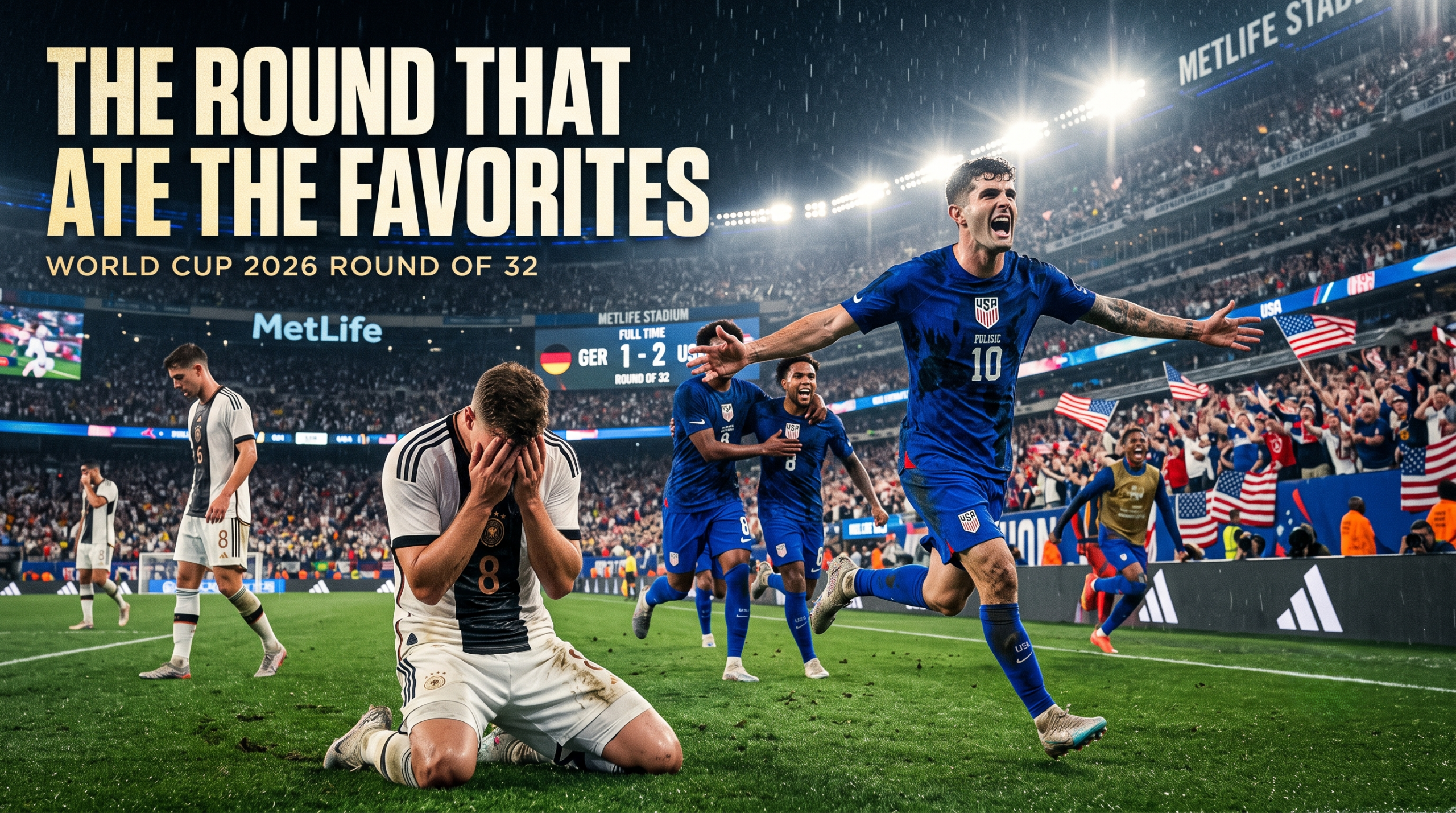
The Round That Ate the Favorites: Inside World Cup 2026’s Round of 32
A note on how this is made: Fanorate is an AI-assisted editorial project from the team at Brillmark. We use AI research and drafting tools to help us cover a 48-team World Cup at the pace fans deserve, with human editorial direction shaping every piece. We’re not on the ground reporting from these stadiums — we’re synthesizing what’s been reported, verified, and confirmed across trusted outlets, and we say so plainly. If we get something wrong, tell us and we’ll fix it.
Opening Hook
Six days. Sixteen matches. Four shootouts, two of them ending four-time and three-time World Cup winners in the same 24-hour news cycle. A country of 600,000 people taking the reigning champions to extra time. A five-time champion needing a 96th-minute winner just to survive a team most of its own fans couldn’t have located on a map three weeks earlier. By the time the Round of 32 finally exhaled on July 3, the World Cup’s field of 48 had been cut in half, and almost nothing about the resulting bracket looked the way the pre-tournament seedings promised it would.
This is the round that separates World Cups that get remembered from World Cups that don’t. The group stage is where stories begin. The Round of 32 is where they either end or turn into something nobody saw coming — and this one turned into both, repeatedly, sometimes in the same stadium on the same night.
Germany and the Netherlands were eliminated in penalty shootouts on the same evening, Brazil needed a 96th-minute winner to survive Japan, Argentina needed extra time to get past Cape Verde, and by the time Colombia closed the round out with a clinical win over Ghana, eight favorites had survived, eight had not, and the World Cup had served notice that reputation was no longer worth anything.
At a glance
SoFi Stadium, Inglewood, June 28
(AET) Stephen Eustáquio’s 92nd-minute long-range strike sent co-host Canada into its first-ever World Cup knockout round.
NRG Stadium, Houston, June 29
Gabriel Martinelli’s stoppage-time winner rescued a Brazil side that had been stunned by Kaishu Sano.
Gillette Stadium, Boston, June 29
Paraguay win 4–3 on penalties. Orlando Gill saved two spot kicks as Paraguay ended a four-time champion’s tournament.
Estadio BBVA, Monterrey, June 29
(AET) Morocco win 3–2 on penalties. Issa Diop’s 91st-minute header forced extra time before Yassine Bounou and Ismael Saibari finished the job.
AT&T Stadium, Arlington, June 30
Erling Haaland’s 86th-minute tap-in beat Amad Diallo’s brilliant equalizer and sent Norway through to a heavyweight last-16 date with Brazil.
MetLife Stadium, East Rutherford, June 30
Kylian Mbappé scored twice as Les Bleus cruised.
Estadio Azteca, Mexico City, June 30 (kickoff delayed by lightning)
Julián Quiñones and Raúl Jiménez struck to keep the co-hosts’ run alive.
Atlanta Stadium, July 1
DR Congo led through Brian Cipenga before Harry Kane’s late brace flipped it.
Seattle Stadium, July 1
(AET) Senegal led 2–0 before Romelu Lukaku and Youri Tielemans, the latter from the spot in the 125th minute, completed one of the round’s great escapes.
Levi's Stadium, Santa Clara, July 1
Folarin Balogun and Malik Tillman scored before Balogun was sent off — a red card that would go on to dominate headlines for entirely different reasons a week later.
SoFi Stadium, Inglewood, July 2
Mikel Oyarzabal’s brace and a Pedro Porro strike; Austria never had a shot on target.
BMO Field, Toronto, July 2
Ronaldo’s 68th-minute penalty and Gonçalo Ramos’s stoppage-time header overturned Ivan Perišić’s opener and ended Luka Modrić’s international career.
BC Place, Vancouver, July 2
Breel Embolo and Dan Ndoye (48 seconds into the second half) ended an 88-year Swiss knockout drought.
Hard Rock Stadium, Miami Gardens, July 3
(AET) Cristian Romero’s extra-time header finally broke the resistance of the tournament’s most beloved underdog story.
AT&T Stadium, Arlington, July 3
Egypt win 4–2 on penalties. Every Egyptian penalty went in; two Australian ones didn’t.
Arrowhead Stadium, Kansas City, July 3
Jhon Arias’s first-time finish was enough against a Ghana side still finding its footing under a caretaker coach.
The Main Story Of The Round
If you had to distill six days of football into one theme, it’s this: the gap between “favorite” and “everyone else” nearly disappeared. Germany and the Netherlands — a combined seven World Cup titles between them — went out on penalties on the same night, both after being pushed to the brink by teams they were supposed to handle. Brazil needed the 96th minute. Argentina needed extra time and a deflected header. Belgium trailed 2–0 to Senegal with under ten minutes to go and somehow found a way to survive. This wasn’t a round where giants stumbled occasionally. It was a round where the entire concept of a “formality” got quietly retired.
Brazil’s win over Japan deserves particular attention with hindsight, because it was the first real crack in the story Carlo Ancelotti’s side had been telling about itself. Kaishu Sano’s early goal stunned a Brazil team that had cruised through the group stage, and it took until Gabriel Martinelli’s 96th-minute strike for the five-time champions to escape with the result their squad’s talent suggested they deserved. At the time, it read as a scare successfully survived. In retrospect, watching what happened to this same Brazil side five days later against Norway, it reads as a warning nobody in the camp fully heeded — a talented team that could be got at through the middle of the pitch by a side willing to sit patient and strike late. Brazil got away with it against Japan. They would not get away with it twice.
Argentina’s afternoon in Miami carried its own foreshadowing. Cape Verde — a nation of fewer than 600,000 people playing in its first-ever World Cup — equalized twice against the reigning champions and came within a matter of inches of the biggest shock in the tournament’s history. Messi scored, missed a golden one-on-one, and ultimately needed his center-backs, not his usual magic, to get Argentina over the line. Lisandro Martínez’s redemption goal and Romero’s extra-time header settled it, but the performance raised the same question Fanorate flagged at the time: is this Argentina team, four years removed from Qatar, still sharp enough defensively to survive elite opposition without needing a rescue act? Round of 16 would answer that question in the most dramatic way imaginable.
The Drama Section
Two dynasties fall in one night. Germany’s exit to Paraguay and the Netherlands’ exit to Morocco landed within hours of each other on June 29, and both were legitimate shocks by any measure — Paraguay ranked 41st in the world, Morocco needing extra time and penalties against a Dutch side many had pegged as semifinal contenders. Neither exit involved a whiff of controversy; both were earned, and both immediately reframed the entire shape of the bottom half of the bracket.
Balogun’s red card — the seed of a much bigger story. The United States beat Bosnia and Herzegovina comfortably enough, but Folarin Balogun’s second-half red card for stepping on Tarik Muharemović’s ankle would not stay a footnote. Within days it became the center of the tournament’s loudest off-pitch controversy, after reports emerged that a suspension review had been personally requested at the highest level of the U.S. government — a story that exploded fully once Round of 16 arrived, but whose roots sit here, in a fairly ordinary Round of 32 dismissal in Santa Clara.
Officiating grumbles start early. Croatia’s Zlatko Dalić became the first manager of the knockout rounds to publicly criticize VAR after a marginal offside call wiped out what would have been a second Croatia goal against Portugal, calling video review something that “kills emotions, it kills everything within you.” Fanorate’s read at the time was that the call looked defensible on the letter of the rule even if the margin was invisible to the naked eye — but Dalić’s frustration was an early tremor of a fault line that would crack wide open five days later, when Argentina’s own charmed run through the bracket started drawing very different accusations from a very different set of opponents.
Australia’s shootout gamble. Tony Popovic’s decision to substitute goalkeeper Patrick Beach — who’d played the game of his life in normal time — for the more experienced Mathew Ryan purely for the penalty shootout against Egypt will be debated in Australian football for months. It didn’t work. Whether that’s proof the swap was a mistake or simply bad luck on a coin-flip decision is exactly the kind of argument knockout football exists to generate.
Emotional Temperature Of The Round
Joy
Egyptian fans, watching a 92-year wait for Round of 16 football finally end; Swiss fans, ending an 88-year knockout drought; Canadian and Moroccan supporters, both making history in their own ways.
Relief
Argentine and Brazilian fans, both watching their teams survive scares that a slightly different bounce would have turned into full-blown crises.
Heartbreak
German and Dutch supporters, watching two of the tournament’s pre-fancied contenders go out on penalties within hours of each other; Cape Verde’s entire nation, whose team leaves as the round’s most beloved story despite the result.
Anger
Croatian fans over the disallowed Gvardiol goal; Belgian federation officials, who would spend the following week furious about a decision connected directly back to Balogun’s red card in this round.
Players Who Defined The Round
Erling Haaland
His 86th-minute goal against Ivory Coast was Norway’s first-ever World Cup knockout win. It would prove to be the opening note of a run that turned into the round’s biggest story five days later.
Lionel Messi
A goal, a missed one-on-one, and a captain’s performance that kept Argentina’s title defense alive against a Cape Verde side that had no business making the champions sweat this much.
Gabriel Martinelli
His 96th-minute winner against Japan is the kind of goal that gets forgotten the moment a team is eliminated a round later, but it was, in the moment, one of the biggest of Brazil’s tournament.
Orlando Gill
Two penalty saves that ended Germany’s World Cup and announced Paraguay as a team nobody wanted to draw.
Mohamed Salah
Playing through a hamstring strain, his ice-cold panenka in the shootout delivered Egypt’s first World Cup knockout win since 1934.
Cristian Romero and Lisandro Martínez
The two center-backs who bailed out their forwards, combining for both of Argentina’s extra-time goals against Cape Verde.
Teams Rising And Falling
Stock rising
- Morocco, Norway, Switzerland, Egypt, Colombia, and Paraguay all enter the Round of 16 carrying real momentum — none of them arrived at this World Cup expecting to be discussed as genuine dark horses, and all of them are now unavoidable in that conversation.
Stock falling
- Germany and the Netherlands are out entirely. Brazil and Argentina both survive, but neither looks like the airtight machine their reputations suggested pre-tournament — a distinction that would matter enormously in the round to come.
Tactical Notes For Serious Fans
The round’s clearest pattern: elite individual talent bailing out shaky structure. Brazil’s midfield got overrun by Japan for long stretches before Martinelli’s quality decided it. Argentina’s defensive line sat too deep for comfort against Cape Verde, inviting pressure a sharper opponent would have punished more than twice. Both results carried a version of the same warning label — win now, fix it later — and only one of those two teams would get the chance to actually fix it before the tournament ended.
Meanwhile, the round’s shootout carnage (four of sixteen matches decided on penalties) reinforced a trend from recent tournaments: preparation matters as much as talent once it comes down to twelve yards. Egypt’s kickers looked drilled and confident. Germany’s and the Netherlands’ did not, on the night that counted.
Qualification Picture
The Round of 16 bracket, locked in as of July 3: Canada vs. Morocco, Paraguay vs. France, Brazil vs. Norway, Mexico vs. England, Portugal vs. Spain, USA vs. Belgium, Argentina vs. Egypt, and Switzerland vs. Colombia. Gone from the tournament: South Africa, Japan, Germany, Netherlands, Ivory Coast, Sweden, Ecuador, DR Congo, Senegal, Bosnia and Herzegovina, Austria, Croatia, Algeria, Cape Verde, Australia, and Ghana — a list that includes two former World Cup champions and several teams that spent the group stage looking like genuine contenders.
Looking Ahead
Brazil’s narrow escape against Japan and Argentina’s extra-time struggle against Cape Verde were, in hindsight, the two most important results of the entire round — not because of what they meant in the moment, but because of what they revealed. Norway, fresh off toppling Ivory Coast, was next up for Brazil. Egypt, fresh off a penalty shootout of their own, was next up for Argentina. Both ties would go on to define the Round of 16 — one through the biggest upset of the tournament so far, the other through a comeback so dramatic it reignited every question about whether this World Cup was bending, even slightly, around its biggest stars.
Fanorate Final Whistle
Sixteen matches, four shootouts, two fallen former champions, and a growing sense that nobody left in the draw could be trusted to survive comfortably. The Round of 32 didn’t just trim the bracket — it planted every seed that would bloom into the drama of the Round of 16: Brazil’s cracks, Argentina’s fragility, Norway’s belief, Egypt’s pedigree. This is what a 48-team World Cup was supposed to deliver on its most optimistic promise, and for six days at the end of June and start of July, it delivered exactly that.
We at Brillmark built Fanorate to cover this tournament with the same care and skepticism we’d want from any outlet we trusted ourselves — researched, cross-checked, and upfront about being an AI-assisted operation rather than a pitchside one. The Round of 16 came next, and it did not calm down.
