No Team Left Standing Looks Invincible: Inside World Cup 2026’s Quarterfinals
A note on how this is made: Fanorate is an AI-assisted editorial project from the team at Brillmark. We use AI research and drafting tools to help us cover a 48-team World Cup at the pace fans deserve, with human editorial direction shaping every piece. We’re not on the ground reporting from these stadiums — we’re synthesizing what’s been reported, verified, and confirmed across trusted outlets, and we say so plainly. If we get something wrong, tell us and we’ll fix it.
Opening Hook
Three days. Four matches, played one at a time across four different cities, because a 48-team World Cup apparently wasn’t going to let anyone catch their breath even at the business end. A missed penalty that turned into a personal highlight reel. A substitute who has now decided two straight knockout matches in under two minutes of playing time each. A disallowed goal that will get replayed in Norway for a generation. And a defending champion that needed a red card and two attackers not named Messi to escape a Swiss side that had, for long stretches, made the best player of his generation look ordinary.
By the time Arrowhead Stadium in Kansas City emptied out on Saturday night, the World Cup was down to its final four, and — for the first time in three rounds — nobody could credibly say which of them was the best team left standing.
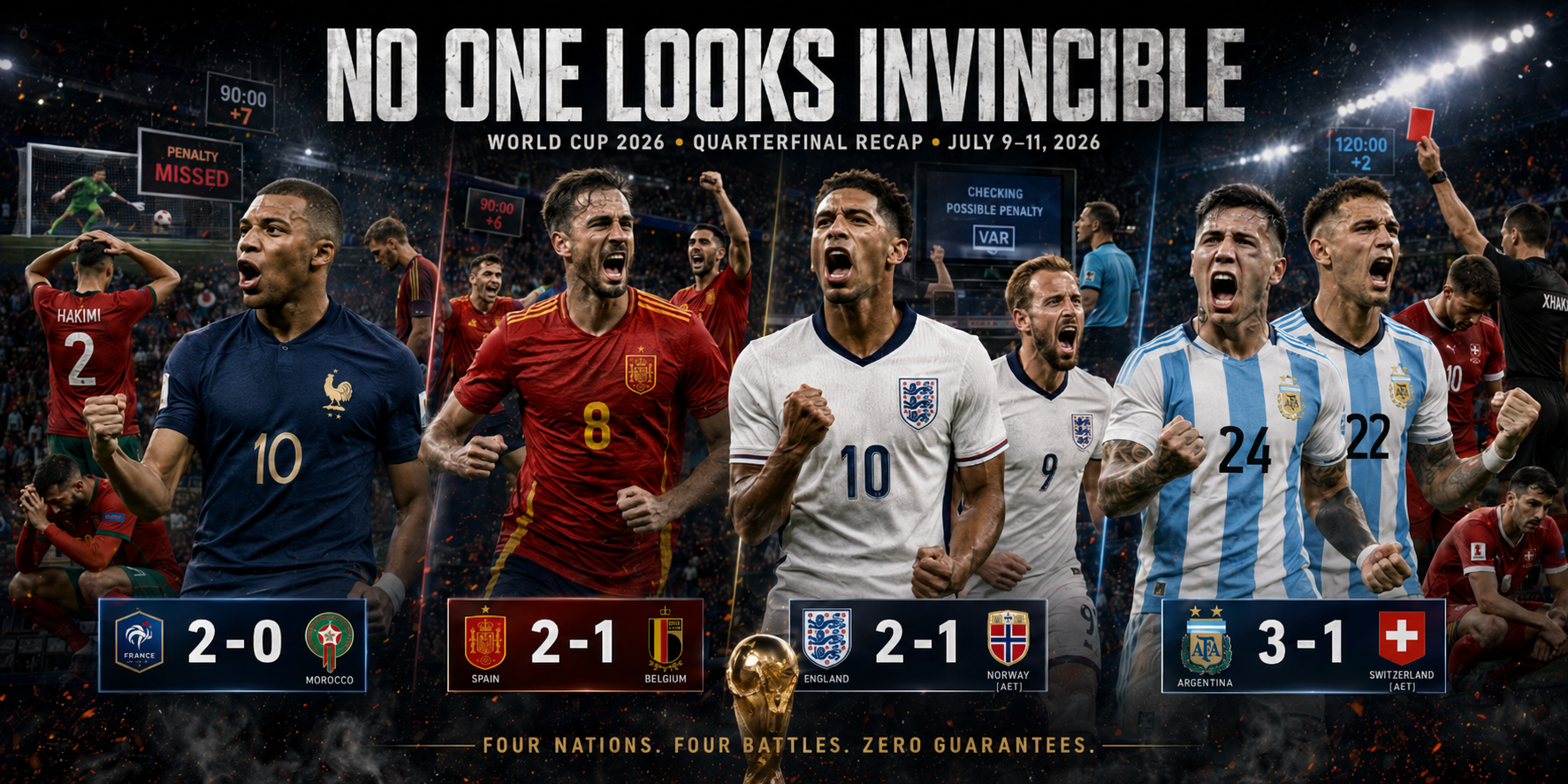
France dispatched Morocco behind a Mbappé penalty-miss-then-brace, Spain needed a substitute’s 88th-minute goal to beat a depleted Belgium, England required extra time and a contentious VAR reversal to see off Norway, and Argentina needed a Swiss red card and second-half reinforcements to survive Switzerland after extra time — setting up France vs. Spain and England vs. Argentina in the semifinals.
At a glance
Gillette Stadium, Foxborough, July 9
Kylian Mbappé missed a 28th-minute penalty, saved by Yassine Bounou after a three-minute VAR delay, then scored in the 60th and assisted Ousmane Dembélé’s goal six minutes later.
SoFi Stadium, Inglewood, July 10
Fabián Ruiz opened the scoring; Charles De Ketelaere equalized for a Belgium side missing captain Youri Tielemans before kickoff; substitute Mikel Merino won it in the 88th minute, less than two minutes after coming on, ending Spain’s tournament-record six-match clean sheet streak in the process.
Hard Rock Stadium, Miami Gardens, July 11 (AET)
Andreas Schjelderup put Norway ahead; Jude Bellingham equalized before halftime and scored the extra-time winner, three minutes into the additional period, after a Torbjørn Heggem goal was VAR-disallowed for an Erling Haaland push in the corner-kick buildup.
Arrowhead Stadium, Kansas City, July 11 (AET)
Alexis Mac Allister’s early header was canceled out by Dan Ndoye before Breel Embolo’s second yellow card left Switzerland a man down; Julián Álvarez broke through in the 112th minute and Lautaro Martínez added a late third.
The Main Story Of The Round
If the Round of 16 was about favorites falling and controversy boiling over, the quarterfinals were about something quieter and, in its own way, more unsettling for the four teams left standing: none of them look finished. Every single result took the harder route. Mbappé missed from the spot before rescuing his own night. Belgium played most of ninety minutes down its captain and lost its goalkeeper to injury mid-match, and still needed a 100-second flash of substitute brilliance to be beaten. England has not won a single knockout match this tournament by more than one goal, and needed a corner-kick reversal and extra time just to get past a Norway side with no real World Cup pedigree. And Argentina — the defending champions, fronted by a 39-year-old captain in what is presumed to be his final tournament — was outplayed for long stretches by a Swiss side missing a fraction of its individual talent, saved only by a red card and by two forwards other than Messi finally breaking through.
That last point deserves real attention, because it’s the closest thing this round produced to a verdict on the biggest storyline hanging over the tournament. After Round of 16, Egypt’s manager accused Argentina and, by extension, FIFA’s officiating of bending toward the champions in the moments that mattered most. Saturday in Kansas City offered a useful data point in the other direction: Switzerland’s rotating-marker scheme held Messi to a single shot in ninety minutes — the best individual containment job any team has managed on him all tournament — and Argentina’s route through was unglamorous and, crucially, uncontroversial. Embolo’s red card was a clean, undisputed second yellow. Álvarez’s goal in the 112th minute was a mismatch created by a numbers disadvantage, not a whistle. If the last round raised legitimate questions about whether this tournament tilts toward its biggest commercial story, this one is at least some evidence that Argentina can also just be a good team that had a hard night and found a way through on the areas the rulebook actually rewards — squad depth and a numerical advantage earned fairly. It doesn’t erase the Egypt questions. It does complicate the idea that Argentina’s entire run has been artificially smoothed.
The round’s other major flashpoint belonged to a different team entirely. Erling Haaland’s shove on Elliot Anderson before Torbjørn Heggem’s would-be go-ahead header was ruled, on review, to have happened during the buildup to the corner rather than incidentally alongside it — a technically defensible call that still cost Norway a legitimate-looking goal at the exact moment their tournament needed it most. It’s the kind of contact that happens at nearly every corner kick in the sport without a whistle, and Norwegian players were right to point out the inconsistency, even while accepting the letter of the law had been followed. Coming one round after the Argentina-Egypt shirt-pull non-call and the Balogun-Trump-FIFA saga, this is now the third straight round in which a marginal contact decision has directly shaped a knockout result — and the pattern, more than any single incident, is what’s keeping the “is this tournament being officiated consistently” conversation alive heading into the semifinals.
The Drama Section
The Haaland shove. Already covered above, but it’s worth restating plainly: this was the round’s single most consequential officiating moment, and it happened in a match that had nothing to do with Argentina — a reminder that inconsistent marginal-contact calls are a tournament-wide issue, not a conspiracy engineered around one team.
The three-minute VAR delay in Foxborough. Mbappé’s penalty was awarded, then reviewed for more than three minutes before he actually took it — an unusually long gap that plausibly cooled his rhythm and contributed to Bounou’s save. Morocco’s staff separately felt the sequence leading to the penalty started with an uncalled foul on Achraf Hakimi moments earlier, a defensible if unresolvable complaint.
Belgium’s accumulating misfortune. Losing captain and midfield anchor Youri Tielemans to a warmup injury before a ball was even kicked, then losing goalkeeper Thibaut Courtois to a muscular issue mid-match, is the kind of compounding bad luck that makes a loss sting differently — not a controversy so much as a reminder that knockout football doesn’t wait for a team’s best-case roster to show up.
Embolo’s red card. Clean, undisputed, and the single biggest tactical hinge point of the entire round — the moment a genuinely competitive Argentina-Switzerland contest turned into a mismatch.
Emotional Temperature Of The Round
Joy
French fans, watching their team look like the tournament’s most complete side for a third straight round; Spanish fans, watching a bench that has now decided two consecutive knockout matches.
Relief
English supporters, aware their team hasn’t been fully convincing all tournament but is one win away from a final anyway; Argentine fans, who watched their talisman go quiet for the first time all summer and still found a way through.
Heartbreak
Moroccan fans, watching a golden generation’s best-ever run end one round short of matching 2022; Belgian supporters, watching their captain and goalkeeper taken from them by injury before the result was even decided.
Fury, tinged with resignation
Norwegian fans and players, who feel — not without reason — that a legitimate goal was wiped out by a standard that isn’t applied consistently across the tournament.
Unease
Neutral fans everywhere, watching four increasingly imperfect teams stumble into the final four and wondering whether the eventual champion will be the best team in the tournament or simply the one that survived the most.
Players Who Defined The Round
Kylian Mbappé
Missed a penalty, then scored his 20th career World Cup goal and added an assist inside twenty minutes, moving to one behind Messi’s all-time tournament scoring record.
Mikel Merino
Two knockout matches, two substitute appearances, two winning goals — the most improbable individual pattern of the entire tournament.
Jude Bellingham
A first-half equalizer and an extra-time winner against Norway, becoming the first player since Diego Maradona in 1986 to score braces in consecutive World Cup knockout matches.
Julián Álvarez
The 112th-minute breakthrough that turned a genuinely nervy afternoon into a comfortable-looking scoreline, doing the job Argentina needed when its biggest name couldn’t.
Yassine Bounou
Saved a penalty from a shooter who’d converted fifteen straight, and still ended the night on the losing side — the round’s best individual performance in a losing cause.
Erling Haaland
Didn’t score, but leaves the tournament as one of its most talked-about figures for a single shove that will be argued about for years.
Teams Rising And Falling
Stock rising
- France, who have now won every match they’ve played and look like the tournament’s most convincing side heading into a final four they’ve reached in three straight cycles.
- Spain, whose willingness to win even after its historic defensive record cracked suggests genuine range rather than a one-dimensional formula.
Stock falling
- Morocco and Belgium are out, both with real credit attached rather than embarrassment.
- England and Argentina both advanced, but neither looks like the version of itself that will be favored on reputation alone in the semifinals — both have now won multiple knockout matches without ever fully controlling one.
Tactical Notes For Serious Fans
Switzerland’s rotating-marker containment scheme on Messi — multiple defenders sharing responsibility rather than one dedicated shadow — was the most effective individual defensive plan deployed against him all tournament, and it’s a template England’s coaching staff will have studied closely before Atlanta. Deschamps’ continued insistence on four committed attacking players in France’s 4-2-3-1, even against a low block, keeps working because Manu Koné has been excellent enough in a lone deep-midfield role to cover for it — a luxury not every semifinal opponent will let France keep. Spain’s winning sequence against Belgium — a company of fresh legs sent forward specifically to attack a tiring back line — is now a repeatable, coachable pattern rather than a coincidence, and it means France cannot simply defend a one-goal Spain lead and assume the danger has passed. England’s pattern of winning through moments rather than sustained control — a spilled ball here, a set piece there — has gotten them to the semifinal, but it’s a higher-variance approach than Argentina’s, even accounting for Argentina’s own shaky night against Switzerland.
Fan Sentiment Pulse
French supporters are the tournament’s most confident fanbase heading into the semifinals, and reasonably so — three quarterfinal-round performances that have ranged from comfortable to dominant. Spanish fans have shifted from quiet pride in an untouchable defensive record to a louder, more visceral belief built on late drama, which some inside that fanbase argue is actually a healthier signal heading into a one-off semifinal. Moroccan and Belgian supporters both leave this round with unusually little bitterness for eliminated fanbases — both felt their teams competed with real credit against sides that were simply slightly better on the night. Norwegian sentiment is the most conflicted of the round: pride in a first-ever quarterfinal appearance, sitting uneasily next to real anger about a decision that cost them a shot at the semifinal. Argentine fans, for their part, are experiencing a version of anxiety that’s new for this tournament run — Saturday was the first time all summer their team looked genuinely breakable, and even a win hasn’t fully erased that feeling heading into Atlanta.
Qualification Picture: The Semifinals
- France vs. Spain
- Dallas Stadium, Tuesday, July 14.
- England vs. Argentina
- Atlanta, Wednesday, July 15.
- Third-place match
- Miami, Saturday, July 18.
- Final
- MetLife Stadium, New Jersey, Sunday, July 19.
Updated Predictions: Semifinals, Final, and the Trophy
Fanorate correctly projected this exact semifinal pairing after the Round of 16 — Argentina vs. England, and France vs. Spain — and the quarterfinals mostly reinforced that read rather than overturning it, with one real complication.
France looks like the tournament’s best team heading into Dallas: unbeaten, increasingly fluent, with Mbappé now hunting the all-time scoring record and Koné giving Deschamps a defensive midfield reliability blanket that wasn’t obviously there in June. Spain’s clean sheet streak is over, and while Merino’s habit of deciding matches off the bench is a genuine weapon, needing a fresh substitute goal in the 88th minute against a Belgium side playing without its captain and, for a stretch, its own goalkeeper is a less commanding platform than Spain’s earlier rounds suggested. Fanorate leans France in Dallas, but with real respect for a Spain team that has now shown it can win when its best-known strength fails it.
England vs. Argentina is the harder call to make with confidence, and Saturday made it harder still. Argentina’s ability to win ugly — surviving a red-card-aided escape after being genuinely outplayed by Switzerland for over an hour — is exactly the trait that wins tournaments, and Messi’s quiet night doesn’t change the fact that Álvarez and Lautaro Martínez have shown all summer they can carry a match when he can’t. But England’s Bellingham is playing historic-tier football right now, and a team that has won every knockout match through moments rather than control is, by definition, capable of producing one more. Fanorate leans Argentina, on the balance of squad depth and knockout pedigree, but flags this as close to a genuine coin flip — the least confident call of the entire bracket so far.
That points to Argentina vs. France in the final — a rematch of the 2022 final that decided the last cycle in the most dramatic way the sport has ever produced. If it happens, expect the same basic shape: France with more control of the game’s overall run of play, Argentina waiting for the moment that matters and finding it through Messi, Álvarez, or Lautaro. Fanorate’s call: Argentina retain the trophy, extending Messi’s storybook ending — though after watching this Argentina side get genuinely troubled by Switzerland, that call carries real uncertainty, and a fully fit, in-form France side missing nobody the way Argentina has occasionally missed its best player is a completely credible spoiler. Confidence level: medium-low, the lowest of any prediction Fanorate has made this tournament — this knockout stage has punished certainty at every turn, and there is no reason to expect that pattern to break now.
Fanorate Final Whistle
The quarterfinals didn’t produce a single dominant performance from any of the four teams that survived, and that might be the most honest thing this round taught us: at this stage of a 48-team World Cup, the trophy doesn’t necessarily go to whoever is best. It goes to whoever survives the most uncomfortable nights. France has had the fewest of those so far. Spain, England, and Argentina have all had at least one — and all three know it. The semifinals start Tuesday in Dallas. Given everything the last three rounds have shown us, expect them to be just as uncomfortable as everything that came before.
We at Brillmark built Fanorate as an experiment in what AI-assisted sports journalism can look like when it’s done with real editorial care — every score, quote, and storyline in this recap was researched and cross-checked against what’s been reported, not generated from thin air, and our predictions remain clearly labeled as editorial judgment rather than fact. We’ll be back with the semifinals.
