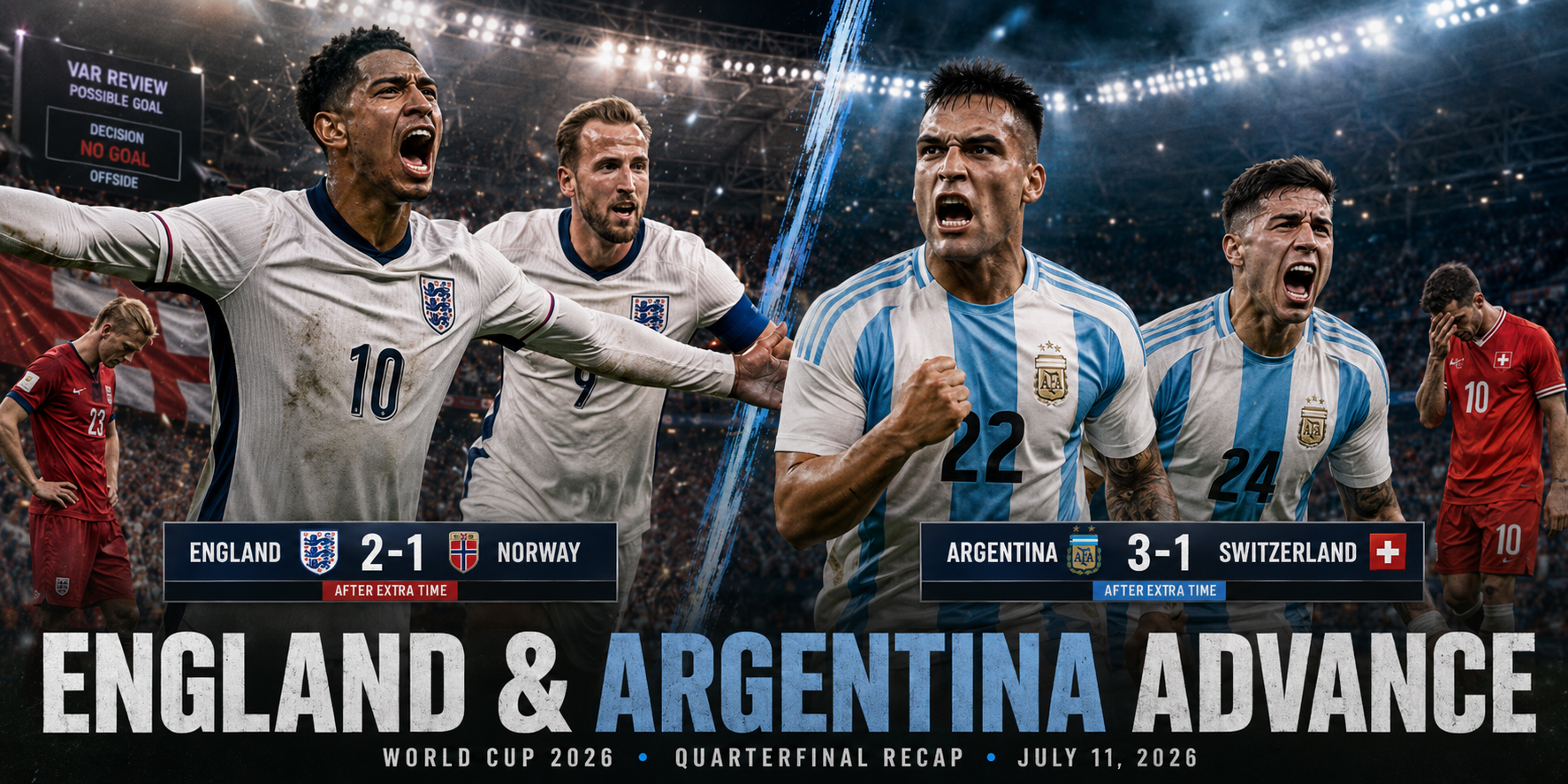
The Last Four: England and Argentina Punch Their Tickets as the World Cup’s Final Quarterfinal Saturday Delivers Extra Time, VAR Chaos, and a Ghost of 1986
Nobody in Miami Gardens breathed normally for about twenty minutes. Jude Bellingham had already dragged England level once, the kind of finish that makes 65,000 people forget they were nervous, and then Erling Haaland went and shoved a man before a corner kick like nobody in that stadium had a phone or a VAR booth watching. The goal came anyway. The goal got taken away. And somewhere in the three minutes of stoppage that followed, you could feel an entire tournament tilt on a single push from a striker who wasn’t even supposed to be the story.
Nine hundred miles west, in a Kansas City stadium that has hosted this World Cup from its very first match to what was, functionally, its funeral for this city, Lionel Messi kept doing the thing 39-year-old legs aren’t supposed to let him do anymore — except this time it wasn’t enough on its own. Switzerland shackled him, one shot in ninety minutes, no goal, and for a long stretch of Saturday night it looked like Argentina’s coronation tour might end in a stadium named for a football team that isn’t even the right sport. Then a red card happened. Then a kid who wasn’t born when Messi debuted for the senior national team hit a right-footed rocket into the top corner like it was nothing.
By the time both final whistles blew, the entire World Cup 2026 bracket had reorganized itself into something almost too poetic to be real. England and Argentina, two nations whose football relationship runs through 1986 and 1998 and a hand that shouldn’t have counted, will meet in Atlanta on July 15 with a place in the final at stake. France and Spain, the tournament’s two most complete teams, get Dallas three days earlier. Whatever else people will say about this World Cup, nobody can say the bracket gods lacked a sense of humor.
This was the day the field went from eight to four, and it did it without a single match settled inside ninety minutes. That should tell you almost everything about the mood by Saturday’s final whistle.
England survived Norway 2-1 in extra time behind a Jude Bellingham brace and a chaotic VAR reversal, and Argentina beat Switzerland 3-1 after extra time as Julián Álvarez and Lautaro Martínez broke through following Breel Embolo’s red card, completing a semifinal lineup of France-Spain and England-Argentina.
At a glance
Hard Rock Stadium, Miami Gardens
After extra time. Bellingham’s stoppage-time-of-extra-time winner sends England through; Norway will spend the flight home replaying a disallowed goal.
Arrowhead Stadium, Kansas City
After extra time. A ten-man Swiss side couldn’t hold on after Embolo’s dismissal, and Álvarez plus Lautaro Martínez turned a nervy afternoon into a laugher in the final stretch.
Two matches. Zero regulation-time results. A tournament that keeps refusing to make anything easy.
The Main Story Of The Day
The story isn’t really the scorelines — it’s that both semifinal spots were decided in the extra thirty minutes, by teams that spent most of regulation looking distinctly beatable. England has not won a single knockout match by more than one goal this tournament. Argentina let a Swiss team that has a fraction of its squad depth push it to 67 minutes level before a red card broke the dam. Neither performance was dominant. Both were desperate. And desperation, more than any tactical marvel, has been the through-line of this entire knockout stage.
What will actually get argued about tonight and tomorrow is Miami. Torbjørn Heggem’s second-half goal — the one that would have put Norway back in front against an England team that had barely found its footing — got wiped off the board because Haaland shoved Elliot Anderson in the box before the corner was even delivered. Technically correct. Emotionally brutal. Norway’s players will point out, fairly, that the sequence of events (foul before the set piece, not during the sequence that produced the shot) is exactly the kind of marginal call that VAR was supposed to eliminate arguments over, not manufacture new ones. England fans will point out, also fairly, that a push is a push and Haaland has been getting away with exactly that kind of contact all tournament. Both things can be true, and that’s precisely why this will dominate radio call-in shows on both sides of the Atlantic for the next 48 hours.
Underneath that controversy sits a quieter, heavier story: Jude Bellingham just did something only Diego Maradona has done at a World Cup. Scoring a brace in consecutive knockout matches — Mexico in the round of 16, now Norway in the quarterfinal — puts him in territory that doesn’t get discussed lightly in this sport. England fans have spent two years arguing about whether Bellingham is already their best player of this generation. This is the kind of week that ends the argument.
And in Kansas City, the mood was different but the stakes identical. This may have been the last time Lionel Messi plays a World Cup match on American soil in a losing scenario that never came — Switzerland had him rattled, quiet, almost invisible for long stretches, and for a team that has built its entire tournament around his gravity pulling defenders out of position, that was the single most alarming ninety minutes Argentina has played since the group stage. It took a red card and two young forwards to bail out the legend. Argentina fans will take the result and not think twice. But anyone being honest about what they watched saw a champion that is one bad break away from a very different July.
Match-By-Match Recap
England 2-1 Norway (AET) — Hard Rock Stadium, Miami Gardens
- Turning point
- Haaland’s push on Elliot Anderson before Heggem’s corner-kick goal, wiped out by VAR in the 55th minute
- Key player
- Jude Bellingham
- Biggest missed chance
- Norway’s disallowed goal, which — call stands or not — was the single moment that would have changed everything about how this match is remembered
- Emotional moment
- Bellingham wheeling away after his extra-time winner, mobbed by teammates who looked less jubilant than simply relieved
- Andreas Schjelderup put Norway ahead in the 35th minute with a strike from the edge of the box that had England’s back line square and slow to close him down — exactly the kind of goal a Benfica winger playing with house money produces against a favorite. England needed an answer before halftime and got one from the player who has become their entire emotional center of gravity: Bellingham leveled it just before the break, and the stadium exhaled as one.
- The match’s defining moment came in the 55th minute. Norway thought they’d retaken the lead when Torbjørn Heggem headed home from a corner, and Hard Rock Stadium’s away end erupted — for about ninety seconds, until the video review flagged that Haaland had shoved Anderson in the build-up before the delivery. Goal off, corner retaken, and the psychological momentum that had been building toward Norway suddenly evaporated. Norway spent the rest of regulation chasing a ghost of what should have been.
- Extra time arrived with both sides gassed, and it was Bellingham again, this time finishing off a spilled Morgan Rogers effort just three minutes into the additional period, who settled it. Norway pushed for an equalizer that never really threatened to arrive. England’s manager will sleep easier than the performance probably deserved — this is now a team that has advanced through the knockouts almost entirely on moments rather than sustained control — but at this stage of a World Cup, moments are the currency that matters.
- What it means
- England reach a fourth World Cup semifinal in program history and get a rematch with Argentina that carries six decades of history most fans in that stadium weren’t alive for and don’t need to be reminded of. Norway go home as the tournament’s great surprise package, a nation that hadn’t sniffed a World Cup in decades suddenly finding itself one bad VAR call from the final four, with Haaland leaving the tournament as its most talked-about individual performer even in defeat.
Argentina 3-1 Switzerland (AET) — Arrowhead Stadium, Kansas City
- Turning point
- Breel Embolo’s second yellow card, which turned a tight, physical contest into an extended Argentine siege
- Key player
- Julián Álvarez
- Biggest missed chance
- Messi’s underused space in the final third before the red card — Switzerland’s defensive setup on him was the best any team has managed all tournament
- Emotional moment
- Messi walking off to a standing ovation from a crowd that understood, whatever happens next, they may have just watched his final match in Kansas City
- Alexis Mac Allister headed Argentina in front in the 10th minute off a Messi corner, and for a while it looked like the procession everyone expected. It wasn’t. Switzerland absorbed everything Argentina threw at them defensively and found an equalizer through Dan Ndoye in the 67th minute, a slipped finish under Emiliano Martínez that silenced the sky-blue-and-white majority in the stadium and sent the match to extra time.
- Then Embolo picked up his second booking, and the match’s entire physics changed. Down to ten men, Switzerland’s defensive structure — which had been excellent for over an hour — simply couldn’t hold. The numbers tell the story bluntly: from that dismissal onward, Argentina had 76% of the ball and fired 17 shots to Switzerland’s two, generating 1.61 expected goals over the final 47 minutes to the Swiss side’s 0.03. Álvarez broke the deadlock in the 112th minute with a right-footed strike into the top corner that Kobel had no chance against, and Lautaro Martínez added insurance late on to end any suspense.
- Messi’s night was uncharacteristically quiet by his standards — six chances created and an assist on the opening goal, but just one shot in regulation as Switzerland’s rotating markers did the best individual containment job on him of the entire tournament. It didn’t matter in the end, but it was a reminder that this Argentina side, brilliant as it’s been, still has moments where its most important player can be neutralized for long stretches.
- What it means
- Argentina reach the semifinal and set up the England rematch, still alive in Messi’s presumed farewell tournament, but Saturday exposed a version of this team that can be shut down defensively if an opponent commits fully to it. Switzerland leave with real credit — a red card away from potentially finishing the job — and Embolo will spend the flight home replaying a decision that turned a famous upset into a manageable defeat.
Best Moments Of The Day
-
Bellingham’s extra-time winner — three minutes into the additional period, reacting first to a loose ball. The stadium needed something decisive after ninety draining minutes, and he provided it instantly.
-
The Haaland-induced VAR reversal — however you feel about the outcome, watching an entire stadium’s celebration get retroactively erased in real time is must-watch football drama.
-
Álvarez’s 112th-minute strike — a Swiss side clinging on with ten men, and he still had to beat a well-set goalkeeper from distance. Technically excellent under maximum fatigue.
-
Messi’s ovation on the walk-off in Kansas City — a crowd, including plenty of neutrals, recognizing they might have just seen the last of him in that building.
-
Ndoye’s equalizer — a genuinely brave finish, low percentage, under a scoreline pressure most 24-year-olds would wilt under.
-
Bellingham’s first-half leveler — the composure to finish calmly right before a halftime whistle that would have sent Norway into the break full of belief.
-
South Beach’s pregame carnival — Ocean Drive shut down for supporters in Viking helmets and Three Lions jerseys, a snapshot of what this tournament has meant for host cities.
-
Kansas City’s Fan Fest hitting capacity — a city playing its final World Cup match sending off the tournament with a sellout crowd even outside the stadium walls.
The Drama Section
The VAR reversal in Miami is the moment that will get relitigated the longest. Haaland shoved Anderson before Heggem’s corner-kick header found the net, and after review, officials ruled the contact happened during the buildup to the delivery rather than incidentally alongside it — enough to wipe the goal and retake the set piece. Is it defensible under the letter of the law? Yes. Is it the kind of contact that happens at basically every corner kick in the world without a whistle? Also yes. That tension — technically correct, inconsistently applied — is exactly the kind of controversy that erodes trust in the system even when the individual call was reasonable.
In Kansas City, Embolo’s red card was more straightforward: two yellow cards, no real ambiguity, and a Swiss side that simply couldn’t survive an hour with ten men against Argentina’s front line. It’s not controversial so much as it is decisive — the moment that changed a genuine contest into a mismatch. Fair officiating, harsh consequence, standard World Cup arithmetic.
No serious injury news emerged from either match, which — after a knockout stage that has chewed through squad depth across the board — counts as its own small mercy heading into a nine-day gap before the semifinals.
The Emotional Temperature
Joy
England supporters who traveled to Miami in numbers well beyond what anyone predicted for a quarterfinal against Norway, and an Argentina fanbase that has now watched Messi extend his farewell tour by at least one more match.
Relief
England’s dressing room, which knows it didn’t play well enough to deserve total confidence heading into Atlanta, and Argentina’s staff, who watched their best player get neutralized for over an hour before the sport’s usual conveyor belt of young talent bailed them out.
Frustration
Norway, who will argue — not unreasonably — that a marginal foul erased a legitimate goal at the biggest moment of their tournament, and Switzerland, who competed with and largely contained Argentina until a red card made it impossible.
Fear
Any neutral hoping for an England-Argentina final gets their wish teed up for the semifinal instead, meaning one of these two heavyweight storylines ends on July 15 rather than July 19.
Hope
Bellingham’s form has England believing in a run that felt implausible a month ago, while Argentina’s ability to win ugly — a hallmark of true champions — has this squad believing it can go back-to-back even when the performance isn’t there.
Players Who Owned The Day
Jude Bellingham
Two goals, including the extra-time winner. First player since Maradona in 1986 to score braces in consecutive World Cup knockout matches. He is no longer just England’s best player — he’s their identity.
Julián Álvarez
The 112th-minute breakthrough goal against a tiring Swiss defense. Every tournament run needs a player who produces when the star attraction is quiet, and that’s been Álvarez’s job all summer.
Erling Haaland
Didn’t score, but his shove before the corner kick will be the single most discussed individual moment of the day, for better or worse, and he’s leaving the tournament as one of its defining figures regardless of the result.
Lionel Messi
Quiet by his own standards — one shot in regulation — but still finished with an assist and six chances created against the best individual defensive job any team has done on him this tournament.
Lautaro Martínez
The insurance goal that put the result beyond doubt, another reminder of the depth of attacking talent Argentina can call on beyond its two headline names.
Andreas Schjelderup
Opened the scoring with a composed strike from the edge of the box, giving Norway’s supporters real belief for the better part of an hour.
Dan Ndoye
The equalizer that forced extra time, a genuinely brave low-percentage finish under pressure that nearly authored the tournament’s biggest upset.
Breel Embolo
Not for the highlight reel — his red card is the moment Switzerland’s afternoon unraveled, and he knows it.
Teams Rising And Falling
Stock Rising
- England, whose knockout-stage mental toughness under Bellingham’s leadership is now a genuine tournament narrative rather than a hopeful theory.
- Argentina, still on course for back-to-back titles and still finding ways to win when the plan doesn’t go perfectly.
Stock Falling
- Norway, who will leave this tournament as a genuine feel-good story but with a nagging what-if attached to a disallowed goal.
- Switzerland, who competed well above expectations for most of ninety minutes but couldn’t survive the moment that mattered most.
Tactical Notes For Serious Fans
Norway’s best spell came from patient buildup through Ødegaard rather than direct balls to Haaland, and it’s worth noting how much more dangerous they looked when they slowed the game down instead of chasing it — a lesson England’s back line should study before facing more patient sides.
England’s extra-time winner came from a loose ball after a spilled effort, not a designed sequence — a reminder that this England team’s knockout success has been built more on chaos management and individual moments than controlled buildup play, which will be tested harder against Argentina’s midfield control.
Switzerland’s containment scheme on Messi — multiple rotating markers rather than a single dedicated shadow — is the closest any team has come to genuinely neutralizing him this tournament, and Argentina’s next opponents will have studied that tape closely.
The moment Embolo’s red card hit, Switzerland’s defensive shape collapsed from a coherent low block into isolated individual duels, illustrating just how fragile a ten-man defensive scheme becomes against elite opposition once the numerical disadvantage removes any cover for mistakes.
Both goals that beat England’s defense in regulation came from central areas after set-piece indecision, a pattern worth watching against Argentina, who have shown throughout the tournament they can manufacture second-ball chances from precisely that kind of static defending.
Fan Sentiment Pulse
Norwegian supporters are the tournament’s most conflicted fanbase tonight — proud of a run nobody predicted, furious about a decision that feels, at minimum, inconsistently applied relative to how contact at set pieces gets officiated elsewhere. Swiss fans are grieving a result that felt within reach for over an hour before the red card changed the math entirely.
Neutrals are largely fixated on one thing: an England-Argentina semifinal carrying six decades of shared history, a matchup almost too dramatically convenient to have been assembled by a random bracket. Miami’s South Beach turned into a genuine cross-cultural street festival before kickoff, with Ocean Drive closed to traffic and supporters from both nations mixing in bars and hotel lobbies for two full days beforehand. Kansas City, hosting its final World Cup match of the tournament, sent the event off with a sellout crowd and a Fan Fest that hit capacity hours before kickoff — a fitting send-off for a city that hosted this tournament’s very first group match back in June.
Qualification Picture
England and Argentina have both helped themselves into the final four, though neither has looked like the tournament’s most convincing side along the way — a fact that should worry both fanbases heading into Atlanta more than the results themselves suggest. France and Spain, who secured their spots on July 9 and July 10 respectively, enter their Dallas semifinal with arguably stronger underlying performances across the tournament, France in particular having won all six matches played so far.
Norway and Switzerland are both eliminated and now play no further role beyond the standard post-tournament analysis, but both depart with reputations enhanced — Norway for reaching a quarterfinal at all, Switzerland for pushing the eventual repeat contenders to extra time with ten men for the last half hour.
The two semifinal losers will meet in Miami on July 18 for third place, with the final set for July 19 at MetLife Stadium in New Jersey.
There is no World Cup match scheduled for Sunday, July 12 — today’s two quarterfinals were the last action before the tournament moves into its semifinal window, and the entire football world now gets a nine-day pause before the final four resumes play. Given that, tomorrow’s real preview is what’s coming during that gap:
- France vs. Spain
- England vs. Argentina
- Third-place match
- Final
England vs. Argentina in Atlanta carries the heaviest historical freight of the entire tournament and features two of the sport’s most compelling individual storylines colliding at once.
Bellingham, whose recent form has him operating in rarefied historical company, against an Argentina midfield that will be specifically drilled to deny him space.
Argentina, who were made to work far harder than expected by a Swiss side missing a man for half the match — a warning sign against an England team playing with genuine belief.
Can Switzerland’s rotating-marker blueprint for containing Messi be replicated by England’s midfield, or does England’s more direct approach play into exactly the kind of transition moments Argentina punishes best?
None on the immediate schedule, but sentiment is split on whether England’s knockout-stage mental resilience or Argentina’s superior individual quality wins out in Atlanta — this is as close to a coin flip as the bracket has produced.
Dallas on Bastille Day for France’s semifinal, and Atlanta for a rematch six decades in the making — both cities should feel like the biggest football events either has ever hosted.
Fanorate Final Whistle
Today taught us that this World Cup’s knockout stage has stopped rewarding the best team and started rewarding the team that survives the longest — extra time in both quarterfinals, a controversial reversal that will outlive the result itself, and a red card that turned a contest into a mismatch. The defining emotion heading into the semifinal break is anticipation edged with unease: England and Argentina both know they haven’t been at their best, and both know that won’t matter if they find one more big moment when it counts.
The question hanging over the next nine days is simple. Is this Argentina team, missing its talisman’s usual influence for long stretches on Saturday, actually vulnerable — or was Saturday just one bad night against a defense built specifically to have one? Atlanta will answer it. Keep watching, because a bracket this dramatically stacked doesn’t come around twice in a generation.
Fanorate is an AI-assisted editorial project from the team at Brillmark. This recap was researched and written with AI tools under human direction — we’re not on the ground at these matches, and any claims here reflect publicly reported facts and statistics, cross-checked across multiple sources, not firsthand physical observation. We’re building this as an experiment in what AI-assisted sports journalism can responsibly look like, and we say so plainly.
