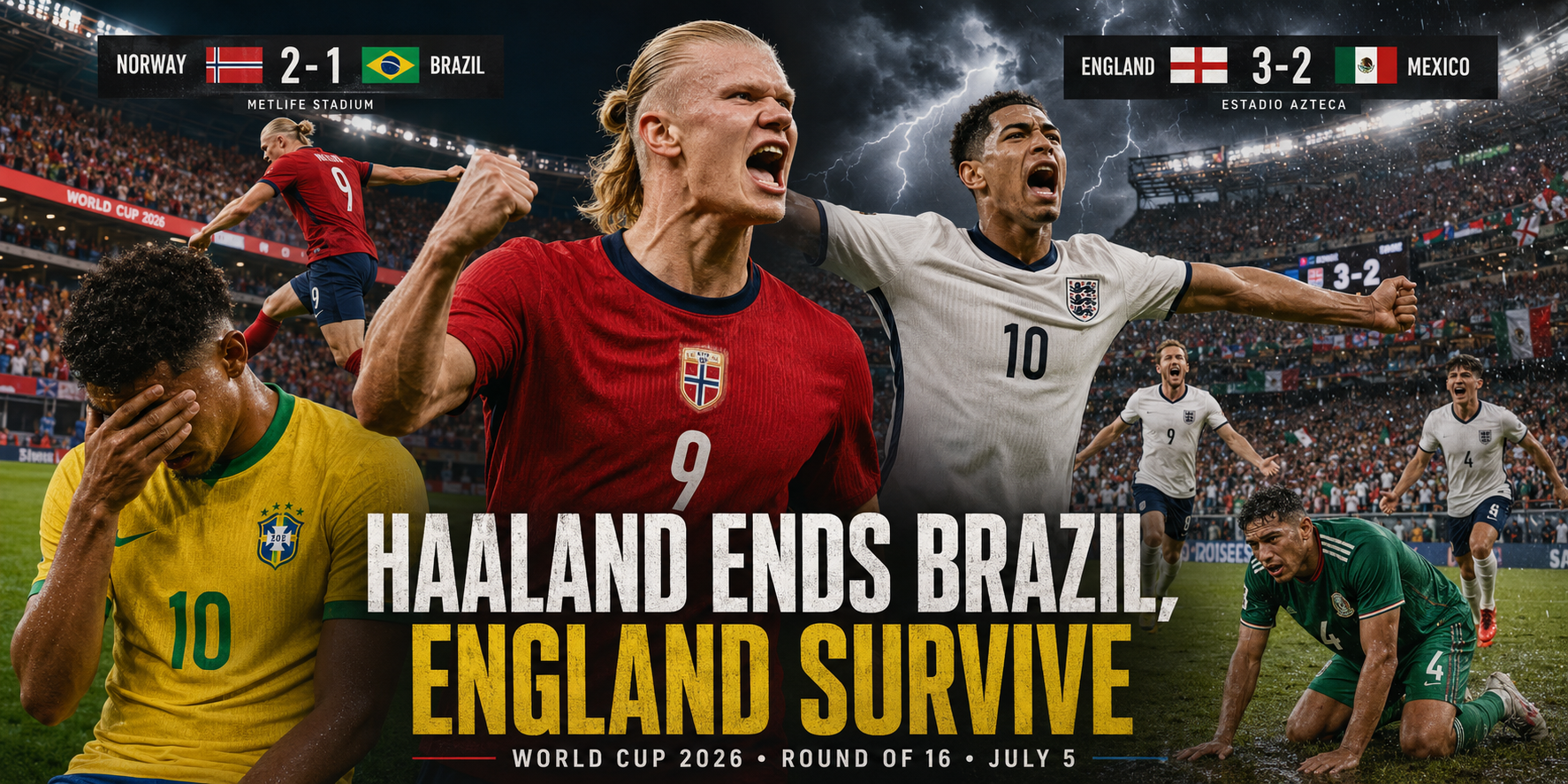
Haaland’s Late Double Ends Brazil’s Dream, England Survive Azteca Chaos: World Cup Round of 16 Delivers a Night Nobody Will Forget
There’s a specific kind of silence that falls over a stadium when a five-time champion realizes the clock isn’t going to save them. It happened at MetLife Stadium a little after 9pm Eastern, when Erling Haaland — who had spent 78 minutes being shoved, doubled up on, and mostly starved of service — found half a yard he didn’t need twice. Brazil fans who’d sung through injury time suddenly had nothing left to sing.
Three hours south and one time zone removed, a different kind of chaos was unfolding at a stadium that has intimidated visiting teams for seventy years. Estadio Azteca had spent the night before rattling with drums, air horns, and fireworks aimed squarely at a hotel full of England players trying to sleep. By the time thunderclouds rolled over Mexico City and forced FIFA to push kickoff back an hour, it already felt like a match daring itself to be dramatic. It obliged.
By the time both final whistles blew, two of the tournament’s most storied programs — a five-time world champion and a co-host playing in front of its own delirious public — were on flights home earlier than anyone in Rio or Mexico City wanted to imagine in June. In their place stand a Norwegian team that hadn’t sniffed a World Cup in nearly three decades and an England side that just became the first in history to beat Mexico at the Azteca, doing it with ten men for the better part of an hour.
This is the version of the World Cup that makes neutrals fall in love and partisans lose their voices — two matches, four goals in the final quarter-hour combined, two red-hot managerial pressers, a diplomatic phone call that somehow ended up deciding who plays up front for the USA, and a bracket that looks nothing like it did twelve hours ago. Sunday, July 5 was Round of 16 at its most unforgiving.
Erling Haaland’s stoppage-time-adjacent brace sent Brazil out of the World Cup in the last 16 for the first time since 1990, while ten-man England toppled Mexico 3-2 at a raucous, storm-delayed Azteca to set up a heavyweight quarterfinal against Norway in Miami.
At a glance
MetLife Stadium, East Rutherford, NJ
Erling Haaland scored twice in the final 11 minutes; Neymar’s stoppage-time penalty arrived too late. Norway reach their first World Cup quarterfinal in program history.
Estadio Azteca, Mexico City (kickoff delayed an hour by thunderstorms)
Jude Bellingham scored twice in 98 seconds and Harry Kane converted a penalty as England survived Jarell Quansah’s red card and a furious Mexico fightback to become the first team ever to beat El Tri at the Azteca.
The Main Story Of The Day
The headline is Haaland, but the story underneath it is Brazil’s uncomfortable pattern repeating itself. This is the sixth straight World Cup in which a European team has ended Brazil’s tournament, and the earliest Brazilian exit since they lost to Argentina in the same round back in 1990. Carlo Ancelotti was brought in specifically to break that cycle, and for 78 minutes his team did most of what was asked — Bruno Guimarães missed a penalty, but Brazil created the better chances, tested Ørjan Nyland repeatedly, and looked the likelier winners. Then Norway did what dangerous counterattacking teams do: they waited, absorbed, and struck through the two players good enough to make a single half-chance count. Andreas Schjelderup’s cross and Haaland’s header in the 79th minute changed the tenor of the entire match; his low finish from the edge of the box eleven minutes later changed the tournament.
What fans will be arguing about into Monday isn’t really the result — Norway deserved it on chances created in the moments that mattered — it’s Ancelotti’s post-match insistence that this is a “new adventure” rather than an ending, and his blunt admission that Brazil’s midfield needs an overhaul. When a manager starts talking about generational transition minutes after elimination, supporters hear it as confirmation that the problems run deeper than one bad penalty and one big striker.
Meanwhile in Mexico City, the story is about who blinked first in a week-long game of psychological warfare. Mexican fans turned the streets around England’s team hotel into a percussion section until 2am, FIFA flirted with moving kickoff to noon to dodge a forecasted storm before backing off, and then the storm showed up anyway, delaying the biggest match of Mexico’s summer by a full hour while 87,000-plus fans sheltered under the Azteca’s roof. None of it mattered. England, ice-cold in the only ways that counted, scored twice in under two minutes through Bellingham and then held on with ten men against the loudest crowd in international football. That combination — bottling the atmosphere, absorbing a red card, and still winning at altitude in a building where Mexico had never lost to England — is the kind of result that changes how a team is perceived for years, not just one summer.
Match-By-Match Recap
Brazil 1-2 Norway — Round of 16, MetLife Stadium
Norway’s first World Cup quarterfinal in the country’s history came against a Brazil side that, for long stretches, played like the better team without ever finding the finish to prove it. Bruno Guimarães had a golden chance to open the scoring from the penalty spot in the first half after Kristoffer Ajer clattered into Matheus Cunha — VAR overturned an initial no-call — but Nyland guessed correctly and pushed it away, the first of several outstanding saves. He denied Gabriel Martinelli at point-blank range, got a foot to Vinícius Júnior after Martin Ødegaard lost the ball dangerously in his own half, and later produced a fingertip stop to prevent an Ajer own goal. The tactical turning point arrived at halftime, when Norway coach Ståle Solbakken swapped in Oscar Bobb and Schjelderup for Antonio Nusa and Alexander Sørloth — a change that directly produced the game’s opening goal when Schjelderup both created and finished, whipping in the cross for Haaland’s header before scoring the eventual difference-maker himself in the buildup sequence. The biggest missed chance belonged to teenage substitute Endrick, sent clean through by a delightful Vinícius outside-of-the-foot pass, only to dink his effort wide with Nyland closing him down. The emotional high point was Neymar’s introduction in the 67th minute, which drew a roar from the pro-Brazil crowd that briefly made it feel like 2002 again — and his stoppage-time penalty, won after a foul on Casemiro, was a fittingly dramatic final note, but arrived four minutes and one Haaland strike too late. For Norway, this validates years of individual talent — Haaland, Ødegaard, Sørloth — finally clicking as a collective on the biggest stage. For Brazil, it’s the second straight cycle ending in an ugly mirror: talented individually, undone by a midfield that couldn’t control a game it mostly dominated territorially.
Mexico 2-3 England — Round of 16, Estadio Azteca
Delayed by an hour and soaked in pre-match psychological warfare, this one still managed to exceed the hype. England’s tactical masterstroke was pace on the counter through Bukayo Saka and quick combination play down the right — Saka’s looping cross found Bellingham for the opener in the 36th minute, and the England midfielder doubled the lead just 98 seconds later by turning in a Kane pull-back. Julián Quiñones halved the arrears for Mexico before halftime, setting up a second half that England had to survive rather than control. The defining moment came in the 54th minute: with England leading 2-1, Jarell Quansah was shown a straight red card after a VAR review of a challenge on Jesús Gallardo, becoming only the fourth England player ever dismissed at a World Cup and the first since Wayne Rooney in 2006. Thomas Tuchel’s response — sacrificing Saka for the defensive reinforcement of John Stones — was the tactical pivot that shaped the remaining 40-plus minutes, with England defending in two banks of four and five and daring Mexico to break them down. Kane’s penalty, won when Anthony Gordon was fouled, made it 3-1 shortly after the sending-off, before Raúl Jiménez’s spot kick pulled Mexico back within one. The biggest missed chance belonged to Mexico in stoppage time, unable to find the finish that would have forced extra time against a visibly exhausted ten men. The emotional gut-punch was reserved for the final whistle: Javier Aguirre, in what may have been his last match in charge before handing over to assistant Rafael Márquez, embracing his players in front of a stunned Azteca that has now, for the first time in its history, watched Mexico lose to England on home turf.
Best Moments Of The Day
-
Haaland’s 90th-minute dagger — a low, driven finish from the edge of the box that ended any hope of a Brazilian rescue act and confirmed Norway’s first-ever World Cup quarterfinal.
-
Bellingham’s 98-second double — English ruthlessness distilled into under two minutes, the kind of spell that decides knockout football.
-
Nyland’s penalty save on Guimarães — a full-stretch dive to his left that kept Norway in a game Brazil were dominating.
-
Schjelderup’s headed assist-then-goal combo — a half-time substitute directly authoring both of his team’s goals.
-
Neymar’s stoppage-time penalty — too little, too late, but a properly emotional final image of Brazil’s tournament.
-
England surviving ten-v-eleven at altitude — a defensive effort that will get remembered longer than most winning performances.
-
Endrick’s outside-of-the-foot assist setup from Vinícius — even in defeat, a moment of pure skill that lit up the broadcast.
-
The Azteca crowd noise through the delay — 87,000-plus fans staying largely put through an hour-long weather postponement, refusing to let the occasion shrink.
The Drama Section
Two red-card storylines dominated the day, and they couldn’t have looked more different. Jarell Quansah’s dismissal was confirmed only after a lengthy VAR review of his challenge on Gallardo — a decision England’s staff will feel harshly cost them numerical parity for the rest of the match, even in victory. Thomas Tuchel didn’t hide his frustration afterward, arguing that refereeing standards across the tournament haven’t matched the occasion.
That frustration connected directly to the day’s other major controversy, even though it involved a different team entirely: FIFA’s decision to suspend Folarin Balogun’s one-match ban following a phone call from President Trump to FIFA president Gianni Infantino, clearing the USMNT striker to face Belgium on Monday. It’s believed to be the first time since 1962 a player has been allowed to feature in a World Cup match immediately after picking up a red card the game before. Belgium boss Rudi Garcia has objected loudly to both the substance of the decision and the short notice it gave his preparation, while USMNT winger Christian Pulisic maintains the original red card was excessive in the first place. Tuchel, asked whether Harry Kane might similarly lobby for Quansah’s ban to be lifted, answered with dry sarcasm rather than outrage — but the underlying point was serious: fans and coaches alike are uneasy about the precedent of political intervention reshaping a refereeing outcome mid-tournament.
Add in the weather delay in Mexico City — FIFA reportedly considered moving kickoff up to noon earlier in the week before sticking with the evening slot, only for the storm to force a different disruption anyway — and the fan noise campaign outside England’s hotel, and July 5 offered a full buffet of off-the-pitch talking points to go with two properly dramatic finishes.
The Emotional Temperature
Joy
Norwegian and English supporters, both watching programs reach territory that felt improbable a few years ago.
Relief
England’s traveling support, who watched their team hold a one-goal cushion for the better part of an hour with ten men in one of football’s most hostile away environments.
Frustration
Brazilian fans questioning penalty selection and game management in the final 15 minutes; Belgian supporters furious at a suspension decision that landed on their opponent hours before kickoff.
Fear
Mexican fans in the stadium’s closing stages, sensing a historic upset slipping away as Jiménez’s penalty briefly reopened the door.
Hope
USMNT fans, buoyed by Balogun’s reinstatement and eager to see whether a Group D winner can finally take down a Golden Generation Belgium side.
Players Who Owned The Day
Erling Haaland
Two goals in 11 second-half minutes, taking him to seven for the tournament and level with Lionel Messi atop the Golden Boot race. This was the performance that turns very good strikers into World Cup legends.
Jude Bellingham
A goal in the 36th minute and another 98 seconds later, the kind of individual burst that swings knockout games before opponents can respond.
Ørjan Nyland
A penalty save on Bruno Guimarães plus multiple point-blank stops kept Brazil at bay long enough for Norway’s attack to find its moment.
Andreas Schjelderup
Introduced at halftime, he created Haaland’s opener with a whipped cross and was directly involved in the sequence for the second — a substitution that decided a World Cup match.
Harry Kane
A calmly taken penalty restored England’s cushion at the moment Mexico’s momentum was building, and his pass created Bellingham’s second goal.
Jarell Quansah
Not for the football alone: his red card forced Tuchel into a defensive reshuffle that England somehow rode all the way to victory, turning a potential collapse into a statement of resilience.
Julián Quiñones
His goal kept Mexico’s comeback hopes alive through the second half and gave the Azteca crowd reason to believe until the final whistle.
Neymar
A stoppage-time penalty converted with the tournament already essentially over — a small personal moment of pride inside a collective disappointment.
Teams Rising And Falling
Stock Rising
- Norway, who have gone from perennial nearly-men to first-time World Cup quarterfinalists on the strength of a defense that bends without breaking and a front line capable of settling any game in a five-minute burst.
- England, too, rise after proving they can win ugly, short-handed, and away from home in conditions engineered specifically to unsettle them.
Stock Falling
- Brazil, eliminated in the round of 16 for the first time since 1990 and facing public questions about squad rebuilding under Ancelotti.
- Mexico fall as well — not for lack of effort or atmosphere, but because a golden opportunity to finally beat a European heavyweight at home slipped away in the same building where they’ve never lost to England, until now.
Tactical Notes For Serious Fans
Norway’s halftime double substitution is a case study in proactive game management — Solbakken didn’t wait for his side to be behind before changing shape, and both introduced players had a direct hand in the winning sequence. England’s response to going down to ten men — sacrificing a forward for a fourth defender rather than simply dropping deeper with the same personnel — reflects a modern trend of using specific defensive substitutes rather than pure tactical retreat. Brazil’s insistence on Guimarães as their penalty taker, defended afterward by Ancelotti on statistical grounds, is worth revisiting given how costly the miss proved; expect more scrutiny of data-driven penalty selection versus in-game instinct. Mexico’s higher pressing line in the final 20 minutes created chances but also left the space in behind that England’s counters continually threatened, a tension host nations at altitude will need to manage carefully in future rounds.
Fan Sentiment Pulse
Norwegian social channels lit up almost instantly after Haaland’s second goal, with a noticeable shift from cautious optimism to full belief once the final whistle confirmed a first-ever quarterfinal. English fan sentiment split along familiar lines — pride in the resilience, paired with real anger at the Quansah decision and pointed questions about disciplinary consistency across the tournament. Brazilian supporters, watched closely by broadcasters given Ancelotti’s high-profile appointment, expressed disappointment rather than fury — the sense being that Norway deserved it more than Brazil failed to deserve it. In Mexico City, the mood outside the Azteca after the final whistle was described as heartbroken but proud, with Aguirre’s likely farewell adding a layer of sentimentality to the sporting disappointment. Neutrals overwhelmingly pointed to the Bellingham double and Haaland’s brace as the day’s signature moments, while the Balogun suspension saga dominated conversation among fans with no direct stake in either evening kickoff — a reminder that the loudest story of a World Cup day doesn’t always come from the pitch.
Qualification Picture
Two quarterfinal spots were confirmed Sunday: Norway, who will face the Mexico-England winner — now confirmed as England — on July 11 in Miami, in what shapes up as one of the must-watch ties of the round. That pairing joins France, who edged a combative Paraguay in Friday’s action, and Morocco, who eliminated co-host Canada, in a quarterfinal on July 9 already being framed as a tactical heavyweight clash. Four Round of 16 spots remain to be settled: Portugal face Spain and the USA face Belgium on Monday, July 6, with Argentina-Egypt and Switzerland-Colombia completing the round on Tuesday, July 7. Brazil and Mexico join Canada and Paraguay among the tournament’s most disappointing exits relative to expectation, while Norway and England have both offered statement performances that suggest neither should be treated as underdogs going forward.
- Portugal vs. Spain
- USA vs. Belgium
Portugal vs. Spain is the marquee tie of the day — Spain have not conceded a single goal through four matches and are averaging two goals a game, while Portugal have grinded through a bumpier road, needing stoppage time to see off Croatia in the previous round.
Cristiano Ronaldo, who finally broke his knockout-stage scoring drought via penalty last time out and will need a career-defining performance to give Portugal a route past the tournament’s stingiest defense.
Belgium, who arrive already frustrated by the Balogun suspension reversal and now have to solve a USMNT side with home advantage and a full-strength attack after Pochettino’s group-topping campaign.
Can Portugal find a way to disrupt Spain’s rhythm rather than simply absorb it, given that sitting deep hasn’t worked for anyone Spain has faced so far?
USA over Belgium isn’t really an upset on paper anymore given the hosts’ form, but doing it against a De Bruyne-Doku-Trossard front line without shipping a late sucker-punch would be the biggest USMNT knockout-stage result in a generation.
Seattle’s Lumen Field has been one of this tournament’s loudest venues for USMNT games, and a home Round of 16 winner-takes-all tie should push that even further; expect a very different sonic experience than the Azteca’s percussion assault, but no less intense.
Fanorate Final Whistle
Today taught us that the World Cup doesn’t wait for anyone’s script — not five-time champions, not co-hosts with 87,000 fans on their side, not even a striker’s suspension when a phone call can apparently rewrite it. The defining emotion of July 5 is whiplash: joy and heartbreak separated by minutes rather than matches, on both sides of the bracket. The question heading into Monday is simple — can Spain’s perfect defensive record survive Ronaldo’s biggest stage, and can the USMNT turn a controversial reprieve into the signature knockout win this program has been chasing for decades? Two matches in, four spots settled, four still up for grabs. Keep watching — this bracket is only getting meaner.
Fanorate is an AI-assisted editorial project from the team at Brillmark. Our match analysis, tactical notes, and recaps are researched and written with AI tools under human editorial direction — we don’t have reporters pitchside, and we’re upfront about that. We’re building Fanorate as much to explore what AI-assisted sports journalism can responsibly look like as we are to cover the tournament itself.
