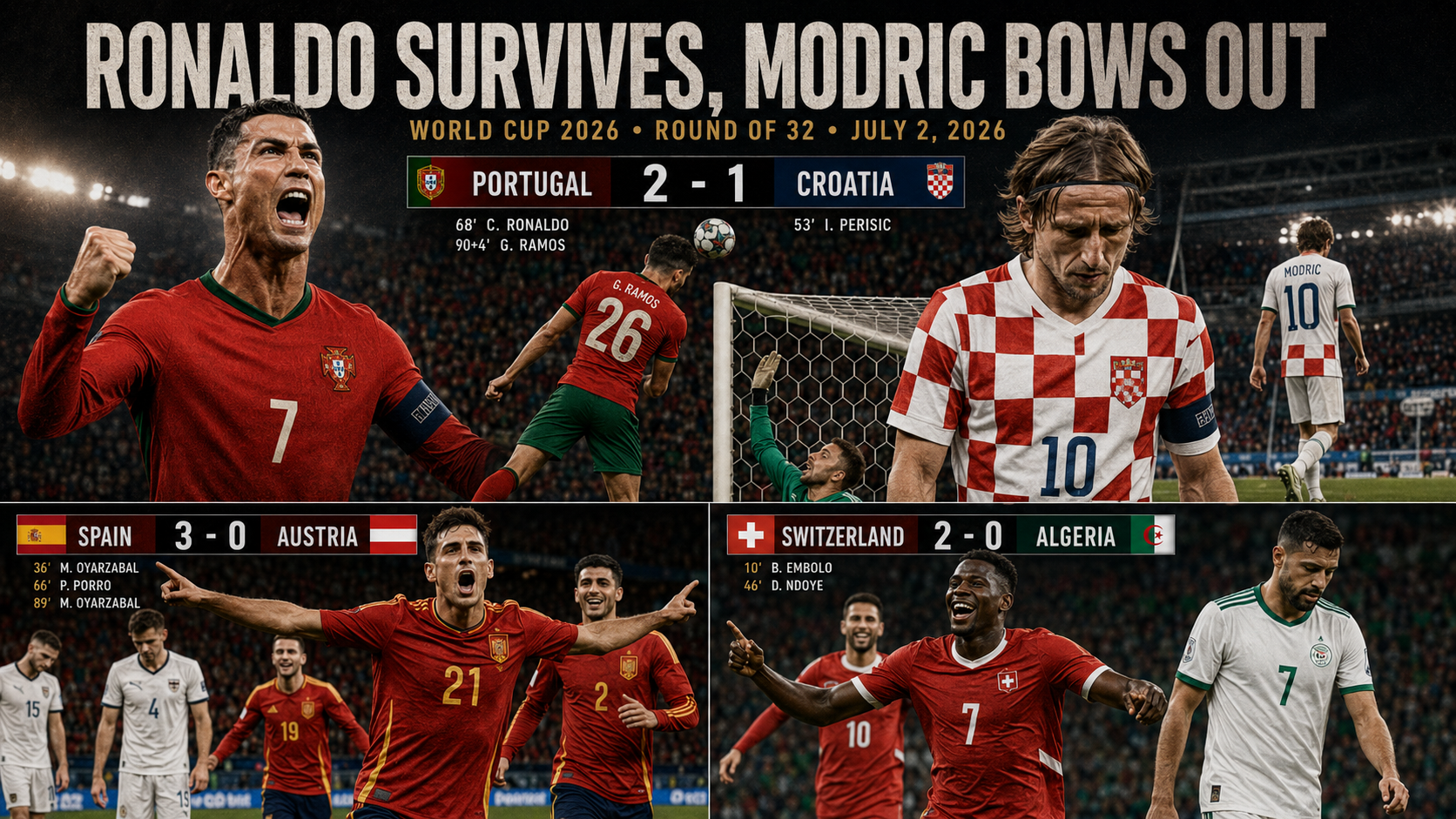
Ronaldo Survives, Modrić Bows Out, and the World Cup Just Ran Out of Mercy
There’s a specific kind of quiet that falls over a World Cup once the group stage ends. No more second chances. No more “we’ll get them next game.” Thursday in Toronto, that quiet had a face, and it belonged to a 40-year-old Croatian midfielder standing near the center circle after the final whistle, applauding a crowd that wasn’t entirely his.
Luka Modrić has been telling interviewers for two years that he takes tournaments one game at a time, and for two years everyone half-believed him. On Thursday night the game ran out. Not because Croatia played badly — they didn’t — but because a 41-year-old across the pitch from him has apparently decided that this specific World Cup, his sixth, is not going to end quietly either. Cristiano Ronaldo scored the penalty that kept his own tournament alive in the 68th minute, and twenty-six-year-old Gonçalo Ramos buried the header that ended Modrić’s in the fourth minute of stoppage time. Football does not care about symmetry. It handed us both storylines in the same ninety-four minutes and let us sort out our feelings afterward.
That was the emotional main event. It was not, technically, the biggest result of the day. Spain spent an evening in Inglewood reminding everyone why they’re the favorites nobody wants to face, dismantling Austria with the kind of calm ruthlessness that makes broadcasters start talking about trophies in June. And up in Vancouver, Switzerland did something more improbable than either: they won a World Cup knockout match for the first time since 1938, a wait so long that the last team to do it for them didn’t have substitutes.
Three matches. Three different flavors of statement. By the time the lights went down on BC Place, the World Cup’s bracket had lost three teams and gained three ghosts that will follow their conquerors for the next round — Austria’s flat attack, Croatia’s fury at a video screen, Algeria’s brief flicker of hope in the first ten minutes before Switzerland simply took the game away from them.
Spain cruised, Portugal survived a VAR storm and a Modrić farewell to edge Croatia, and Switzerland finally broke an 88-year knockout curse — and all three winners now know exactly who’s waiting for them in the Round of 16.
At a glance
SoFi Stadium, Inglewood, California
Mikel Oyarzabal scored twice either side of a Pedro Porro strike; Austria never had a shot on target. Meaning: Spain look like the tournament’s most complete team right now, and they’ll face Portugal for a quarterfinal spot.
BMO Field, Toronto
Ivan Perišić’s second-half strike had Croatia dreaming until Ronaldo’s 68th-minute penalty and Ramos’s stoppage-time header turned the match on its head. Meaning: Ronaldo’s tournament survives; Modrić’s, in all likelihood, does not.
BC Place, Vancouver
Breel Embolo in the 10th minute and Dan Ndoye 48 seconds into the second half did the damage. Meaning: the Swiss end an 88-year wait for a World Cup knockout win and now await the Colombia-Ghana survivor.
The Main Story of the Day
Everything else on Thursday will get talked about, but Toronto is where the tournament earned its headline. Portugal versus Croatia had been sold for a week as Ronaldo versus Modrić, one last time, and for long stretches it looked like the kind of tactical stalemate that makes those narratives feel manufactured — a goalless first half in which Portugal held the ball and generated almost nothing sharp, and Croatia sat patient and compact, waiting.
Then Perišić got Croatia in front with a low finish across goal in the 53rd minute, and for fifteen minutes Toronto believed. Ronaldo’s response wasn’t pretty — it came from the penalty spot after Nikola Vlašić dragged down Renato Veiga in the box — but it counted exactly the same as a wonder strike, and by the time the board went up for stoppage time, this match had already delivered more tension than the other two combined.
What fans will be arguing about tomorrow isn’t the goals, though. It’s the VAR review that came moments after Ronaldo’s equalizer, when Croatia thought they’d retaken the lead through Jošku Gvardiol, only for the goal to be chalked off because Igor Matanović was ruled to have gotten the faintest touch on a Perišić cross, putting Mario Pašalić offside. It was the kind of call that requires four camera angles and a physics degree to fully explain, and Croatia manager Zlatko Dalić didn’t wait for the explanation — he said afterward that the officiating had been poor and that video review “kills emotions, it kills everything within you.” Whether he’s right is a debate Fanorate expects to run through the rest of the knockout rounds; what’s not debatable is that the disallowed goal changed the emotional temperature of the last twenty-five minutes, and Ramos made Croatia pay for however long they spent arguing about it.
Two careers, one match, one review that will get replayed a thousand times before Saturday. That’s the story of the day.
Match-by-Match Recap
Spain 3-0 Austria
Spain didn’t so much win this as administer it. Mikel Oyarzabal opened the scoring in the 36th minute, finishing off a move built down the left through Marc Cucurella, and by the time he added his second in the 89th — same combination, same side, almost the same finish — the only real question left was how many Spain would end up with. Pedro Porro’s 66th-minute strike, teed up by substitute-turned-creator Álex Baena, was the goal that actually killed the contest as a spectacle; everything after was Spain politely declining to embarrass their opponents further.
- Tactical turning point
- Spain’s decision to keep loading the left channel with Cucurella and Baena rather than spreading possession evenly. Austria never solved it, conceding from the same side twice.
- Key player
- Oyarzabal, whose brace makes him the early frontrunner for this tournament’s most efficient forward — quiet for long stretches, ruthless in the moments that mattered.
- Biggest missed chance
- Austria’s best look came just past the half-hour when Michael Gregoritsch got in behind but rushed his first touch under pressure from Spain’s high line — the kind of chance a knockout side needs to bury and didn’t.
- Emotional moment
- Austria’s bench emptying three substitutes inside a ten-minute window after Porro’s goal, a visible white flag from a coaching staff that knew the scoreline had already told the story.
- What it means
- Spain advance with a plus-three goal difference and zero shots conceded on target — genuinely frightening form heading into a mouth-watering Round of 16 date with Portugal. Austria go home having reached the knockout stage for the first time in over a decade, which is its own quiet success even if Thursday stung.
Portugal 2-1 Croatia
Covered in depth above, but worth restating: this was the match of the day by feel even if not by scoreline gap. A cagey, goalless first half gave way to a frantic second in which Croatia led, lost the lead to a penalty, appeared to retake it before VAR intervened, and then lost the match entirely in the fourth minute of stoppage time to a Rafael Leão cross and a Gonçalo Ramos header.
- Tactical turning point
- Portugal’s switch to a more direct approach after falling behind, funneling crosses toward Ramos and Leão rather than continuing to probe through midfield — it took forty minutes to pay off, but it paid off.
- Key player
- Ramos, whose stoppage-time header will be the moment fans remember, though Ronaldo’s ice-cold penalty under maximum pressure deserves equal billing.
- Biggest missed chance
- The disallowed Gvardiol goal isn’t technically a “missed chance” in the conventional sense, but it will feel like the biggest one Croatia had all night by the time they watch it back.
- Emotional moment
- Modrić being substituted in the closing minutes to a standing ovation from both sets of fans, a rare moment of the crowd setting aside the scoreline to acknowledge what they were watching leave the stage.
- What it means
- Portugal now face Spain in Dallas on July 6 in what’s shaping up as the most anticipated Round of 16 tie on the board. Croatia’s golden generation, built around Modrić since 2018, exits a World Cup for the first time without reaching a semifinal since he became their totem — a genuinely emotional marker for a country that punches enormously above its weight.
Switzerland 2-0 Algeria
The quietest story of the day by narrative volume, and maybe the most historically significant. Switzerland hadn’t won a World Cup knockout match since 1938 — 88 years, a gap so large it predates penalty shootouts, substitutions, and the back-pass rule. They ended it by doing something almost unfair to Algeria: scoring early through Breel Embolo in the 10th minute, then killing the game 48 seconds after the second-half restart through Dan Ndoye, before Algeria’s legs had even settled back into their positions.
- Tactical turning point
- Switzerland’s press immediately after halftime. Algeria conceded the second goal without a single settled defensive action in the second period — a brutal, avoidable way to lose control of a match.
- Key player
- Johan Manzambi, whose driving run and cutback set up Embolo’s opener, was arguably the most influential player on the pitch even though his name isn’t on the scoresheet.
- Biggest missed chance
- Riyad Mahrez had Algeria’s best sight of goal in the first quarter-hour, cutting inside from the right before firing over — the kind of finish he’s scored a hundred times in his career, just not on this night.
- Emotional moment
- Mahrez, in his first-ever World Cup knockout appearance at 35 years old after missing the 2018 and 2022 tournaments through squad omissions, walking off to warm applause from neutral fans who understood exactly what this stage meant to him personally, regardless of the result.
- What it means
- Switzerland advance with real momentum and a favorable-looking path, waiting to learn whether Colombia or Ghana awaits them in Vancouver next week. Algeria leave with pride largely intact after a group stage that included a wild 3-3 draw with Austria, but the manner of the second-half collapse will sting in review.
Best Moments of the Day
-
Gonçalo Ramos’s stoppage-time header — the single biggest moment of the day, delivered at the exact instant Croatia thought they’d survive.
-
Ronaldo’s penalty under pressure — cool, mechanical, exactly what you’d expect from someone who has taken this walk a hundred times before.
-
Dan Ndoye’s 48-second restart goal — one of the fastest, most brutal second-half openers you’ll see in this tournament.
-
Modrić’s ovation on the touchline — the day’s purest emotional moment, and one that had nothing to do with the scoreboard.
-
Oyarzabal’s matching braces from the same channel — a small tactical joke Austria never got.
-
Mahrez’s first World Cup knockout minutes at 35 — a personal milestone buried inside a team loss.
-
Manzambi’s driving run for Switzerland’s opener — the kind of play that gets a player noticed by clubs watching from Europe.
-
Austria’s early substitutions — not a highlight in the traditional sense, but a rare, honest in-game concession that told you everything about the mood on their bench.
The Drama Section
The VAR review in Toronto is going to dominate radio call-in shows for the next twenty-four hours, and fairly so. The technology ruled Igor Matanović offside by a margin invisible to the naked eye on a touch that determined whether Croatia briefly retook the lead. Reasonable people can watch the replay and land in different places — that’s exactly why Dalić’s postgame comment about VAR “killing emotions” will resonate with a chunk of the fanbase even if the letter of the rule was applied correctly. Fanorate’s position: the call appears defensible on the rulebook, but the sport still hasn’t solved the problem of a marginal offside decision landing with the emotional weight of a red card, and that tension isn’t going away.
No red cards fell across any of the three matches — a relatively tame disciplinary day by knockout-stage standards, with Austria’s Stefan Pösch picking up the only notable booking, an 83rd-minute yellow that changed nothing about the outcome. No confirmed injury news emerged from any of the three matches severe enough to threaten a Round of 16 absence, which counts as a genuine relief given how physical the knockout rounds tend to get.
The Emotional Temperature
Joy
Spain’s traveling support, who watched their team concede zero shots on target in a knockout match and are allowed, for one night, to start thinking bigger than the Round of 16.
Relief
Portugal, and specifically anyone who has watched Ronaldo carry the weight of “last World Cup” narratives since 2022 — he delivered when it mattered, and the tournament goes on for him.
Frustration
Croatia, understandably, over the disallowed goal, and Algeria over a second half they simply didn’t show up for.
Fear
Whoever draws Spain next. That’s not hyperbole; a team with this attacking output and zero shots conceded on target is the most dangerous kind of opponent — the one playing with margin.
Hope
Switzerland, who now have real belief that 88 years of knockout futility can end with something bigger than a Round of 16 exit, and Mahrez personally, whose long-delayed World Cup knockout debut, even in defeat, felt like a story worth celebrating on its own terms.
Players Who Owned the Day
Mikel Oyarzabal
Two goals, two identical build-ups down the left, zero fuss. His movement in behind Austria’s backline was the difference between a comfortable win and a rout, and he’s quietly building a case as the tournament’s most clinical striker so far.
Cristiano Ronaldo
One penalty, buried without hesitation in the biggest moment of his night. At 41, in what’s almost certainly his final World Cup, he’s still the player Portugal hands the ball to when the stakes are highest.
Gonçalo Ramos
The stoppage-time header that actually won the match. Ramos has now scored in a knockout game against a genuine contender, the kind of moment that follows a young forward’s reputation for years.
Breel Embolo
An early goal that set the tone for Switzerland’s entire performance, finishing calmly from a tight angle inside the box.
Dan Ndoye
48 seconds into the second half is about as fast as a knockout-deciding goal gets. Ndoye turned a nervy 1-0 into a comfortable 2-0 almost before Algeria’s players had found their positions.
Pedro Porro
A goal from a right-back in a knockout match is never just a stat line; it’s a sign of a team so dominant that its full-backs are getting into the box unmarked.
Luka Modrić
No goal, no assist, and quite possibly the final World Cup appearance of a genuinely generational midfielder. Some performances get remembered for what happened around them rather than in the box score, and this is one of them.
Riyad Mahrez
A missed early chance that will nag at him, but his mere presence on a World Cup knockout pitch at 35, after two tournaments watching from home, is a storyline in its own right.
Teams Rising and Falling
Stock Rising
- Spain look like the team to beat right now — attacking fluency, defensive solidity, and a bench deep enough to make late substitutions look like reinforcements rather than concessions.
- Portugal rise too, not because they were dominant, but because they showed they can win ugly, which is a different and arguably more valuable skill in a knockout tournament.
- Switzerland’s stock jumps the furthest in relative terms — nobody outside their own camp expected an 88-year wait to end this cleanly.
Stock Falling
- Croatia’s golden generation, built entirely around Modrić’s influence since 2018, likely closes its World Cup chapter without a deep run to show for this cycle — a genuinely significant moment for Croatian football to reckon with.
- Austria’s tournament ends with questions about their attacking identity after generating almost nothing against a Spain side that, to be fair, would have troubled most teams in the field.
- Algeria leave with sympathy rather than criticism, undone more by a ruthless six-minute spell than by any deeper flaw.
Tactical Notes for Serious Fans
Spain’s insistence on repeatedly attacking through the same left-sided combination — Cucurella overlapping, Baena underlapping — wasn’t subtle, and Austria never adjusted their defensive shape to account for it. That’s a coaching failure as much as a personnel one, and expect Portugal to specifically prepare for it on July 6.
Portugal’s shift from patient possession to direct crossing after conceding is a pattern worth tracking. Manager sides that can flip approaches mid-match, rather than doggedly sticking to a gameplan that isn’t working, tend to go further in knockout football — and Portugal just proved they have that switch available.
Switzerland’s immediate second-half press is a tactic increasingly common in this tournament: teams are treating the moments right after the restart as a soft spot in opposition concentration, and Ndoye’s 48-second goal is the most extreme example yet of that theory paying off.
Croatia’s compact mid-block for the first fifty minutes worked almost perfectly — the issue wasn’t the setup, it was game management once they took the lead, when a team with Modrić’s experience will want to see more control of tempo rather than the back-and-forth stretch that ultimately let Portugal in.
Fan Sentiment Pulse
Spanish social channels spent Thursday night in celebration mode, but a specific strand of commentary has already started building: is this Spain squad good enough to go all the way, or will the football world once again wait for them to hit a wall against a heavyweight? Portuguese fans are split between pure relief and lingering nerves about a defense that struggled to contain Croatia for large stretches. Croatian supporters are, understandably, the most emotionally raw fanbase tonight — genuine grief over Modrić mixed with real anger at the officiating, a combination that tends to produce the loudest online reaction of any result on the board. Swiss fans, by contrast, are simply having fun; 88 years is long enough that nobody in that fanbase expected to be celebrating a knockout win in their lifetime, and it shows. Neutral fans across North America seem to have landed on the Modrić ovation as the moment of the night — the kind of clip that travels well beyond football circles. Host-city atmosphere in Toronto was reportedly the loudest of the three venues, unsurprising given the storyline on the pitch, while Vancouver’s crowd, further from either nation’s diaspora base, still delivered a strong, neutral-leaning roar for Switzerland’s second goal.
Qualification Picture
With Spain, Portugal, and Switzerland punching their tickets Thursday, thirteen of the sixteen Round of 16 places are now filled, and the bracket’s shape is becoming visible in a way it wasn’t a week ago. Spain-Portugal is locked in for July 6 in Dallas — arguably the single most attractive tie the Round of 16 could have produced. Switzerland now knows it will face the winner of Friday’s Colombia-Ghana match in Vancouver. The final three Round of 16 slots come down to Friday’s closing trio of Round of 32 fixtures: Australia versus Egypt, Argentina versus Cape Verde, and Colombia versus Ghana. Whoever survives those three matches completes the bracket, and two of Friday’s winners — the Argentina/Cape Verde survivor and the Australia/Egypt survivor — are already locked into a meeting in Atlanta on July 7.
Friday, July 3
- Australia vs. Egypt
- Argentina vs. Cape Verde
- Colombia vs. Ghana
Argentina vs. Cape Verde. It’s not close on paper, but paper hasn’t mattered much for Cape Verde all tournament — the smallest nation by population ever to reach a World Cup knockout stage went through the group phase unbeaten, drawing with Spain and Uruguay along the way. Facing Messi in Miami, in front of a stadium that will likely be split far more evenly than the world rankings suggest, is the biggest stage this program has ever seen.
Lionel Messi, who leads the tournament with six goals — a hat-trick against Algeria, a brace against Austria, and a strike against Jordan — and is one big Friday performance away from cementing this as one of the great individual World Cup runs at age 39.
Egypt, who are already dealing with uncertainty over Mohamed Salah’s fitness after a hamstring strain forced his withdrawal against Iran. He’s expected to be available, but whether he starts or comes off the bench could define Egypt’s first-ever World Cup knockout match.
Can Colombia’s James Rodríguez, at 34 the conductor of a team relying heavily on his vision, control tempo against a Ghana side that lost its final group match but has shown real defensive organization when set up to absorb pressure?
Cape Verde over Argentina remains the headline possibility, but don’t sleep on Ghana finding a way past a Colombia team that drew its own final group match — knockout football has a way of punishing complacency.
Miami’s Hard Rock Stadium, where Cape Verde’s diaspora community has already turned group-stage matches into carnival scenes, and where Friday night could produce the loudest neutral-leaning crowd of the tournament so far.
Fanorate Final Whistle
Thursday taught us that this World Cup has stopped being polite. Draws are gone, careers are ending in real time, and video review is now as much a part of the emotional experience as the goals themselves. The defining emotion of the day sits somewhere between awe and grief — awe at Spain’s ease and Switzerland’s history, grief for Croatia and, specifically, for a midfielder who spent nearly two decades making this stage look manageable. The question heading into Friday is simple: does the bracket’s final trio produce another coronation, or does Cape Verde — or Ghana, or Egypt — give us the shock that reminds everyone why the group stage existed in the first place. Either way, keep watching. This tournament just started taking itself seriously.
Fanorate is an AI-assisted editorial project from the team at Brillmark. We use AI research and drafting tools to help us cover the World Cup at the pace fans deserve, with human editorial judgment guiding every published piece. We disclose this openly because we think readers deserve to know how their sports coverage gets made.
