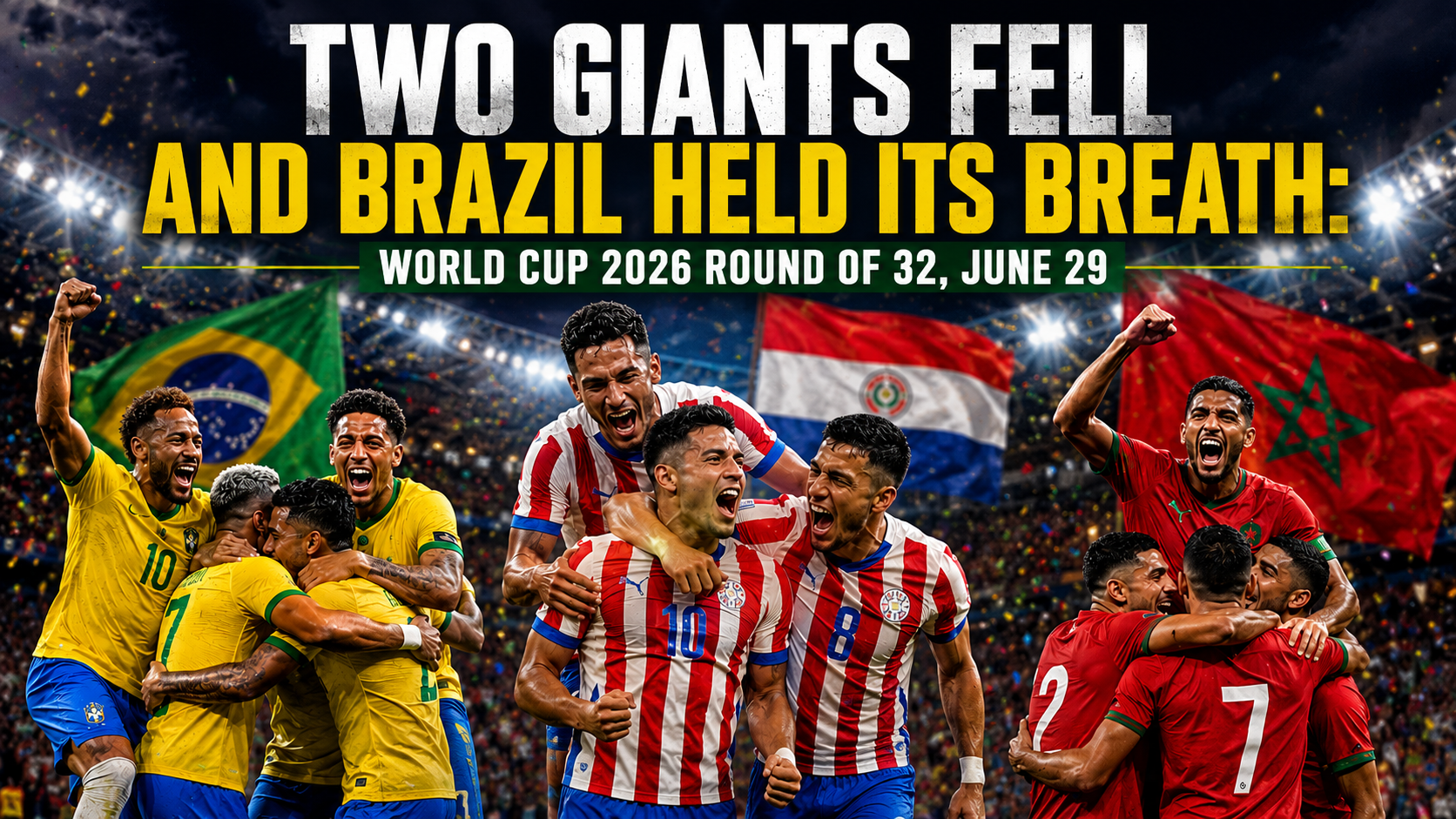
Two Giants Fell and Brazil Held Its Breath: World Cup 2026 Round of 32, June 29
An AI-assisted Fanorate dispatch from a day the bracket cracked open.
There are days at a World Cup that rearrange the furniture. You wake up assuming the room looks one way, and by the time the last whistle goes in Mexico City’s old cathedral of a stadium, the heavyweights are gone and the underdogs are dancing on the sponsor boards.
Monday was one of those days.
Germany are out. The Netherlands are out. Both on penalties, both after leading or level deep into the night, both undone by goalkeepers who decided this was their tournament to steal. And Brazil — five-time champions, the team everyone keeps waiting to either coronate or bury — needed until the 96th minute to avoid joining them on the early flight home. If you went to bed at half-time, you missed a different World Cup than the one that existed by midnight.
This is what the expanded 48-team format promised and rarely delivers in the group stage: a knockout round where the gap between giant and minnow shrinks to the width of a crossbar and the nerve of a man twelve yards out. On June 29, that gap closed completely.
Germany and the Netherlands were eliminated in shootouts on the same night while Brazil escaped Japan with a stoppage-time winner, leaving the Round of 32 littered with fallen favorites.
At a glance
NRG Stadium, Houston
Gabriel Martinelli’s 96th-minute winner rescued a stumbling Brazil after Kaishu Sano had stunned them. Meaning: the favorites survive, but the cracks are showing.
Gillette Stadium, Boston
(4–3 pens) Orlando Gill saved two penalties as Paraguay pulled off one of the great World Cup shocks. Meaning: a four-time champion is gone, and Paraguay believe.
Estadio BBVA, Guadalupe (Monterrey)
(3–2 pens) Issa Diop’s 91st-minute header forced extra time before Yassine Bounou and Ismael Saibari finished the job. Meaning: the 2022 semifinalists prove that run was no fluke.
The main story of the day
For two years the conversation around this World Cup has been about the obvious names. Brazil and Ancelotti. France and their suffocating depth. Spain, fresh and fluid. Germany rebuilding around Florian Wirtz and Jamal Musiala. The Netherlands, semifinalists last time out and quietly fancied by people who watch closely. The bracket was supposed to thin the herd politely, the way these things usually go in the first knockout round.
Instead, two of those names are already packing.
What makes Monday sting for the fallen isn’t that they were outplayed — neither Germany nor the Netherlands was truly second-best over ninety minutes. It’s that both met opponents who refused to accept the script. Paraguay defended like men who’d been told the result didn’t matter and decided to prove everyone wrong out of spite. Morocco did what Morocco now does at World Cups: they hung around, absorbed pressure, and struck at the precise moment a tiring favorite stopped concentrating. Issa Diop’s header arrived in the 91st minute, the cruelest possible time, the moment the Dutch bench had already started to believe.
And then the goalkeepers took over. Orlando Gill for Paraguay, Yassine Bounou for Morocco — two men who turned a coin-flip into a coronation. Penalty shootouts are supposed to be lotteries. On Monday they looked like auditions, and the underdogs aced them.
The thread running through all three matches is nerve. Brazil had just enough of it to survive; Germany and the Netherlands ran out at the worst possible moment. That’s the debate fans will carry into tomorrow: is this the format exposing the gap between elite tournament temperament and elite talent, or is it simply the beautiful chaos of knockout football finally arriving? Either way, the field looks very different than it did at breakfast.
Match-by-match recap
Brazil 2–1 Japan — the great escape in Houston
For an hour, this was a story about Japan refusing to be impressed. Kaishu Sano pounced on a sloppy Brazilian pass in midfield and drilled a right-footed finish from the edge of the area in the 29th minute, and suddenly the most-watched team in the tournament was chasing a game it expected to control. Japan’s pressing was disciplined and brave; Brazil’s buildup was nervy, the kind of performance that gets a coach asked uncomfortable questions. Casemiro changed the temperature. His 56th-minute header, nodded in from a Gabriel Magalhães delivery, was equal parts relief and reminder — the veteran doing veteran things when the side around him looked young and rattled. From there Brazil pushed, Japan dug in, and the match drifted toward extra time with the kind of inevitability that makes neutrals nervous and Brazilians furious. Then the 96th minute. Martinelli, on as a substitute, poked at a loose ball that Zion Suzuki could only palm onto the inside of the post before it trickled over the line. Cruel for Japan, who deserved at least the lottery of penalties. Decisive for Brazil, who advance without convincing anyone.
- Tactical turning point
- Brazil’s switch to a more direct, wide approach after the equalizer, leaning on substitutes to stretch a tiring Japanese back line.
- Key player
- Casemiro — the goal, the leadership, the calm he later credited as the difference.
- Biggest missed chance
- Japan’s failure to add a second when Brazil were at their most disjointed midway through the first half.
- Emotional moment
- Japanese players sinking to the turf at the final whistle, a goal away from extra time and undone in the last act.
- What it means
- Brazil march on to a Round of 16 tie in New Jersey, but with injury worries hanging over Casemiro and Lucas Paquetá, both to be assessed. Japan go home with their heads high and a what-if that will linger.
Paraguay 1–1 Germany (Paraguay win 4–3 on penalties) — the shock in Boston
This is the one they’ll still be talking about in four years. Julio Enciso headed Paraguay in front in the 42nd minute from a Matías Galarza cross, and rather than fold under the weight of German pressure, La Albirroja settled into a defensive performance of genuine quality. Kai Havertz hauled Germany level eight minutes after the break with a glancing header from a Florian Wirtz delivery, and the game became a long, grinding examination of nerve. Germany thought they’d won it when Jonathan Tah forced the ball home from a corner — but VAR intervened, ruling a foul on the Paraguayan goalkeeper, and the goal was wiped away. Extra time settled nothing. And so it came down to the discipline of the spot, where Paraguay had a plan and Germany, it turned out, had a ghost. This was the first penalty shootout Germany had ever lost at a World Cup, a statistic so improbable it tells you everything about what just happened. Orlando Gill became the night. He saved from Havertz, then from Nick Woltemade, and when Tah ballooned his effort over the bar, José Canale stepped up to send Paraguay through and Germany out. Manuel Neuer’s own save kept it agonizingly close, which only made the ending more brutal.
- Tactical turning point
- Paraguay’s decision to sit deep and compress space after going ahead, daring Germany to break them down through the middle — which Germany, for all their possession, never truly did.
- Key player
- Orlando Gill — two saves in the shootout and a goalkeeping display that turned a coin-flip into a heist.
- Biggest missed chance
- Tah’s skied shootout penalty, the final, fatal miss.
- Emotional moment
- Neuer, possibly in his last World Cup act, standing alone as Paraguay’s bench emptied.
- What it means
- Germany, four-time world champions, are eliminated in the Round of 32 — a result that will trigger a reckoning back home. Paraguay are into the last 16 and believing in something bigger.
Morocco 1–1 Netherlands (Morocco win 3–2 on penalties) — déjà vu in Mexico
Cody Gakpo’s 72nd-minute strike looked like it would carry the Netherlands through. For nineteen minutes it did. Then Chemsdine Talbi swung in a long cross, Issa Diop rose above everyone, and his 91st-minute header dragged Morocco back from the edge of elimination and into extra time. If you’ve watched Morocco at recent World Cups, you recognized the pattern immediately — the patience, the late strike, the sense that they’re never quite beaten. Extra time belonged to the goalkeepers. Soufiane Rahimi’s footwork put him clean through in the 97th minute, but Bart Verbruggen somehow got a hand to it. From there the chances dried up, and the night funneled toward penalties — Morocco’s favorite genre. Yassine Bounou, who has built a reputation as a shootout specialist, saved Crysencio Summerville’s attempt, and Ismael Saibari calmly tucked the winner into the low left corner. The Netherlands, semifinalists at the last World Cup, are out in the first knockout round. Morocco, who shared that 2022 final-four stage, march on and announce that their golden generation has plenty left.
- Tactical turning point
- Morocco’s late shift to throwing bodies forward and overloading the back post, which manufactured the Diop equalizer.
- Key player
- Yassine Bounou — the save in the shootout, the calm, the experience.
- Biggest missed chance
- Rahimi’s one-on-one in extra time, denied by Verbruggen.
- Emotional moment
- Saibari wheeling away after the decisive penalty, Morocco’s traveling support in Monterrey erupting.
- What it means
- The Netherlands face hard questions about a generation that keeps falling short of its talent. Morocco prove the 2022 run was a foundation, not a fluke.
Best moments of the day
-
Martinelli’s 96th-minute winner. The single most dramatic instant of the day — the ball off the post, the half-second of doubt, the eruption. A tournament saved from a single poke.
-
Tah’s skied penalty. Heartbreak as theater. The moment a four-time champion’s tournament ended in the worst possible way.
-
Diop’s 91st-minute header. Morocco’s refusal to die, delivered with a header that turned certain elimination into eventual survival.
-
Orlando Gill’s double shootout save. A goalkeeper authoring his own legend in real time.
-
Bounou denying Summerville. Cool, inevitable, the save everyone half-expected and still couldn’t believe.
-
Casemiro’s equalizer. The veteran steadying a panicking favorite with one thumping header.
-
Sano’s opener for Japan. A clean steal and a confident finish that briefly turned the bracket upside down.
-
Verbruggen’s stop on Rahimi. A reminder that even on a losing night, the Dutch keeper had moments of brilliance.
-
Havertz’s header to drag Germany level. For a while, it looked like the goal that would save them.
-
Enciso’s opener for Paraguay. The strike that gave the underdogs belief — and the platform for everything that followed.
The drama section
VAR had its fingerprints on the biggest result of the night. Germany believed they’d won the game when Jonathan Tah bundled the ball in from a corner; the review found a foul on the Paraguayan goalkeeper, and the goal was erased. It was a defensible call — contact on a keeper in a crowded six-yard box is exactly what the protocol exists to police — but try telling that to a German fan who watched their team’s tournament hinge on a frame of replay. Reasonable people will argue about it. Fewer will argue that it was wrong.
The penalties were where the real drama lived. Two shootouts, two eliminated giants, and two goalkeepers who turned probability into theater. There’s a temptation to call shootouts unfair — and there’s truth to the idea that they reward nerve over ninety minutes of merit. But both Paraguay and Morocco earned their moments by staying in games they were supposed to lose. That’s not luck. That’s a plan executed under maximum pressure.
The injury worries are real, too. Brazil emerged with concerns over Casemiro and Paquetá, both to be assessed before the weekend. For a side that didn’t convince, losing two midfield anchors would be a genuine problem heading into the last 16.
The emotional temperature
Joy
Paraguay and Morocco, unfiltered and deserved. Two fan bases that arrived hoping and leave believing.
Relief
Brazil — pure, exhausted, slightly embarrassed relief. They advanced without answering a single question about their form.
Frustration
Japan, a goal from extra time and undone in the 96th minute, knowing they were the better side for long stretches.
Fear
German football, staring down a post-mortem that will dominate headlines for weeks.
Hope
Every neutral who loves an upset, and every smaller nation watching the bracket and thinking, why not us?
Players who owned the day
Orlando Gill
Two shootout saves and a performance that will define a career. He spoke afterward about studying every German taker in detail — preparation made visible at the highest-stakes moment.
Yassine Bounou
The shootout specialist did shootout-specialist things, saving Summerville and steering Morocco through. Calm bordering on serene.
Gabriel Martinelli
On as a substitute, decisive in the 96th minute. The kind of impact that wins tournaments and saves coaches.
Casemiro
The equalizer, the leadership, the calm he later named as Brazil’s defining trait. A reminder of why experience matters in knockout football.
Julio Enciso
The opener that gave Paraguay belief, and a willing runner all night against a stacked German defense.
Issa Diop
A center-back who rose at the death to score the goal that changed the entire match. Defenders aren’t supposed to write the headline; he did.
Kaishu Sano
The opener was a moment of real quality, and his pressing set the tone for a Japanese performance that deserved more.
Cody Gakpo
A goal and a constant threat on a night that, cruelly, still ended in elimination.
Teams rising and falling
Stock rising
- Paraguay — from plucky qualifiers to genuine knockout dark horses, with a goalkeeper in the form of his life.
- Morocco — the 2022 semifinal run looks less like a one-off with every passing tournament. Battle-hardened, ruthless on penalties, dangerous.
- Brazil (with an asterisk) — they advanced, and in knockout football survival is its own currency. But nobody left Houston more convinced of their title credentials.
Stock falling
- Germany — out in the Round of 32, a result that demands an explanation. The talent is there; the tournament temperament, again, was not.
- Netherlands — semifinalists last time, eliminated in the first knockout round this time. A generation running short on chances to deliver.
- Japan — not a falling team so much as a heartbroken one. They were good enough to win; they didn’t.
Tactical notes for serious fans
Paraguay’s game plan against Germany was a masterclass in low-block discipline. They conceded territory deliberately, kept their defensive shape narrow, and forced Germany to try to break them through congested central areas rather than in transition. Germany’s possession rarely translated into the clear, high-quality chances that justify that much of the ball.
Morocco’s late equalizer was no accident of fortune. As the clock ran down, they committed numbers to the box and specifically targeted the back post with crosses — the exact channel Diop attacked. When you load that zone repeatedly against a tiring back line, eventually one drops. It did.
Brazil’s struggle was a buildup problem. Japan’s pressing triggers were sharp, and Brazil’s first-phase passing was loose enough to invite the Sano interception that led to the opener. The fix, when it came, was simplicity: go wider, go more direct, use fresh legs to stretch the game rather than play through the press.
Both shootout outcomes underline a quiet truth of the modern game — elite goalkeeping preparation is now a tactical weapon. Gill and Bounou didn’t guess; they studied. The teams that invest in shootout analytics keep reaping the rewards.
Fan sentiment pulse
- Happiest fan base
- Paraguay, comfortably. Knocking out a four-time world champion on penalties is the kind of memory that gets passed down through generations.
- Most nervous
- Brazil supporters, who got the result but none of the reassurance. The mood is relief shadowed by worry, especially with injuries to key men.
- Most frustrated
- German fans, facing an early exit and the familiar, exhausting cycle of national soul-searching.
- Neutrals' favorite moment
- Martinelli’s last-gasp winner and Gill’s shootout heroics are splitting the vote — chaos and competence in equal measure.
- Host-city atmosphere
- Monterrey’s Estadio BBVA crackled with a heavily pro-Morocco crowd, the traveling support turning a neutral venue into something close to a home tie. Houston and Boston brought big, expectant crowds for the European and South American giants — and watched two of them, in Boston, file out stunned.
- Social mood
- Loud, divided, delighted. Upset days are when football’s online conversation is at its best — full of disbelief, dark humor from the eliminated, and pure joy from the survivors.
Qualification picture
Two more spots in the Round of 16 are filled by the day’s penalty winners — Paraguay and Morocco — alongside Brazil, who join the last 16 and await a tie in New Jersey. The headline of the round so far is attrition at the top: with Germany and the Netherlands gone, the bracket’s upper reaches have lost two of their most credentialed names, and the path opens up for anyone bold enough to take it.
- Those who helped themselves most
- Paraguay and Morocco, who didn’t just advance but did so against opponents ranked far above them.
- Under pressure now
- the remaining favorites still to play, who will note that being the better team for ninety minutes guaranteed nobody anything on Monday.
- Still alive and dangerous
- every underdog left in the draw, because the giants just proved they’re catchable.
Tuesday, June 30
Three more Round of 32 ties, three more chances for the bracket to surprise us.
- Ivory Coast vs. Norway
- France vs. Sweden
- Mexico vs. Ecuador
Mexico vs. Ecuador at the Azteca. A host nation under enormous pressure, in the most iconic stadium in World Cup history, against a stubborn, physical Ecuador side that won’t be intimidated. The noise alone will be worth the price of admission.
Whoever leads France’s line against Sweden. With France’s depth, the question isn’t whether they have match-winners — it’s which one steps forward against a disciplined Swedish block.
Mexico, full stop. A host exit in the Round of 32 at the Azteca would be a national event for all the wrong reasons. Expect a cauldron.
Can Norway’s direct, physical, set-piece-heavy approach unsettle an Ivory Coast side that prefers to play through the lines? Whoever wins the duel in the air may win the match.
Ecuador over Mexico. Ecuador have the defensive organization and the physicality to frustrate a nervous host, and after Monday, nobody should dismiss an underdog.
The Azteca. If Monday taught us anything, it’s that a partisan crowd can lift an underdog and crush a favorite. Mexico will need theirs at full volume — and so will Ecuador’s traveling few.
Fanorate final whistle
What did Monday teach us? That this World Cup has no safe seats. Germany and the Netherlands arrived as contenders and left in the back of the bracket’s first real test, undone not by humiliation but by the thinnest margins football offers — a disallowed goal, a skied penalty, a header in the 91st minute. Brazil survived the same fate by a single poke off the post. The line between marching on and going home was, on this day, almost invisible.
The defining emotion was disbelief — the good kind for Paraguay and Morocco, the gutting kind for the fallen. And the question we carry into tomorrow is simple: if Germany and the Netherlands can fall this early, who’s actually safe? Mexico at the Azteca might find out the hard way. France might prove the favorites can still hold their nerve.
Keep watching, because a World Cup that eats its giants in the first knockout round is a World Cup where anything you predict is one penalty away from looking foolish. That’s exactly why we love it.
About this piece: Fanorate is an AI-assisted editorial project built by the team at Brillmark. We at Brillmark use AI tools to research, draft, and produce this daily recap from publicly reported match data, and a human-guided editorial process shapes the result. We’re open about that. We don’t attend matches or conduct physical reporting, and we don’t claim to — everything here is built from cross-checked public reporting. Where facts were unconfirmed at publication, we’ve said so rather than guess.
