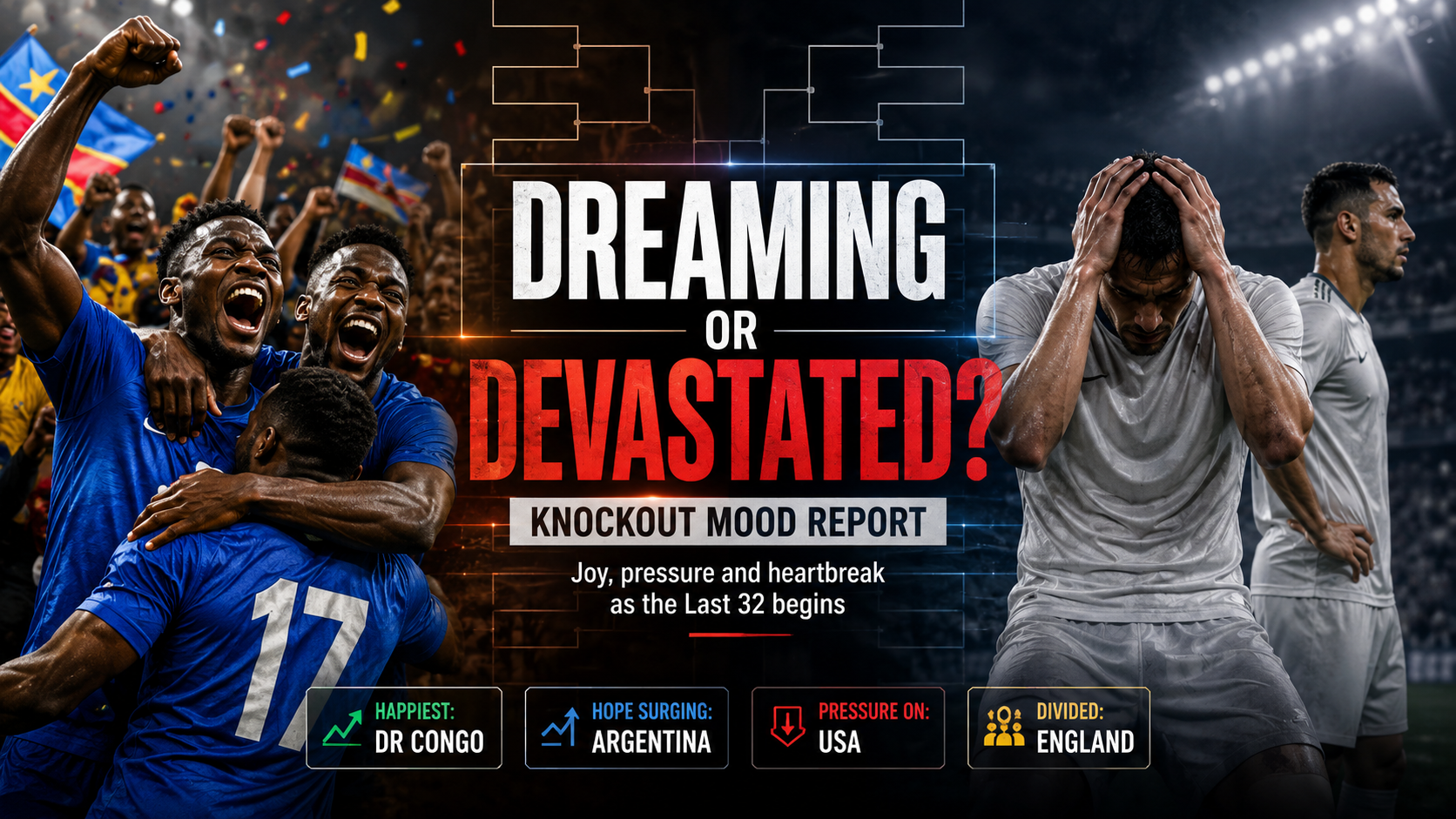
The World Cup Mood Report: Who’s Dreaming, Who’s Devastated as the Knockouts Begin
For a moment on Saturday evening, in a stadium in Atlanta, half a million people who weren’t there felt like they were. DR Congo had been losing. Then they weren’t. And when the last goal went in deep into stoppage time, a country that had not won a knockout match at a World Cup in more than half a century — that last appeared at this tournament in 1974, under a different name, eliminated without a point — stopped breathing and then exhaled all at once. The players collapsed into each other. Somewhere thousands of miles away, in Kinshasa and in the diaspora kitchens of Houston and Brussels and Paris, the same scene played out in living rooms.
That is what the end of a group stage does. It takes the tournament’s polite opening fortnight — the flags, the fan festivals, the wide-eyed first-timers — and it sharpens everything to a point. By Saturday night the field of 48 was a field of 32, and overnight the whole thing changed character. Until now, a bad afternoon could be survived. From here, a bad afternoon is the end. One defeat and you fly home.
So this is the moment to take the temperature. Not the standings — those belong elsewhere — but the feeling. After three rounds of group football across three countries and sixteen cities, what does this World Cup actually feel like to the people in the seats, the players on the grass, the managers under the lights and the millions watching from sofas on four continents? The answer has shifted since our last mood report. Two weeks ago the dominant emotion was pressure. Now it’s something more final: settled accounts. Dreams have been realized or buried. The waiting is over. And a new, colder kind of tension — win-or-go-home tension — has taken its place.
About this report
This is a Fanorate feature produced through our AI-assisted editorial process. We at Brillmark research published reporting, verify the facts we can, and write the analysis in our own original language. We don’t reproduce social posts, chants, broadcast commentary or quotes. Where something is informed opinion rather than confirmed fact, we say so plainly. Sentiment described here is summarized from public reaction, not lifted from it. Facts were checked against authoritative reporting as of Sunday, June 28, 2026, the morning of the first knockout match.
The emotional state of the tournament
- Overall mood
- Charged and bittersweet. The group stage delivered exactly what the expanded format’s defenders promised and its critics feared in equal measure — genuine fairy tales alongside genuine cruelty, the two often arriving in the same hour. There is joy in the survivors and grief in the eliminated, and almost no one feels neutral about how they got here.
- Biggest emotional swing
- Ecuador, who flipped a tournament narrative in ninety minutes. A team built on caution and clean sheets went to New Jersey, fell behind to Germany inside two minutes, and instead of folding came back to win 2-1 — Germany’s first major-tournament upset defeat since their loss to Japan in 2022. For Ecuadorians it was disbelief turned to ecstasy. For Germans it was a result that confirmed every quiet anxiety, even as their side still advanced.
- Most anxious fan base
- The United States, oddly, given they won their group. Topping Group D should have been a coronation. Instead a 3-2 defeat to an already-eliminated Türkiye on the final kick of the night turned a victory lap into a cold shower. The math didn’t matter; the feeling did. American supporters carried real belief into the final round and now carry a nagging question into a knockout meeting with Bosnia and Herzegovina: which USA shows up?
- Happiest fan base
- DR Congo, with no serious challenger. Cape Verde’s quiet miracle — the smallest nation ever to reach a World Cup knockout round — runs it close, and Ecuador’s giant-slaying joy is right there too. But the Atlanta comeback produced the single purest scene of the group stage, and the happiness radiating out of Kinshasa and the Congolese diaspora is the deepest in the tournament.
- Most divided fan base
- England. Through as group winners, yes, but on a diet of set-piece goals and stuttering open play. The optimists see a side topping its group and grinding out clean results; the pessimists have watched a stagnant attack against Panama and a reliance on dead balls and are already bracing for the familiar third act. The DR Congo tie that awaits them has only sharpened the split.
- Strongest national hope
- Argentina. The holders cruised through, won their group, and managed legs so comfortably that Lionel Messi started the final game on the bench and the result never wobbled. A nation that won in 2022 and dreams of one last perfect chapter is carrying the heaviest, most hopeful emotional load in the field.
- Loudest criticism
- Germany and Portugal. Two heavyweights who advanced but unconvinced anyone doing it — Germany beaten by Ecuador, Portugal blunt and goalless against a sharper Colombia. When you carry this much pedigree, second place and a hard knockout draw read as warnings, not reassurance.
The biggest dramas of the final group round
-
Iran, an inch from the knockouts, sent home by arithmetic
- What happened
- A disallowed last-gasp winner, a crossbar, and then elimination decided by tiebreakers across other groups.
- Why fans care
- It’s the tournament’s purest example of how thin the margins are in this format. Iran did almost everything right and still went home.
- Who's upset
- Iranian supporters, and a wide circle of neutrals who felt the team deserved better than a screen and a spreadsheet. Is the reaction fair? Largely, yes. The offside call appears correct by the letter of the law; the heartbreak is no less real for that. Correct and cruel are not opposites.
- What it reveals
- In a 48-team field, the third-place lottery turns other people’s games into your executioner. That’s the format working as designed — and it’s brutal.
The cruelest story of the entire group stage doesn’t involve a red card or a brawl. It’s a frozen frame of video and a third-place table. Iran thought they’d beaten Egypt in stoppage time — the defender wheeled away, the celebrations started — and then VAR ruled the goal out for offside. Seconds later they hit the crossbar. They finished third in their group on the night and spent two days clinging to the best-third-placed math. When it settled, they were out, edged by sides with better goal difference.
-
The Messi non-call and the consistency question
- What happened
- A series of decisions that, taken together, looked uneven depending on the shirt involved.
- Why fans care
- VAR was sold as the end of injustice. Every inconsistency feels like a broken promise, and the perception that big names get protected is the most corrosive version of that.
- Who's upset
- Algerians, Uzbeks, and anyone who believes the standard bends toward stardom. Is the reaction fair? Partly. Some of these are defensible in isolation; the problem is the pattern, not any single call. Trust remains the tournament’s scarcest resource, and these moments keep spending it.
Refereeing controversy didn’t end with the group stage; it just changed targets. The most-discussed incident of the final round centered on Lionel Messi escaping even a booking after a studs-up challenge on Algeria’s Aïssa Mandi — the kind of contact that has produced red cards elsewhere in the tournament. It landed alongside other consistency rows: Uzbekistan were left aggrieved when a goal against Portugal was chalked off for a build-up foul, while a broadly similar incident involving Argentina’s Alexis Mac Allister against Austria went unpunished.
-
Ecuador’s fury, then Ecuador’s redemption
- Why fans care
- It’s the rare controversy that resolved itself on the pitch. The villain became a footnote because the underdog refused to let the night be defined by a whistle.
- What it reveals
- Emotional momentum is real. Ecuador turned a sense of injustice into fuel.
Before Ecuador beat Germany, they were furious with Germany — or rather with the officials. Ecuadorian reporting flagged a contested non-call in the build-up to Germany’s early opener as a grievance. Then they scored twice and won anyway, which is the most satisfying possible answer to a refereeing complaint: render it irrelevant. The anger curdled into one of the great group-stage upsets.
-
The Algeria–Austria ghosts of 1982
- What happened
- A genuinely open, swinging 2-2 with both sides going for it — Algeria’s captain Riyad Mahrez leading from the front.
- Why fans care
- The framing alone created tension. Football’s memory is long, and integrity questions travel across decades. Is the reaction fair? The suspicion was understandable; the football dispelled it. The 2-2, with both teams pushing late, was the opposite of a stitch-up. Austria advanced; Algeria sweated the third-place math and ultimately survived it.
History pressed down on Kansas City. The last competitive World Cup meeting between Algeria and Austria is one of the sport’s most infamous nights — the 1982 “Disgrace of Gijón,” a result that suited both sides at a third party’s expense. So any final-day fixture between them where a particular scoreline might conveniently help both teams invited suspicion before kickoff.
-
The VAR call that finally went Ghana’s way
- What happened
- A technically defensible interference ruling that let a contested goal stand.
- Why fans care
- It’s a referendum on whether the technology is applied evenly. One fan base’s vindication is another’s robbery. Is the reaction fair? On balance the call looked like a consistent application of the interference rule rather than a gift — but try telling that to either set of supporters.
After a group stage spent feeling hard done by — most notably the uncalled penalty against England in the opening round — Ghana finally got a review fall in their favor. Their equalizer against Croatia survived a check despite an offside player in the build-up, with officials ruling no interference. Croatians were incensed; Ghanaians felt weeks of grievance lift in a single roar from the bench.
-
The manager sacked after one match — and how it ended
- What it reveals
- Sometimes the dramatic intervention is just the first act of a quiet failure. The speed of the sacking made headlines; the result it was meant to prevent arrived anyway.
The most jarring story of the group stage’s opening round was Tunisia dismissing head coach Sabri Lamouchi after a single match, with Hervé Renard stepping in. The redemption arc never arrived. Tunisia exited the group stage winless, and the gamble that began in panic ended in elimination — a sobering bookend to the most extreme managerial decision of the tournament.
Fan sentiment pulse, region by region
Europe
Mood: Relieved more than thrilled. The giants mostly advanced, but several limped, and the continent that expected to dominate spent the group stage being dragged into fair fights it didn’t want. Biggest pride: France’s ruthless, perfect group and a peaking attack; Spain’s quiet, unbeaten efficiency. Biggest frustration: Germany losing to Ecuador, and Portugal’s blunt goalless finish against Colombia. The aristocracy got through; it didn’t impress. Most-discussed team: Germany, for the loss and the lingering doubts. Most-discussed player: Cristiano Ronaldo, whose farewell tour now runs through a knockout reunion with Croatia and Luka Modrić. Underdog they’re rallying behind: Cape Verde, who have made romantics of even the most jaded European fans.
South America
Mood: Buoyant and a little vindicated. CONMEBOL has plenty to celebrate — Argentina serene, Brazil efficient, Colombia genuinely impressive, Ecuador heroic. Biggest pride: Colombia winning their group ahead of Portugal and looking like a side nobody wants; Ecuador’s takedown of Germany. Biggest frustration: Uruguay’s group-stage exit, a hard fall for a proud football nation now asking pointed questions about its generational transition. Most-discussed team: Argentina, inevitably, with Colombia closing fast. Most-discussed player: Messi — for the dream he’s chasing and, this round, for the non-call that went his way. Underdog they’re rallying behind: Ecuador, the region’s giant-killers.
North America
Mood: Proud but suddenly wary. The hosts all advanced, but the swagger of opening week has been tempered by reality checks. Biggest pride: Mexico completing the group stage with a perfect record and three clean sheets; Canada and South Africa both reaching their first-ever knockout rounds in the same window. Biggest frustration: The USMNT’s flat final-game loss to Türkiye, and the broader unease that the “whole world welcome” promise remains unmet for fans locked out by visa policy. Most-discussed team: The USMNT, now equal parts belief and doubt. Most-discussed player: Christian Pulisic, the emotional spine of the host run. Underdog they’re rallying behind: Canada at home, in a single-elimination opener that suddenly feels enormous.
Africa
Mood: Exhilarated and historic. This has been a landmark group stage for the continent. Biggest pride: Cape Verde’s record-setting run, DR Congo’s comeback for the ages, South Africa’s first-ever knockout berth, and Ghana, Algeria, Senegal and Morocco all advancing. Biggest frustration: The visa wall keeping fans of several African nations from attending in person, and a sense that African sides are still under-credited even as they keep delivering. Most-discussed team: DR Congo, the feel-good story of the knockouts. Most-discussed player: DR Congo’s Yoane Wissa, whose stoppage-time heroics dragged a nation into history. Underdog they’re rallying behind: All of them — this is a continent watching its smaller nations rewrite their record books in real time.
Asia
Mood: Quietly satisfied, with a sting. Japan and Australia advanced; Uzbekistan exited their debut with heads high; South Korea and Iraq went home. Biggest pride: Japan’s composure in topping a tough group situation, and Uzbekistan proving on debut that they belonged. Biggest frustration: Uzbekistan’s cruel exit after leading DR Congo, South Korea falling short, and the punishing late-night kickoff times back home that turn fandom into an endurance sport. Most-discussed team: Japan, now facing Brazil in a glamour tie. Most-discussed player: Japan’s attacking spark, carrying the region’s deepest knockout hopes. Underdog they’re rallying behind: Australia, the gritty survivors.
Middle East
Mood: Bruised and emptied out. The region’s emotional center, Iran, is gone in the cruelest fashion, and the host-region debutants have departed. Biggest pride: Jordan’s first-ever World Cup, complete with a goal against the world champions to take home; the symbolism of representation. Biggest frustration: Iran’s heartbreaking elimination on third-place math, Saudi Arabia and Qatar both out, and the political turbulence that shadowed Iran throughout. Most-discussed team: Iran, for reasons that bleed well beyond football. Most-discussed player: Iran’s attacking talisman, whose disallowed moments became the region’s defining gut-punch. Underdog they’re rallying behind: Their own departed sides, with a lingering solidarity for fans kept out of the stands entirely.
Host nation sentiment
Mexico
Football-country energy, undiluted and now backed by the best group-stage record of any host. El Tri completed the group with a perfect nine points and three clean sheets, the Estadio Azteca shaking as a 40-year-old goalkeeper was sent on to chase a sixth World Cup — sentiment and substance in the same night. The three Mexican host cities have drawn the tournament’s biggest cumulative crowds, the Zócalo has become an open-air cathedral on match days, and a Round of 32 tie with Egypt back in Mexico City means the party continues at full volume. If atmosphere were a trophy, Mexico would already be holding it.
United States
A grade that slipped a notch, and the reason is mood, not math. The USMNT topped its group, the head coach who began under heavy skepticism is now genuinely beloved, and the fan festivals have been busy — FIFA’s fan-fest network passed two million visitors before the group stage was even over, with US venues regularly at capacity. But the final-game stumble against Türkiye punctured some of the euphoria, and the moral cloud hasn’t lifted: a travel ban affecting citizens of dozens of countries means the “whole world welcome” promise is, for many, broken. Electric inside the gates; uneasy outside them.
Canada
Co-hosts riding a genuine wave of discovery. Canada lost their final group game to Switzerland and still reached the knockout rounds for the first time in the men’s tournament’s history, and now they host the very first knockout match of the World Cup in Los Angeles against South Africa. Canadian fans, less steeped in World Cup ritual, are learning what single-elimination pressure feels like in real time. The footprint is smaller than its co-hosts’, but the engagement is real and climbing, and a home knockout opener is exactly the kind of stage that converts casual interest into something lasting.
Team mood index
One emotional category per team, with a line on why. No qualification math — just the vibe as the knockouts begin.
Flying
Argentina (serene, rested, Messi managed for the long haul), France (perfect group, attack peaking), Mexico (flawless record, home, deafening), DR Congo (history made, and they backed it up), Ecuador (giant-killers with momentum and belief).
Believing
Brazil (winning without fuss, eyeing a deep run), Colombia (group winners ahead of Portugal, quietly excellent), Spain (unbeaten, economical, dangerous), Cape Verde (the smallest nation ever to reach the last 32, and dreaming).
Relieved
England (top of the group, but it felt like survival), Switzerland (group winners without drama), Morocco (came from behind to advance and steady the ship), Austria (survived a fraught final night).
Nervous
United States (a flat finish punctured the buzz), Japan (through, but Brazil awaits), Canada (home pressure in a sudden-death opener), Norway (advanced, but questions about a rotated, sharpness-light finish).
Frustrated
Portugal (blunt and goalless when it mattered, a tough draw ahead), Algeria (left their fate to others’ math), Ghana (through, but never able to shake a sense of grievance).
Angry
Uzbekistan (exited their debut feeling they let a winning position slip), and the lingering anger of fan bases burned by VAR inconsistency.
Divided
England over whether the glass is half full, and Germany, whose fans can’t agree whether the Ecuador loss was a blip or a warning.
Crisis mode (and gone)
Tunisia (a coach sacked after one match, then a winless exit — the arc that began in panic ended in elimination). Iran (eliminated by inches and arithmetic, the emotional wreckage of the group stage).
Coach pressure rankings
The managers carrying the heaviest emotional and media weight as the knockouts begin. This is about heat, not tactics, and not qualification math.
-
Julian Nagelsmann (Germany) — Advancing while losing to Ecuador bought time, not peace. The “what’s wrong with Germany?” chorus is now the loudest in the tournament, and a knockout exit would be a referendum.
-
Roberto Martínez / Portugal’s bench — A blunt, goalless group finish, a Ronaldo farewell to stage-manage, and a Croatia tie nobody wanted. The pressure cooker has a lid and a clock.
-
Mauricio Pochettino (USA) — The most fascinating entry. Beloved one week, second-guessed the next after the Türkiye stumble. Host-nation knockout expectation is its own kind of vice.
-
Luis de la Fuente (Spain) — The favorite’s burden never fully lifts. Unbeaten and economical, but the demand is a trophy, and anything less will be dissected.
-
Marcelo Bielsa (Uruguay) — Out in the group stage with a proud nation asking hard questions. The pressure now is retrospective and existential.
-
The bench of any limping favorite — wherever a heavyweight advanced without convincing, the knives are being sharpened in case of an early exit.
-
Jesse Marsch (Canada) — Co-host, home crowd, first-ever knockout, and a nation discovering that expectation cuts both ways.
-
Hervé Renard (Tunisia) — Inherited a side mid-tournament after an unprecedented sacking and couldn’t save it. The post-mortem on that whole saga lands on his desk.
-
The manager carrying a beloved veteran’s farewell — managing the emotional logistics of an icon’s last dance is a pressure all its own.
-
Any coach whose fan base feels VAR-robbed — grievance is a heavy thing to carry into single-elimination football, and several benches are carrying it.
This ranking weighs expectation, performance, selection scrutiny and fan temperature — not standings.
Players under the spotlight
- Hero of the moment
- Yoane Wissa of DR Congo. Two goals including a stoppage-time clincher and an ice-cold penalty to drag his country into the knockouts for the first time. No individual performance carried more emotional weight on the final day.
- Most criticized star
- Germany’s attacking leaders, who shoulder the blame for the Ecuador loss simply because they’re the names everyone bought the shirts for. Pedigree makes you the lightning rod when the team underwhelms.
- Most protected young player
- The breakout talents being shielded by managers and media as the spotlight intensifies — the youngsters whose nations are quietly building around them without wanting to crush them under expectation.
- Most polarizing player
- Lionel Messi. Adored for the dream he’s chasing, and this round a flashpoint after escaping a card for a studs-up challenge that critics insist would have been punished for anyone else. As ever, there is no neutral take.
- Most emotional celebration
- DR Congo’s full-time scenes in Atlanta — less a celebration than a national catharsis fifty years in the making.
- Player carrying national expectations
- Messi for Argentina and Christian Pulisic for the United States, from opposite ends of the pressure spectrum — one trying to finish a legend’s story, the other trying to prove a stumble was a blip.
Viral and cultural moments
The internet’s favorite scenes have skewed, gratifyingly, toward joy and disbelief. DR Congo’s comeback turned a stadium and a global diaspora into a single roaring organism, and the Congolese communities of North American host cities — the same ones who made an earlier group game in Houston feel like a home fixture — turned the qualification into a street party. Cape Verde’s achievement set off celebrations on a tiny island and across its scattered families, the kind of pride that doesn’t need a trophy to feel like one. Ecuador’s takedown of Germany produced the giddy, can-you-believe-it energy that only an underdog win delivers.
Underneath the clips runs the same cultural current that has defined this tournament from the start: the diaspora is its secret engine. North America’s immigrant communities have made “home” and “away” almost meaningless labels — stadiums thousands of miles from a team’s actual country have become its loudest support. Mexico’s Zócalo, packed for every El Tri match, has become the tournament’s enduring image of a host nation fully, joyfully engaged. That, more than any single goal, is what 2026 will be remembered for.
We describe these trends rather than reproduce any individual post, image or clip.
What fans are arguing about
- Was the Iran offside call the right way to end a team's World Cup?
- Technically correct, emotionally indefensible — the debate is less about the call than about a format that lets tiebreakers do the killing.
- Does Messi get protected by referees?
- The Mandi non-call lit this up. One camp sees a clear double standard; the other sees a marginal incident inflated by his fame.
- Is Germany in real trouble, or was Ecuador a one-off?
- Believers point to top spot and two opening wins; skeptics point to the manner of the loss and a creaky look.
- Should England be worried about their attack?
- Two set-piece goals against Panama have the pessimists nervous; the optimists say winning ugly is a knockout virtue.
- Is VAR applied evenly?
- The Uzbekistan-versus-Argentina comparison reignited the consistency war between purists and pragmatists.
- Did the expanded format deliver or dilute?
- The fairy tales (Cape Verde, DR Congo) are the defense; the third-place lottery that dumped Iran is the prosecution.
- Was sacking Tunisia's coach after one match vindicated or exposed by a winless exit?
- Decisive leadership, or panic that changed nothing?
- Is the travel ban a stain the tournament can't wash out?
- Widely held that it is; a minority frames it as beyond football’s control.
- Is Ronaldo's send-off a story or a distraction as Portugal stutter?
- Romantics want the farewell; pragmatists want the focus on a misfiring team.
- Has the USMNT actually arrived, or did the Türkiye loss expose the hype?
- Believers cite the group win; cynics cite the final-kick collapse.
What the media is overreacting to
- "Germany is in crisis."
- One upset loss while still topping the group is a warning, not a collapse. The talent is real; the panic is premature.
- "The USMNT is finished."
- A flat result against an eliminated side, in a game they’d already effectively won, is being treated as a verdict. It’s a wobble, not a diagnosis.
- "VAR has ruined the World Cup."
- A handful of genuinely contested calls get amplified into an existential indictment of technology that mostly works as intended.
- "Every underdog is now a contender."
- Cape Verde and DR Congo earned their place and their goodwill — but romance and a deep run are different things, and the hype is outrunning the evidence.
- "The third-place format is a disgrace because Iran went out."
- It’s painful, but it’s the rule everyone knew going in. The system did exactly what it was designed to do; that it produced heartbreak doesn’t make it broken.
What fans aren’t talking about enough
The eliminated who left a mark.
Uzbekistan, Jordan, Haiti, Curaçao — debutants and long-absent nations who went home with goals, performances and pride that will seed the next cycle. Their exits got a shrug; they deserved a salute.
The goalkeepers.
Several smaller nations survived the group stage almost entirely on heroic goalkeeping, and these players are getting a fraction of the attention the scorers receive.
The travelers.
Fans who crossed oceans and emptied savings to follow their teams between distant host cities in punishing heat are the unsung backbone of every atmosphere.
The host cities falling for football.
Communities with no deep soccer tradition are converting in real time, and that quiet shift is a bigger legacy story than any single result.
The dignity in the third-place lottery.
For every team that scraped through on math, another went home on it without complaint. There’s grace in how some of these sides accepted a cruel exit that deserves more than a passing mention.
Human stories worth featuring
Angles Fanorate could expand into standalone pieces:
- DR Congo's fifty-year wait
- from Zaire in 1974, eliminated pointless, to a stoppage-time comeback and a first knockout berth. A complete national arc, and a diaspora homecoming, in one night.
- Cape Verde, the smallest nation ever to reach the knockouts
- half a million people, a squad stitched from diaspora careers, and a place in the record books. The defining underdog story of 2026.
- Iran's heartbreak
- an inch offside, a crossbar, and elimination by other people’s results. A reported piece on what it feels like to do almost everything right and still go home.
- Ecuador's heist in New Jersey
- the most un-Ecuadorian half-hour of their tournament, and the best. How a cautious team learned to chase a game and toppled a giant.
- The fans locked out
- supporters of banned nations watching from afar while their teams represented them, and the petitions and boycott debates that grew around it.
- Mexico's perfect group and a veteran's sixth World Cup
- sentiment and excellence fused at a shaking Azteca.
- Tunisia's whole saga
- a coach gone after one match, a caretaker’s reset, and a winless exit. A study in how panic and pressure compress a tournament.
Tournament drama forecast: into the Round of 32
No bracket math — just the emotional weather ahead.
- Fan bases entering the knockouts nervous:
- United States supporters, jolted by the Türkiye stumble and unsure which team turns up; Japan’s, staring down Brazil; Canada’s, carrying home expectation into a sudden-death opener; and Germany’s, who can’t shake the Ecuador hangover.
- Coaches facing the most pressure:
- Germany’s Nagelsmann and Portugal’s bench above all, with Pochettino’s host-nation spotlight close behind. An early exit for any of the three would detonate.
- Emotionally fragile vs united:
- Germany and Portugal look brittle — talented but unconvinced of themselves. Argentina, France, Mexico, Colombia and DR Congo look united, their players and supporters fused into a single mood by the way they finished the group.
- Rivalries that could explode:
- Portugal–Croatia carries a Ronaldo–Modrić farewell subtext that will electrify Toronto. Any tie pairing a VAR-burned fan base with the beneficiaries of an earlier call is a tinderbox. And the diaspora-heavy matchups — Netherlands–Morocco among them — carry an identity charge well beyond the result.
- Stadiums likely to deliver the best atmosphere:
- Mexico’s home venues, the loudest American hosts, Toronto for the Portugal–Croatia drama, and any ground a large diaspora has adopted. The noise is following the communities, not the seedings.
Fanorate final verdict
- What emotion defines the group stage?
- Finality. For three weeks teams could survive their mistakes. That mercy is gone, and the group stage’s last act was the sound of accounts being settled — fairy tales sealed, dreams buried, the field cut in half.
- Which drama matters most?
- Off the pitch, the travel-ban story endures as the tournament’s conscience — a World Cup that promised the whole world and locked some of it out. On it, Iran’s elimination by inches and arithmetic, the single most heartbreaking sequence of the group stage.
- Which fan base deserves sympathy?
- Iran’s supporters, who watched their team come within an offside flag and a crossbar of controlling their own fate, then go home on someone else’s math. With them, the fans of every banned nation still watching from a distance.
- Which fan base is dreaming biggest?
- Argentina, with Messi rested and a perfect ending in view — shadowed by the pure, disbelieving joy of DR Congo and Cape Verde, who are dreaming a different dream entirely: not of winning it, but of how far an impossible story can run.
- Which coach is feeling the heat?
- Germany’s Julian Nagelsmann. Advancing while losing to Ecuador didn’t quiet the doubts; it amplified them, and a knockout slip would turn a warning into a crisis.
- Who is the emotional face of the tournament?
- DR Congo’s Yoane Wissa, for the comeback that made a nation cry with joy, and Iran’s heartbreak as its mirror image — the two faces of a group stage that handed out ecstasy and devastation in the same forty-eight hours.
- What should fans watch emotionally in the knockouts?
- Watch the limping giants — Germany and Portugal — and whether their fragility is real. Watch the underdogs who turned romance into qualification and dare them to keep going. And watch the stadiums the diaspora has claimed, because that’s where this World Cup’s true feeling lives, and the volume only goes up from here.
