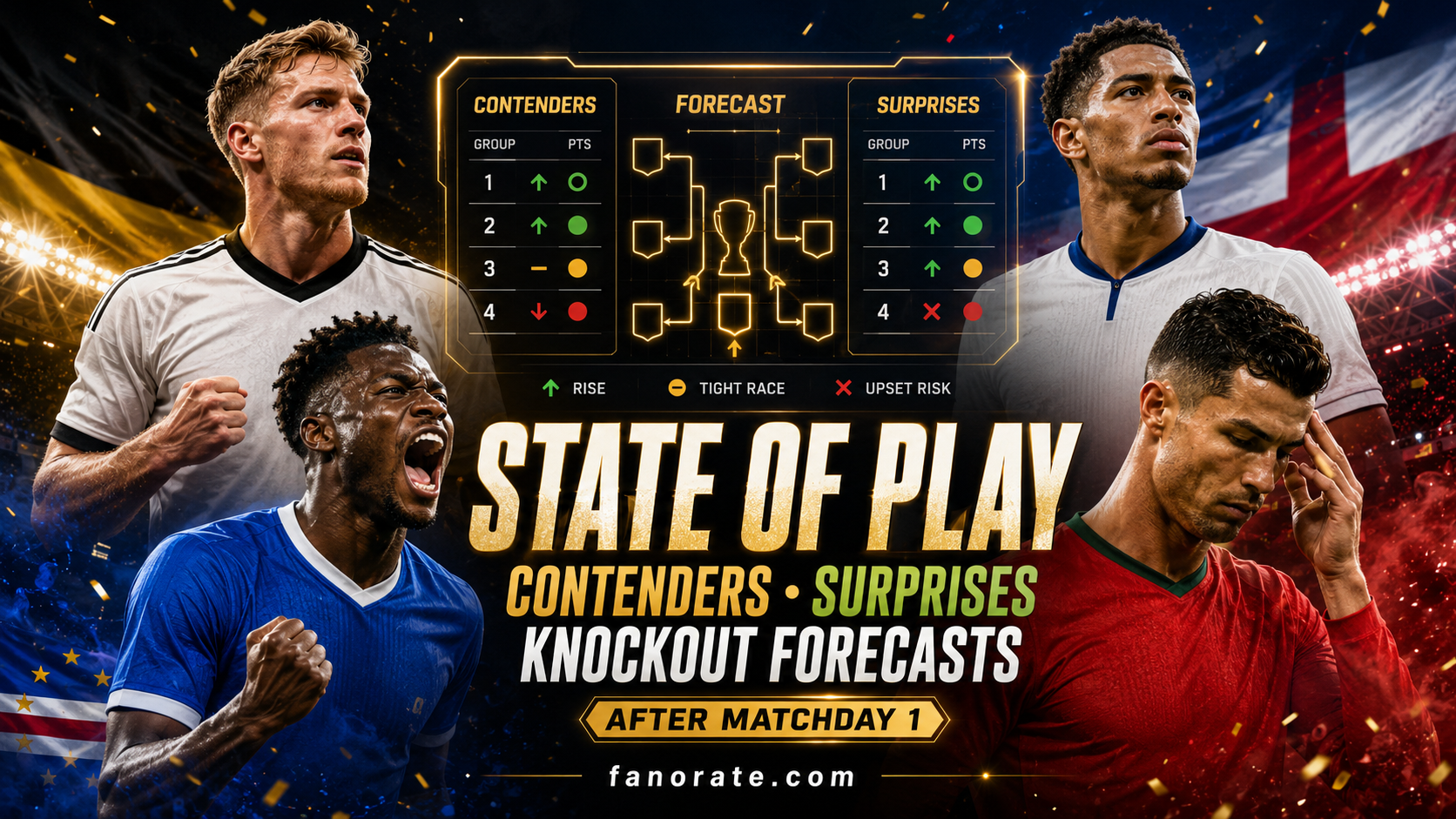
World Cup 2026 State of Play: Contenders, Surprises and Knockout Forecasts After Matchday 1
The biggest World Cup in history finally exhaled its first full breath. Forty-eight teams, twelve groups, three host nations and one sprawling, gloriously complicated bracket — and after a single round of fixtures we already have a tournament with a personality. Some favorites swaggered. One European champion froze. A debutant nation made history with a header, and a 38-year-old legend rewrote a record book that looked closed.
This is Fanorate’s deep read of everything that mattered in Matchday 1: what happened, what it means, and where it points. Settle in.
About this analysis
Fanorate is a research-led, AI-assisted football publication produced by the team at Brillmark. This feature was written by synthesizing publicly reported results, statistics and match coverage from multiple outlets into original analysis. We did not attend matches or conduct first-hand interviews. All scores and standings reflect the completed first round of group-stage fixtures as of June 17, 2026; figures are drawn from public reporting and may be refined as official data settles. Predictions and rankings are our editorial judgment, not statements of fact.
Executive Summary
- Biggest surprise
- Cabo Verde’s 0-0 draw with reigning European champions Spain. Tournament debutants, ranked far below La Roja, walked off having held one of the favorites to a goalless stalemate, inspired by 40-year-old goalkeeper Vozinha’s reported seven-save masterclass.
- Biggest disappointment
- Spain. Twenty-seven shots, more than two expected goals by the underlying numbers, and nothing to show for it. Without the injured Lamine Yamal to unlock a packed box, the European champions looked blunt and predictable.
- Best match
- England 4-2 Croatia. Six goals, a Harry Kane first-half brace, a spirited Croatian fightback to level the game, and then a Jude Bellingham–Marcus Rashford one-two punch to settle it. Drama, quality and jeopardy in one package.
- Best goal
- Yoane Wissa’s header for DR Congo against Portugal. Not the most technically spectacular strike of the round, but a powered header off an Arthur Masuaku cross that delivered a nation’s first-ever World Cup goal, 52 years after their debut. Context is everything.
- Most impressive team
- Germany. A 7-1 demolition of Curaçao is the kind of statement scoreline that resets expectations — even allowing for the gulf in opposition.
- Most vulnerable favorite
- Portugal. Held 1-1 by DR Congo and, by the expected-goals read, arguably second best. For a side many tipped to lift the trophy in Cristiano Ronaldo’s final tournament, it was a wobble.
- Emerging dark horse
- Sweden. A 5-1 thrashing of Tunisia announced a side with genuine attacking venom built around an elite forward line. Few neutrals had them circled. They should now.
Tournament Snapshot
Across the 24 first-round fixtures, the numbers tell a story of a high-scoring, entertaining opening:
- Matches played
- 24 (one full round across all 12 groups)
- Total goals
- 75
- Average goals per match
- roughly 3.1 — a healthy, attack-minded clip
- Clean sheets
- eight, kept by Mexico, Scotland, Australia, Ivory Coast, Argentina, Ghana and both sides in the Spain–Cabo Verde stalemate
- Comeback wins
- essentially none — winners tended to lead and stay ahead, while the round’s great fightbacks (DR Congo, Japan, New Zealand) produced draws rather than victories
- Largest winning margin
- Germany 7-1 Curaçao (+6), the round’s defining blowout
- Highest-scoring games
- Germany 7-1 Curaçao (8 goals), then a cluster of six-goal thrillers in Sweden 5-1 Tunisia and England 4-2 Croatia
- Biggest stages
- the tournament opener in Mexico City and the marquee fixtures at the large United States venues drew the heaviest crowds of the round; precise official attendance figures vary by source, but the showpiece occasions played to capacity or near it
The headline takeaway: an expanded 48-team field has not diluted the spectacle so far. It has, however, produced a handful of lopsided scorelines — the price of admission for a tournament that now includes more first-timers than ever.
Group-by-Group Analysis
Mexico and South Korea strike first
Results: Mexico 2-0 South Africa; South Korea 2-1 Czechia. Standings: Mexico (3, +2), South Korea (3, +1), Czechia (0), South Africa (0).
Co-hosts Mexico opened the entire tournament with a composed, clean-sheet win that settled nerves inside a heaving home crowd. South Korea matched them on points with a battling win over Czechia. The tactical read: both leaders were efficient rather than overwhelming, and the June 18 head-to-head between Mexico and South Korea will likely decide top spot. Most likely to win the group: Mexico, riding home advantage. Runner-up: South Korea. In danger: South Africa, who created little and now must chase. Concern: Mexico’s attack looked functional, not fearsome.
Four-way deadlock
Results: Canada 1-1 Bosnia & Herzegovina; Qatar 1-1 Switzerland. Standings: all four teams level on 1 point.
The only group where every side drew, leaving it wide open. Co-hosts Canada will feel they should have beaten Bosnia at home, while Switzerland’s draw with Qatar was a mild underperformance for the seeded side. Most likely to win the group: Switzerland, on pedigree. Runner-up: Canada, with home backing. In danger: nobody is out, but Qatar must take points from someone. Surprise: Qatar’s resilience hints they will not be the pushover some expected.
Scotland steal a march
Results: Brazil 1-1 Morocco; Scotland 1-0 Haiti. Standings: Scotland (3, +1), Morocco (1), Brazil (1), Haiti (0).
The round’s quiet sensation. Brazil, dropping points against a strong, well-drilled Morocco side, sit behind Scotland — who ground out exactly the kind of 1-0 that wins tournaments-within-tournaments. Morocco’s semifinalist core from 2022 looks every bit as awkward to play. Most likely to win the group: Brazil still, on talent. Runner-up: Morocco. In danger: Haiti. Concern for Brazil: a recurring inability to break down a low block early.
The USA make a statement
Results: USA 4-1 Paraguay; Australia 2-0 Türkiye. Standings: USA (3, +3), Australia (3, +2), Türkiye (0), Paraguay (0).
Co-hosts USA produced the headline result of their World Cup history — four goals, including a brace from Folarin Balogun, the first multi-goal World Cup game by an American man since 1930. Australia’s clean-sheet win over a fancied Türkiye was equally eye-catching. Most likely to win the group: USA, with momentum and home crowds. Runner-up: Australia. In danger: Türkiye, who badly need a response. Surprise: Türkiye’s flat, goalless display.
Germany’s thunderclap
Results: Germany 7-1 Curaçao; Ivory Coast 1-0 Ecuador. Standings: Germany (3, +6), Ivory Coast (3, +1), Ecuador (0), Curaçao (0).
Seven goals. Whatever the caveats about Curaçao’s level, Germany announced themselves as a side rediscovering ruthlessness in front of goal. Ivory Coast’s tidy win over a usually stubborn Ecuador was nearly lost in the noise. Most likely to win the group: Germany. Runner-up: Ivory Coast. In danger: Curaçao, now staring at an enormous goal-difference hole. Concern: the scoreline flattered the gap; sterner tests will reveal whether Germany’s defense is as convincing as its attack.
Sweden serve notice
Results: Netherlands 2-2 Japan; Sweden 5-1 Tunisia. Standings: Sweden (3, +4), Japan (1), Netherlands (1), Tunisia (0).
The Netherlands’ draw with a fearless Japan was a genuine warning sign for a side with deep talent and unresolved questions. Sweden, meanwhile, blew the doors off Tunisia behind an attack that looks tournament-grade. Most likely to win the group: Sweden, on current form, with the Netherlands close behind. Runner-up: Netherlands. In danger: Tunisia. Surprise: Japan matching the Dutch blow for blow.
Honors even all round
Results: Belgium 1-1 Egypt; Iran 2-2 New Zealand. Standings: all four level on 1 point.
Another fully drawn group, and another underwhelming start for a fancied European side — Belgium were pegged back by Egypt. New Zealand’s 2-2 with Iran was a thrilling, end-to-end advert for the underdogs. Most likely to win the group: Belgium, with the most individual quality. Runner-up: Egypt. In danger: nobody yet, but New Zealand will need to repeat their bravery. Concern: Belgium’s defensive lapses.
Spain freeze, debutants soar
Results: Spain 0-0 Cabo Verde; Saudi Arabia 1-1 Uruguay. Standings: all four level on 1 point.
The story of the round. Spain, the European champions, were held scoreless by World Cup debutants Cabo Verde, whose 40-year-old goalkeeper Vozinha produced a man-of-the-match goalkeeping clinic. Uruguay’s draw with a battling Saudi Arabia added to the sense of a group refusing to follow the script. Most likely to win the group: Spain — the talent and the chances are there, the finishing and Yamal’s fitness are not yet. Runner-up: Uruguay. In danger: nobody is safe, which is exactly Spain’s problem. Surprise: the entire group.
France and Norway flex
Results: France 3-1 Senegal; Norway 4-1 Iraq. Standings: Norway (3, +3), France (3, +2), Senegal (0), Iraq (0).
Star power delivered. Kylian Mbappé struck twice as France saw off a dangerous Senegal, while Erling Haaland’s brace powered Norway to an emphatic four-goal opener on the grandest stage many of their players have ever experienced. Most likely to win the group: France, on depth. Runner-up: Norway. In danger: Senegal and Iraq, both beaten. Tactical note: Norway’s directness through Haaland is a blunt instrument that works.
Messi makes history
Results: Argentina 3-0 Algeria; Austria 3-1 Jordan. Standings: Argentina (3, +3), Austria (3, +2), Algeria (0), Jordan (0).
The defending champions began with a statement and a milestone: Lionel Messi scored his first World Cup hat-trick, drawing level with the all-time record of 16 World Cup goals. Austria’s confident win over Jordan made it a perfect round for the group’s seeds. Most likely to win the group: Argentina. Runner-up: Austria. In danger: Algeria and Jordan. Concern: none yet for Argentina, who looked the part.
Portugal stumble, Colombia cruise
Results: Portugal 1-1 DR Congo; Colombia 3-1 Uzbekistan. Standings: Colombia (3, +2), Portugal (1), DR Congo (1), Uzbekistan (0).
João Neves struck early for Portugal, but Yoane Wissa’s first-half-stoppage-time header earned DR Congo their first-ever World Cup point — and, by the expected-goals read, the Congolese were arguably the better side. Ronaldo, starting his 23rd World Cup match as the oldest outfield player ever to do so, could not find a winner. Colombia, by contrast, were excellent, with Daniel Muñoz and Luis Díaz to the fore. Most likely to win the group: Colombia, on the evidence so far, ahead of Portugal. Runner-up: Portugal. In danger: Uzbekistan. Surprise: DR Congo’s organization and threat.
England survive a thriller
Results: England 4-2 Croatia; Ghana 1-0 Panama. Standings: England (3, +2), Ghana (3, +1), Croatia (0), Panama (0).
The round’s best game. Harry Kane’s first-half brace put England in command, Croatia roared back through Martin Baturina and Petar Musa to level, and then Bellingham and Rashford restored order after the break. Ghana’s stoppage-time winner against Panama, via Caleb Yirenkyi, was the round’s latest drama. Most likely to win the group: England, despite defensive jitters. Runner-up: Ghana, on momentum, with Croatia to recover. In danger: Panama and a shell-shocked Croatia. Concern: England conceding twice to a Croatia side many consider past its peak.
Top Performers XI
A best-of-the-round selection, with reasoning rooted in what these players actually did on Matchday 1.
Goalkeeper
- Vozinha (Cabo Verde): Seven reported saves to deny Spain on debut. A 40-year-old producing the goalkeeping performance of the round is exactly the kind of story this tournament exists for.
Defenders
- Daniel Muñoz (Colombia): Opened the scoring and bombed forward relentlessly in a dominant team display.
- An Australia center-back pairing that kept a clean sheet against a talented Türkiye attack earns collective recognition for the round’s most disciplined defensive shift.
- Arthur Masuaku (DR Congo): The cross for Wissa’s historic header capped an excellent attacking-full-back display in a point earned against Portugal.
Midfielders
- Jude Bellingham (England): Scored the goal that broke Croatia’s resistance and drove England’s tempo.
- João Neves (Portugal): A bright, early goal and Portugal’s most threatening presence on an otherwise frustrating night.
- Martin Baturina (Croatia): On the losing side, but his goal and creativity against England announced him to a global audience.
Forwards
- Lionel Messi (Argentina): A record-equaling hat-trick. Enough said.
- Folarin Balogun (USA): A brace in a historic 4-1, the first multi-goal World Cup match by a US man since 1930.
- Harry Kane (England): A first-half brace in the round’s most entertaining game.
Honorable mentions to Kylian Mbappé and Erling Haaland, both of whom scored twice and would walk into most other rounds’ XIs.
Rising Stars
Young players whose stock rose on Matchday 1. (Bios reflect the best available public reporting as of June 17, 2026.)
João Neves (Portugal) — age 21, Paris Saint-Germain, central midfield.
Already a Champions League–winning midfielder, Neves used the World Cup stage to show his range: he scored Portugal’s goal and dictated their best spells. A relentless presser and tidy progressive passer, he is the heartbeat of Portugal’s next generation. Watch him because he is the future of the side, now.
Martin Baturina (Croatia) — early 20s, attacking midfielder.
Croatia’s defeat dominated headlines, but Baturina’s goal and inventive playmaking against England suggested the post–Modrić creative torch is being passed. A press-resistant No. 10 with vision, he is the player to build Croatia’s next cycle around.
Caleb Yirenkyi (Ghana) — young midfielder/forward.
His stoppage-time winner against Panama was the kind of decisive moment that launches reputations. Energetic and fearless, he gave Ghana a late hero and a vital three points. Watch him as Ghana push for a knockout berth.
Leandro Campaz (Colombia) — young attacker.
A stoppage-time goal to seal a 3-1 win over Uzbekistan capped an impressive cameo in a Colombia side brimming with confidence. A direct, two-footed attacker, he adds depth to one of the round’s most convincing teams.
Lamine Yamal (Spain) — age 18, Barcelona, winger
he is the youngster the whole tournament is waiting on. Limited by injury for the Cabo Verde opener, his return to full fitness may be the single biggest swing factor in Spain’s campaign. If he hits form, the rising-stars conversation could quickly become his alone.
Tactical Trends
- Formations
- The round rewarded balance over extremes. Sides built on a solid back four with a clear defensive midfield anchor (Argentina, France, Australia) looked most secure, while teams over-committing in possession without penetration (Spain) were left exposed to the counter and the frustration of a low block.
- Pressing
- The most successful pressers — Germany, Sweden, Argentina — combined aggressive ball-winning with immediate vertical intent. The trend is clear: win it high, attack fast. Several favorites who pressed without a plan for the second phase (Belgium, Portugal) were punished with dropped points.
- Possession
- The Spain–Cabo Verde game was the cautionary tale of the round. Possession without penetration is now a liability against deep, disciplined blocks — and an expanded field means more such blocks. Expect the smarter favorites to prioritize chance quality over territory.
- Set pieces
- Decisive. DR Congo’s historic equalizer came from a delivered cross headed home; several of the round’s goals originated from dead balls and wide deliveries. With so many evenly matched ties looming, set-piece execution looks like a knockout-stage difference-maker.
- Counterattacking
- Norway and France showed the value of devastating transition through elite individual runners (Haaland, Mbappé). Direct, vertical football is thriving — partly because newer teams sit deep and invite it.
- Defensive strategies
- The low-block-and-counter model delivered the round’s biggest upset (Cabo Verde) and its best underdog points (DR Congo, Egypt, New Zealand). Organized, compact defending is the great equalizer of the 48-team era.
- Emerging innovation
- With eight of twelve third-placed teams advancing, expect a tactical sub-game late in the group stage: sides managing goal difference and discipline (cards count in third-place tiebreakers) as carefully as results. Coaches who treat the group as a points-and-goal-difference optimization problem will gain an edge.
Golden Boot Race
Five players already scored twice or more. Here is how the race shapes up. (Goal totals are after Matchday 1; “probability” is our editorial read.)
-
Lionel Messi (Argentina) — 3 goals. A hat-trick out of the gate, a kind remaining group schedule, and a team built to feed him. Historical pedigree is unmatched. Probability: high as the early leader, moderate to win outright given Argentina may rest him in a blowout.
-
Folarin Balogun (USA) — 2 goals. Riding a historic performance and home crowds, with a winnable schedule. Probability: a genuine contender if the USA keep scoring.
-
Kylian Mbappé (France) — 2 goals. Elite finisher, elite supply line, deep France squad. The most likely player to score in every game he starts. Probability: among the favorites.
-
Erling Haaland (Norway) — 2 goals. A pure goal machine; the question is how far Norway advance and whether the supply continues against better defenses. Probability: strong while Norway last.
-
Harry Kane (England) — 2 goals. A serial tournament scorer with a favorable group. Probability: solid contender.
Most likely winner: Kylian Mbappé — the blend of finishing quality, supply and a France team likely to go deep is the safest bet for sustained scoring. Dark horse: Folarin Balogun — host-nation momentum and a kind draw could carry him further than the market expects. Surprise contender: Alexander Isak / Viktor Gyökeres of Sweden — if the Swedes keep scoring in fives, one of their forwards could gatecrash the top of the chart.
Golden Ball Race
The award for the tournament’s best overall player, as the early picture stands:
-
Lionel Messi (Argentina). The defending Golden Ball winner began with a record-equaling hat-trick. Narrative, form and stage are aligned. He is the man to beat.
-
Kylian Mbappé (France). If France go deep and he keeps scoring, he is the natural heir.
-
Jude Bellingham (England). The most complete midfield performer of the round; a deep England run would put him squarely in contention.
-
Harry Kane (England). Goals plus leadership.
-
Erling Haaland (Norway). A wildcard whose ceiling depends entirely on Norway’s longevity.
Rationale: The Golden Ball historically rewards a star who carries a team to the latter stages. Messi and Mbappé sit atop the list because both combine individual brilliance with sides built to last.
Golden Glove Race
- Best performances so far
- Vozinha (Cabo Verde) produced the single best goalkeeping display of the round to deny Spain. Among goalkeepers in winning sides, the keepers behind Mexico, Australia, Ivory Coast and Argentina all kept opening clean sheets.
- Clean-sheet potential going forward
- The award typically follows a deep run plus defensive solidity. On that basis, the goalkeepers of France, Argentina and Germany are best placed — strong squads likely to reach the latter stages with quality back lines in front of them. Australia’s keeper is the outside shout after a composed clean sheet against Türkiye.
- Defensive support quality
- Argentina and France offer the most balanced protection; Germany’s attack dazzles but its defense is unproven against elite opposition. Vozinha’s heroics, while spectacular, depend on Cabo Verde surviving the group — unlikely, but their organization gives him a platform.
Best Young Player Award
For players meeting the tournament’s age eligibility (born on or after January 1, 2005):
-
João Neves (Portugal). A goal, control and maturity beyond his years. If Portugal recover and advance, he is the frontrunner.
-
Lamine Yamal (Spain). Eligibility and ceiling are unmatched; the only question is fitness and whether Spain go deep. A return to form makes him the favorite.
-
Martin Baturina (Croatia). Standout creativity on debut; needs Croatia to bounce back to stay in contention.
Likelihood of a deep run: Neves (Portugal) and Yamal (Spain) belong to the strongest teams among the eligible youngsters, giving them the best platform. Baturina’s hopes hinge on a Croatian revival.
Fair Play Award
The Fair Play Award rewards disciplinary record across the tournament. After a single round, the cleanest starts belonged to the sides that controlled games without resorting to cynical fouling — Mexico, Australia, Argentina and Germany all combined comfortable results with disciplined performances. Among the smaller nations, Cabo Verde and New Zealand earned points with organized, fair defending rather than gamesmanship. These are the early front-runners, though the award is a marathon: the picture will shift as fatigue and stakes rise.
Breakthrough Team Award (Editorial Category)
Most likely to exceed expectations: Sweden. A 5-1 opener was the loudest understated result of the round. With an elite, in-form forward line and a balanced, hard-working spine, Sweden have the profile of a team that could reach the latter stages and surprise a fancied opponent. Honorable mentions to Morocco, whose draw with Brazil confirmed they remain a knockout-grade side, and DR Congo, whose point against Portugal hints at a group-stage shock in the making.
Knockout Stage Forecast: Group Winners and Runners-Up
Reasoning combines current standing, schedule, squad depth and the eye test.
| Group | Predicted Winner | Predicted Runner-Up | Reasoning |
|---|---|---|---|
| A | Mexico | South Korea | Hosts’ momentum and crowd edge; Korea the steadier of the chasers |
| B | Switzerland | Canada | Swiss pedigree to recover; Canada’s home advantage |
| C | Brazil | Morocco | Talent reasserts for Brazil; Morocco too good to fade |
| D | USA | Australia | Hosts flying; Australia’s defensive solidity travels |
| E | Germany | Ivory Coast | Germany’s firepower; Ivory Coast the clear second force |
| F | Sweden | Netherlands | Sweden’s form vs Dutch class — a genuine coin-flip for top spot |
| G | Belgium | Egypt | Belgium’s quality to tell; Egypt edge a tight group |
| H | Spain | Uruguay | Spain’s quality should still win out; Uruguay the steadiest rival |
| I | France | Norway | French depth; Haaland’s Norway as the second seed |
| J | Argentina | Austria | Champions in control; Austria the clear No. 2 |
| K | Colombia | Portugal | Colombia look the part; Portugal to recover into second |
| L | England | Ghana | England’s quality; Ghana’s momentum over a wounded Croatia |
The boldest calls: Colombia over Portugal in Group K, and Sweden topping Group F ahead of the Netherlands. Both reflect Matchday 1 evidence over pre-tournament reputation.
Third-Place Ranking Forecast
Eight of the twelve third-placed teams advance to the Round of 32, ranked by points, then goal difference, goals scored, disciplinary record and FIFA ranking. Crucially, these are the teams we project to finish third in their groups — not the group winners or runners-up forecast above. Excluding our predicted top two from every group, here are the twelve sides we expect to fight for third, and the eight most likely to survive the cut.
Our projected eight qualifiers, with reasoning
-
Scotland (Group C) — Expected ~3-4 pts, even-to-positive GD, ~80% qualification. Already sitting on three points after their 1-0 win over Haiti; even if Brazil and Morocco edge above them, that early haul makes them the best-placed third side in the field.
-
Japan (Group F) — ~3-4 pts, even GD, ~75%. A point off the Netherlands plus a winnable date with Tunisia should bank enough; their attack travels.
-
Croatia (Group L) — ~3-4 pts, recovering GD, ~70%. Beaten by England but far too good to fade; Panama and a wounded-but-beatable Ghana offer a clear path back.
-
Ecuador (Group E) — ~3-4 pts, even GD, ~65%. Defensively excellent; a likely win over Curaçao plus a competitive shot elsewhere keeps them alive.
-
Senegal (Group I) — ~3 pts, even GD, ~60%. Talent to recover from the France defeat, with Iraq a winnable fixture.
-
Türkiye (Group D) — ~3 pts, slight negative GD, ~55%. A flat opener, but the quality to beat Paraguay and steal a result keeps them in the mix.
-
DR Congo (Group K) — ~3-4 pts, even GD, ~55%. Already off the mark with their historic point against Portugal; Uzbekistan is a genuine chance for a win.
-
Iran (Group G) — ~3 pts, even GD, ~50%. One point banked from a tight, open group where a single extra result should be enough.
Bubble teams just outside: Czechia (A), Bosnia & Herzegovina (B), Algeria (J) and Cabo Verde (H) — any could leapfrog the bottom of this list with a single result, and Cabo Verde’s defensive organization makes them the most dangerous of the four.
Updated Tournament Power Rankings (Top 20)
“Pre” = our pre-tournament expectation tier; arrows show movement after Matchday 1.
-
Argentina (Pre: 1) — — Champions looked the part; Messi milestone.
-
France (Pre: 2) — — Stars delivered, depth intact.
-
Germany (Pre: 5) — ▲ Seven goals reframed the conversation.
-
England (Pre: 4) — ▲ Won the round’s best game, if nervily.
-
Brazil (Pre: 3) — ▼ A draw with Morocco raises old questions.
-
Spain (Pre: 2) — ▼▼ The round’s great underachievers.
-
Sweden (Pre: 12) — ▲▲ The breakout side of Matchday 1.
-
Portugal (Pre: 6) — ▼ Held by DR Congo; vulnerable.
-
Netherlands (Pre: 7) — ▼ A flat draw with Japan.
-
Colombia (Pre: 11) — ▲ Convincing and cohesive.
-
Uruguay (Pre: 9) — — Steady if unspectacular.
-
Morocco (Pre: 13) — ▲ Confirmed knockout pedigree.
-
Mexico (Pre: 14) — ▲ Hosts off to a clean-sheet start.
-
USA (Pre: 17) — ▲▲ Historic opener, real momentum.
-
Belgium (Pre: 10) — ▼ Dropped points to Egypt.
-
Norway (Pre: 18) — ▲ Haaland-powered statement.
-
Croatia (Pre: 12) — ▼ Beaten, but far from finished.
-
Japan (Pre: 19) — ▲ Earned a draw with the Dutch.
-
Austria (Pre: 20) — ▲ Professional, winning start.
-
Ivory Coast (Pre: NR) — ▲ Forced their way into the conversation.
Just missed: Switzerland, Ecuador, Egypt, Australia.
Supercomputer vs Human Insight
Statistical models love Matchday 1 results because they are real, recent data points. But probability tables can mislead when read without football context. Where the numbers and the human read diverge:
- Squad depth
- A model rates Spain highly on expected goals from their Cabo Verde performance (more than two xG). A human sees a side over-reliant on an injured teenager and short of a true penalty-box finisher. The eye test is more worried than the spreadsheet.
- Injuries
- No model fully captures the swing factor of Lamine Yamal’s fitness for Spain, or how a single knock to Mbappé or Messi would reshape an entire bracket.
- Momentum
- Germany’s +6 goal difference inflates their model rating; the schedule has not yet tested their defense. Conversely, the USA’s momentum and crowd energy are real edges a pure ratings system underweights.
- Travel and geography
- The 48-team format spans three nations and vast distances. Teams shuttling between climates and time zones face a fatigue tax that models treat as noise but coaches treat as central.
- Atmosphere
- Home advantage for Mexico, the USA and Canada is worth more than its numerical coefficient — the opening round showed all three lifted by their crowds.
- Experience
- When margins are razor-thin, tournament-hardened sides (Argentina, France, Brazil, Uruguay) tend to find the extra gear that probability cannot quantify.
The synthesis: trust the model on Argentina, France and Germany’s quality; trust the human read that Spain are more fragile, Sweden more dangerous, and the host nations more formidable than the raw numbers suggest.
Bracket Forecast
Confidence levels reflect how strongly the Matchday 1 evidence supports each call.
- Most likely quarterfinalists (8)
- Argentina, France, Germany, England, Brazil, Spain, Sweden, Colombia. (Confidence: moderate — one round is a small sample.)
- Most likely semifinalists (4)
- Argentina, France, Germany, England. (Confidence: moderate-low.)
- Most likely finalists (2)
- Argentina vs France — a rematch of the 2022 final, and the two sides who looked most complete and most balanced in the opening round. (Confidence: low — this far out, it is an educated projection, not a prediction.)
- Most likely champion
- Argentina. (Confidence: low-to-moderate.) The defending champions combine the tournament’s best player in form, a settled spine, and the experience to win the tight games an expanded bracket guarantees. France are the closest challenger, Germany the in-form wildcard.
Fanorate Verdict
- Biggest lesson from Matchday 1:
- In the 48-team era, the gap between the elite and the organized underdog is narrower than the seedings suggest. Cabo Verde, DR Congo, Egypt, New Zealand and Japan all proved that compact, disciplined defending plus one moment of quality can humble a favorite. The teams that prepared for low blocks thrived; the ones that assumed possession equals progress did not.
- One team everyone is underrating: Sweden.
- A 5-1 opener with an elite forward line, and still flying under the radar of casual fans. They have the profile of a side that ruins someone’s summer in the knockouts.
- One team everyone is overrating: Portugal.
- A 1-1 draw with DR Congo in which they were arguably second best is not the start of a champion. Ronaldo’s farewell narrative is seductive, but the football was not.
- One player who could become a global superstar: João Neves.
- At 21, he is already a winner at club level, and the World Cup stage suits him. A deep Portugal run would make him a household name worldwide.
- One prediction likely to shock readers: Colombia win Group K ahead of Portugal — and reach the quarterfinals.
- On Matchday 1 evidence, they were the more convincing, more cohesive side, and the bracket may open kindly. Write it down.
Sources informing this analysis: CBS Sports, FIFA.com, ESPN, Al Jazeera, Goal.com, France 24, NBC News, FOX Sports, Olympics.com, Yahoo Sports and Opta Analyst reporting on the 2026 FIFA World Cup group stage. All analysis, rankings and forecasts are Fanorate’s original editorial work.
