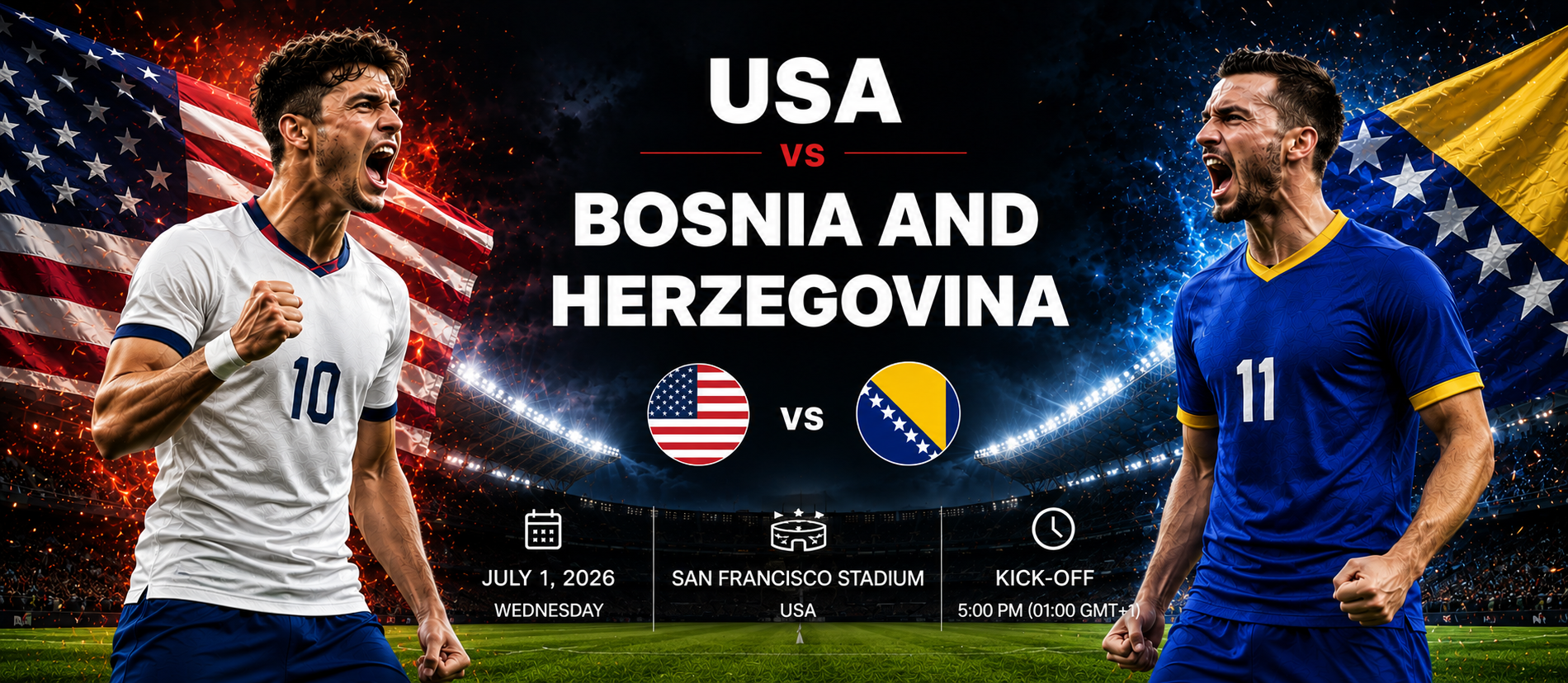
USA vs Bosnia & Herzegovina
USMNT face Bosnia and Herzegovina in the World Cup 2026 Round of 32 at Levi’s Stadium. Tactical preview, predicted lineups, key matchups, and final score prediction.
- July 1, 2026 Wed
- Levi’s Stadium Santa Clara
- Kick-Off 8:00 PM ET
A collision of trajectories.
This is a fascinating collision of trajectories. The United States arrive as Group D winners and clear favorites, playing on home soil in front of what will be a heavily pro-American crowd in Santa Clara. Bosnia and Herzegovina arrive as one of the competition’s best third-placed qualifiers — a wounded but stubborn side that survived a brutal beating from Switzerland and still found a way through. On paper, this is a mismatch.
In knockout football, on a humid summer night with a nation’s expectations pressing down on the hosts, it is anything but a formality.
Everything you need at kickoff
- Stage
- Round of 32 48-team format
- Date
- Wed, July 1, 2026
- Kickoff
- 8:00 p.m. ET 5:00 p.m. local PT
- Venue
- Levi's Stadium Santa Clara, California
- Referee
- Not yet confirmed Announced 24–48h pre-match
- Weather
- Mid-60s–low-70s°F Dry, mild, breezy (forecast)
- At Stake
- Winner → Round of 16 Not a quarterfinal
- Days of Rest
- USA 6 · Bosnia 7 Marginal Bosnia edge
The USA last played June 25 (vs Türkiye) for six days’ rest into July 1; Bosnia last played June 24 (vs Qatar) for seven — effectively level, with Bosnia holding a marginal one-day edge.
The floor of acceptable
The winner advances to the Round of 16. For the United States, this is the floor of acceptable: a host nation is expected to reach at least the last 16, and likely beyond. Progressing keeps the dream of a deep, era-defining home run alive and sustains the commercial and emotional momentum of the tournament for the host. For Bosnia and Herzegovina, reaching the Round of 16 would be among the greatest results in the nation’s football history — a fairy-tale extension of a tournament that, after the Switzerland defeat, looked dead. The reward on the other side is a Round of 16 tie against a higher-seeded knockout opponent, raising the stakes further.
United States: 9/10 pressure. Hosts. National expectation. A pro-USA crowd that will turn anxious if goals don’t come. Anything short of the Round of 16 — and realistically a deep run — reads as failure for the home nation. The pressure is almost entirely on Pochettino’s side.
Bosnia and Herzegovina: 3/10 pressure. House money. Nobody expected them to be here, and a defeat to the hosts on the road carries no shame.
Freedom from expectation is itself a competitive asset.
Momentum, fatigue, and four ways it breaks
Momentum: USA 6/10
Two convincing wins, then a rotated loss. The defeat dents the aura slightly but is widely understood as a rest fixture. Net: positive, with a small asterisk.
Momentum: Bosnia 7/10
Counterintuitively higher. They are arriving on the emotional high of a must-win victory over Qatar that rescued their tournament after the Switzerland battering. Underdogs riding redemption momentum are dangerous in one-off knockouts.
Fatigue: firmly favors the USA
Both teams are well-rested — the USA had six days, Bosnia seven — but the USA’s group-stage rotation, especially the nine changes vs Türkiye, means key men (Pulisic, Balogun, Adams, McKennie) carry fresh legs, a deliberate advantage. Bosnia’s concern is older legs: Džeko (40) and Kolašinac (32) cannot sustain peak intensity for 90+ minutes, and the bench is thinner. If it goes to extra time, the ledger tilts firmly toward the USA.
Scenario 1 — the hosts assert control
Most likely. The USA score inside the first half-hour, likely via Balogun or a set-piece/cross. Bosnia, forced to chase, get stretched, and the USA add a second on the counter or another dead ball. A 2-0 or 2-1 home win that looks comfortable but isn’t a thrashing.
Scenario 2 — the grind
Plausible. Bosnia execute the plan: compact, no early goal, half-time level. The crowd grows tense, the USA force it, and the game is decided by a single moment — a Pulisic flash of brilliance, a contentious VAR penalty, or a Bosnian set piece. A tight 1-0 either way, or a 1-1 into extra time.
Scenario 3 — the upset
Real, not remote. Bosnia score first from a corner, defend ferociously, ride a Vasilj save or a VAR reprieve, and spring Mahmić/Alajbegović on the break for a second. The USA throw bodies forward and get caught. A 2-1 Bosnia win that detonates the host nation’s tournament — the kind of result that defines a World Cup’s early rounds.
Scenario 4 — penalties
The match stays level through 120 minutes — Bosnia’s survival plan working, the USA unable to break a disciplined block, older Bosnian legs just holding. A shootout under home pressure becomes the great equalizer. Coin flip.
What would surprise nobody
The USA winning 2-0 or 2-1 and progressing as expected; Bosnia scoring from a Kolašinac-delivered set piece; Pulisic being named in the XI and being the USA’s brightest spark; a nervy, narrow scoreline rather than a comfortable rout; Džeko being substituted around the 70-minute mark.
What would shock the tournament
Bosnia winning in 90 minutes and knocking out the hosts; a 4+ goal USMNT blowout (their attack has been efficient, not prolific); the match being decided inside the opening 15 minutes by a moment of individual Bosnian brilliance; Edin Džeko, at 40, scoring the winner against the host nation.
We publish no invented statistics or fabricated win probabilities — these are reasoned scenarios.
Tale of the tape
The USA won Group D with six points. They blitzed Paraguay 4-1 in Los Angeles — a Bobadilla own goal inside seven minutes, a Folarin Balogun first-half brace, and a Gio Reyna strike deep in stoppage time — with Christian Pulisic the creative hub before being withdrawn at halftime to manage minutes. A 2-0 win over Australia in Seattle followed (a Burgess own goal and a goal for young Alex Freeman), clinching knockout qualification with a match to spare — a USMNT first — with Pulisic held out as a precaution. With top spot secured, Pochettino made nine changes for the finale — the most ever for the USMNT between two World Cup matches — and a heavily rotated side led twice (Trusty, Berhalter) before Kaan Ayhan won it for Türkiye 3-2 in the eighth minute of stoppage time.
Bosnia finished third in Group B with four points, qualifying as one of the best third-placed teams. They earned a gritty 1-1 draw at co-hosts Canada — injury fill-in Jovo Lukić heading home a corner to lead for nearly an hour before substitute Cyle Larin equalized on 78 minutes. Then came a sobering 4-1 defeat to Switzerland: goalless and competitive past the hour until Tarik Muharemović’s straight red card for denying an obvious goalscoring opportunity reduced them to ten men, after which they were overrun late, with Ermin Mahmić grabbing a ferocious consolation. Needing a result, they delivered a 3-1 win over Qatar — 18-year-old Kerim Alajbegović drilling in from 20 yards to become his country’s youngest-ever World Cup scorer, an Edin Džeko volley forcing an own goal, and Mahmić sealing it as the captain marked his 150th cap. Crucially, Muharemović’s one-match ban was served here, so he returns for the Round of 32.
This is a front-foot team that thrives when it scores first and can pin opponents back with wide pace and pressing intensity. Three group goals came either from set pieces and crosses forcing own goals or from second-phase chaos in the box — a reminder that the USMNT’s most reliable source of goals is delivery into dangerous areas, not slick central combination play. Balogun looks like a genuine tournament striker, and the squad depth is real — Pochettino made nine changes and still led Türkiye twice.
A resilient, set-piece-oriented, emotionally driven side built around a low-to-mid block, aerial threat, and the leadership of 40-year-old Edin Džeko. They are most comfortable defending a lead and least comfortable when stretched, chasing a game, or reduced in numbers — the Switzerland match is the cautionary tale. Their youth movement (Alajbegović, Mahmić, Bajraktarević) gives them more attacking dynamism than a typical veteran underdog. They will not dominate possession against the USA and won’t try to.
Match 1 was the template: aggressive, Pulisic-led, front-foot, scoring early and pressing. Match 2 was the same identity executed without Pulisic — more reliant on structure, set pieces and youthful energy (Freeman, Dest), proving the system survives the absence of its star. Match 3 was a deliberate departure: nine changes, a deeper-creative experiment with Berhalter, and a fringe back line that showed promise going forward but cracked late. The throughline: the first-choice XI plays on the front foot and scores early; the rotation XI is functional but leakier.
Match 1 established the identity: compact, set-piece dangerous, willing to defend a lead. Match 2 forced an unwanted evolution — the red card turned them into a survival outfit and revealed how quickly the shape collapses when stretched. Match 3 was the synthesis: back to a controlled, lead-protecting block, but now trusting youth (Alajbegović starting to produce, Mahmić scoring) to add a transition threat. They have learned they cannot trade blows; they must defend, strike on set pieces and breaks, and weather storms.
Matt Turner (New England) remains first choice in goal, backed by Freese and Brady. The headline storyline is Chris Richards (Crystal Palace), rated by many as the USMNT’s best defender, who has been managing an ankle issue and whose match sharpness is a live question. Antonee Robinson (Fulham) and Sergiño Dest (PSV) provide overlapping width, with Tim Ream, Auston Trusty (who scored vs Türkiye), Alex Freeman (who scored vs Australia) and others in a deep group. Tyler Adams (Bournemouth) anchors midfield with Weston McKennie (Juventus) box-to-box and Malik Tillman and Gio Reyna offering creativity. Christian Pulisic (AC Milan) is the talisman, returning from a managed leg issue and expected to start, with in-form Folarin Balogun (Monaco) the No. 9 and Weah, Pepi, Wright, Aaronson and Zendejas providing depth. No suspensions confirmed.
Nikola Vasilj (30) is first choice in goal, backed by Jurkas and Zlomislić. Key defenders include veteran Sead Kolašinac (32), the athletic Amar Dedić (23), the towering Nikola Katić (29) and Stjepan Radeljić (28, listed at 6’7″), with Tarik Muharemović (23) returning from suspension and central to the back line’s organization. A combative double pivot of Amir Hadžiahmetović (29) and Ivan Šunjić (29) screens, while Ermin Mahmić (21, two group goals) has emerged as a genuine threat from midfield and wide areas. Up front, captain and record scorer Edin Džeko (40, 73 international goals) leads the line, likely supported by Ermedin Demirović (28), with 18-year-old breakout star Kerim Alajbegović and the set-piece-scoring Jovo Lukić among the options. No active suspensions for the Round of 32; Džeko’s stamina across 90 minutes is a natural management question, not a confirmed injury.
- Better in nearly every department: more talent, more pace, more depth, home advantage and fresher legs.
- A striker in form (Balogun), a difference-making star (Pulisic) and a midfield engine in Adams–McKennie to control tempo.
- Multiple ways to score — and when they score first, as in both wins, they play their devastating front-foot game.
- The crowd, the legs and the bench all favor the hosts in the final 20 minutes.
- Dangerous and reliable from set pieces — Kolašinac delivery onto Katić, Radeljić, Muharemović and Džeko is a genuine threat.
- A low-to-mid block they are comfortable defending a lead in.
- Counter speed to exploit space behind the high USA fullbacks through Mahmić and Alajbegović.
- A youth movement (Alajbegović, Mahmić, Bajraktarević) adding attacking dynamism beyond Džeko.
- Emotional resilience — they responded to the Switzerland humiliation with a statement win.
- A tendency toward late concentration lapses, as the Türkiye finale showed.
- An attack that can look more dangerous in transition than in patient breakdown of a deep block — precisely what Bosnia will offer.
- Structure is good but fragile once stretched or a man down — the back line lacks recovery pace against quick, rotating forwards.
- Older legs in Džeko (40) and Kolašinac (32) cannot sustain peak intensity for 90+ minutes, and the bench is thinner.
- Least comfortable when chasing a game; their model depends on having a lead to protect.
Pochettino vs Barbarez
Mauricio Pochettino has a clear plan: press, dominate wide areas, score early, and avoid letting Bosnia settle into a comfortable block. His group-stage rotation gives him fresh legs and tactical optionality. The risk is impatience — if the USA don’t score early and the crowd grows anxious, do they force it and leave space for Bosnia’s breaks and set pieces?
Sergej Barbarez, a former national-team captain appointed in April 2024, will set up to frustrate: a compact mid-to-low block, two screening midfielders, aggressive set-piece routines, and Džeko as an outlet to relieve pressure. His chess move is the counter — spring Mahmić, Alajbegović or a wide runner into the space Dest and Robinson vacate. He also has emotional levers: this is a wounded, proud group that responded to the Switzerland humiliation with a statement win, and he will lean into siege mentality.
Key duels to watch
Folarin Balogun vs Katić / Muharemović
Balogun’s movement and pace against Bosnia’s tall-but-not-quick central defenders. If he can drag them into wide channels or run the gaps in behind, the USA’s most likely route to goal opens.
Christian Pulisic vs Amar Dedić
Assuming Pulisic starts left, he attacks Bosnia’s best defender. Dedić’s athleticism makes this the cluster the whole match may turn on.
Edin Džeko vs Chris Richards
A 40-year-old aerial fox against a possibly-undercooked elite defender. On set pieces and crosses, Džeko remains lethal; Richards’ sharpness is the question.
Tyler Adams vs the Hadžiahmetović–Šunjić pivot
Whoever wins the midfield-screening battle controls tempo. The USA want to play through; Bosnia want to clog and break.
Dest & Robinson overlaps vs Bosnia’s wide tracking
Bosnia’s fullbacks and wide men must follow American overlaps or concede the byline.
The decisive sub battle: Pochettino’s bench (Reyna, Pepi, Wright, Aaronson, Zendejas) is deeper and more dangerous than Barbarez’s. In a tight game past the 70th minute, the USA’s depth is a structural advantage.
The names that decide it
6.5. Steady, untested by a barrage; the Türkiye finale wasn’t his XI.
7.5. Created the Freeman goal; attacking spark down the right.
6.0 (fitness-flagged). Quality is unquestioned; sharpness is the variable.
6.5. Trusty scored vs Türkiye and offers a left-footed option.
7.0. Relentless overlapping runner.
7.5. The metronome; sets the press triggers.
7.5. Energy, late runs, leadership.
7.0. Line-breaking passer and carrier.
8.0 (availability-flagged). The difference-maker when fit.
7.0. Pace to stretch a deep block.
8.0. Two goals, clinical, the tournament’s American find.
6.5. Will be busy; shot-stopping crucial.
7.0. Athletic, the tournament’s most reliable Bosnian defender.
6.5. Returns from ban; organizes the back line.
6.5. Aerial dominance, but recovery pace a concern.
7.0. Veteran nous, set-piece delivery, an assist already.
6.5. Screening, breaking up play.
6.5. Combative partner in the pivot.
7.5. Two goals; Bosnia’s most in-form attacker.
7.5. Breakout teenager, fearless.
7.0. Links play, supports Džeko.
7.0. Aging but a genuine aerial and penalty-box threat; leadership intangibles off the chart.
How to read these ratings
Ratings are this editorial team’s subjective 1–10 read of current tournament form, not a statistical model.
History and the small print
Nine changes in the finale
Pochettino made nine changes for the dead-rubber loss to Türkiye — the most ever for the USMNT between two World Cup matches.
Bosnia’s youngest-ever scorer
Eighteen-year-old Kerim Alajbegović drilled in from 20 yards against Qatar to become his country’s youngest-ever World Cup scorer.
Džeko’s 150th cap
Captain Edin Džeko, Bosnia’s record scorer with 73 international goals, marked his 150th cap against Qatar at age 40.
Two own goals for the USA
The USA benefited from an own goal in each of their two group wins — Bobadilla turning in a McKennie cross vs Paraguay and Burgess vs Australia — underscoring how their goals come from delivery into the box.
One of the youngest American scorers
Alex Freeman became one of the youngest American World Cup scorers ever with his goal against Australia.
The red card that changed everything
Bosnia were level with Switzerland past the hour until Tarik Muharemović’s straight red turned an 11-v-11 contest into a damage-limitation exercise; his one-match ban was served and he returns for the Round of 32.
Best guess at kickoff
Both lineups are projections based on group-stage selections and reported fitness; treat as informed estimates, not confirmed teamsheets. Pulisic’s and Richards’ starting status are the key USA uncertainties. USA likely subs: Reyna or Aaronson for a tiring wide man (~65′), Pepi or Wright for Balogun if chasing or closing, Berhalter to shore up midfield if protecting a lead. Bosnia likely subs: Tabaković or Bazdar for Džeko (~70′) to keep a fresh aerial focal point, Gigović or Burnić for legs in midfield, Lukić for a set-piece aerial gamble if chasing.
Kerim Alajbegović, 18, has at least one moment that makes him a global talking point.
Folarin Balogun scores or assists. At least one goal in the match comes from a set piece or a cross forcing an error — the recurring theme of this group stage. Pochettino makes an attacking change before the 70th minute if it’s still level. And the match is decided by a margin of one goal, in 90 minutes or beyond.
How the underdog can win
Not with clichés — with a specific plan. Score first or stay level to halftime: Bosnia’s entire game model depends on having something to protect, and a 0-0 at the break with a restless crowd is their dream scenario. Win the set-piece exchange — their most realistic goal source — with Kolašinac delivery onto Katić, Radeljić, Muharemović and Džeko; they scored from a corner against Canada, and the USA’s rotated back line looked shaky on dead balls late vs Türkiye. Exploit the space behind Dest and Antonee Robinson, who both push high, by breaking Mahmić and Alajbegović into those channels on the counter. Bait American impatience: sit compact, deny the early goal, let the home crowd’s anxiety infect the players, and capitalize on a forced error or a transition. And take it to extra time or penalties as a strategy, not an accident — surviving to a coin-flip ending neutralizes much of the USA’s edge, provided their older legs hold.
If it goes the distance, the picture is genuinely uncertain. The USA’s recent knockout history carries the familiar weight of expectation, and a young squad would be taking spot kicks under enormous home pressure — a double-edged sword; Bosnia, playing with house money, would feel freer. Goalkeeping is roughly even on the night (Turner vs Vasilj). Bosnia have experienced, composed takers (Džeko, if still on, Demirović, Kolašinac); the USA have technically gifted takers (Pulisic, Balogun, Tillman) but would carry the heavier psychological load. A shootout would be a true 50/50, and the pressure asymmetry slightly favors the underdog’s mindset.
United States 2-1 Bosnia and Herzegovina in 90 minutes. Man of the match: Folarin Balogun. The likely turning point: an early-to-mid first-half USA goal that forces Bosnia out of their preferred lead-protecting shape, followed by a tense Bosnian set-piece response and a USA second-half clincher.
The USA’s superior talent, pace, home advantage, fresher legs and deeper bench should tell over 90 minutes — but Bosnia’s set-piece threat and counter speed make a clean sheet unlikely and a comfortable margin improbable. Expect the hosts to win without ever fully settling nerves. Confidence: medium. The outcome — USA progression — is more confident than the manner; an upset is a live, non-trivial possibility, and a penalty shootout is entirely plausible.
The favourite’s case is straightforward: the USA are better in nearly every department — more talent, pace, depth, home advantage, fresher legs, and a coach with a clear, proven plan. They have a striker in form (Balogun), a difference-making star (Pulisic) and a midfield engine (Adams–McKennie) to control tempo. Bosnia cannot match them for athleticism and were comprehensively beaten the one time they faced genuine top-tier quality. If the USA score first, as in both wins, Bosnia’s instinct to defend a lead becomes a liability — because they won’t have a lead to defend.
What’s verified, and what isn’t
This preview is a research-led, AI-assisted analysis produced by the Brillmark/Fanorate editorial team. All scorelines, scorers, squad details and disciplinary records were verified against multiple public match reports as of June 27, 2026. Where a fact could not be confirmed with confidence — particularly projected starting elevens, the match referee and weather — we flag the uncertainty rather than guess.
Verified via multiple public match reports: USA Group D results and scorers (4-1 Paraguay; 2-0 Australia; 3-2 loss to Türkiye) and the nine-change rotation; Bosnia Group B results and scorers (1-1 Canada; 4-1 Switzerland; 3-1 Qatar) and their third-place, best-third-placed qualification. Venue, date and 8 p.m. ET kickoff; Pochettino and Barbarez as the head coaches; both 26-man rosters; Muharemović’s red card and served ban; Alajbegović’s record youngest-scorer goal; Džeko’s 150th cap at 40.
Flagged uncertainties: both projected starting elevens — especially whether Pulisic and Chris Richards start — are informed estimates, not confirmed teamsheets; the match referee was not confirmed at the time of writing; the weather is a typical-conditions estimate; “one yellow away” lists could not be verified to the individual-player level; and the Round of 16 opponent depends on results not yet settled.
No fabricated statistics or win probabilities were used. All ratings in the Player Form Index are explicitly labeled as subjective editorial assessments.
We publish no invented statistics or fabricated win probabilities.
