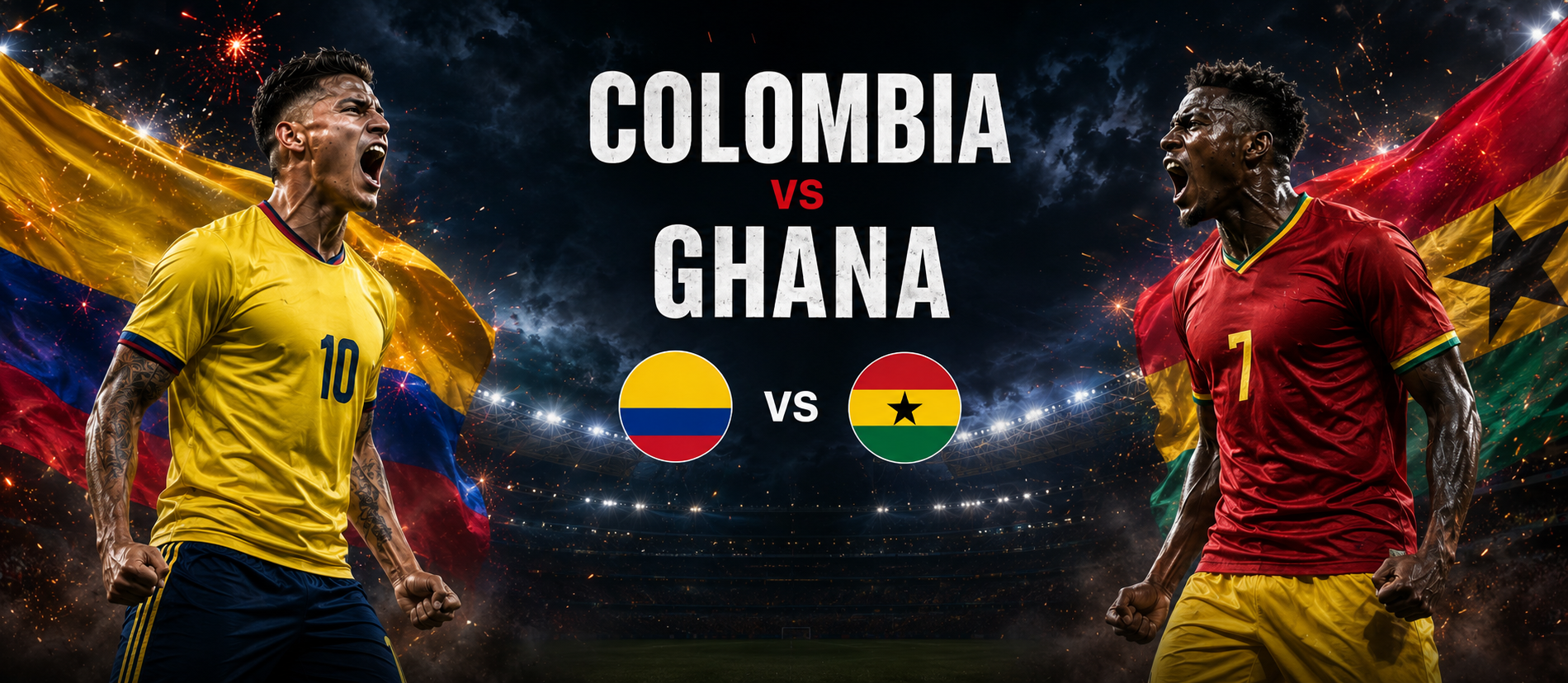
Colombia’s Control vs Ghana’s Chaos
Colombia vs Ghana World Cup 2026 Round of 32 preview: tactics, squads, key matchups, lineups, prediction and analysis for Match 87 at GEHA Field at Arrowhead Stadium, Kansas City, July 3.
- July 3, 2026 Friday
- GEHA Field at Arrowhead Stadium Kansas City
- Kick-Off 8:30 PM ET
Colombia are the more complete side. Ghana are a transition-and-organization team shorn of their talisman.
Colombia are the more complete side. They top a group containing Portugal, conceded only twice, and possess a midfield-and-attack spine — James Rodríguez orchestrating, Díaz threatening on the left, Quintero offering set-piece and creative punch, Muñoz bombing forward from right-back — that no Ghana player can individually match. Their weakness is finishing: for all the territory and chances, Colombia needed deflections and stoppage-time moments to win games. A side that converted its chances would have far better than seven points and two goals against.
Ghana are a transition-and-organization team shorn of their talisman. The Kudus injury is enormous — he is the player who turns half-chances into goals and beats a man to create overloads. Without him, Ghana’s attack runs through Semenyo’s directness, Iñaki Williams’ running and Nuamah’s delivery, but the group stage showed those threads rarely weave into sustained pressure. What Ghana do have is a defensive structure that frustrated England, a captain (Jordan Ayew) who leads from the front, a midfield anchored by Thomas Partey’s experience, and a bench that has already decided one match. They are dangerous in moments, not over 90 minutes.
The fundamental tension of this tie: Colombia’s control vs Ghana’s chaos. If the game becomes a structured, possession-heavy contest, Colombia should dominate. If it fragments into a transition-heavy, set-piece-flecked scrap, Ghana’s profile gives them a puncher’s chance.
Everything you need at kickoff
- Date
- Friday, July 3, 2026
- Kickoff (USA)
- ~8:30 p.m. ET 7:30 p.m. local CT
- Venue
- GEHA Field at Arrowhead Stadium Kansas City, Missouri
- Stage
- Round of 32 Match 87 · Winner advances to R16
- Rest
- ~5–6 days (both sides) Both closed group on June 27
- Weather
- ~88–93°F (31–34°C) Open-air · humid · evening kickoff deliberate
Kickoff time is provisional until FIFA’s final confirmation — listed times have varied slightly across ticketing platforms. The referee appointment was not yet publicly confirmed at time of writing; FIFA typically announces knockout appointments 24–48 hours before kickoff. As Group K winners, Colombia were routed into a Round of 32 meeting with one of the best third-placed sides; Ghana, finishing third in Group L among the eight best third-placed teams, drew the Group K winner.
Control vs chaos — with a place in the Round of 16 on the line
Both teams finished the group on June 27 and meet on July 3 — roughly five to six days’ rest, an unusually even fatigue footing. Neither carries a glaring fatigue disadvantage. The bigger physical variable is the Kansas City heat and humidity: an open-air, uncovered Arrowhead in early July, even at an evening kickoff, taxes both squads’ legs and rotation depth. Colombia’s deeper, more balanced squad and Ghana’s demonstrated reliance on impact substitutes both point to the bench mattering late. Ghana’s transition-heavy style is energy-intensive; sustaining it for 90-plus minutes in the heat is a real concern, which dovetails with Queiroz’s likely plan to conserve and strike late.
Colombia carry the weight of expectation. As group winners and clear favorites, anything but victory would be a serious disappointment for a nation that missed 2022 and remembers 2014’s quarterfinal run. Ghana play with house money. Few expected them to escape Group L; reaching the Round of 32 already exceeds the floor. That freedom is dangerous — a Ghana side with nothing to lose, set up to frustrate and counter, is exactly the kind of opponent that springs upsets. The psychological asymmetry favors the underdog’s mindset even as the quality favors Colombia.
The winner advances to the Round of 16 — one step from the quarterfinals, with the realistic prospect of a deep run still alive. For Colombia, victory keeps a genuinely ambitious campaign on track; this is a squad whose ceiling, with draw luck, stretches toward the latter stages. For Ghana, simply reaching the Round of 16 would be a landmark — bettering their 2014 and 2022 group-stage exits and matching the knockout presence that underpinned their golden 2010 generation. The loser’s tournament ends here, making this a true win-or-go-home crossroads with outsized stakes for both football cultures.
The psychological asymmetry favors the underdog’s mindset even as the quality favors Colombia.
The narratives writing themselves into Match 87
Díaz’s double act
Luis Díaz scored and assisted in Colombia’s opener against Uzbekistan — becoming only the second Colombian to achieve that in the same World Cup match since 1966, after James Rodríguez vs Japan in 2014. He is Colombia’s most likely matchwinner and Ghana’s most dangerous individual problem.
The right-back who keeps scoring
Daniel Muñoz, a full-back, has scored twice in two group games — a remarkable attacking return from right-back. His two-goal tally makes him one of the tournament’s most eye-catching contributors outside the recognized forwards, and his overlapping channel is Colombia’s most productive avenue.
Ghana’s first knockout since 2010
Ghana have not reached the knockout stage of a World Cup since their famous 2010 run — ended in a quarterfinal against Uruguay still raw in the national memory. Four points from Group L and a best-third-placed berth brought them here. This is already a landmark, and the Black Stars have nothing to lose.
Kudus: the defining absence
Mohammed Kudus is out of the entire tournament with a quad injury and a recovery setback — a defining blow to Ghana’s attack. He is the player who turns half-chances into goals and beats a man to create overloads. Without him, Ghana’s attack is a different, simpler proposition.
The England blueprint
Ghana’s 0–0 draw against England — the result that secured their knockout berth — was built on a disciplined low block, a compact midfield and a collective willingness to defend deep and counter. Queiroz is almost certain to replicate that template here: sit in, absorb, and wait for Colombia’s finishing to fracture.
The Colombia–Ghana dynamic is layered: a better side trying to unlock a well-organized, motivated underdog with a precise game plan. Every angle of this tie has a story.
Tale of the tape
Colombia finished Group K unbeaten with seven points — a 3–1 win over Uzbekistan, a 1–0 win over DR Congo and a 0–0 draw with Portugal that secured top spot as group winners. They conceded only twice across all three matches. A Davinson Sánchez header in the 91st minute against Portugal was disallowed for marginal offside after VAR review, denying what would have been a winning goal in a match Colombia had dominated.
Ghana took four points from Group L — a 1–0 win over Panama (95th-minute winner from substitute Yirenkyi off a Thomas-Asante assist), a 0–0 draw with England (clean sheet held under sustained pressure) and a 1–2 defeat to Croatia (Luckassen equalizer canceled by Vlašić’s 83rd-minute header from a Modrić corner). Four points was enough to advance as one of the eight best third-placed teams, marking Ghana’s first knockout qualification since 2010.
Lorenzo’s 4-3-3 stayed consistent in shape but evolved in intent across three matches. Against Uzbekistan, Colombia played expansively and were occasionally loose. Against DR Congo, they tightened defensively and committed full-backs higher to break a low block — successfully in territory, less so in conversion. Against Portugal, the side matured into a controlled, low-risk, defensively excellent unit capable of trading blows with an elite opponent without losing its shape. The trajectory is toward greater solidity; the constant is a search for a reliable finisher to complement Díaz.
Queiroz’s 4-2-3-1 began as a passive, reactive structure against Panama, evolved into a disciplined low block plus counter against England — the template that suits Ghana best — and held that shape against Croatia until set pieces undid them. The clearest evolution is the growing reliance on the bench: Thomas-Asante’s match-winning cameo against Panama established substitutes as a primary attacking lever. Expect Queiroz to set up reactively, cede possession, and look to strike on the break and from second balls.
Juan Quintero is Colombia’s primary set-piece weapon — his through-ball led to the 76th-minute DR Congo winner and his delivery drew danger throughout the Portugal match. Against a Ghana side that conceded twice from set pieces in the group stage, Quintero’s dead balls represent a live and recurring danger.
Jonas Adjetey is Ghana’s primary aerial threat at both ends of the pitch. Set pieces proved costly against Croatia — two goals conceded from dead balls — but also productive: Luckassen’s equalizer came from a Nuamah delivery. Against Quintero’s delivery, Ghana’s aerial vulnerability is a live danger; but their own set-piece threat is a two-way battleground both sides will look to exploit.
- Tournament’s form right-back in Muñoz — two group goals from a defensive position
- Elite wide threat in Díaz — pace, directness, end product
- Tempo-setting creative engine in James Rodríguez (captain)
- Genuine set-piece menace in Quintero’s delivery
- Defense that conceded only twice while holding Portugal
- Disciplined low block and defensive resilience — held England to a 0–0 clean sheet
- Dangerous on transition and from substitutes — bench already won one match
- Jonas Adjetey as an aerial set-piece threat at both ends
- Thomas Partey’s midfield experience anchoring the defensive structure
- Psychological ‘house money’ freedom as an underdog with nothing to lose
- Persistent finishing and conversion problem — needed deflections and stoppage-time moments to win games
- Can be patient to a fault; relies on individual quality over sustained cutting edge to break deep blocks
- Mohammed Kudus out for the entire tournament — a defining absence removing Ghana’s best individual attacker
- Scored just twice in the group stage — neither from headline attackers Semenyo or Williams
- Recurring vulnerability defending aerial set pieces — conceded twice from dead balls vs Croatia
- Without Kudus, attack is industrial rather than creative; sustained pressure is rare
Whoever imposes their tempo likely wins
Néstor Lorenzo has built a side with a settled 4-3-3 identity, defensive maturity and creative quality. His challenge is breaking a Ghana side that will likely sit deep — the exact problem DR Congo posed. Expect Lorenzo to commit full-backs high, use James and Quintero to find pockets between Ghana’s lines, and trust Díaz’s individual quality to unlock the block. His in-game lever is Quintero — and the bench creativity that already produced the Campaz winner against Uzbekistan.
Carlos Queiroz — the 73-year-old Portuguese tactician who took the Ghana job only in April 2026, replacing Otto Addo after friendly defeats to Austria and Germany — is a pragmatist’s pragmatist. His England template (deep block, compact midfield, counter and set pieces) is precisely the plan he is likely to deploy here. Queiroz will accept low possession, aim to frustrate Colombia for 60-plus minutes, keep the game scoreless or low-scoring, and unleash his bench (Thomas-Asante and fresh runners) late — the formula that beat Panama. His great vulnerability is the set-piece frailty Croatia exposed; against Quintero’s delivery, that is a live danger.
Key duels to watch
Luis Díaz vs Ghana’s right side (Seidu/Williams tracking back)
The tie’s pivotal duel. If Díaz isolates Ghana’s right-back in transition or one-v-one, he can decide the match. Ghana must double up and deny him space to run into.
Daniel Muñoz vs Ghana’s left flank
Colombia’s attacking right-back will push high. Whoever Ghana station wide-left must contain Muñoz’s overlaps — a failure here opens Colombia’s most productive channel.
Thomas Partey vs James Rodríguez
Ghana’s anchor against Colombia’s conductor. If Partey can screen the space James operates in and cut the supply line, Ghana disrupt Colombia’s rhythm. If James finds pockets, Colombia flow.
Antoine Semenyo vs Davinson Sánchez/Colombia’s back line
Ghana’s best route to a goal is Semenyo running at a back line in transition. Sánchez’s recovery pace and positioning will be tested against Ghana’s most dangerous carrier.
Set pieces: Quintero’s delivery vs Ghana’s defending — and Ghana’s aerial threat vs Colombia’s marking
Ghana conceded twice from set pieces against Croatia but also scored from a defensive-zone player; this is a two-way battleground. Quintero’s delivery vs Ghana’s aerial vulnerability is the tie’s most probable source of the decisive moment.
Queiroz will accept low possession, aim to frustrate Colombia for 60-plus minutes, keep the game scoreless or low-scoring, and unleash his bench late — the formula that beat Panama.
The names that decide it
Colombia’s talisman — scored and assisted in the opener, a constant threat and the only attacker on either side whose individual quality can unlock a low block in a single moment. Colombia’s most likely matchwinner and the player Ghana’s entire defensive shape must account for.
Two goals from right-back in the group stage — a remarkable attacking return. His overlapping runs open Colombia’s most dangerous channel, and his work-rate at both ends makes him Colombia’s standout performer of the tournament so far.
Orchestrator and captain — equaling the Colombian record for World Cup appearances. His tempo-setting, creative delivery and vision are the engine that unlocks Ghana’s compact shape. If Partey can’t neutralize him, Colombia flow.
Decisive creative and set-piece influence — his through-ball assisted the DR Congo winner, and his delivery is Colombia’s primary weapon against a Ghana side that conceded twice from set pieces in the group stage.
Ghana’s most dangerous carrier and their clearest route to a goal — his directness, pace and willingness to run at defenders on the break make him the threat that exploits the space Muñoz vacates bombing forward.
Experienced anchor and the calming presence Ghana need against Colombia’s midfield. If Partey screens the space James operates in and cuts the supply line, Ghana disrupt Colombia’s rhythm entirely.
Ghana’s most consistent creative outlet — his delivery created the Croatia equalizer, and his carrying is the mechanism through which Ghana manufacture attacking moments without Kudus.
Captain, leader and Ghana’s record-setting World Cup veteran. His work-rate, leadership and ability to hold the line are Ghana’s connective tissue — the player who holds the team’s shape and collective spirit under pressure.
Ones to Watch: Bench Impact & Emerging Threats
Colombia: Jaminton Campaz came off the bench to head Colombia’s third against Uzbekistan in stoppage time, and Juan Quintero has been the decisive creative force as either a starter or substitute — his vision and set-piece delivery give Lorenzo an attacking dimension the recognized midfielders cannot fully replicate.
Ghana: Brandon Thomas-Asante provided the assist that led to Ghana’s Panama winner after coming off the bench, establishing substitutes as Queiroz’s primary attacking weapon. Twenty-year-old Caleb Yirenkyi — who scored Ghana’s 95th-minute winner against Panama, the latest goal Ghana have ever scored at a World Cup — is another live late-game threat from the bench.
A World Cup knockout has a habit of being decided by names that didn’t appear in any pre-match headline. In this tie, the bench could be the difference.
The numbers behind the match
Only the second Colombian since 1966
Luis Díaz became only the second Colombian to score and assist in the same World Cup match since 1966 — after James Rodríguez vs Japan in 2014 — when he achieved the feat against Uzbekistan in the group opener.
Ghana’s latest-ever World Cup goal
Caleb Yirenkyi’s winner against Panama came at 94 minutes and 4 seconds — the latest goal Ghana have ever scored at a World Cup, and one of the tournament’s most dramatic late moments of the group stage.
James equals a Colombian record
James Rodríguez equaled the Colombian record for World Cup appearances during the group stage — a milestone for the captain and creative fulcrum whose delivery and vision remain Colombia’s primary rhythm-setter in this tournament.
The £64m new arrival
Antoine Semenyo completed a £64 million transfer from Bournemouth to Manchester City in January 2026 — one of the highest-profile winter moves of the season — before arriving at his first World Cup as Ghana’s most dangerous attacking weapon.
The 2010 shadow
Ghana carry the weight of their 2010 quarterfinal against Uruguay — a match decided by a last-minute handball and a shootout that still echoes in the national memory more than 15 years later — into any penalty scenario this tie might produce.
Provisional. Lorenzo’s XI is relatively predictable; Queiroz is more likely to surprise with a reactive setup. Ghana’s center-back and full-back slots are genuinely uncertain given Queiroz’s rotation — exact pairings should be confirmed nearer kickoff against FIFA’s official team sheets.
At least one set piece produces a goal or a major chance — the tie’s likeliest source of the decisive moment.
Colombia generate clearly more shots and possession but, true to form, leave the game closer than the chance-count suggests. Daniel Muñoz, not a recognized forward, is again among Colombia’s most dangerous attackers from right-back. Ghana’s most threatening passages all come from transition and substitutes, not sustained build-up. If Colombia don’t score before the 70th minute, the closing 20 become genuinely nervy.
One Player Nobody Is Talking About
Caleb Yirenkyi, 20. He came off the bench against Panama and tucked home a cross from Thomas-Asante’s assist in the 95th minute — at 94:04, the latest goal Ghana have ever scored at a World Cup. The decisive moment, the record, the match winner: all from a 20-year-old who had produced precisely zero shots in the first half. Yirenkyi is not in Ghana’s Key Player Matchups, not among the names Ghana’s opponents study pre-match, and not in any conversation about this tie’s likely outcomes. But Queiroz’s bench has already changed one match, and Yirenkyi was the player who finished the move. If Ghana find themselves chasing the game — or protecting a lead late — a 20-year-old with an eye for the moment could once again be the difference.
A Colombian breakthrough in the second half — most plausibly from a Muñoz overlap or a Quintero set piece — forces Ghana out of their shell, after which Colombia’s quality tells. Ghana’s late goal sets up a nervy finish but arrives too late. Man of the Match: Luis Díaz — the single highest-quality attacker on the pitch and Colombia’s most probable matchwinner.
Colombia are the better, deeper, more in-form side, organized at the back and rich in the final third, against a Ghana team that is well-drilled but short of attacking firepower and missing its best player. The structural mismatch favors Colombia. The caveat — and why this is not a blowout pick — is Colombia’s persistent group-stage finishing problem and Ghana’s proven ability to frustrate elite sides (see: England) and strike on the break. Confidence: moderate-to-high on the outcome (Colombia advancing), lower on the exact scoreline. A 1–0 Colombia win or a penalty shootout are both very live alternatives, and a Ghana upset is a genuine, if minority, possibility.
A tense, low-scoring game that hinges on a single moment
Four qualitative narrative paths present themselves for this tie, ordered roughly from most to least expected. The most expected: Colombia dominate possession, Ghana sit deep, and the breakthrough comes via a Muñoz overlap, a Díaz moment, or a Quintero set piece somewhere in the 35th–65th minute — Colombia manage the game with their midfield and see out a 2–0 or 2–1 win, with Ghana’s late bench push coming up short.
The second path is the grind and the late blow: a tense, low-scoring affair mirrors Colombia’s DR Congo and Portugal games; it stays scoreless into the final 20 minutes, and Colombia’s quality — or a single substitute moment — finally tells in a 1–0 win. Ghana frustrate but cannot manufacture the equalizer. The third path is penalties: Ghana execute the England template perfectly, keep it scoreless through 90 and extra time, and drag Colombia to a shootout — composure and Ospina’s experience tilt it Colombia’s way, but it goes to the wire. The fourth path — the upset — sees Semenyo or Williams run into the space Muñoz vacates, finish the break, Ghana defend the lead with everything they have, and Colombia’s conversion problem proves fatal.
On penalties, Colombia carry experienced, composed takers in James Rodríguez, Quintero and Díaz, plus a veteran keeper in Ospina with big-game pedigree. Ghana carry painful World Cup shootout history — the 2010 quarterfinal heartbreak against Uruguay still echoes in the national memory — though none of the current likely takers were central to that night. Jordan Ayew’s leadership and Ati-Zigi’s shot-stopping are assets. But shootouts are coin-flips, and Ghana’s ‘nothing to lose’ freedom can level the mental playing field.
The structural logic strongly favors Colombia. But this is a side whose finishing has been the persistent caveat throughout the group, against an opponent that held England, knows how to frustrate, and has already proved it can win a match from the bench late. Watch the 70th minute: if the score is still level, this tie becomes everyone’s watch.
Shootouts are coin-flips, and Ghana’s ‘nothing to lose’ freedom can level the mental playing field.
