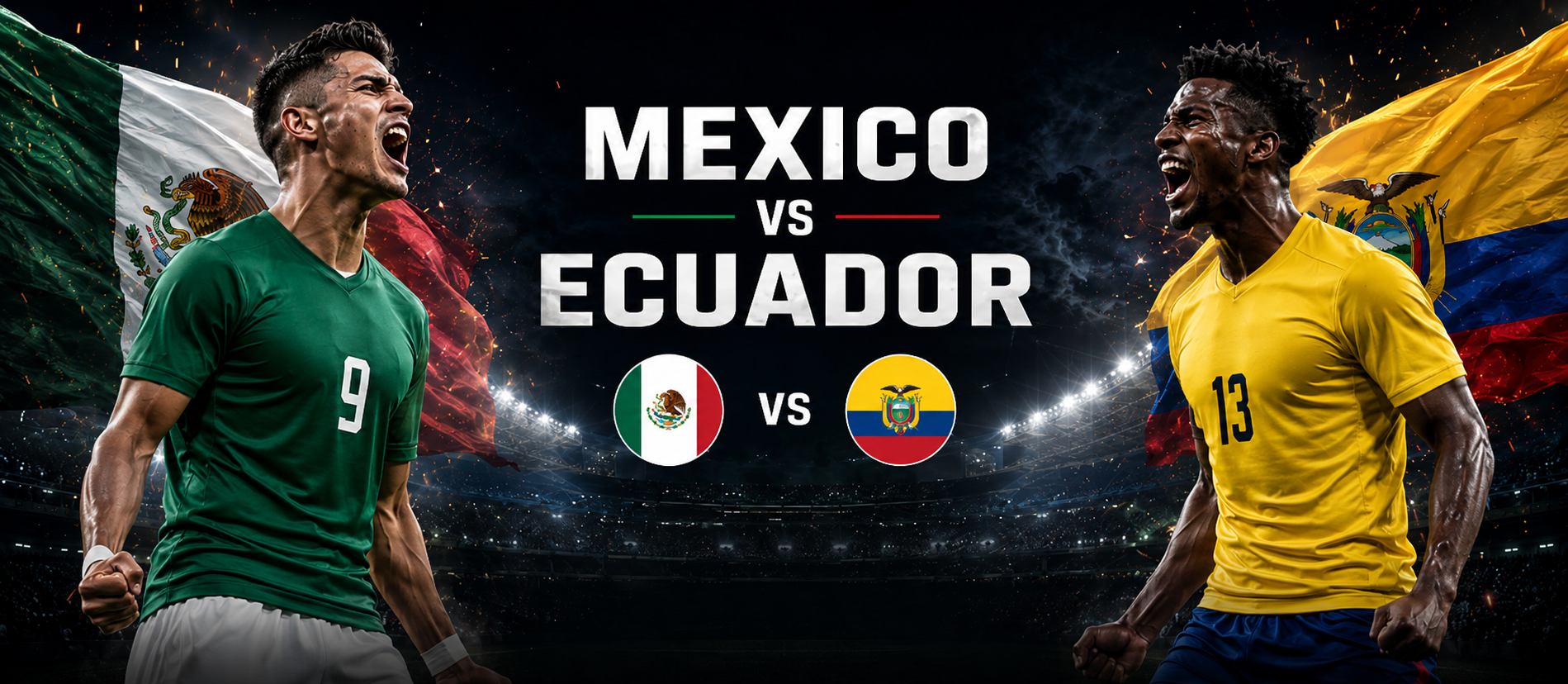
The Azteca’s First Knockout Night
Mexico vs Ecuador World Cup 2026 Round of 32 preview: lineups, tactics, key matchups, altitude factor at the Azteca, fatigue, predictions and analysis.
- June 30, 2026 Tue
- Estadio Azteca Mexico City
- Kick-Off 9:00 PM ET
The defensive machine meets the comeback kings.
Mexico are a pragmatic, structurally disciplined side built for tournament survival rather than aesthetic dominance. Under Javier Aguirre — in his third spell in charge — they defend in a compact block, press selectively and zonally rather than man-for-man, and look to win the second ball and break with intent. The headline number is the one that matters in knockout football: zero goals conceded in three games. They are organised, they have a goalkeeper in form (Rangel), an elite ball-winning captain in Edson Álvarez, and a generational teenager in Mora. They also have the single largest non-footballing advantage in the tournament: the Azteca, its altitude, and 80,000-plus partisans.
Ecuador are, on paper, one of the most defensively rigorous teams at the World Cup — a reputation forged in qualifying, where they conceded a famously small number of goals and built around the brilliance of Caicedo, Pacho and Hincapié. Yet the group stage exposed a different problem: a chronic difficulty turning territory and chances into goals. They out-shot two opponents heavily and came away with one point from those two games. The Germany comeback proved the ceiling is high and the character is real; the Curaçao stalemate proved the floor exists. They are excellent without the ball and capable in transition, but they must convert.
The Germany comeback proved the ceiling is high and the character is real; the Curaçao stalemate proved the floor exists.
Everything you need at kickoff
- Fixture
- Match 79 · Round of 32 Mexico vs Ecuador
- Date
- Tue, June 30, 2026
- Kickoff
- ~7:00 p.m. local (CST) 9:00 p.m. ET
- Venue
- Estadio Azteca "Mexico City Stadium" for the tournament (Coyoacán, Mexico City)
- Altitude
- ~2,200–2,240 m ~7,200–7,350 ft above sea level
- Stage
- Round of 32 Winner advances to Round of 16
- Bracket
- Mexico: Group A Winners Ecuador: Group E Third-Place (one of eight best)
- Days of rest
- Both: 5 days Both last played June 25
- Broadcast (US)
- Fox Sports Telemundo
- Referee
- Not confirmed No appointment found in public reporting as of June 29
Mexico’s local date is Tuesday June 30 (evening kickoff ~7 p.m. CST). Some UK/international previews render it as Wednesday July 1 in their own time zones — this is a time-zone artifact. The venue is officially Estadio Banorte for sponsorship reasons, historically Estadio Azteca, and branded ‘Mexico City Stadium’ for FIFA purposes — all three names refer to the same stadium. Capacity: 87,523, the largest stadium in Latin America.
40 years of history waiting to be rewritten
Mexico carry the heavier burden. This is the defining context. Mexico have not advanced past the Round of 16 at any World Cup since 1986 — the so-called ‘fifth game’ curse, here re-framed as a Round of 32 hurdle in the expanded format. A perfect group raises expectations to a near-unbearable pitch; anything but progress at a home World Cup, in the Azteca, would be a national disappointment. The favourite’s tag, the host’s tag, and the historical baggage all sit on Mexican shoulders.
Ecuador are gloriously free. They were nearly eliminated; everything from here is profit. As one of the best third-placed teams, no one expected them in the last 32, let alone beyond. That psychological freedom is exactly what makes underdogs dangerous in knockouts.
The winner advances to the Round of 16. For Mexico, victory means a genuine shot at finally breaking the Round of 16 ceiling that has stood since 1986 — and doing so on home soil would make them a serious deep-run threat. For Ecuador, advancing would equal and then surpass their 2006 achievement (their only previous knockout appearance, when they fell to England in the Round of 16), turning a near-elimination into the best World Cup run in their history.
Mexico have not advanced past the Round of 16 at any World Cup since 1986 — the so-called ‘fifth game’ curse, re-framed as a Round of 32 hurdle in the expanded format.
Narratives writing themselves
Mexico’s perfect group — a first in co-host history
Three games, three wins, six goals scored, zero conceded, nine points. Mexico became the first co-host ever to win their group and set the best group-stage return in their World Cup history. The Azteca’s bandwagon is full and the stadium is theirs — now comes the test that has ended every Mexico dream since 1986.
Rangel’s 87th-minute double save that won South Korea
With Mexico holding 1-0 against South Korea and the game on a knife-edge, goalkeeper Raúl Rangel denied Cho Gue-sung’s close-range header and then Yang Hyun-jun on the rebound around the 87th minute. Reports called it the single most important act of goalkeeping in Mexico’s group campaign. Mexico became the first team in the tournament to mathematically reach the knockouts that night.
Mora at 17 and Ochoa at 40 — generational bookends in the same match
Against Czechia, 17-year-old Gilberto Mora started and became the youngest Mexican ever to begin a World Cup match. Late in the same game, 40-year-old Guillermo Ochoa came off the bench to become only the third player in history — alongside Lionel Messi and Cristiano Ronaldo — to appear at six World Cups. Two pieces of history, one evening.
Ecuador’s Germany miracle
Ecuador were going home. Then Nilson Angulo equalised at 1-1, VAR overturned a German penalty, and substitute Kevin Rodríguez flicked on a corner for Gonzalo Plata to stab home the winner around the 77th minute. Ecuador ended Germany’s winning run, qualified as one of the eight best third-placed sides, and earned the tagline: nobody wants to play this team now.
The Curaçao stalemate: 27 shots, xG north of 3, still 0-0
Ecuador battered Curaçao — reports cite around 27 shots and an xG north of three to Curaçao’s fraction of one — but goalkeeper Eloy Room produced a colossal performance (widely reported at around 15 saves) to claim a point. Enner Valencia had the two clearest first-half chances and could not force either home. Ecuador’s conversion anxiety was established here before the Germany comeback reframed everything.
The nations have met around 28 times, with Mexico winning the clear majority. Their only previous World Cup meeting (2002 group stage) finished 2-1 to Mexico.
Tale of the tape
Mexico won Group A with nine points: 2-0 vs South Africa (Quiñones; second scorer unconfirmed across sources), 1-0 vs South Korea (Romo 50′; Rangel’s 87th-minute double save), 3-0 vs Czechia (Mora’s history-making start; Ochoa’s sixth-World-Cup cameo). Three wins, zero goals conceded — the best group-stage return in Mexico’s World Cup history and the first co-host ever to win their group.
Ecuador finished third in Group E (four points): 0-1 vs Ivory Coast (Amad 90′, despite hitting the woodwork twice; Ecuador’s 19-match unbeaten run ended), 0-0 vs Curaçao (27 shots, xG north of 3; Room made ~15 saves), 2-1 vs Germany (Angulo 7′, Plata 77′; VAR overturned a German penalty; qualified as one of eight best third-placed teams). A campaign of frustration redeemed in 90 unforgettable minutes.
Aguirre’s base is a 4-3-3 that morphs fluidly — into a back-three look in possession and a compact 4-1-4-1 or low block out of it. The throughline: Álvarez as the single pivot, Romo as the connector, and a refusal to over-commit. Against South Africa they settled early and managed a chaotic game; against South Korea they leaned into defensive control and trusted a single moment of opportunism; against Czechia, with qualification secured, they were at their most expansive. Expect a conservative, game-management posture in the knockouts.
Beccacece’s 4-3-3 (which can present as a 4-2-3-1) is defined by midfield control through Caicedo, ball-playing centre-backs initiating from the back, and full-backs pushing high for width. The evolution was psychological as much as tactical: dominant but punished late in Match 1; more shots and same frustration in Match 2; and with elimination looming in Match 3, Beccacece embraced risk — the Rodríguez substitution, full-backs higher, a willingness to leave gaps in the chase. The question is whether they revert to their controlled identity or carry the adventurous streak that beat Germany.
The Azteca, at roughly 2,200–2,240 metres, is an acclimatisation edge that compounds late in games. Mexico have spent the entire tournament at home and are fully adapted; sports scientists note that visiting players at this elevation experience faster onset of fatigue and a reduced capacity to sustain high-intensity sprints. Mexico are reported unbeaten in nine World Cup matches at the stadium.
Defensive Pedigree
Willian Pacho (Paris Saint-Germain, a UEFA Champions League winner) and Joel Ordóñez form a strong central pairing; Piero Hincapié (Arsenal, on loan from Bayer Leverkusen, a Premier League title-winner in 2025-26) operates at left-back/left centre-back. This is arguably the best back four Mexico will have faced in the tournament — and Ecuador’s qualifying identity was built on conceding a famously small number of goals.
- Defensive record: zero goals conceded in 270-plus minutes is structure, a goalkeeper in form, and a back line that has not been breached — Ecuador’s central flaw (scoring) runs straight into Mexico’s central strength.
- The Azteca at 2,200 metres: altitude, crowd and historical familiarity are tangible, repeatable edges that tilt the final 20 minutes toward the hosts.
- Game management: won 1-0 against South Korea and defended a lead — the exact skill set knockout football rewards.
- Captain Álvarez: elite ball-winning pivot who sets the tone; his presence is the engine of Mexico’s defensive press.
- Bench depth: Giménez, Mora, and fresh legs at full-back give Aguirre multiple closing-stretch options.
- Caicedo: among the best defensive midfielders at the World Cup — destroyer, distributor, and the assist for Plata’s Germany winner.
- Elite back four (Pacho, Hincapié, Ordóñez, Franco): a Champions League winner and a Premier League title-winner among them; arguably the best defence Mexico have faced.
- Mental resilience: beat Germany from near-elimination — proof of character and ceiling.
- Set-piece and transition threat: Plata and Angulo have the pace to target Mexico’s full-backs in 1v1 situations in transition.
- Pressure-free underdog mindset: Ecuador fear nobody after the Germany game; psychological freedom is a genuine weapon.
- Ecuador’s elite back four (Pacho/Hincapié) may neutralise the forward line — this is arguably the best defence Mexico have faced in the group.
- Jiménez returning from rest — sharpness unproven after rotation against Czechia.
- Historical curse: Mexico have not advanced past the Round of 16 at any World Cup since 1986 — the pressure of expectation can weigh on nerves.
- Chronic conversion problem: out-shot two opponents heavily and collected just one point; their finishing anxiety is real and runs into Mexico’s central defensive strength.
- Altitude disadvantage: Ecuador’s coastal/altitude mix offers partial familiarity (Quito sits higher), but playing at 2,200m against an acclimatised host is a genuine physical tax, most acute after the 70th minute.
- Full-backs pushed high leave transition exposure: if Mexico break fast, the channels behind Hincapié and Franco are Ecuador’s exposed zone.
The tempo chess match
Javier Aguirre is a tournament pragmatist with a personal thread to this stadium — he played at the 1986 World Cup as a midfielder and managed Mexico at 2002. He will not abandon the structure that produced three clean sheets. Expect a compact mid-block, disciplined pressing triggers, and a plan to manage the game’s tempo, leaning on the altitude to wear Ecuador down in the final 25 minutes. His selection levers: when to introduce Mora’s creativity, and whether to start Jiménez or Martínez/Giménez.
Sebastián Beccacece must choose an identity. His Ecuador can sit in a controlled mid-block and counter — the safer route given the altitude and crowd — or replicate the front-foot bravery that beat Germany. He has shown he will gamble when cornered (the Rodríguez substitution). The smart read is a controlled first hour, absorbing the Azteca’s early storm, then a calculated push if the game is level. His core dilemma: how high to commit full-backs Hincapié and Franco against a Mexican side that breaks fast.
Key duels to watch
Moisés Caicedo vs the Mexican midfield (Álvarez/Romo)
The game’s central battle. If Caicedo dictates, Ecuador control tempo and protect their press. If Álvarez and Romo crowd him and force the ball wide, Mexico choke Ecuador’s best route to goal.
Mexico’s back line vs Plata and Angulo
Mexico have not conceded; Ecuador’s wide pair are their sharpest finishers. Whether Sánchez and the left-back can contain 1v1 wide threats may decide the tie.
Enner Valencia vs Montes (and the altitude)
A 36-year-old No. 9 chasing history against a centre-back who has not been beaten — at 2,200 metres, where late-game running is brutal for the visiting side.
Pacho/Hincapié vs Jiménez and the Mexican forward line
Two Champions League/Premier League-calibre defenders against a veteran striker returning from a rest. Service and movement, not raw chances, will be the theme.
The benches: Mora/Giménez vs Páez/Rodríguez
Both managers have genuine game-changers in reserve. Rodríguez already altered one knockout-defining game for Ecuador; Mexico’s Mora and Giménez can do likewise.
The chess match hinges on tempo. Mexico want a slow, low-scoring, late-deciding game. Ecuador, paradoxically, may also be content with that — they are built to defend — but their toothlessness in front of goal means a 0-0 grind eventually favours the hosts and a shootout, where the crowd and the occasion lean Mexican.
The names that decide it
Captain and single pivot: reliable shield, sets the tempo, and his leadership at altitude matters. If Álvarez and Romo crowd Caicedo and force Ecuador wide, Mexico choke Ecuador’s best route to goal. Named as Mexico’s Man of the Match in our final prediction — the captain who neutralises the opponent’s engine room wins this game.
Outstanding across the group — three clean sheets, with the 87th-minute double save against South Korea described as the single most important act of goalkeeping in Mexico’s group campaign. In form and operating in a stadium that amplifies every save into an occasion.
Opened the tournament’s scoring — and the entire World Cup’s scoring — with an early finish against South Africa that transformed a tense, expectant crowd into a wall of sound. Sharp in the box and a fixture in the starting XI.
Scored the decisive South Korea goal, pouncing on a loose ball after the goalkeeper’s error on the 50th minute. Energetic connector between pivot and attack; his predatory instinct in the final third complements Álvarez’s screening role.
17-year-old (Tijuana): youngest Mexican ever to start a World Cup match, composed and assured in his historic appearance vs Czechia. Aguirre is carefully managing his minutes — he may start or be introduced as the creative wildcard when Ecuador tire at altitude.
Outstanding — best player on the pitch even in defeat against Ivory Coast; controlled midfield, delivered the cross that led to Plata’s Germany winner. The game’s single most pivotal figure: if Caicedo dictates tempo, Ecuador control the tie. Our Bold Prediction: Caicedo is the best player on the pitch regardless of result.
Outstanding — the Germany matchwinner, stabbing home around the 77th minute after Rodríguez’s flick-on. In-form and decisive; carries the pace and finishing threat in the wide channel that is Ecuador’s most dangerous attacking route against Mexico’s full-backs.
Paris Saint-Germain’s UEFA Champions League winner — elite-level defending; rarely beaten. One half of an arguably Champions League-quality central pairing alongside Ordóñez. Mexico’s forwards will find this the hardest back line they have faced.
Arsenal (on loan from Bayer Leverkusen), Premier League title-winner in 2025-26. Composed, aggressive, big-game experience. His attacking capacity from left-back is a weapon in transitions, balanced against the exposure he creates when pushed forward.
Ecuador’s all-time leading scorer (captain, 36) arrives reportedly one goal short of 50 for his country. Movement and leadership intact, but missed presentable chances vs Curaçao. The 50-goal milestone narrative will follow every touch he gets at the Azteca.
Rising Stars & Breakout Candidates
Mexico: Gilberto Mora (17, Tijuana) already made history as the youngest Mexican to start a World Cup match — composed and assured against Czechia. If Aguirre unleashes him from the start against Ecuador, a big knockout performance at the Azteca would announce him as one of the tournament’s breakout stories. Santiago Giménez (AC Milan) is the high-pedigree alternative centre-forward whose impact sub role carries an obvious goal threat if Mexico need to chase or protect.
Ecuador: Kendry Páez (19, on loan at River Plate from Chelsea) is a high-upside bench option described as a creative wildcard waiting to inject quality if Ecuador chase the game. Kevin Rodríguez has already altered one knockout-defining game as a substitute — his flick-on from a corner created Plata’s Germany winner. A repeat intervention in Mexico City would make him the tournament’s most consequential impact player.
A perfect group, two pieces of history, and 40 years of Mexican heartbreak
Mexico: first co-host ever to win their group
Mexico won Group A with nine points, three wins and zero goals conceded — the best group-stage return in their World Cup history, and the first time a co-host nation has won their group outright. The Azteca has hosted its team from the very first match of the tournament.
Ochoa joins Messi and Ronaldo in a six-World-Cup club
40-year-old Guillermo Ochoa came off the bench against Czechia to become only the third player in history — alongside Lionel Messi and Cristiano Ronaldo — to appear at six FIFA World Cups. He is a ceremonial presence now, but the moment was real history.
Mora at 17: youngest Mexican ever to start a World Cup match
17-year-old Gilberto Mora (Tijuana) started against Czechia and became the youngest Mexican player ever to begin a World Cup match. He played with a composure that belied his age, and his minutes are being carefully managed by Aguirre ahead of the knockouts.
Ecuador beat Germany — and ended their winning run
Gonzalo Plata’s 77th-minute poke past Manuel Neuer gave Ecuador a 2-1 win over Germany, ending Germany’s lengthy winning run and sending Ecuador through as one of the eight best third-placed teams. They were 90 seconds from going home.
Mexico unbeaten in nine World Cup matches at the Azteca
Mexico are reported unbeaten across their last nine World Cup fixtures played at the Estadio Azteca, a venue that sits at roughly 2,200 metres of altitude. Visiting teams have never beaten Mexico in a World Cup at the ground — a record Ecuador are now asked to end.
Best guess at kickoff
Mexico’s full-back selection is the least certain call — the verified Czechia XI had Sánchez–Reyes–Montes–Chávez, while some predictions list Vásquez or Gallardo in those roles. Mora’s place (starter or impact sub) is another live question. Ecuador’s formation can present as 4-3-3 or 4-2-3-1; Angulo is listed under forwards in the squad but appears in the midfield row in some lineup renderings — confirm against official team sheets on the day.
Caicedo is the best player on the pitch regardless of result.
Mexico keep it tight but are made to work far harder than a 3-0 group sign-off suggested; this is decided by a single goal or by penalties. A set-piece produces a goal — both teams’ most reliable source against organised defences. Gilberto Mora makes a meaningful impact off the bench (or as a starter) and continues his breakout tournament. If it reaches a shootout, the decisive miss comes from the favourite, not the underdog.
One Player Nobody Is Talking About
Raúl Rangel. Mexico’s group stage has generated headlines for Mora’s youth, Ochoa’s history and Álvarez’s leadership — but it is Rangel who has made the flawless defensive record possible. His 87th-minute double save against South Korea — denying Cho Gue-sung’s close-range header and then Yang Hyun-jun on the rebound — was described as the single most important act of goalkeeping in Mexico’s group campaign, and the act that made Mexico the first team in the tournament to mathematically advance to the knockouts. Three clean sheets, a match-saving intervention, and the Azteca’s roar behind him: if Mexico go deep, Rangel’s form is the quiet foundation of everything.
A second-half set-piece or transition goal breaks the deadlock, with the altitude tax on Ecuador’s legs opening the decisive gap after the hour. Man of the Match: Edson Álvarez — if Mexico win, it will be because their captain neutralised Caicedo and controlled the tempo the Azteca demanded.
Ecuador’s fatal group-stage flaw — converting chances — collides with Mexico’s defining strength — not conceding — in a stadium engineered to punish visiting fitness. Ecuador are good enough to make it agonising and good enough to win it; the balance of structure, venue and game management nudges it Mexico’s way. Extra time and penalties are a live alternative. Confidence: medium. The favourite is rightly favoured, but Ecuador’s defensive quality, big-game pedigree and pressure-free mindset make an upset or a shootout entirely plausible. This is not a banker.
Ecuador are good enough to make it agonising — and good enough to win it
Nobody would be surprised by a 1-0 Mexico win sealed in the second half as Ecuador tire at altitude. A goalless, tense affair drifting toward extra time. Plata or Angulo scoring against the run of play. The match turning on a VAR review (it featured heavily in Ecuador’s group games). Rangel making a decisive late save to preserve a clean sheet, again — all of these fit the expected script.
What would shock the tournament: Ecuador winning comfortably — two-plus goals — and ending Mexico’s home dream early. Mexico conceding three or more at the Azteca after a flawless group. A red card or injury to Caicedo or Álvarez reshaping the contest inside 30 minutes. Enner Valencia scoring a hat-trick to reach 50 international goals on this stage. Any of those outcomes would redefine the tournament narrative; the exact kind of night knockout football occasionally writes.
Ecuador are good enough to make it agonising and good enough to win it — the balance of structure, venue and game management nudges it Mexico’s way.