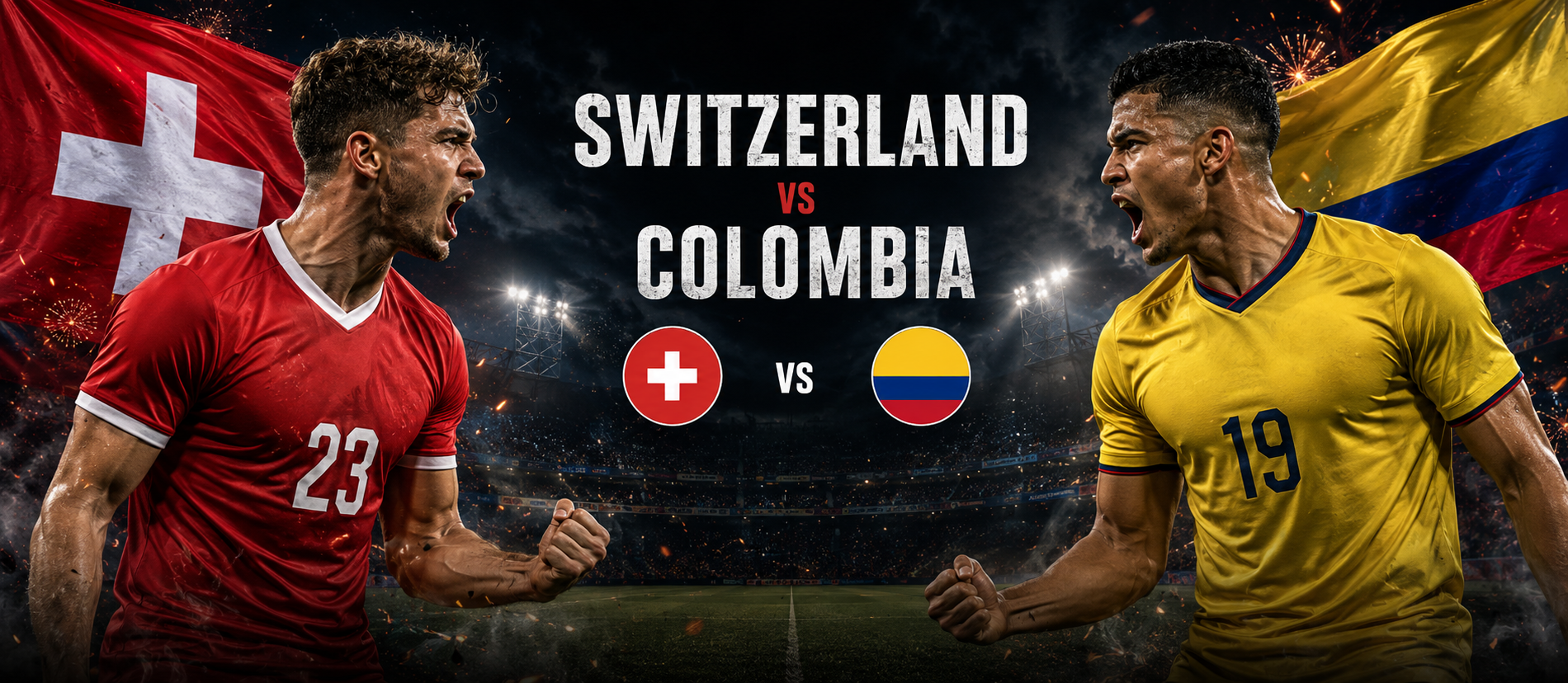
The round’s most even tie
Switzerland vs Colombia World Cup 2026 Round of 16 preview: tactics, squads, suspension risks, key matchups, lineups and our Vancouver prediction.
- July 7, 2026 Tue
- BC Place Vancouver
- Kick-Off 4:00 PM ET
Everything you need at kickoff
- Date
- Tue, July 7, 2026
- Kickoff
- 4:00 p.m. ET 1:00 p.m. local · 20:00 UTC
- Venue
- BC Place Vancouver, Canada
- Stage
- Round of 16 Winner meets Egypt–Argentina winner
- Referee
- Not yet confirmed FIFA names officials 24–48h out
- Weather
- Mild & dry, ~70°F/21°C Roof closed for all matches
- Surface
- Natural hybrid grass Installed for this World Cup
- Rest
- Switzerland: 5 days, no travel Colombia: 4 days + cross-country flight
The two sides have met only once at a World Cup — a group-stage match at USA 1994 that Colombia won 2-0. A circulating claim that they met in 2018 is a mix-up with Switzerland’s win over Serbia. Both teams won their groups (Switzerland topped Group B; Colombia topped Group K) and arrive unbeaten through four matches; this is widely framed as one of the most evenly matched ties of the round.
Structure vs. individual quality
Switzerland are the tournament’s model of controlled improvement. They are unbeaten through four matches, have not conceded since the Canada game, and just delivered their first World Cup knockout win in nearly nine decades using a shape — a back three — that differed from anything they’d shown in the group stage. Their identity is organizational: disciplined defending, patient buildup through Xhaka and Freuler, and a bench (Manzambi above all) capable of deciding games. Their most obvious weakness remains conversion efficiency in open play.
Colombia are the more individually gifted of the two sides and arguably the stingier defensively across the tournament as a whole — just one goal conceded in four matches. Their spine — James Rodríguez orchestrating, Luis Díaz threatening in behind, Muñoz raiding from right-back, Quintero and Arias offering craft — is a match for almost anyone left in the bracket. Their questions are about freshness and finishing: they have needed moments of individual quality rather than sustained control to win two of their four matches, and the James Rodríguez fatigue subplot from Kansas City, combined with the long haul to Vancouver, is a real fitness variable.
The tension of this match: Switzerland’s structural solidity and home-stadium comfort against Colombia’s superior individual ceiling and slightly better defensive numbers, with rest, travel and heat recovery as the wildcard.
How it could unfold
Switzerland’s freshness tells late
A tight, cagey first hour with both defenses on top. Switzerland’s bench — Manzambi, if not starting, or a burst from Okafor/Amdouni — or a set piece breaks the deadlock in the final 25 minutes, and Colombia’s legs, visibly heavier after the travel and heat exposure, cannot respond in time. Something like 1-0 or 2-0 Switzerland. (Most likely.)
Colombia’s quality wins it early
Díaz or Arias produces a moment of individual brilliance inside the first half-hour, before fatigue becomes a factor, and Colombia’s defense — the tournament’s stingiest so far — shuts the door. 1-0 or 2-1 Colombia.
The shootout
Both defenses hold, both attacks are cancelled out, and a genuinely even tie goes to extra time and penalties — the most fitting outcome for what looks like the round’s closest matchup on paper. Draw through 120 minutes, coin-flip shootout.
The statement blowout
Either Switzerland’s structural solidity completely overwhelms a fatigued Colombia (a 3-0 type scoreline), or Colombia’s attacking talent proves too much for a Swiss defense caught in an experimental system (a 3-1 type Colombia win). Given how tight the numbers are, a multi-goal margin either way would be a genuine surprise. (Least likely.)
Qualitative narrative scenarios, ordered roughly from most to least expected. No probabilities are assigned or implied.
Tale of the tape
Switzerland topped Group B — a 1-1 draw with Qatar (Embolo penalty), a 4-1 rout of Bosnia and Herzegovina (Manzambi twice, plus Vargas and a Xhaka penalty) and a 2-1 win over co-hosts Canada (Vargas and Manzambi). In the Round of 32 they beat Algeria 2-0 at BC Place — Embolo (10′) and Ndoye (46′) — for their first World Cup knockout win in 88 years and their first-ever run of three consecutive World Cup wins.
Colombia topped Group K — 3-1 over Uzbekistan (Muñoz, Díaz and a Campaz stoppage-time third), 1-0 over DR Congo (a deflected Muñoz winner) and a 0-0 draw with a Ronaldo-led Portugal in which a late Davinson Sánchez header was ruled out for a marginal offside. In the Round of 32 they beat Ghana 1-0 in Kansas City through an early Jhon Arias goal, then game-managed the rest — with James Rodríguez withdrawn at halftime for heat and fatigue.
Murat Yakin’s group-stage baseline was a possession-oriented 4-2-3-1/4-3-3 hybrid. The Qatar match showed volume without ruthlessness; Bosnia showed how devastating the bench could be once a man advantage opened the game; Canada showed a pragmatic, transition-first approach that scored almost immediately after halftime. The Round of 32 against Algeria was the biggest shift yet: a switch to a back three (Zakaria-Elvedi-Akanji) with Rodríguez and Ndoye in wide, hybrid roles. The throughline is a coaching staff getting progressively more comfortable making bold in-tournament changes.
Néstor Lorenzo’s 4-3-3 has stayed structurally consistent, but the team’s intent evolved: expansive and occasionally loose against Uzbekistan, tighter and more patient against a low DR Congo block, then genuinely elite and compact against Portugal. Against Ghana the approach shifted again — score early, then manage the game defensively rather than press for a second. The clearest evolving subplot is squad management: withdrawing James Rodríguez at halftime for a more physical option (Ríos) suggests Lorenzo is already thinking about a long tournament.
Gregor Kobel is the undisputed No. 1. Manuel Akanji is the defensive leader; Nico Elvedi and Denis Zakaria completed the back three against Algeria. Captain Granit Xhaka sets the tempo with Remo Freuler as the screen. Breel Embolo leads the line, Dan Ndoye was the Round of 32’s standout, and Johan Manzambi — three group-stage goals off the bench — is the constant selection debate. Injuries: Luca Jaquez (muscle) missed Algeria and Silvan Widmer’s fitness is unconfirmed — both flagged. Suspensions: none, and Switzerland picked up zero cards against Algeria, so no player carries any disciplinary risk.
David Ospina remains the senior No. 1, though one post-Ghana report suggesting Camilo Vargas could start is an unresolved discrepancy. Daniel Muñoz is the breakout attacking weapon with two group-stage goals from right-back; Davinson Sánchez, Yerry Mina and Jhon Lucumí form the back line that has conceded only once. James Rodríguez remains the creative fulcrum in what is very likely his final World Cup; Luis Díaz is the most explosive threat. Injuries: an unverified knock to Jhon Córdoba, plus James’s monitored workload. Suspensions: none — but Jhon Arias and Richard Ríos are each one caution away from missing the Quarterfinal after being booked against Ghana.
- Disciplined defending and organization — no goals conceded since the group’s second match.
- Bench depth, with Manzambi capable of deciding games late.
- A coaching staff willing to change shape entirely for a knockout tie.
- A clean disciplinary sheet — no card risk into this match.
- The tournament’s stingiest defense — one goal conceded in four matches.
- An elite individual spine: James Rodríguez, Díaz, Muñoz, Quintero and Arias.
- Comfortable protecting a one-goal lead for long periods.
- Elite dead-ball technicians for a possible shootout.
- Conversion efficiency in open play — they can dominate without scoring.
- Ricardo Rodríguez can be targeted for recovery pace in wide areas.
- Finishing — they have needed individual moments rather than sustained control to win.
- Freshness — four days’ rest, a long flight and James Rodríguez’s Kansas City fatigue.
- Two key players (Arias, Ríos) one booking from a Quarterfinal ban.
Who reads the moments better
Murat Yakin has shown, across four matches, an increasing willingness to change shape entirely rather than force a system — the shift to a back three against Algeria being the clearest evidence yet. His public comments after that win were measured rather than triumphant, crediting defensive solidity above individual brilliance and stressing that there are no easy opponents in the knockout rounds.
Néstor Lorenzo has built a settled, defensively excellent 4-3-3 that matured visibly across the group stage, capped by the scoreless draw with Portugal. His clearest in-tournament management decision was substituting James Rodríguez at halftime against Ghana for fitness reasons — a sign he is willing to prioritize the tournament’s arc over any single match, which could matter again given the short turnaround to Vancouver.
The meta-battle: Yakin has shown more willingness to adapt shape reactively within a single knockout match; Lorenzo more willingness to manage his best player’s minutes proactively across the tournament. Whoever reads the specific in-game moments of this tie better likely decides it.
Key duels to watch
Luis Díaz vs Switzerland’s back three
If Yakin repeats the back-three system, Díaz’s ability to isolate a wing-back in transition is Colombia’s clearest route to goal.
Daniel Muñoz vs Dan Ndoye
Two of the form full-back/wide players of the round on opposite flanks, potentially matched up directly. Whoever wins their side of the pitch could decide the tie.
Granit Xhaka vs James Rodríguez
The two captains and the two metronomes. Whichever midfield controls the ball longer likely controls the match.
Manuel Akanji vs Jhon Córdoba / Luis Suárez
Akanji’s aerial and positional command against Colombia’s central striker options — more important if Colombia go direct to manage James Rodríguez’s minutes.
The Swiss bench vs Colombia’s fatigue
With Colombia carrying a heavier travel and heat-recovery burden, the final 20-30 minutes could again favor Switzerland’s deeper reserve of impact substitutes.
Arias and Ríos’s discipline vs the referee’s whistle
Both are one caution away from missing the Quarterfinal — a live tactical consideration for Lorenzo about when, or whether, to substitute either proactively.
The fatigue gap is arguably the single biggest structural storyline of the match. Switzerland have not left Vancouver since their July 2 win — five days’ rest, zero travel, and a stadium they know intimately. Colombia beat Ghana in Kansas City on July 3, giving them four days and a long relocation to the Pacific coast, with James Rodríguez reportedly withdrawn at halftime specifically because of the heat. If the match is still level with 20-25 minutes to go, the team with fresher legs and the deeper bench holds a real edge.
The names that decide it
Untested in high-value moments but composed and error-free through four matches.
The defensive lynchpin in both the back four and the Algeria back three; reads transitions superbly.
Calm, positionally excellent, an ideal partner for Akanji.
His elevation into the back three against Algeria paid off, including the interception that led to Ndoye’s goal.
Experienced and reliable, but can be targeted for recovery pace in wide areas.
The tournament’s metronome for Switzerland; controls tempo and scored a key penalty in the group stage.
Disciplined, wins his duels, rarely the story but always effective.
Scored the decisive second goal against Algeria and was arguably the Round of 32’s best Swiss performer.
Consistent scoring contributor across the group stage.
Opened the scoring against Algeria; a persistent physical and penalty-box threat.
Three group-stage goals from the bench; the single most talked-about individual storyline in the Swiss squad.
Composed and experienced; beaten only once across four matches (subject to the goalkeeper-selection caveat).
Two group-stage goals from right-back; arguably Colombia’s most in-form outfield player.
Defensively excellent against Portugal, unlucky to have a header ruled out.
Part of a back line that has conceded only once all tournament.
Still the creative fulcrum and a legacy-defining presence, though the Ghana halftime withdrawal is a fitness flag worth monitoring.
The screening presence that lets James and Quintero operate further forward.
Decisive creative and set-piece influence; assisted the DR Congo winner.
Scored the Ghana winner; must now also manage being one card from a quarterfinal absence.
Colombia’s most dangerous individual attacker; scored and assisted in the opener and remains the likeliest matchwinner.
Solid but unspectacular in front of goal, and (unverified) carrying a knock into this tie.
Momentum Meter
Switzerland — confident, trending toward red hot. Unbeaten through four matches, a first knockout win in 88 years, no goals conceded since the group’s second match, and a breakout star in Manzambi still to be fully unleashed. The tactical flexibility shown against Algeria adds to the sense of a team peaking at the right time.
Colombia — confident, tempered by fitness questions. Also unbeaten, with the tournament’s stingiest defense and individual quality running through the XI. But the James Rodríguez fatigue subplot and the long travel leg introduce a note of uncertainty that Switzerland simply don’t have to answer.
What would — and wouldn’t — surprise us
A one-moment game
A tight, low-scoring game decided by one moment of quality or one fresh substitute.
Díaz or Ndoye scores
Luis Díaz or Dan Ndoye on the scoresheet.
A nervy finish
A nervy final 20 minutes regardless of who is ahead.
Extra time or penalties
Extra time and/or a shootout, given how evenly matched the two sides look on the group-stage and Round of 32 evidence.
Rotated discipline
Neither Arias nor Ríos playing the full 90, as Lorenzo manages their disciplinary risk.
A blowout
A comfortable, multi-goal win for either side (3-0 or worse).
Switzerland leaking goals
Switzerland conceding multiple goals, having shipped only three across four matches.
Colombia’s defense cracks
Colombia’s defense — the tournament’s stingiest among the sides reviewed here — conceding more than once.
A James farewell winner
James Rodríguez, playing what may be his final World Cup, scoring the winning goal in a signature late-career moment.
A Kobel error
A Swiss goalkeeping error, given Kobel’s clean record so far this tournament.
How each team wins it
Framing Colombia as the underdog here is more about situational factors — rest, travel, home-stadium comfort for Switzerland — than a genuine quality gap. This is arguably the most evenly matched tie of the round on paper.
Why the favorite (Switzerland) should win
- Home-stadium comfort: a third straight match at BC Place, on a pitch and in a building they already know.
- Rest advantage: five days versus four, and — more significantly — zero travel versus a long cross-continent relocation.
- Tactical flexibility already proven: Yakin has shown he’ll change system for a knockout tie and been rewarded for it.
- Bench depth: Manzambi’s form suggests Switzerland can introduce a genuine matchwinner in the final third of the game.
- No disciplinary risk: Switzerland enter with a clean card sheet, while Colombia must manage two players one caution from the quarterfinal.
How the underdog (Colombia) can win
- Lean on individual quality early, before fatigue becomes a factor — Díaz isolating a wing-back, or a Quintero set piece, in the first 30 minutes.
- Manage James Rodríguez’s minutes proactively, not reactively, preserving both energy and structure.
- Avoid needless cards from Arias and Ríos, both one caution from missing the quarterfinal.
- Exploit Switzerland’s back three if Yakin repeats it — the channels behind the wing-backs are where Díaz and Muñoz thrive.
- Draw Switzerland into a compact, low-event game that plays to Colombia’s defensive strength.
- Trust the goalkeeper and set pieces to steal it if open play stalls.
Penalty Shootout Analysis
If the tie is level after 90 (and, per the knockout format from this round onward, extra time), a shootout is genuinely plausible given how tight the quality gap is. Switzerland have composed takers in Xhaka, Embolo and Vargas and a reliable goalkeeper in Kobel. Colombia counter with James Rodríguez, Quintero and Díaz — all experienced, high-pressure performers — and Ospina’s big-tournament pedigree in goal. Neither side has been forced to a shootout yet this tournament. On paper it looks close to a coin flip; if anything, Colombia’s array of elite dead-ball technicians gives them a marginal psychological edge, offsetting Switzerland’s edge in structure and freshness.
Best guess at kickoff
Provisional and speculative. Neither federation has confirmed an official lineup as of the time of writing — treat everything as informed projection based on the most recent match selections, not confirmed team news. Colombia’s starting goalkeeper is subject to a flagged uncertainty, with one report suggesting Camilo Vargas over David Ospina.
Dan Ndoye is directly involved — goal or assist — in whatever Switzerland produce, continuing his Round of 32 form.
James Rodríguez does not play all 90 minutes, regardless of the scoreline, as Lorenzo continues to manage his workload. At least one of Jhon Arias or Richard Ríos is booked, forcing a genuine quarterfinal-availability sweat for Colombia. A set piece produces a goal or a clear, deflating chance for at least one side. And if Switzerland use the back-three system again, Colombia’s first clear chance comes from exploiting the space behind a Swiss wing-back.
The weight each side carries
Colombia carry the heavier weight of expectation. A nation that missed the 2022 World Cup entirely and remembers the golden generation of 2014 will see a squad this talented — James, Díaz, Muñoz, Quintero — as one with genuine title-contending potential if the draw is kind. Anything less than a deep run would be viewed domestically as underachievement given the individual quality on the teamsheet.
Switzerland play with comparatively more freedom. Reaching a first World Cup knockout win in 88 years already represents a landmark, and a quarterfinal berth would be a genuine story regardless of what follows — though Yakin’s group has shown enough that failing to reach it here would sting more than it would have a month ago.
The turning point comes with a Swiss goal in the final 25 minutes, exploiting fresher legs and bench depth against a Colombian side managing fatigue from the Kansas City heat and cross-country travel. Man of the Match: Dan Ndoye, with Luis Díaz the obvious alternate shout if Colombia’s individual quality decides the game instead.
This is close to a coin flip on pure quality — Colombia may well have the better individual talent and arguably the better defensive record — but Switzerland’s home-stadium comfort, extra day of rest, zero travel, clean disciplinary sheet and demonstrated bench impact tip the balance. Confidence is moderate on the outcome and low on the exact scoreline: this looks like the most evenly matched Round of 16 tie in our research, and a Colombia win, a draw through 120 minutes, or a low-scoring Swiss win are all genuinely live outcomes.
One win from history
The winner advances to face the winner of Egypt vs Argentina, played earlier the same day at Mercedes-Benz Stadium in Atlanta. Argentina reached that tie by beating Cabo Verde in extra time and enter as heavy favorites over an Egypt side making a first Round of 16 appearance since 1934 after eliminating Australia on penalties — meaning the most likely quarterfinal opponent for the winner here is Lionel Messi’s Argentina, though Egypt’s run shows the format’s capacity for surprise.
For Switzerland, reaching a modern-era quarterfinal would be a genuine historic achievement — their only deeper run came on home soil in 1954. For Colombia, it would match their best-ever finish (2014) and, with this squad’s attacking talent, open a realistic conversation about a run all the way to the final four. Either way, a probable date with Argentina raises the stakes considerably — and adds motivation to win this tie comfortably enough to arrive at that test with fresh legs.
