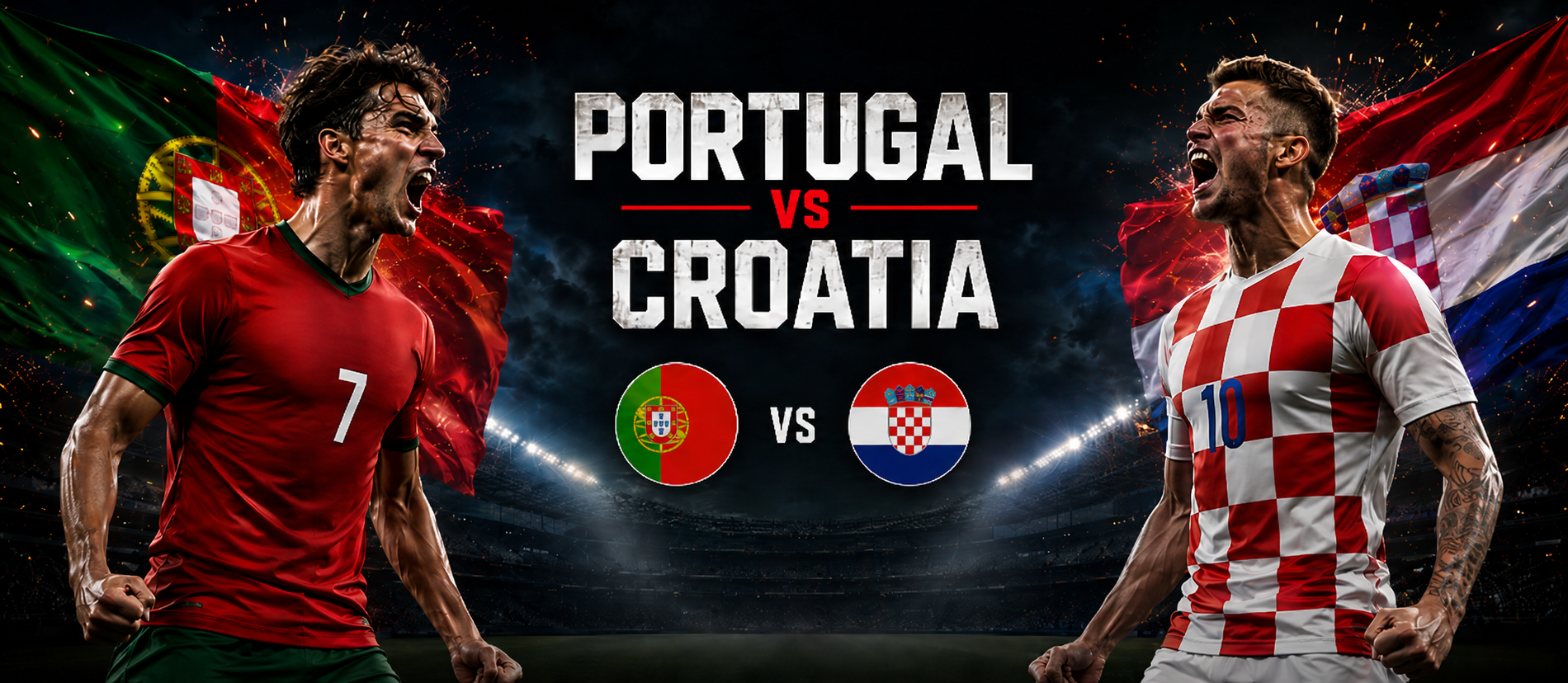
Ronaldo, Modric and the Last Dance
Portugal vs Croatia Round of 32 preview: Ronaldo vs Modric in Toronto on July 2. Form, tactics, lineups, key matchups and our verified score prediction.
- July 2, 2026 Thu
- BMO Field Toronto
- Kick-Off 7:00 PM ET
Whoever wins the tempo battle most likely wins.
Portugal are a team of extremes. At their best — the Uzbekistan night — they are as talented front-to-back as anyone in the tournament: a world-class spine of Diogo Costa, Ruben Dias, Vitinha, Bruno Fernandes and a forward line bursting with pace in Rafael Leao and Pedro Neto. At their worst — the DR Congo and Colombia stalemates — they are ponderous against organised defences, over-reliant on individual moments, and prone to letting games drift. Ronaldo remains the emotional and goalscoring focal point, but the team’s identity is now built around Vitinha’s midfield control and the PSG/City-laden engine room around him.
Croatia are, as ever, defined by their midfield and their tournament temperament. They lost their opener to England and still progressed with calm authority, because when Modric, Kovacic and the supporting cast get on the ball, Croatia control time itself. The concern is the same one that has shadowed them for years and now bites harder: pace and athleticism at the back, and what happens when the game becomes a sprint rather than a chess match. England exposed exactly that. Portugal, with Leao and Neto, have the runners to try the same.
Portugal want the game fast and open; Croatia want it slow and controlled. Whoever imposes their tempo most likely wins.
Everything you need at kickoff
- Fixture
- Match 83 · Round of 32 Portugal vs Croatia
- Date
- Thu, July 2, 2026
- Kickoff
- ~7:00 p.m. ET Verify against final FIFA listing
- Venue
- BMO Field "Toronto Stadium," Toronto, Canada
- Stage
- Round of 32 Winner advances to Round of 16
- Bracket
- Portugal: Group K Runners-Up Croatia: Group L Runners-Up
- Days of rest
- Both: 4 days Both finished group stage June 27
- Referee
- Not confirmed FIFA had not published Match 83 appointment as of June 29
Both teams finished the group stage on Saturday, June 27 — Portugal drawing 0-0 with Colombia in Miami, Croatia beating Ghana 2-1 in Philadelphia. That gives both sides four full days before kickoff on July 2 — no rest advantage either way, which is rare and worth noting. BMO Field is an open-air stadium; early-July Toronto typically sits in the low-to-mid 20s Celsius by evening, with a realistic chance of passing showers. Forecasts this far out diverge — treat exact conditions as provisional.
A farewell stage for two of the game’s greats
Portugal carry the heavier burden. They are favourites by reputation and squad value, they carry the emotional weight of the Diogo Jota tribute — the symbolic ’27+1′ squad member, whose family attend as guests of the federation — and this is framed as Ronaldo’s last realistic shot at a World Cup. Anything short of the Round of 16 would be a national disappointment.
Croatia play with the freedom of the perennial overachiever. Runners-up in 2018, semi-finalists in 2022, written off again in 2026 — and yet here. Modric’s farewell adds emotion but not the same expectation. They are dangerous precisely because the pressure sits on the other bench.
The winner advances to the Round of 16. For Portugal, advancing keeps alive the Ronaldo farewell narrative and a realistic deep run given the squad’s talent. For Croatia, it would extend Modric’s final World Cup and reinforce their identity as the tournament side nobody wants to draw. The loser goes home — and for both Ronaldo (41) and Modric (40), that would almost certainly be the final act of a World Cup career.
Croatia are dangerous precisely because the pressure sits on the other bench.
Narratives writing themselves
The last dance of two legends
Cristiano Ronaldo (41) and Luka Modric (40) are almost certainly playing their final World Cup. Two of the defining footballers of the last two decades, meeting in a single-elimination match in Toronto. Toronto did not plan it, but it could hardly have scripted it better.
The Diogo Jota tribute
Jota and his brother died in a car accident in 2025, weeks after helping Portugal win the Nations League. Martinez carried him as a symbolic ’27+1′ squad member; the players wear wristbands bearing his name, Ruben Neves wears the number 21 in his honour, and Jota’s family have attended as guests of the federation. It is the emotional backdrop to Portugal’s entire campaign.
Ronaldo makes history at six different World Cups
Against Uzbekistan, Ronaldo became the first player ever to score at six different World Cups — a brace that pushed his career tally to 10 goals, more than any other Portuguese player, Eusébio included. He then started vs Colombia to become the oldest outfield player to start a World Cup match (41 years and 132 days), matching Messi by appearing at a sixth World Cup finals.
Modric: oldest assist in World Cup history
Modric’s corner delivery set up Vlasic’s decisive header against Ghana, making the 40-year-old the oldest player on record to provide a World Cup assist. His legs over 120 minutes are the variable every Dalic substitution decision revolves around — but, at 40, the brain and delivery that define him are undimmed.
Croatia’s venue familiarity in Toronto
Croatia have already played at BMO Field (Toronto Stadium) this tournament — beating Panama 1-0 in the group stage, with Budimir scoring and Stanisic assisting. The surface and surroundings are familiar territory heading into the Round of 32.
Portugal and Croatia meet at a World Cup for the first time.
Tale of the tape
Portugal qualified from Group K as runners-up (5 points): 1-1 vs DR Congo (J. Neves 6′; Wissa 45+), 5-0 vs Uzbekistan (Ronaldo 6, 39; N. Mendes 17; Nematov OG 60; Leao 87), 0-0 vs Colombia. The Uzbekistan demolition — Ronaldo’s historic brace, five goals of varied quality — was a tournament high; the flat draw with Colombia illustrates the gap between Portugal’s ceiling and floor.
Croatia progressed from Group L as runners-up (6 points, behind England): 2-4 vs England (Baturina 36, Musa 45+5), 1-0 vs Panama (Budimir, Stanisic assist), 2-1 vs Ghana (Vlasic; second Croatian scorer flagged as uncertain across sources; Luckassen 73′ for Ghana). A bad opening loss, then two controlled results — the tournament discipline that has defined Croatia’s last decade.
Portugal are now built around Vitinha’s midfield control, with Joao Neves providing energy and Bruno Fernandes the creative thrust. Rafael Leao and Pedro Neto supply pace on the wings. Martinez has shown two faces: bold attacker (Uzbekistan) and pragmatic defender (Colombia). His question in Toronto is which tempo he chooses — and which version of Portugal shows up against Croatia’s control game.
Croatia under Dalic are defined by their midfield and tournament temperament. When Modric, Kovacic and the supporting cast get on the ball, Croatia control time itself. Their blueprint against Portugal will resemble the Panama game: slow the tempo, dominate the ball, lean on set pieces and Modric’s craft, and stay in the match until a moment of quality or a shootout. Dalic learned from the England chaos and hardened Croatia’s identity around control-and-set-pieces.
Diogo Costa was excellent against Colombia, keeping a clean sheet against a lively Colombian front line. Portugal conceded just once in the group (Wissa’s header vs DR Congo). Ruben Dias marshals the back line and is the defensive leader. The back four is strong and deep — Nuno Mendes (PSG), who scored against Uzbekistan, is among the best left-backs in the world.
Croatia's Achilles Heel
The concern is pace and athleticism at the back — a vulnerability that has shadowed Croatia for years and bites harder in 2026. Outside Gvardiol, Croatia can be got at in behind. England exposed exactly this; Portugal, with Leao and Neto, have the same tools. Their forwards (Budimir and Musa) also lack elite pace, putting even more onus on the midfield to create.
- Superior talent at most positions — from Diogo Costa in goal to a forward line of Ronaldo, Leao and Neto — with more match-winners per position than Croatia.
- Pace on the wings (Leao and Neto) to exploit Croatia’s primary vulnerability: the back line outside Gvardiol’s zone.
- Deep bench that can change the game — Goncalo Ramos, Bernardo Silva, Matheus Nunes and Joao Cancelo all capable of altering a match late.
- Midfield engine: Vitinha, Joao Neves and Bruno Fernandes give Martinez flexible solutions in and out of possession.
- Diogo Costa’s form and the squad’s proven ability to defend a result — as the Colombia stalemate showed.
- World-class midfield control: Modric and Kovacic dictate tempo and can hold the ball to drain the clock better than almost any side.
- Set-piece delivery: Modric’s corner that set up Vlasic’s decisive header vs Ghana proves the weapon is live in tight knockout games.
- Tournament pedigree and shootout credentials: 2018 runners-up, 2022 semi-finalists, and Livakovic as a proven penalty-shootout hero.
- Venue familiarity: Croatia have already played at BMO Field this tournament, beating Panama 1-0 here — a small but genuine edge.
- Resilience: beaten by England in the opener, Croatia progressed with calm authority — the hallmark of a team that knows how to survive.
- Ponderous against organised deep defences — the DR Congo and Colombia draws exposed the failure mode: possession without penetration.
- Ronaldo’s role is now situational; in tight, controlled games he can become isolated and the team’s reliance on individual moments shows.
- Finishing second in Group K puts them on the harder bracket fork — anxiety can influence decisions under pressure.
- Pace deficit at the back outside Gvardiol — England exposed this in transition; Portugal have exactly the same tools to exploit it.
- Forwards lack top-tier pace and creativity in behind — Budimir and Musa are functional finishers, not gamebreakers.
- Over 120 minutes, Modric’s legs are the variable — and losing his tempo control changes Croatia’s identity fundamentally.
Tempo versus control
Roberto Martinez has shown two faces in the tournament: the bold attacker who unleashed Portugal on Uzbekistan, and the pragmatist who set up to protect a point against Colombia. His big calls are around tempo and Ronaldo’s minutes — start him and build around him, or use him as a weapon late? Martinez backed Ronaldo through the pre-tournament noise and was rewarded. Expect him to try to make the game fast and stretch Croatia’s defence.
Zlatko Dalic is the master of the slow burn. He knows his squad cannot win a track meet — so his blueprint is the Panama game: dominate the ball, control the tempo, lean on set pieces and midfield craft, stay in the match until a moment of quality or a shootout. Dalic’s tournament record in tight knockouts — runners-up 2018, semis 2022 — is the reason no one should dismiss Croatia regardless of the form line.
Key duels to watch
Vitinha vs Mateo Kovacic
The battle for midfield tempo. If Vitinha dictates, Portugal play fast and Croatia chase. If Kovacic slows it and Croatia win the second balls, the game becomes the kind of controlled grind Croatia want. This is the match’s true control room.
Rafael Leao / Pedro Neto vs Croatia’s back line
Portugal’s pace against Croatia’s primary vulnerability. Outside Gvardiol, Croatia can be turned and run at. Every Leao isolation against a non-Gvardiol defender is a moment of danger.
Luka Modric vs the Portugal press
If Portugal press aggressively, can the 40-year-old still find the picture under pressure? His Ghana assist says yes. But Portugal’s young midfield runners — Joao Neves in particular — will hunt him.
Cristiano Ronaldo vs Josko Gvardiol
The veteran’s box instincts against the best young defender on the pitch. Ronaldo’s threat is now situational — crosses, set pieces, transition — and Gvardiol is exactly the athlete built to limit him.
Set pieces: Bruno Fernandes / Modric delivery vs both penalty areas
Both teams scored or threatened from dead balls in the group stage. With two elite deliverers, this could decide a tight game — Croatia’s set-piece winner vs Ghana and Portugal’s midfield delivery are equally dangerous weapons.
The chess match is tempo versus control. Whoever blinks first on game state — Portugal forcing it open, or Croatia successfully slowing it down — gains the edge. Both managers are comfortable with either instruction; the players’ execution will settle it.
The names that decide it
The metronome — Portugal’s most important outfield player and the engine of everything they do well. If Vitinha dictates the tempo against Kovacic, Portugal win the midfield battle. Named as MOTM in our final prediction: his tempo control is the reason Portugal could survive Croatia’s grind and reach a penalty lottery.
First player to score at six different World Cups; 10 career World Cup goals; oldest outfield player to start a World Cup match (41y 132d vs Colombia). The emotional leader and a genuine threat from set pieces and transition. Facing Gvardiol is his primary defensive challenge.
Decisive vs Uzbekistan; a consistent pace threat who isolates Croatia’s non-Gvardiol defenders. Every Leao one-v-one against a slower Croatian centre-back or full-back is a high-danger moment — this is Portugal’s most repeatable way to unlock a defensive block.
The creative hub and set-piece delivery for Portugal. He assisted the opening goal vs DR Congo and provides the link between midfield and attack. Can be wasteful but is always involved — in a game where set pieces matter, his delivery is a weapon.
8.5 form rating — the highest among Portugal’s outfield starters. Scored against Uzbekistan (free-kick), relentless overlaps, defensively sound. Portugal’s best all-round group-stage performer, overlooked in favour of the big names but central to everything Portugal do well.
40 years old, fifth World Cup, captain, and now the oldest player on record to assist at a World Cup (vs Ghana). His brain and delivery are undimmed; his legs over 120 minutes are the variable every Dalic substitution decision revolves around.
Croatia’s best defender and quickest centre-back — back from a broken shin and confirmed fit. His athleticism is the answer Croatia have to Portugal’s pace threat. Gvardiol vs Ronaldo and Leao is the defensive duel that decides whether Croatia hold the line.
Press-resistant, carries Croatia through pressure, and is the engine behind their ball-retention game. If Kovacic wins his duel with Vitinha for midfield control, Croatia slow the game and frustrate Portugal into the kind of narrow, low-event match Dalic designs for.
Set-piece menace who scored the decisive goal vs Ghana from a Modric corner. Two-goal threat from deep in the group stage; in a tight knockout where set pieces matter, his movement and finishing from corners and free-kicks make him Croatia’s most dangerous scoring option.
Dependable starter and the single biggest reason Croatia’s penalty-shootout pedigree is a genuine strength rather than a hope. His 2022 knockout heroics are a known psychological factor — if this game goes to penalties, opposing teams know exactly who is standing in goal.
Rising Stars & Breakout Candidates
Portugal: Nuno Mendes (8.5 form rating, the highest among Portugal’s outfield starters) has been the team’s most complete performer end to end — a scorer, a creator and a defensive anchor at left-back. The group stage spotlight bypassed him in favour of Ronaldo and Leao, but in Toronto his output will be central. Joao Neves, who scored against DR Congo and brings relentless energy to the press, is the young runner whose tournament coming-of-age may arrive in the knockouts.
Croatia: Martin Baturina scored against England and was Croatia’s brightest young creator in the group. At Como, he has developed one of the most elegant midfield games in the squad; a big knockout performance in Toronto would announce him on the global stage. Luka Sucic (Real Sociedad) adds fresh midfield legs and directness — watch for either as the Modric-replacement-in-waiting.
Six World Cups, one historic assist, and a first-ever knockout meeting
Ronaldo scores at six different World Cups — a first in history
Cristiano Ronaldo’s brace against Uzbekistan made him the first player ever to score at six different World Cup tournaments, pushing his career tally to 10 goals — more than any other Portuguese player, Eusébio included. He achieved the feat at the age of 41.
Oldest outfield player to start a World Cup match
Ronaldo started Portugal’s 0-0 draw with Colombia at 41 years and 132 days, becoming the oldest outfield player on record to start a World Cup match. In doing so he also matched Lionel Messi by appearing at a sixth World Cup finals.
Modric: oldest player on record to assist at a World Cup
Luka Modric’s corner delivery set up Vlasic’s decisive header against Ghana, making the 40-year-old Croatian captain the oldest player ever to provide a World Cup assist — during what is likely his fifth and final World Cup.
Portugal and Croatia meet at a World Cup for the first time
Despite decades of international football and multiple shared European Championships, Portugal and Croatia have never met at a World Cup before this Round of 32 tie. Historically, Portugal have the better head-to-head record across all competitions.
Croatia have played at BMO Field before — this tournament
Croatia beat Panama 1-0 at Toronto Stadium (BMO Field) in the group stage, with Budimir scoring and Stanisic assisting. They return to the same venue for the Round of 32 — a familiarity advantage no other team in this tie possesses.
Best guess at kickoff
Projections based on group-stage selections and reported fitness; not confirmed team news. Croatia’s exact left-back is the least certain call — the source lists ‘left-back (confirm)’ and Dalic rotated across the group. The Modric/Sucic midfield balance is also variable — Dalic may deploy a 4-2-3-1 with more compactness. Confirm against official team sheets on the day.
Nuno Mendes is Portugal’s most influential player, more so than any forward.
Cristiano Ronaldo and Luka Modric both start, and broadcasters spend the first ten minutes on nothing else. The game is decided by a set piece or a substitution, not open-play fluency. Whichever team scores first wins in regulation; if it is 0-0 at 75 minutes, it goes the distance. If it reaches penalties, Livakovic makes at least one save.
One Player Nobody Is Talking About
Nuno Mendes. Portugal’s group-stage form index leader (8.5 — the highest among outfield starters), scorer against Uzbekistan with a clever free-kick, and a relentless contributor at both ends of the pitch throughout the group stage. While the spotlight falls squarely on Ronaldo, Bruno Fernandes and Rafael Leao, Mendes was Portugal’s most complete performer end to end. Martinez’s blueprint of attacking full-back pressure through Mendes’s runs and delivery is the engine Portugal use to stretch defences horizontally — and in a tight knockout against Croatia’s defensive midfield, his ability to arrive late and combine in the final third may prove more decisive than any centre-forward movement.
A Croatian set piece or Portugal substitution forces extra time; the shootout follows. Man of the Match: Vitinha — if Portugal control the midfield enough to survive Croatia’s grind and reach the lottery, his tempo control will be the reason.
This is the hardest kind of game to call — a true coin-flip between Portugal’s superior talent and Croatia’s superior knockout temperament. Portugal’s depth and quality give them the edge over a full match, but Croatia’s defensive solidity in slow games and their shootout pedigree make a clean Portugal win far from guaranteed. We lean Portugal because of bench depth and the sense that, in a one-off, their ceiling is higher and their squad can change the game late. But we hold this loosely. Predicted score: Portugal 1-1 Croatia after 90 minutes and extra time; Portugal to win on penalties. Confidence: low-to-moderate — a Croatia win, particularly on penalties, is entirely live.
The classic Croatian knockout story could repeat — and Ronaldo’s World Cup would end in heartbreak
Nobody would be surprised by a tight, tense, low-scoring knockout that goes to extra time. Croatia frustrating Portugal and forcing a grind. Ronaldo scoring from a set piece or penalty. A late substitute changing the game for Portugal given their bench depth. VAR involvement on a tight offside or penalty call — all of these would fit the expected script.
What would shock the tournament: a Croatia blowout (3-0 or more — their defensive profile makes this very unlikely). Ronaldo being benched from the start. Portugal conceding three or more. A red card for one of the two icons that defines the narrative. Any of those outcomes would be the tournament’s defining story; the exact kind of night knockout football occasionally produces.
For both Ronaldo (41) and Modric (40), the loser’s exit would almost certainly be the final act of a World Cup career.
