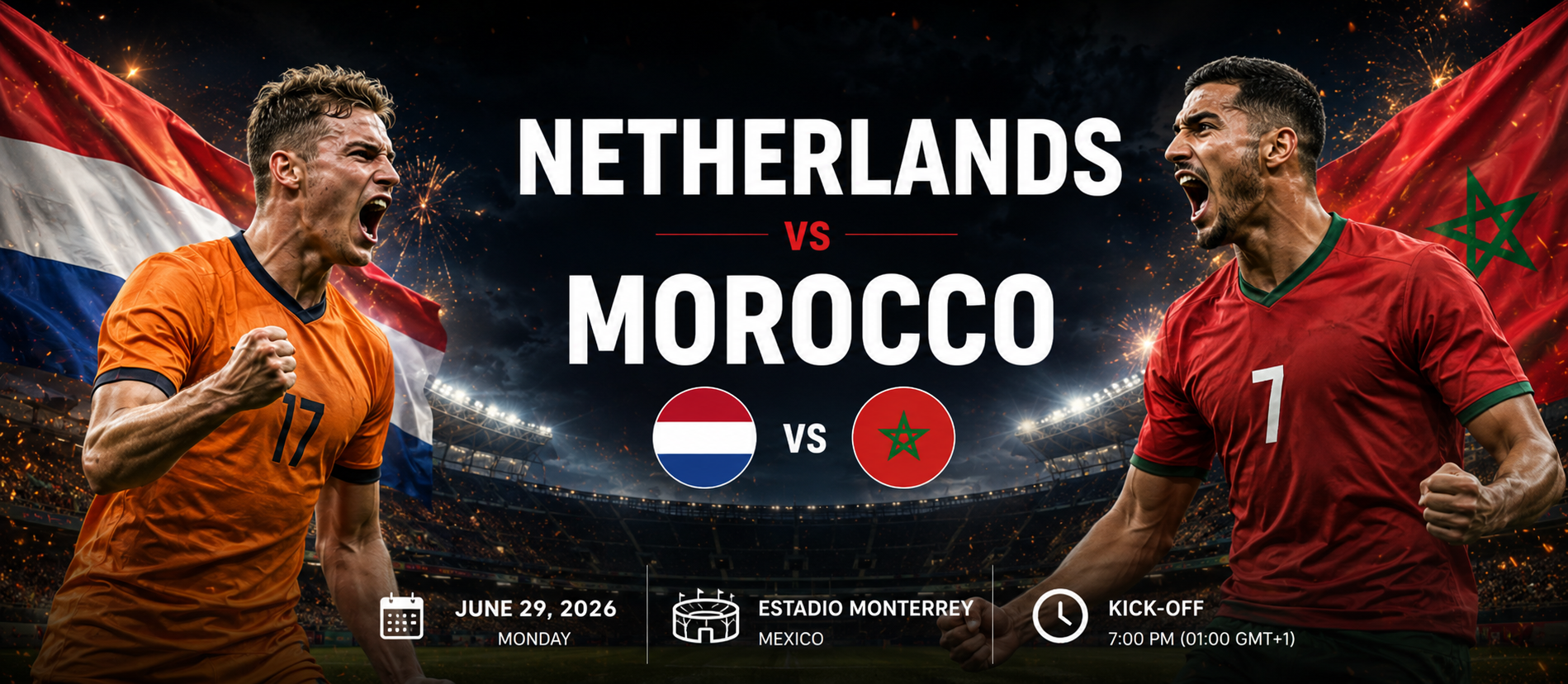
Netherlands vs Morocco
Netherlands vs Morocco World Cup 2026 Round of 32 preview: tactics, predicted lineups, Dutch-born Atlas Lions, key matchups, fatigue, score prediction.
- June 29, 2026 Mon
- Estadio BBVA (Estadio Monterrey)
- Kick-Off 9:00 PM ET
How Fanorate builds this preview.
Fanorate is a research-led, AI-assisted football publication. We do not attend training or run our own fitness tests. Everything below is synthesised from public reporting, official match data and on-the-record quotes, cross-checked as of June 27, 2026. Unconfirmed details are flagged in the Fact-Check Notes. We do not invent probabilities, insider information, or quotes.
Everything you need at kickoff
- Stage
- Round of 32 First knockout round
- Date
- Mon, June 29, 2026
- Kickoff
- 9:00 p.m. ET ~03:00 CET (Jun 30)
- Venue
- Estadio BBVA Guadalupe/Monterrey, Mexico
- Referee
- Wilton Sampaio Brazil
- Conditions
- 30°C+ ~530m altitude
- At Stake
- Winner → Round of 16 vs South Africa/Canada winner (~Jul 4)
- Head-to-Head
- Netherlands lead 2-1 3 meetings, never drawn
Netherlands’ final group match was June 25 (vs Tunisia); Morocco’s was June 24 (vs Haiti) — roughly three to four days of recovery for the Dutch and four to five for Morocco, a marginal but real edge for the Atlas Lions. Monterrey sits at roughly 530 metres above sea level with expected temperatures above 30°C, making heat and mild altitude a genuine factor, especially if the tie reaches extra time.
The gateway to a deep run
The winner advances to the Round of 16 — not, despite some loose bracket talk, a quarterfinal — to meet the winner of South Africa vs Canada, scheduled on or around July 4. That is, on paper, a favourable next assignment for either of these heavyweights, which raises the stakes here enormously: this tie is effectively the gateway to a very winnable last-16 match and a deep run. Beyond that, the bracket points toward potential meetings with Germany, France or Norway in the last eight, with defending champions Argentina on the far side of the draw. For the Netherlands, victory keeps a genuine route to the final open. For Morocco, it would confirm the 2022 semi-final was no accident and validate the bold early-tenure gamble on Ouahbi.
The Netherlands carry the heavier burden of expectation. They are higher-ranked (FIFA No. 7 vs No. 11 at last reading), group winners, perennial nearly-men of the World Cup, and widely tipped as dark horses. A Round-of-32 exit to Morocco would be filed as a serious underachievement at home — and Koeman knows it, which is why he keeps deflecting the favourites label.
Morocco play with the lighter load of the admired underdog who already over-delivered in 2022. A defeat here would be disappointing but not catastrophic; a win would be a statement that the semi-final run was no fluke and that the Ouahbi era has lift-off.
That asymmetry of pressure is itself a Moroccan weapon.
Momentum, fatigue, and four ways it breaks
Momentum: Netherlands high, with an asterisk
Ten goals, top of the group, a ruthless 5-1 and a controlled 3-1 — but two late/mid-game lapses (Japan’s equaliser, Tunisia’s goal) keep the needle just short of maximum.
Momentum: Morocco quietly strong
Unbeaten, level with Brazil, the tournament’s standout breakout forward in Saibari, and a manager preaching belief. The Haiti scare (twice behind) is the dent. Net: momentum slightly favours the Netherlands on goals scored, but Morocco’s unbeaten run and Brazil performance keep them dangerous and confident.
Fatigue: a marginal Moroccan edge
Both squads finished the group on June 24–25, so neither is unusually fresh or jaded. Morocco’s extra day of rest is a marginal plus, and Ouahbi’s heavy rotation against Haiti means his first-choice starters — Hakimi, Mazraoui, Diop, Bouaddi, Ounahi — banked extra recovery. Koeman, by contrast, named close to his strongest side against Tunisia. The Monterrey heat and altitude are the great equalisers: the depth of the Dutch bench could prove decisive in the final 25 minutes — unless Morocco’s own bench (Rahimi, Yassine, En-Nesyri) tips it the other way.
Scenario 1 — Dutch fast start, controlled win
The Netherlands strike early (as vs Sweden and Tunisia), Morocco have to chase, and Dutch midfield control plus bench depth see it out. Plausible scoreline: Netherlands 2-0 or 2-1. This is the most likely path if the Dutch avoid their concentration lapses.
Scenario 2 — tight transitional chess match
Morocco press in spells and defend the box; the game hinges on one set piece or one Saibari/Hakimi transition. Could fall either way. Plausible: 1-0 either team, or 1-1 into extra time.
Scenario 3 — the upset
Morocco repeat their opening-30 intensity from the Brazil game for longer, are clinical, exploit the Dutch back post, and ride Bounou. Plausible: Morocco 2-1, or a 1-1 draw and a Moroccan shootout win. This is the realistic upset route, and it is far from far-fetched.
Scenario 4 — goalfest swinging on lapses
Both defences misfire (Dutch back-post softness vs Aguerd-less Moroccan centre); end-to-end chaos. Plausible: 3-2 either way. Less likely than 1 or 2 but consistent with both teams’ group-stage profiles.
What would surprise nobody
A Dutch early goal followed by a nervy finish; Morocco scoring from a quick transition or a Hakimi-instigated overload; a late substitution (Rahimi/Yassine for Morocco; Summerville/Depay for the Dutch) changing the game; a booking-heavy, physical midfield battle around De Jong; extra time, given how evenly the two sides project.
What would shock the tournament
A Moroccan blowout (3-0 or more) against a Dutch side tipped as dark horses; a Bounou red card or a catastrophic Dutch defensive collapse; Saibari being completely anonymous after three goals in three games; the Netherlands losing despite scoring first.
No fabricated percentages — these are qualitative, evidence-based pathways.
Tale of the tape
The Netherlands arrived among the dark-horse favourites and left the group stage as one of the form attacking sides, scoring ten goals across three matches. They opened with a 2-2 draw against Japan in which they led twice and were pegged back twice — Van Dijk’s 51st-minute header and Summerville’s 64th-minute finish answered each time, before a stoppage-time Ogawa header (off Kamada) exposed Dutch fragility defending late crosses. The response was emphatic: a 5-1 demolition of Sweden, with Brobbey scoring twice inside 17 minutes and Gakpo twice early in the second half, and substitute Summerville adding a late fifth. Top spot was sealed with a 3-1 win over Tunisia — an early Skhiri own goal and Brobbey’s seventh-minute strike (his third of the tournament) before Van Hecke restored the margin — and Koeman noted the Dutch finished the group without any cards, injuries or suspensions.
Morocco finished level on points with Brazil and second only on goal difference — confirming the 2022 semi-finalists remain a serious side, now under a new coach. They opened with a statement 1-1 draw against Brazil: Ismael Saibari punished slack defending on 21 minutes, chipping Alisson after latching onto a Brahim Díaz through-ball, before Vinícius Júnior equalised with a stunner and Alisson produced a late double save. A 1-0 win over Scotland followed — Saibari striking after just 71 seconds, the fastest goal of the 2026 World Cup to that point and Morocco’s fastest ever at a World Cup — before Morocco managed the game. With qualification effectively in hand, a heavily rotated side twice fell behind to Haiti before recovering to win 4-2, Hakimi (goal and assist) and Saibari keeping them level and substitutes Rahimi and Yassine sealing second place.
This is a high-ceiling attacking team with arguably the deepest forward line in the tournament: Gakpo, Brobbey, Malen, Summerville, Depay, Kluivert, Lang and Weghorst give Koeman options most managers would envy. The midfield trio of Gravenberch, Reijnders and Frenkie de Jong combines press resistance, progression and control, and Van Dijk remains the organising spine. The recurring concern is defensive concentration in transition and from set pieces — Japan punished it, Tunisia briefly exploited it. Against a counter-attacking, set-piece-aware Morocco, those lapses are the obvious fault line.
The 2022 semi-finalists are now coached by Mohamed Ouahbi, the Belgium-born tactician who won the FIFA U-20 World Cup 2025 and replaced Walid Regragui after his resignation in March 2026. Ouahbi has nudged Morocco from a pure low-block-and-counter identity toward a more proactive, possession-comfortable approach — “When we defend, it is so we can attack better,” he has said. The Brazil performance proved they can press and play; the Haiti match proved that, rotated, they can be loose. Hakimi’s overlapping runs are the team’s clearest attacking weapon, and Saibari has been the tournament’s revelation up front.
Match 1 (Japan) was a 4-3-3 that flowed forward but left gaps in transition and at the back post. Match 2 (Sweden) saw Koeman trust Brobbey’s penalty-box instincts through the middle and emphasise low cutbacks from both flanks (Gakpo left, Dumfries right) — the most fluent attacking display. Match 3 (Tunisia) was about control and game management with the same spine; the fast start showed the template, the mid-game dip showed the flaw. The likely tweak for Morocco is Micky van de Ven returning at left-back for Nathan Ake, adding recovery pace against Morocco’s quick wide players — a direct response to the transition vulnerability that cost them against Japan.
Ouahbi’s progression has been visible. Against Brazil, Morocco pressed high and kept the ball with confidence. Against Scotland, they showed they can also win low-event games by striking early and managing. Against Haiti, the rotated side revealed how reliant the structure is on its first-choice spine. Expect a 4-2-3-1 with the strongest XI restored — Bounou; Hakimi, Diop, an Aguerd replacement, Mazraoui; a double pivot of Bouaddi and El Aynaoui; Brahim Díaz, Ounahi and El Khannouss behind Saibari — a balance of athleticism, creativity and a forward in red-hot form.
Bart Verbruggen (Brighton) is the clear No. 1, backed by Flekken and Roefs. Van Dijk (Liverpool, captain) and Jan Paul van Hecke (Brighton) started centrally against Tunisia; Denzel Dumfries (Inter) is an attacking outlet at right-back, and Micky van de Ven (Tottenham) is expected to return at left-back for Nathan Ake, bringing recovery pace. The first-choice midfield is Gravenberch, Reijnders and De Jong, with Koopmeiners, De Roon, Wieffer and others in depth. Gakpo, Brobbey and Malen are the likely front three, with Summerville, Depay, Kluivert, Lang and Weghorst off the bench. Xavi Simons (ACL) is not in the squad; Depay made it despite limited minutes; Dumfries and Brobbey were passed fit after slight knocks. No suspensions — a clean group-stage card record.
Yassine Bounou is the No. 1 with no fitness concerns (his “own goal” vs Haiti came off a Lenny Joseph back-heel, not a performance fault). Captain Achraf Hakimi (95+ caps) at right-back is the team’s biggest threat going forward, with Noussair Mazraoui (Manchester United, Amsterdam-born) expected back at left-back. Issa Diop is expected to start centrally; the partner slot is unsettled by the loss of Nayef Aguerd, ruled out of the tournament. A double pivot of Ayyoub Bouaddi and Yahya El Aynaoui is expected, with Bilal El Khannouss and Azzedine Ounahi providing creativity and Sofyan Amrabat (Dutch-born) experienced steel from the bench. Brahim Díaz has been the chief creator (two assists for Saibari); Saibari — PSV’s Eredivisie Player of the Year, reportedly set for Bayern Munich — leads the line as top scorer with three, with bench game-changers Rahimi, Yassine and En-Nesyri.
- The deepest forward line in the tournament — Gakpo, Brobbey, Malen, Summerville, Depay, Kluivert, Lang and Weghorst — bench firepower no opponent in this round can match over 90-plus minutes.
- Midfield control through De Jong, Reijnders and Gravenberch, able to keep the ball away from Morocco and starve the counter.
- Set-piece threat: Van Dijk, Van Hecke and Reijnders’ deliveries have already produced goals.
- A fast start — early goals against Tunisia and Sweden’s early concession show they can put a tie to bed before the opponent settles.
- Pace to cover transitions, with Van de Ven’s likely return addressing their one repeatable flaw.
- A high press that unsettled Brazil and the ability to keep the ball against elite opposition.
- Hakimi’s overlapping runs — the team’s clearest attacking weapon — and 2v1 overloads with El Khannouss and Díaz.
- Aerial threats from set pieces and crosses (En-Nesyri off the bench, Hakimi’s delivery) to attack the Dutch back post.
- A genuine bench weapon: Rahimi and Yassine both scored against Haiti.
- Shootout pedigree — Bounou’s reputation and reliable penalty-takers in Hakimi and Saibari.
- Defensive concentration in transition and from set pieces — Japan punished it, Tunisia briefly exploited it.
- Control can dip mid-game and late, as the Japan equaliser and the spell after Tunisia’s goal both showed.
- The Aguerd-shaped hole at centre-back, where the replacement partner is Morocco’s biggest question mark.
- A rotated side looked defensively soft against Haiti, conceding twice to a far lower-ranked team.
- Sustaining their press and intensity for 90-plus minutes in Monterrey heat.
Koeman vs Ouahbi
Ronald Koeman has the deeper, more decorated squad and a clear template: get early width, hit cutbacks, dominate the ball through De Jong and Reijnders, and use a stacked bench to finish games. His tactical tweak — Van de Ven for Ake — is a direct, pre-emptive answer to the transition softness that nearly cost the Dutch against Japan. Koeman has been pointedly humble in public, refusing the favourites tag and calling this Oranje’s first real knockout test, while Van Dijk has openly said Morocco “have weaknesses we must exploit.”
Mohamed Ouahbi is the wildcard. Three months into the job, fresh off a U-20 world title, he has already shown he will not simply park the bus — Morocco pressed Brazil and kept the ball. His challenge is sustaining that intensity for 90-plus minutes in Monterrey heat and covering the Aguerd-shaped hole at centre-back. His bench is a genuine weapon: Rahimi and Yassine both scored against Haiti, giving him late-game variance. The chess match hinges on whether Ouahbi presses (and risks the space Dutch runners crave) or sits and counters (Regragui’s old blueprint, which beat better teams in 2022).
Key duels to watch
Achraf Hakimi vs Van de Ven / Gakpo
Hakimi’s overlapping runs are Morocco’s most reliable source of chaos. If Van de Ven starts, his recovery pace is the single best Dutch answer; Gakpo’s defensive workrate ahead of him matters just as much. Win this flank and you likely win the match.
Frenkie de Jong vs Morocco’s press
Reijnders expects Morocco to be aggressive in duels. If De Jong can turn out of pressure and progress, the Dutch control the game. If Morocco swarm him (Bouaddi/El Aynaoui), transitions open up.
Brian Brobbey vs Issa Diop and Aguerd’s replacement
With Aguerd out, Morocco’s central pairing is less settled. Brobbey’s physical, back-to-goal play and the threat of Dutch crosses (Dumfries, Reijnders set pieces) target exactly that uncertainty.
Ismael Saibari vs Van Dijk / Van Hecke
Saibari’s movement and quick finishing have already undone Brazil and Scotland. The Dutch centre-backs cannot switch off — Japan and Tunisia both scored when concentration dipped.
The Dutch-born subplot, on the pitch
Mazraoui and Salah-Eddine will be marking and tracking players they call close friends, while Saibari attacks the country he grew up playing football in. Emotion cuts both ways.
Expect a hybrid from Ouahbi: press in spells, defend the box in numbers, and live off Hakimi, Díaz and Saibari in transition.
The names that decide it
7.0. Solid, untested by anything elite; will be busier here.
7.5. Crossing and overlapping threat; defensively he must respect Morocco’s left-side runners.
8.0. Scored vs Japan, organiser-in-chief; the key to nullifying Morocco’s transitions.
7.0. Scored vs Tunisia but was on the wrong side of Japan’s first goal; concentration is the watchword.
7.0 (if restored). His recovery pace is tailor-made for Hakimi and wide threats.
7.5. Assisted Van Dijk; carries and presses well.
8.0. Set-piece deliveries and tempo; one of the Dutch metronomes.
8.0. Press resistance against Morocco’s aggressive midfield will be decisive.
7.0. Direct running on the right.
8.5. Three goals, in-form, won the No. 9 shirt outright.
8.5. Two vs Sweden, the most reliable Dutch attacking talisman.
7.5. Big-game keeper; will need to be at his best, especially in a possible shootout.
8.5. Goal and assist vs Haiti; the team’s spark and danger.
7.0. Steps in amid the Aguerd absence; aerial duels with Brobbey/Weghorst loom.
6.5. Uncertainty here is Morocco’s biggest question mark.
7.5. Two-way full-back, knows the Dutch players intimately.
7.0. Young, energetic pivot; discipline under Dutch midfield rotation is key.
7.0. Anchor; ball-winning against De Jong/Reijnders.
8.0. Two assists; the creative hub.
7.5. Carrying and link play; rested vs Haiti, fresh.
7.5. Creativity and set-piece threat from the left of the band.
9.0. Three goals, the tournament’s breakout forward, and he’ll relish facing Dutch friends.
How to read these ratings
Ratings are 1–10, reflecting current World Cup 2026 form and likely influence on this tie, not career standing.
History and the small print
Three previous meetings
Netherlands lead the head-to-head 2-1: the Dutch won 2-1 at the 1994 World Cup (Bergkamp, Roy), Morocco won a 1999 friendly 2-1, and the Netherlands won a 2017 friendly 2-1 in Agadir. The teams have never drawn.
The fastest goal of the tournament
Ismael Saibari struck after just 71 seconds against Scotland — the fastest goal of the 2026 World Cup to that point and Morocco’s fastest ever at a World Cup.
Three Dutch-born Atlas Lions
Sofyan Amrabat, Noussair Mazraoui and Anass Salah-Eddine were all born in the Netherlands, and several Morocco players know the Dutch squad well.
Bounou’s 2022 shootout heroics
At Qatar 2022 Morocco beat Spain on penalties in the Round of 16, with Bounou the hero, saving twice.
Hakimi’s decisive Panenka
Hakimi memorably converted the decisive Panenka against Spain in that 2022 shootout.
Ten Dutch goals in the group
The Netherlands scored ten goals across three matches, leaving the group as one of the form attacking sides in the tournament.
A referee subplot
Brazilian referee Wilton Sampaio worked the 2022 World Cup, including the Netherlands’ Round of 16 win over the USA; his nationality adds a small subplot given Morocco’s group-stage meeting with Brazil.
Best guess at kickoff
Lineups are projections drawn from Sports Mole and other previews plus group-stage selections; final XIs are at the managers’ discretion. The centre-back partner alongside Diop is uncertain owing to Aguerd’s absence. Netherlands’ likely changes: Summerville or Depay for a tiring forward around the hour, Koopmeiners or De Roon to shore up midfield if protecting a lead, and Ake if reverting to a back five late. Morocco’s likely changes: Rahimi and/or Yassine as attacking changes (both scored vs Haiti), Amrabat to add midfield steel if defending a lead, and En-Nesyri as a target man late.
Ismael Saibari scores or assists — extending the tournament’s best individual storyline against the country he grew up in.
Brian Brobbey scores his fourth goal of the World Cup. Achraf Hakimi completes the most attacking-third entries of any player on the pitch. The match produces at least one goal from a set piece or cross — the Dutch’s proven weapon and Morocco’s proven target. And if it reaches penalties, Bounou makes at least one save.
How the underdog can win
Morocco’s route is specific and mandatory. Win the first 30 minutes the way they did against Brazil — their high press unsettled the five-time champions early, and Saibari’s early goals prove the model; they simply need to be more clinical. Attack the Dutch back post and the half-spaces from set pieces and crosses, the proven weakness Japan and Tunisia both exposed. Use Hakimi to pin the Dutch left-back and create 2v1s with El Khannouss and Díaz, forcing Gakpo to track back and tiring Van de Ven. Make De Jong uncomfortable with aggressive duels and tight marking to choke Dutch build-up and invite turnovers to spring Saibari. Stay disciplined late and back Bounou in a shootout. And weaponise the emotion and the heat: familiarity with the Dutch players removes any intimidation, and Monterrey’s conditions favour the side more comfortable defending in a mid-block and countering.
A shootout is a live possibility in a tie this evenly weighted, and Morocco have genuine pedigree: at Qatar 2022 they beat Spain on penalties with Bounou the hero, saving twice, and they have reliable takers in Hakimi (the decisive 2022 Panenka against Spain) and Saibari. The Netherlands carry their own mixed shootout history — the 2014 quarter-final win over Costa Rica with Tim Krul a famous high, semi-final heartbreak that same year a low. On current evidence, if it goes to penalties, Morocco would arguably be the marginal favourites — a notable inversion of the open-play hierarchy, and a strong reason for the Dutch to settle the tie inside 90 or 120 minutes.
Netherlands 2-1 Morocco — the Dutch to advance, possibly after a scare or extra time. Man of the match (projected): Cody Gakpo, expected to combine goal threat with the defensive diligence needed to help contain Hakimi. The likely turning point: a Dutch set-piece or cross exploiting Morocco’s Aguerd-weakened central defence, against the run of a strong Moroccan opening.
The Netherlands’ superior squad depth, midfield control and bench should, narrowly, tell over the full distance — but Morocco’s press, Saibari’s form, Hakimi’s threat and Bounou’s shootout pedigree make this the most dangerous assignment any “favourite” faces in the Round of 32. We would not be remotely surprised by a Moroccan win or a shootout. Confidence: medium. This is a genuine coin-flip dressed as a mismatch — the Dutch are favoured, but only just.
The favourite’s case rests on squad depth, especially in attack — Gakpo, Brobbey, Malen, Summerville, Depay, Kluivert, Lang and Weghorst give bench firepower no opponent in this round can match over 90-plus minutes. Midfield control through De Jong, Reijnders and Gravenberch can keep the ball away from Morocco and starve the counter-attacks they rely on. Set-piece threat from Van Dijk, Van Hecke and Reijnders targets Morocco’s Aguerd-weakened central defence, the fast start can put a tie to bed early, and Van de Ven’s likely return specifically addresses the one repeatable Dutch flaw.
What’s verified, and what isn’t
Coach correction (important): Morocco’s head coach is Mohamed Ouahbi, not Walid Regragui. Regragui resigned in March 2026; Ouahbi (Belgium-born, FIFA U-20 World Cup 2025 winner) was appointed roughly three months before the finals. Any briefing naming Regragui as current coach is out of date.
Stage correction: The next round for the winner is the Round of 16, not a quarterfinal. The 48-team format runs Round of 32 → Round of 16 → quarterfinals.
Venue naming: The stadium is officially Estadio BBVA (in Guadalupe, Monterrey metro area), widely referred to in World Cup contexts as Estadio Monterrey. Both names refer to the same ground.
Kickoff time: Confirmed as 9:00 p.m. ET, which corresponds to roughly 03:00 in the Netherlands/Morocco and the early hours of June 30 CET — reflected in some European outlets dating the match “June 30.”
Aguerd absence: Reported as ruled out of the tournament with a pre-tournament injury; the identity of his exact replacement alongside Issa Diop is not confirmed, and we have flagged it as uncertain rather than naming a starter with false confidence.
One-yellow-away suspensions: We could not verify a specific named player on either side carrying a single-booking risk, and deliberately did not fabricate one. The Netherlands’ clean group card record was confirmed by Koeman.
Saibari transfer: Reported as set to join Bayern Munich; this is transfer reporting, not an official confirmation. No probabilities in this article are presented as statistical model outputs; all “likelihood” language is qualitative editorial judgement.
We do not invent probabilities, insider information, or quotes.
