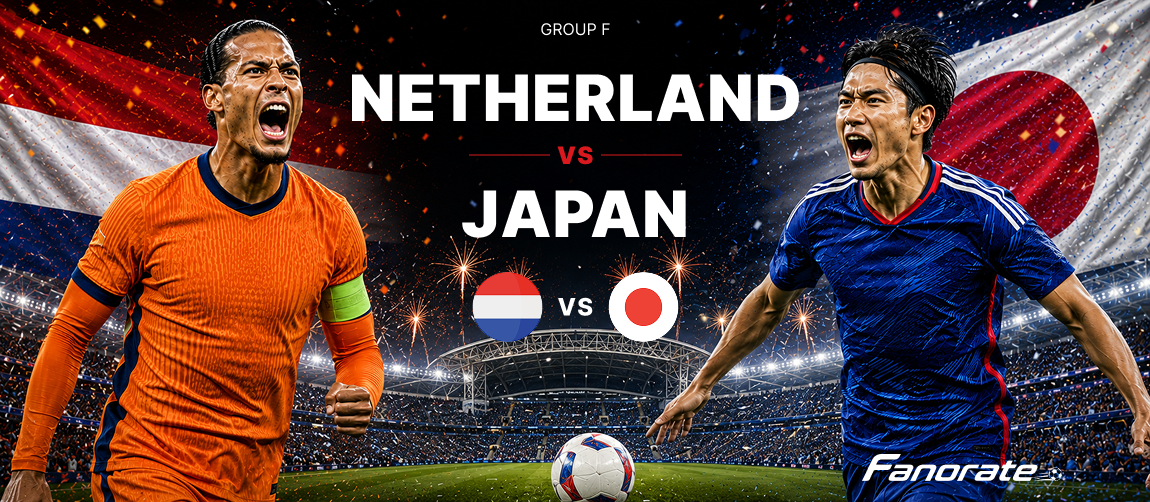
A Tactical Chess Match Opens Group F at AT&T Stadium
Netherlands vs Japan at AT&T Stadium on June 14 opens Group F. The Oranje meet the Samurai Blue in a tactical duel. Lineups, key players, predictions inside.
- June 14, 2026 Sunday
- AT&T Stadium
- Kick-Off 4:00 PM
Two teams built on intelligence — now forced to outthink each other.
There is a particular kind of football match where the loudest noise inside the stadium does not come from the crowd but from the tactical adjustments happening in real time on each manager’s clipboard. Netherlands versus Japan is that kind of match.
The Oranje have, throughout their footballing history, produced some of the most influential thinking on how the game is played. Total Football. The pressing trap. The role of the inverted winger. A generation of Dutch coaches has exported these ideas globally. Japan, on the other hand, have built one of the most quietly impressive footballing infrastructures in the modern game — a system that has produced two consecutive Round of 16 appearances and one of the genuinely well-trained midfield units at international level.
In Arlington, Texas, on June 14, they meet. The stage is enormous. The atmosphere will be loud.
The football should be very, very good.
Everything you need at kickoff
- Date
- Sun, June 14, 2026
- Kickoff (USA)
- 4:00 p.m. ET 1:00 p.m. PT
- Venue
- AT&T Stadium Arlington, Texas
- Group
- Group F Netherlands, Japan, Sweden, Tunisia
- Stage
- Matchday 1 Group F
- Capacity
- 80,000+ Expandable
- Venue
- Domed stadium Climate-controlled
AT&T Stadium — better known to most American sports fans as the home of the Dallas Cowboys — has been retrofitted with a tournament-grade football pitch. The atmosphere inside the dome on World Cup matchdays will be unlike any standard NFL Sunday.
Stop falling short
For the Netherlands, the equation is straightforward: stop falling short. Despite a generation of elite players, the Oranje have not won a senior World Cup. Their 2022 quarterfinal exit on penalties to Argentina was framed as a missed opportunity. The 2024 European Championship semifinal run revived some hope, but did not produce silverware. Time is no longer infinite for several key veterans.
For Japan, the question is psychological as much as tactical. The Samurai Blue have repeatedly produced spectacular group-stage performances — beating Germany and Spain in 2022 in particular — only to fall short in the Round of 16. Breaking that ceiling means starting with a positive result against an elite European side. There is no better stress test.
Group F also contains Sweden and Tunisia, both capable of competing on any given day.
Matchday 1 sets the tone, and neither the Netherlands nor Japan will want to be the team chasing the group on Matchday 2.
Narratives writing themselves
Ronald Koeman’s tactical evolution
The Oranje manager has spent the cycle refining his pressing structure and his use of inverted fullbacks. This is the platform for his tactical statement.
Hajime Moriyasu’s continuity
The Japan manager has maintained a clear identity through multiple cycles, and the squad’s familiarity with his system is one of its primary strengths.
Van Dijk’s likely final World Cup
The captain, the defensive leader, the player who personifies Dutch football’s late-2010s revival. Twilight chapters always carry weight.
Japan’s European-based core
A majority of the Japanese squad now plays in top European leagues, a structural shift that has reshaped what a Japanese national team looks like.
Tactical detail as drama
This is a match where the difference between winning and losing may come down to a single decision about where to receive the ball on a goal-kick. Watch closely.
Tale of the tape
The Netherlands’ build-up to 2026 has continued refining the same tactical core from the Euro 2024 cycle.
Japan have been one of the most consistent international teams of the past four years. Their qualifying campaign was emphatic, and they enter the World Cup with rare squad continuity.
A 4-3-3 with inverted fullbacks and aggressive central midfielders. Koeman has emphasized vertical passing, structured high pressing and quick combinations in the half-spaces.
A 3-4-2-1 / 4-2-3-1 hybrid that emphasizes positional discipline, intelligent pressing triggers and quick combination play in the final third.
Inswinging deliveries to Van Dijk, De Vrij, and a clever short-corner routine that has been refined through the cycle.
Set-piece routines have been a quiet strength; short-corner combinations have produced multiple goals across qualifying cycles.
- An elite-tier center back partnership anchored by Van Dijk.
- A complete midfielder in Frenkie de Jong, who, when at his best, is among the most press-resistant in the world.
- Wide creativity from Gakpo and others, capable of creating chances from limited space.
- Set-piece quality, with multiple aerial targets.
- A complete midfield combination — Endo, Kubo, Mitoma — capable of competing with elite European sides.
- Defensive structure that gets the basics right with remarkable consistency.
- A goalkeeper in Suzuki who has matured into one of the underrated keepers at the tournament.
- Tactical flexibility — the team can shift between three- and four-back shapes mid-match.
- Striker depth has been a long-running debate. A clinical finisher could elevate the team another full tier.
- Defensive transition speed at fullback under pressure.
- Tournament mentality — the Oranje have flirted with elite glory for years without crossing the threshold.
- Striker output — finding a consistent center-forward goal threat remains a question.
- Physical mismatches against the elite European athleticism.
- Round of 16 ceiling — the squad must prove they can beat a top-tier team in a knockout context.
The kind of match tactical analysts dream about
This is the kind of match that tactical analysts dream about. Both teams want intelligent possession. Both teams have pressing structures. Both teams can deploy multiple shapes.
Key questions
Where does Frenkie de Jong receive the ball?
If he can drop between center-backs and break Japan’s first line of pressure with one pass, the Netherlands will dominate.
Can Japan trap the Dutch fullbacks?
If Mitoma can isolate one-versus-one and Kubo can connect into space, Japan create their own chances.
Who wins the half-space duels?
Both teams use inside-forward positioning to overload the area between fullback and center-back. This is where the most goals will originate.
The first half-hour will likely be cagey. Both managers are too smart to commit early. By halftime, one team will have established possession dominance — and almost certainly will have created the better chances of the half.
The names that decide it
The captain. Calm, dominant in the air, capable of distributing into midfield with one quick pass.
When fit and confident, one of the most complete midfielders in world football.
A versatile attacker who has matured into a genuine top-tier scorer.
A senior leader with an ability to produce a moment from nothing.
The cycle’s breakout central midfielder — press-resistant, creative, an emerging international name.
The face of Japanese football’s modern generation — technical, fearless, capable of changing matches.
A specialist in one-versus-one situations whose Premier League form has been consistently elite.
A captain figure whose tactical intelligence anchors the team.
A creator with elite movement between the lines.
A young, modern goalkeeper with elite shot-stopping and distribution.
Rising Stars & Breakout Candidates
Netherlands: Young attackers from the Eredivisie and German Bundesliga are pushing for late-tournament minutes.
Japan: Several J.League-developed players are emerging with European pedigree; one of them will likely earn meaningful minutes here.
A quiet habit of stunning Europe
Significant historical encounter
Group stage clash at the 2010 FIFA World Cup in South Africa, where Dutch secured a 1-0 victory.
The 1994 World Cup connection
Both nations have appeared at multiple World Cups since then, but their footballing trajectories have intersected in unusual ways — coaching exchanges, club football transfers, technical inspiration.
Japan’s giant-killing tradition
From 2018’s match against Belgium to 2022’s wins over Germany and Spain, Japan have a recent habit of stunning Europe.
AT&T Stadium scale
The venue is one of the most cinematic in American sports, with a video board larger than a soccer field stretched horizontally.
Texas football culture
Often defined by American football, the Dallas-Fort Worth area has a strong and growing association football community.
A uniquely American football carnival
The Dallas-Fort Worth metro is one of the most diverse in the United States. Expect:
Dutch supporters in orange
- A substantial Dutch supporter contingent in orange — joined by the German diaspora given proximity to that group.
- A pre-match fan festival at AT&T Stadium plaza with food vendors representing both nations.
Japan's coordinated faithful
- Japanese fans in deeply organized colors, often with banners and meticulously coordinated tifos.
- A growing Texas-based football culture, with local FC Dallas supporters joining the carnival.
The atmosphere will be different from any European or Asian World Cup match — it is a uniquely American football carnival.
Fantasy & Betting Angle — informational only
A few storyline-aware angles:
Kubo or Mitoma creative output: if your fantasy rewards key passes and dribbles, both rank highly.
Gakpo anytime scorer: consistent goal threat over the cycle.
Both teams to score: plausible given the attacking depth.
A wildcard: a Japanese set-piece goal in the second half is a sneakier market than it should be.
Play responsibly. Football is best enjoyed match-first.
Best guess at kickoff
Lineups are best estimates based on current form and tactical preference. Late changes from injury or strategy remain possible.
The match ends in a draw, but the standout performer of the day is Takefusa Kubo.
He will produce one assist and a moment of skill so audacious that highlight packages across the football world will lead with it for 24 hours.
One Player Nobody Is Talking About
Tijjani Reijnders. While the Van Dijk and De Jong headlines dominate Dutch coverage, Reijnders is the player who connects defense to attack with the kind of subtle, well-weighted passes that don’t make highlight reels but win tournaments.
A tactical, cagey match decided by individual brilliance on both sides. The Netherlands score first through a set piece, Japan equalize through a Kubo-orchestrated combination in the second half, and both managers leave Texas with the same number of points and the same number of questions. Man of the match: a tie between Reijnders and Kubo.
For football intellectuals as much as for football romantics
This is a match for football intellectuals as much as for football romantics. Two teams that have spent decades thinking carefully about the game now meet in an opener that will demand the best from both. The Netherlands need to convert long-promised potential into tournament success. Japan need to prove that 2022’s wins were the beginning of an era rather than its peak.
If you appreciate the game’s chess-match nuances — pressing trigger choices, build-up shape, set-piece geometry — this is the match of the opening week.
Settle in. Take notes.
