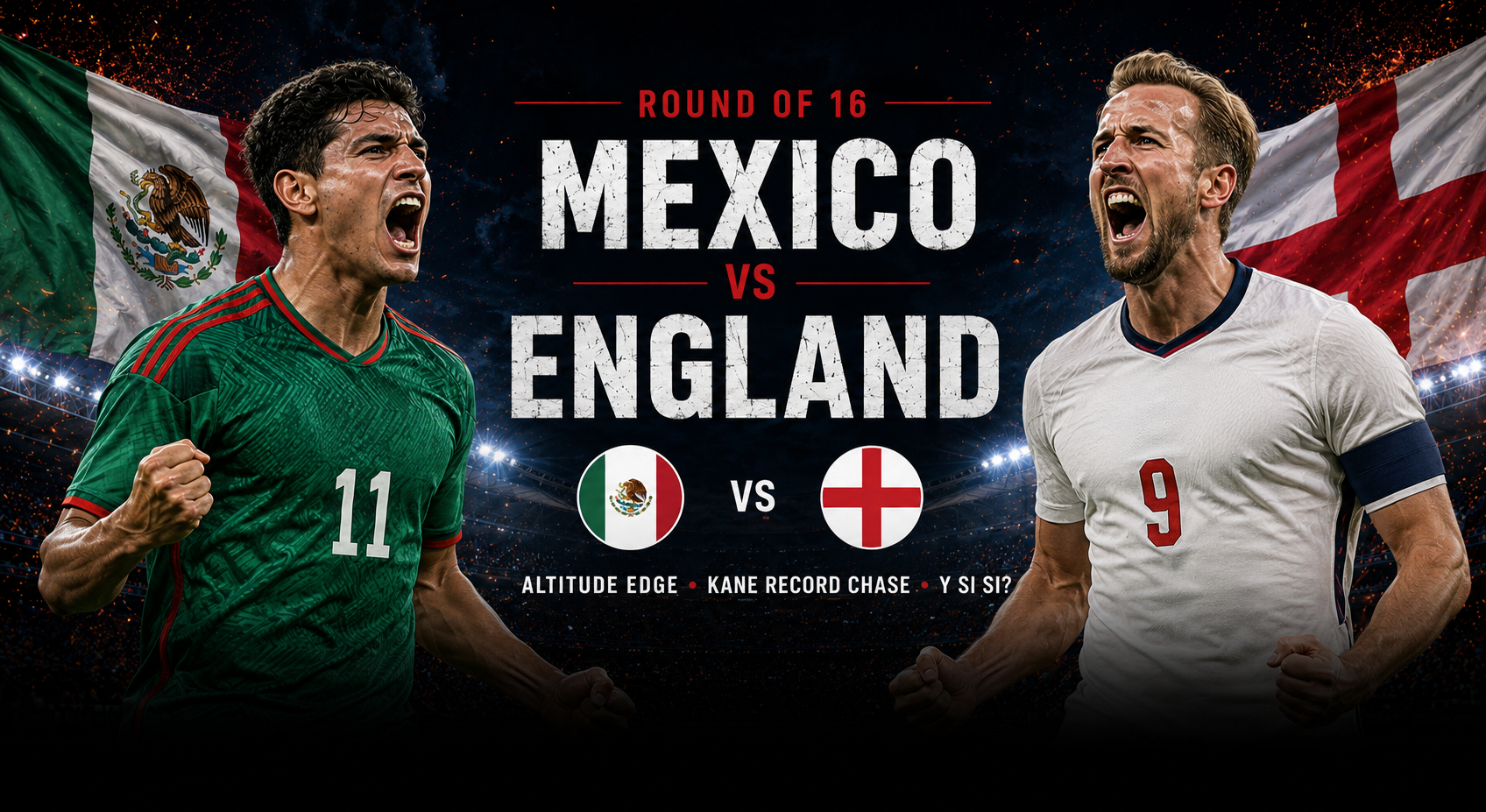
Altitude, Atmosphere and Harry Kane’s Record Chase at the Azteca
Mexico host England at the Azteca in the World Cup 2026 Round of 16. Altitude, Kane’s record, Tuchel vs Aguirre, lineups, key matchups and a full score prediction.
- July 5, 2026 Sunday
- Estadio Azteca Mexico City
- Kick-Off 8:00 PM ET
A note on how Fanorate builds these previews.
This preview is a research-led, AI-assisted analysis produced by the Brillmark team for Fanorate. Every factual anchor below — results, scorers, squads, managers, injuries, the referee appointment and the bracket path — was cross-checked against multiple public sources (FIFA, ESPN, Sky Sports, Opta Analyst and others) and verified as of July 3, 2026.
Where something is genuinely unconfirmed — Mexico’s precise disciplinary picture, the final England right-back call, some transliterated assistant-referee names — we flag it as uncertain rather than guess.
We do not invent statistics, and we do not publish fake win probabilities. This is football analysis, not betting advice.
Everything you need at kickoff
- Stage
- Round of 16 Match 92 · winner to Quarterfinal
- Date
- Sun, July 5, 2026
- Kickoff
- 2:00 p.m. ET 12:00 local · moved fwd, provisional
- Venue
- Estadio Azteca Mexico City · ~2,240 m altitude
- Referee
- Alireza Faghani (Iran) Reported; assistant spellings provisional
- Weather
- Afternoon storm risk ~31% at midday, ~21°C
- Rest
- Both 4–5 days MEX home-based · ENG cross-country
Estadio Azteca sits roughly 2,240 metres (7,220 feet) above sea level — the highest-altitude stadium in North America and, by most accounts, the single biggest physical variable in this fixture. The kickoff was moved forward from an original 6:00 p.m. local (8:00 p.m. ET) slot to around 12:00 p.m. local (2:00 p.m. ET / 7:00 p.m. BST) to reduce lightning and flooding risk — corroborated by several reports and by Javier Aguirre’s press-conference complaint, though the exact minute is provisional pending FIFA’s final timing sheet. The Azteca’s canopy covers only about 80% of the seating bowl and does not enclose the pitch, so the match remains exposed to weather. Both sides last played on four to five days’ rest with no extra-time exertion in the Round of 32; the winner advances to a Quarterfinal against the winner of Brazil vs Norway, also played July 5 at MetLife Stadium in East Rutherford, New Jersey.
The weight is heavier on the hosts
The winner advances to face the winner of Brazil vs Norway, also on July 5 at MetLife Stadium — meaning both would-be quarterfinalists are already known to be in red-hot knockout form, having needed dramatic late goals (Martinelli for Brazil, Haaland for Norway) to advance from the Round of 32. For England, a win here would set up a genuinely daunting quarterfinal against one of the tournament’s most star-studded attacking sides. For Mexico, reaching a first World Cup quarterfinal since they last hosted the tournament in 1986 would be a genuinely historic achievement — and would likely see them travel away from the Azteca’s protective bubble for the first time in the tournament, removing the single biggest variable that has carried them this far.
This is one of the more balanced pressure equations of the round. England, a top-tier FIFA nation with serious trophy ambitions and a squad widely regarded as one of the four or five most talented in the draw, would face fierce domestic criticism for an exit here — especially against a host nation. But Mexico face arguably even greater pressure of a different kind: a co-host nation, a 40-year knockout drought only just ended, an entire country daring to believe via “¿Y si sí?”, and a golden opportunity at the Azteca that will not come again in most of this squad’s careers. A home Round of 16 exit to England would be viewed domestically as a squandered, once-in-a-generation chance.
Momentum sits with the hosts. Mexico are red hot — a perfect group record, zero goals conceded across four matches, a 40-year knockout-stage curse broken in style, and an entire host nation rallying around “¿Y si sí?”. England are steady but trending toward uncertain — group winners, yes, but via a goalless draw, a laboured Panama win and a genuine fright against a World Cup debutant, with Kane’s brace papering over cracks rather than erasing them.
The weight is heavier on Mexico’s shoulders precisely because expectation has shifted from “please don’t embarrass us” to “this is genuinely winnable” in the space of one result.
Narratives writing themselves
Altitude as the great equalizer
Estadio Azteca sits roughly 2,240 metres above sea level — the single biggest physical variable in this fixture. Both Thomas Tuchel and Harry Kane have publicly described the altitude as a “huge advantage” for Mexico that England cannot fully adapt to in a four-day window.
Kane above Pelé
Harry Kane’s DR Congo brace moved him above Pelé to 13 World Cup goals across his career and made him England’s all-time World Cup scorer — the defining England storyline of the tournament.
An unbreached defence
Mexico have not conceded a single goal through four matches, are unbeaten at the Azteca for 13 years across 89 competitive matches, and no visiting team has ever beaten Mexico at this stadium in ten World Cup attempts.
Bellingham’s disciplinary tightrope
Jude Bellingham was booked in the Round of 32 win over DR Congo; a second caution against Mexico would rule England’s creative fulcrum out of the quarterfinal — the single most consequential disciplinary flag in the entire tie.
“¿Y si sí?”
Mexico City erupted after the Ecuador win, and the “¿Y si sí?” (“What if… yes?”) slogan has become the rallying cry of the co-hosts’ run — a nation daring to believe a deep run is possible after a 40-year knockout drought.
Advantage in home-conditions specialism: Aguirre, by a distance. Advantage in raw individual quality and squad depth: Tuchel. The match may hinge on which manager adapts fastest to a compressed pre-match preparation window — England to the altitude, or Mexico to an unfamiliar and unwanted midday kickoff.
Tale of the tape
Javier Aguirre’s Mexico topped Group A with three wins from three and still have not conceded a single goal through four matches: 2-0 over South Africa (Quiñones 9′, Jiménez 67′), 1-0 over South Korea (Romo 50′), 3-0 over Czechia (Chávez, Quiñones, Fidalgo 90+’), then 2-0 over Ecuador in the Round of 32 (Quiñones 22′, Jiménez 31′). The Ecuador win ended a 40-year World Cup knockout-stage drought; Ecuador’s Piero Hincapié was sent off in stoppage time and, per Opta Analyst, Mexico out-xG’d Ecuador 1.02 to 0.73.
Thomas Tuchel’s England won Group L: 4-2 over Croatia (Kane 12′ pen, 42′; Bellingham 47′; Rashford 85′), a 0-0 draw with Ghana, and 2-0 over Panama (Bellingham 62′, Kane 67′ — Kane’s 11th World Cup goal, breaking Gary Lineker’s England record). In the Round of 32 they survived a genuine scare, trailing DR Congo to a 7th-minute Brian Cipenga goal before a Harry Kane brace (75′, 86′) completed a 2-1 comeback — moving Kane above Pelé to 13 career World Cup goals.
Mexico have built their run on a clear identity: control games through pressing and quick transitions, let Quiñones and Alvarado carry the ball into dangerous areas, and defend with real discipline in behind. Their biggest strength is knowing exactly who they are — a counter-punching, home-crowd-fuelled side that thrives on the emotional energy of the Azteca. They have changed from a slightly ragged, opportunistic side in the group opener to an increasingly composed, clinical unit by the Ecuador win.
England remain a team of outstanding individual quality with a recurring structural puzzle: how to break down a well-drilled defensive block without simply waiting for a set piece or a Kane/Bellingham moment. The attacking group — Kane, Bellingham, Saka, Gordon, Rashford in reserve — is arguably the most talented in the competition, and Declan Rice anchors the midfield superbly. But across four matches they have dominated territory more reliably than they have converted it, and a defence — specifically at right-back — has now been directly punished. They have changed from expansive and open against Croatia to increasingly reliant on late-match magic to survive.
Aguirre opened aggressively against South Africa, pressing high but inviting late-game indiscipline (Montes’ red card). Forced into a reshuffle for South Korea, Mexico became more compact and pragmatic, winning ugly off a goalkeeping error. Against a dead-rubber Czechia they played with freedom, scoring three from open play. Against Ecuador all the threads combined: quick, direct transitions, defensive discipline and the game management to see out a man-advantage finish calmly. The clear trajectory is toward greater control without sacrificing the pace in behind that makes them dangerous.
Tuchel began expansively in a 4-2-3-1 against Croatia and was punished twice defensively. Against Ghana the same shape prioritised control and a clean sheet at the cost of fluency. Against Panama, injuries forced right-back improvisation, and against DR Congo that improvisation was directly exploited for the opening goal — Tuchel’s answer was to introduce Anthony Gordon, whose direct running and delivery unlocked two goals in the final quarter of an hour. The clear trajectory is from open-and-risky toward pragmatic-and-reactive: England increasingly need a substitution or a moment of quality to change games rather than dictating them from the opening whistle.
No fitness concerns are being reported for Mexico — they emerged from the Ecuador win with a clean bill of health, including 17-year-old Gilberto Mora’s historic start passing without incident. No suspensions: César Montes’ group-stage red-card ban has already been served (missed the South Korea match) and does not carry into the knockouts. On the one-yellow-away question, available match reports name no Mexico player cautioned against Ecuador, so Mexico appear to enter with a clean disciplinary slate — flagged as based on match-report data rather than an official FIFA disciplinary bulletin.
Right-back is England’s central selection headache: Reece James (hamstring) has missed multiple matches with an unclear return timeline, Tino Livramento was ruled out of the tournament before it began, Jarell Quansah (ankle) is a doubt since Panama, and Djed Spence — exposed for DR Congo’s goal — Ezri Konsa or an unnaturally deployed Rice/O’Reilly are the options. Declan Rice reported hamstring tightness after covering at right-back but Tuchel expects him available. No suspensions currently, but Jude Bellingham, booked in the 19th minute against DR Congo, is one yellow card away from missing the quarterfinal — the single most consequential disciplinary flag in the tie.
- Knowing exactly who they are: a counter-punching, home-crowd-fuelled side that thrives on the emotional energy of the Azteca.
- A defence that has not conceded in four matches — the standout statistic of their tournament.
- An increasingly composed, clinical unit by the Ecuador win.
- Outstanding individual quality: Kane, Bellingham, Saka and Gordon form arguably the most talented attacking group in the competition.
- Declan Rice anchoring the midfield superbly.
- A captain in Kane who can decide a knockout match in the final quarter of an hour.
- A tendency toward reckless discipline in moments of chaos (two Mexico-adjacent red cards against South Africa, one their own).
- A defensive record built against South Africa, South Korea, Czechia and Ecuador — good but not elite attacking sides.
- A recurring inability to break down a well-drilled defensive block without a set piece or a Kane/Bellingham moment.
- A defence — specifically at right-back — that has now been directly punished.
- Dominating territory more reliably than converting it into goals.
Home-conditions specialism against raw quality
Javier Aguirre vs Thomas Tuchel is a fascinating contrast in profile and circumstance. Aguirre, in his third stint as Mexico coach and with a track record stretching back to the 2002 and 2010 World Cups, has built a pragmatic, disciplined side that presses hard early, defends with real organisation, and strikes quickly through Quiñones and Alvarado on the counter. His boldest call — starting the untested Raúl Rangel ahead of six-time-World-Cup veteran Guillermo Ochoa — has been vindicated by four clean sheets. His challenge now is squeezing every possible advantage from the altitude and the crowd while avoiding the discipline lapses that produced two red cards in the tournament opener.
Tuchel, a Champions League winner in his first World Cup as England manager, arrives having repeatedly solved games from the bench rather than from kickoff — Rashford against Croatia, Gordon against DR Congo. His tactical dilemma is genuinely difficult: does he start Gordon to attack Mexico’s back line immediately, accepting the altitude will sap his players’ legs faster than usual, or stick with a more conservative approach and lean again on Kane and Bellingham against a deep-lying home side? He must also finally solve the right-back puzzle in the most hostile away atmosphere of the tournament and manage Bellingham’s disciplinary risk without losing his creative influence.
Advantage in home-conditions specialism: Aguirre, by a distance — this is precisely the kind of occasion, opponent profile and stadium he has spent a career learning to exploit. Advantage in raw individual quality and squad depth: Tuchel. The match may hinge on which manager adapts fastest to a compressed pre-match preparation window — England to the altitude, or Mexico to an unfamiliar and unwanted midday kickoff that disrupts their own routine.
Why the favorite should win: England have more individual quality across the pitch, from Kane’s clinical finishing to Bellingham’s craft to Saka’s end product to Rice’s control, and have shown twice that they can find a way to win even when not playing well. Their bench (Gordon, Rashford, Mainoo, Eze, Watkins, Toney) offers more game-changing depth than Mexico’s, and if the match stays close into the final half hour England’s superior depth becomes decisive. Mexico’s defensive record, while impressive, has been built against South Africa, South Korea, Czechia and Ecuador — good but not elite attacking sides. If England can survive an expected early Mexico surge, their class should tell in the same way it eventually told against Croatia and Panama.
How the underdog can win: Mexico should use the altitude as a first-15-minutes weapon, pressing aggressively from kickoff before England’s bodies settle; attack the same right-back space DR Congo found through Quiñones and Alvarado; carefully provoke Bellingham into a second yellow in a legitimately physical atmosphere; sit slightly deeper once ahead and defend the box like Ghana and Panama forced England to break down; and, above all, trust the emotional swing of an early goal — if Mexico score inside the first 20–25 minutes, the deafening crowd becomes a genuine physical and mental factor while England chase a game at elevation. The realistic Mexico win looks like a tight 1-0 or 2-1.
Key player matchups
Harry Kane vs César Montes / Mexico’s centre-back pairing
England’s all-time leading scorer, now the most in-form finisher at this World Cup, against a Mexico defence that has not conceded all tournament. If Kane finds space in behind or wins the ball in the air, Mexico’s clean sheet run is under genuine threat for the first time.
Julián Quiñones vs England’s right-back
Whichever of Spence, Konsa or O’Reilly starts, Mexico’s most dangerous attacker in transition will look to attack exactly the space DR Congo exploited — arguably the single biggest tactical crack in England’s setup meeting the tournament’s most in-form wide forward not named Kane.
Declan Rice / Jude Bellingham vs Edson Álvarez
The two captains’ midfields — England’s control-and-carry axis against Mexico’s anchor and disciplined double pivot — will determine tempo. If Álvarez wins this battle, Mexico can spring transitions; if Rice and Bellingham dominate it, England should create the sustained pressure that has eventually told against Croatia and Panama.
Jordan Pickford vs Raúl Rangel — goalkeeper comparison
Pickford was beaten early by DR Congo’s Cipenga; Rangel has been the form goalkeeper of the tournament with four clean sheets. In a match many expect to be tight, whichever goalkeeper commits the fewer errors could decide it.
Anthony Gordon vs Mexico’s left side
If Tuchel starts Gordon rather than holding him as an impact substitute, his direct running and delivery — the source of both Kane goals against DR Congo — immediately becomes a major weapon against a deep block.
If Mexico score inside the first 20–25 minutes, the psychological equation flips: an already deafening crowd becomes a genuine physical and mental factor, and England — already fatigued by altitude — face the extra burden of chasing a game at elevation, which sports science suggests disproportionately punishes a team forced to play with more urgency and higher work-rate.
The names that decide it
9/10. Three goals, an assist, the tournament’s outstanding Mexican player and the biggest individual threat England will face.
7.5/10. Two goals, a reliable focal point and aerial outlet.
7.5/10. A tournament-record three assists; the creative supply line for Mexico’s forwards.
8/10. Four clean sheets and rising confidence; arguably the form goalkeeper of the tournament alongside a handful of others.
7.5/10. Captain and midfield anchor, the platform behind Mexico’s attacking players.
6.5/10. Composed since returning from suspension, but the red card against South Africa is a discipline flag worth remembering given the emotional intensity expected at the Azteca.
7/10 (for a 17-year-old). Handled a historic knockout start calmly; whether Aguirre trusts him again in an even bigger occasion is a genuine selection call.
10/10. Tournament-defining brace to win the DR Congo match, England’s all-time leading World Cup scorer, now above Pelé’s career tally. The single most important player in this fixture.
8.5/10. Goal and assist in the group stage, the creative fulcrum, but the suspension risk hangs over his display here.
8/10. Controls the game defensively but managing a physical toll after covering at right-back; fitness worth monitoring.
7.5/10. Reliable width and delivery, a repeatable route to goal via set pieces.
7/10. Solid, but was beaten at his near post by Cipenga’s early strike against DR Congo — a mark against an otherwise composed tournament.
8/10 (rising). Two match-defining assists off the bench against DR Congo; a genuine case for starting against a deep-lying Mexico.
7/10. Composed centrally, part of a defence that has largely held even amid the right-back issues.
5.5/10. The clear weak point — directly exposed for DR Congo’s goal and unresolved heading into the Azteca.
History on the line
Fortress Azteca
Mexico are unbeaten at the Azteca for 13 years across 89 competitive matches, and no visiting team has ever beaten Mexico at this stadium in ten World Cup attempts.
Kane above Pelé
Kane’s DR Congo brace moved him to 13 career World Cup goals, above Pelé, and made him the first England player to score a brace in a World Cup knockout match since Gary Lineker against Cameroon at Italia ’90.
Four clean sheets, 40 years broken
Mexico have not conceded a single goal through four matches and ended a 40-year World Cup knockout-stage drought, their last such win coming in 1986.
Mora makes history
Seventeen-year-old Gilberto Mora made a historic first World Cup start against Ecuador — the second-youngest player ever to start a World Cup knockout match, behind only Pelé.
Alvarado’s assist record
Roberto Alvarado has become the first Mexican player to record three assists in a single World Cup edition since 1966.
Best guess at kickoff
Lineups are projections based on group-stage and Round of 32 selections plus the confirmed injury/fitness picture; England’s right-back and whether Tuchel starts Gordon are the two biggest open questions, and Aguirre must decide whether to persist with the 17-year-old Mora after his historic start or lean on the more experienced Brian Gutiérrez. Mexico’s XI looks close to settled and unchanged in outline from the Ecuador win.
Jude Bellingham picks up a second yellow card of the knockout rounds and is banned for the quarterfinal — a significant subplot regardless of the final score.
Harry Kane scores again, extending his lead as England’s all-time World Cup scorer and further widening his gap above Pelé. Julián Quiñones has at least one clear sight of goal in the first half hour, testing Mexico’s ability to punish England’s back line early. Anthony Gordon, whether starting or coming off the bench, is directly involved in England’s goal — repeating his DR Congo impact. And the match is not settled until after the 70th minute, continuing England’s pattern of late knockout-stage breakthroughs.
Mexico take an early lead or create the better chances in the first 25–30 minutes, riding the crowd and the altitude, before England gradually seize control in the second half and Kane (or a Kane-Bellingham combination) produces the moment that turns the tie, likely after the 60-minute mark, in the pattern now familiar from Panama and DR Congo. Man of the Match: Harry Kane, projected to provide the decisive intervention once again.
Four scenarios frame the match. Most likely overall (editorial judgment), England grind through the altitude: Mexico start fast and create the better early chances, England absorb the pressure and Kane or Bellingham produces a moment of quality after the hour mark to win a tight 1-0 or 2-1, mirroring the Panama and DR Congo template. In the credible upset, Mexico ride the wave — an early goal turns the Azteca into a genuine physical and psychological factor and they defend a 1-0 or 2-0 win, extending their unbeaten Azteca World Cup record. A cagey stalemate could be resolved late or in extra time by fresh legs off the bench, or go to penalties neither side has experienced this tournament. Least likely, England’s class tells early and comprehensively — an early Kane header from a Saka delivery silences the crowd and they win comfortably, 3-0 or similar. No fixed percentages are offered; these are reasoned editorial judgments, not statistical models.
Not a match we would call comfortably
The individual quality gap — particularly at the very top end, Kane and Bellingham against Mexico’s talented but slightly less battle-tested attacking pair of Quiñones and Jiménez — should tell across 90 minutes even accounting for the altitude and crowd disadvantage. But this is genuinely one of the closer “favourite vs host” match-ups of the round, and a Mexico win, or a Mexico goal that forces a nervy finish, would not be a shock in any sense.
Confidence is moderate on the result (England to advance) and low-to-moderate on the exact scoreline. A Mexico win, a 1-0 grind either way, or extra time are all live, credible alternatives — this is not a match we would call comfortably, and the altitude/atmosphere combination genuinely could flip it.
What would surprise nobody: a tight, low-scoring match decided by one moment of quality; Mexico scoring first, aided by the crowd and the early-game altitude effect on England; England needing a substitute’s impact (Gordon, Rashford, Eze or Mainoo) to change the game; Kane scoring or assisting the decisive goal; and a tense, error-strewn final 20 minutes as fatigue and altitude bite for England specifically.
What would shock the tournament: Mexico winning comfortably by two or more goals and delivering the co-hosts’ best knockout result since 1986; England conceding first and never recovering; a red card for a high-profile England player amid a combative occasion; Mexico’s clean-sheet run extending through a fifth straight match against an attack as talented as England’s; or extra time and a shootout at the Azteca.
Neither side has needed a shootout so far this tournament, so there is no in-tournament pedigree for either. On paper England have elite, composed takers — Kane, Bellingham, Rice, Saka and Eze — and Pickford has previously built a reputation for preparing seriously for shootouts, though that predates this tournament and is background context rather than an in-tournament stat. Mexico’s picture is less battle-tested at senior men’s level in recent cycles, but Rangel’s calm command of his box and a technical group of takers (Quiñones, Alvarado, Álvarez, Jiménez) would not be unreasonable to back either — and the sheer weight of a deafening home crowd behind every Mexico kick should not be underestimated.
A Mexico win, or a Mexico goal that forces a nervy finish, would not be a shock in any sense.
