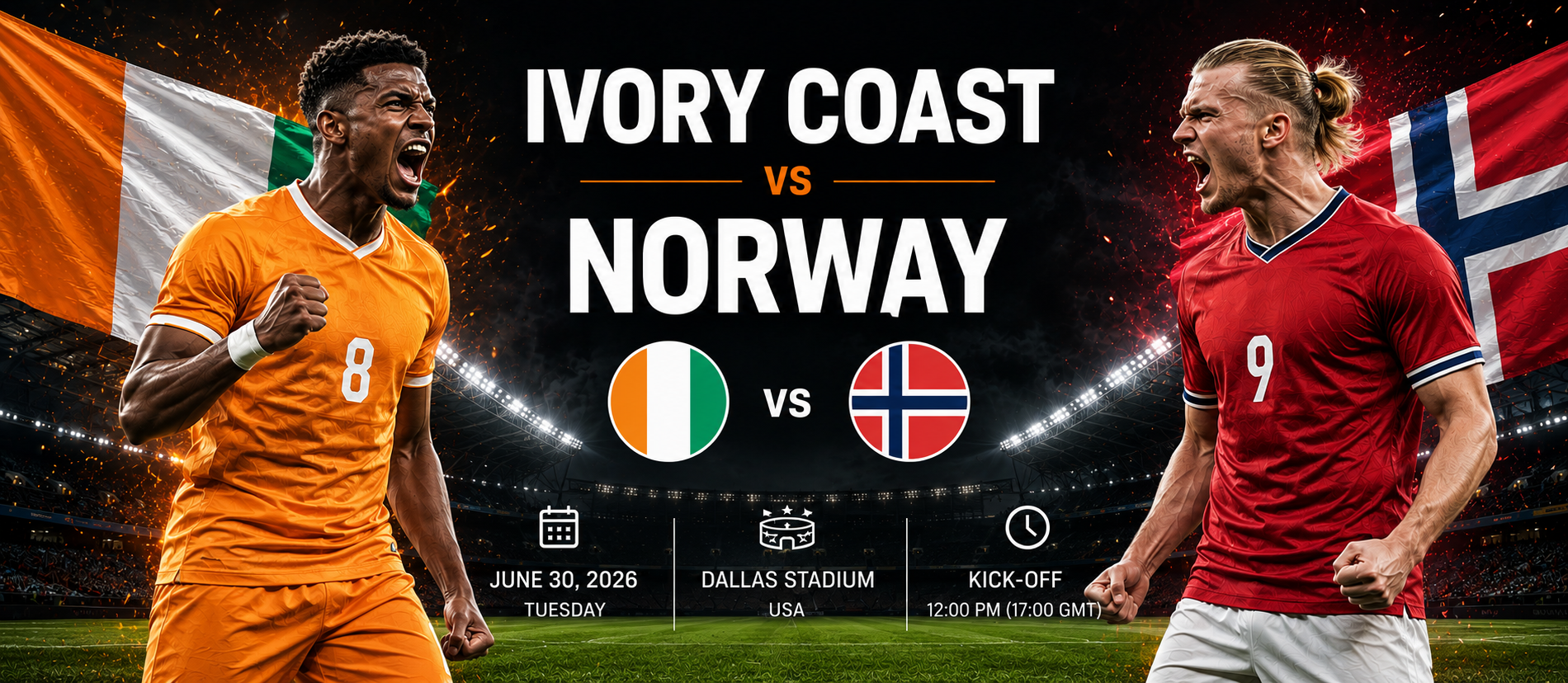
Ivory Coast vs Norway, Round of 32
Haaland vs the Elephants in Dallas. Tactics, lineups, key matchups, prediction and full analysis.
- June 30, 2026 Tue
- AT&T Stadium Arlington
- Kick-Off 1:00 PM ET
Everything you need at kickoff
- Fixture
- Ivory Coast vs Norway Côte d'Ivoire vs Norway · FIFA World Cup 2026 Round of 32
- Date
- Tue, June 30, 2026
- Kickoff
- 1:00 p.m. ET 12:00 p.m. CT · 6:00 p.m. BST
- Venue
- AT&T Stadium Arlington, Texas · "Dallas Stadium" · retractable roof
- Referee
- Glenn Nyberg (Sweden) Reported as appointed; likely-but-confirm until FIFA's final release
- Weather
- Mid-90s °F, humid Roughly 35°C; the roof decision will materially shape the physical demands
- Rest
- Ivory Coast 4 · Norway 3 days A one-day edge to Ivory Coast — though Norway's manager argues he deliberately neutralised it
- At stake
- Winner → Round of 16 Not a quarterfinal — the next step in the 48-team bracket is the Round of 16
This is a genuine first: the two nations have never met at senior level, and Ivory Coast have never before reached a World Cup knockout round. For Norway, it is their first World Cup since 1998 and a chance to match — and ideally beat — the Round of 16 finish of the Bergkamp-era class.
Pressure, momentum and a Dallas heatwave
Pressure — Ivory Coast: Playing with house money. Already in uncharted territory (first knockout round ever), and the pressure of “must qualify from the group” is gone. Expectation is low; freedom is high. That can be dangerous for opponents.
Pressure — Norway: More pressure. This is the Haaland generation’s chance to make a deep run in their first tournament in 28 years, and they are the marginal favourites with the bookmakers. The weight of “Haaland’s Norway should beat Ivory Coast” sits on them.
Momentum — slight edge Ivory Coast: The Elephants enter on the back of a confident, controlled, history-making 2-0 win, with their match-winners in form (Pépé, Amad). Norway’s last competitive 90 minutes was a 4-1 humbling by France — even with the caveat of rotation, that is not the ideal psychological send-off, though it can be filed under “didn’t really try.”
Fatigue: Ivory Coast have four days’ rest to Norway’s three, but Solbakken rested Haaland, Ødegaard and others against France, so his key players carry fewer minutes than a straight rest-day count suggests — by his own argument the “one extra day” advantage is neutralised. The heat is the great equalizer: a mid-90s°F Dallas afternoon with an open roof would blunt Norway’s high press and arguably favour the more energy-efficient Ivorians; a closed, climate-controlled roof makes Norway’s running game more sustainable.
Round of 16 at stake: For Ivory Coast, a Round of 16 place would be the deepest run in their history. For Norway, it would match their 1998 high-water mark and set up a Haaland-led tilt at the quarterfinals.
Favouritism is its own burden.
Four reasoned scenarios
Haaland decides it (most likely Norway path)
Norway weather an early Ivorian press, get the ball to Haaland in a transition moment, and he scores. Ivory Coast chase, the game opens, and Norway’s pace punishes the space. Norway win, perhaps 2-1.
The Elephants suffocate it (most likely Ivory Coast path)
Faé’s compact block denies Haaland clean service; the game is tight, physical and low-event. Ivory Coast strike once in transition (Amad/Pépé) or from a set piece and defend their lead with the maturity they showed vs Ecuador. Ivory Coast win 1-0.
Shootout (very plausible)
Two evenly matched, cagey sides cancel out across 120 minutes. It goes to penalties — where Ivory Coast’s recent AFCON knockout pedigree gives them the edge. Draw after extra time; Ivory Coast advance on penalties.
Open and chaotic (the wildcard)
The heat and two transition-happy teams produce an end-to-end game. Norway’s defensive leaks meet Ivory Coast’s counters and it finishes high-scoring — 3-2 either way, with the team that defends its lead better going through. Slight lean Norway given Haaland’s finishing.
No fake percentages — these are reasoned narrative weightings, not modelled probabilities.
Tale of the tape
Ivory Coast are a counter-punching, physically imposing side built on a heavyweight central-defensive pairing, a balanced midfield three, and dangerous wide players who hurt teams in transition. They are emotionally mature — they did not fold after the gut-punch Germany defeat — and they have a manager in Emerse Faé who reshapes his team to the opponent. Their weak points: bench depth relative to the elite, and a tendency to invite pressure that can occasionally cost them late (see: Germany).
Norway are a fast, vertical, front-loaded team whose entire gravitational field bends toward Erling Haaland. With Ødegaard pulling strings behind the striker line and runners like Antonio Nusa and Holmgren Pedersen breaking forward, they generate chances in waves. But they concede chances too. The defence — organised in qualifying (five goals conceded in eight games) — has looked more porous in the tournament proper, shipping two to Senegal and four to France. They are a team that wants to win 3-2, not 1-0.
Pragmatism: grind, suffer, strike when it matters. Match 1: Ivory Coast 1-0 Ecuador (June 14) — Amad Diallo’s 90th-minute winner after a lung-busting Wilfried Singo run ended Ecuador’s 19-game unbeaten run, with Ecuador hitting the woodwork three times. Match 2: Germany 2-1 Ivory Coast (June 20, Toronto) — Franck Kessié finished a Yan Diomandé cross to lead at the break before substitute Deniz Undav volleyed an equaliser and won it in the 94th minute; Singo picked up a knee scare. Match 3: Curaçao 0-2 Ivory Coast (June 25) — a Nicolas Pépé brace in a must-win handled with “control, maturity and attacking quality,” with a half-time switch from 4-4-2 to 4-3-3, sealing first-ever knockout qualification.
Tournament Journey — Group I runners-up behind France
Norway’s first World Cup in 28 years. Match 1: Iraq 1-4 Norway (June 16, Boston) — Haaland twice (29′, 43′), Leo Østigård from an Ødegaard corner and an Aymen Hussein own goal; Hussein had levelled for Iraq before Haaland pounced on goalkeeper hesitation. Match 2: Norway 3-2 Senegal (June 22) — Marcus Holmgren Pedersen and a Haaland brace (48′, 58′) put Norway in command before Sarr twice hit back, including a nervy stoppage-time goal; Haaland became only the sixth player to score multiple goals in each of his first two World Cup appearances. Match 3: Norway 1-4 France (June 26) — with qualification assured, Solbakken made sweeping changes and rested Haaland and captain Ødegaard, and a heavily rotated side was punished by Dembélé’s hat-trick, with only Thelo Aasgaard’s goal as a positive.
Opened with a patient, reactive shape against Ecuador, content to defend deep and strike late. Against Germany they were braver, leading at the break before bench depth undid them. Against Curaçao, Faé flipped from 4-4-2 to 4-3-3 at half-time to assert control. The throughline: a compact mid-block, central protection from a double or triple pivot, and wing-led transitions. Expect the 4-3-3 — the playmaker-runner-stabiliser midfield Solbakken described — against Norway.
Solbakken’s base is a 4-3-3 that presses high, wins the ball, and feeds Haaland vertically, with Ødegaard as the advanced creator. The Iraq and Senegal games showed the attacking blueprint working — and the defensive cracks. The France game is a tactical outlier: a rotated side, rested stars, and a result Solbakken effectively sacrificed. The key question for June 30 is whether the rest pays off in sharper legs, or whether the rhythm disruption of a 4-1 thrashing lingers.
Yahia Fofana is the clear No. 1, a 2024 AFCON winner. The defence is built around Evan Ndicka with Odilon Kossounou and Emmanuel Agbadou as centre-back options (Faé has rotated); Singo offers pace and power on the right (knee scare reportedly minor) and Ghislain Konan is first-choice left-back. Captain Franck Kessié is the talismanic all-action presence, Ibrahim Sangaré the screening stabiliser, with Seko Fofana, Jean-Michaël Seri and the emerging Oulai in support. Amad Diallo is the matchwinner; Nicolas Pépé arrives in form; Simon Adingra, Yan Diomandé, Evann Guessand, Ange-Yoan Bonny and Jonathan Bamba complete a deep attack. Sébastien Haller, the 2024 AFCON final hero, was omitted. No confirmed suspensions; per-player booking lists could not be verified.
Ørjan Nyland is the experienced first choice in goal. Kristoffer Ajer and Leo Østigård anchor a centre that is the team’s question mark, with Julian Ryerson and Marcus Holmgren Pedersen providing overlapping full-back thrust. Captain Martin Ødegaard is the creative fulcrum (benched vs France for rotation, not injury), with Sander Berge and Fredrik Aursnes providing steel and Thelo Aasgaard energy from deep. Erling Haaland is the entire plan and a four-goal Golden Boot contender, with Alexander Sørloth a powerful alternative and Antonio Nusa the standout winger. No confirmed suspensions; per-player booking lists could not be verified.
- A heavyweight central-defensive pairing and genuine physical power — flagged by Solbakken as their biggest strength.
- A balanced midfield three and dangerous wide players who hurt teams in transition.
- Emotional maturity — they did not fold after the Germany defeat.
- A manager in Emerse Faé who reshapes his team to the opponent.
- Erling Haaland — the single best player on the pitch and a four-goal Golden Boot contender.
- A supporting cast built to feed him: Ødegaard pulling strings, Nusa and attacking full-backs breaking forward.
- They score goals in clusters and thrive in transition.
- Bench depth relative to the elite.
- A tendency to invite pressure that can occasionally cost them late, as the stoppage-time Germany defeat showed.
- A defence that has looked porous in the tournament — two conceded to Senegal, four to France.
- Shaky at defending a lead; they do not always close games out cleanly.
- A team that wants to win 3-2, not 1-0.
Faé’s adaptability vs Solbakken’s conviction
Emerse Faé has been the quiet star of Ivory Coast’s group stage — a manager unafraid to make a big call (omitting Haller, the half-time 4-4-2 to 4-3-3 switch vs Curaçao) and trusted by his players after steering them to the 2024 AFCON title. His instinct here will be control: a compact mid-block to deny Haaland service, disciplined full-backs, and a plan to spring Amad, Pépé and Singo in transition.
Ståle Solbakken has been refreshingly transparent: he all but conceded the France game to rest legs, then framed it as cancelling out Ivory Coast’s extra recovery day. His blueprint is simpler — high press, fast vertical transitions, feed Haaland — but it is potent. He laid out the matchup with unusual candour to FIFA.com: “I think they have a good mix in their midfield three, with a playmaker, a runner and a stabiliser. They also have two good wingers, a striker that can both keep the ball up and go behind and they have two powerhouses at centre-back.” He flagged physicality as Ivory Coast’s biggest strength, and revealed his rotation logic: “We have cancelled out their one extra day to rest now we should be on equal terms in terms of physicality.”
Key player matchups
Erling Haaland vs Ivory Coast’s centre-backs (Ndicka & partner)
The game within the game. If Ndicka and his partner win the physical duel and deny Haaland service in behind, Norway’s plan A stalls. If Haaland gets isolated against a single defender in transition, he punishes it.
Martin Ødegaard vs Ibrahim Sangaré / the Ivorian pivot
Ødegaard wants pockets between the lines. Sangaré’s screening discipline — and how aggressively Kessié steps up — determines whether the Arsenal captain conducts the game or is smothered.
Wilfried Singo vs Antonio Nusa
Two pacey, powerful operators on opposite touchlines. Whoever wins their wing wins a huge share of the territory battle. Both can attack and both must defend.
Amad Diallo vs Norway’s full-back (Ryerson / Bjørkan)
Amad in transition against a defence that has been opened up repeatedly is Ivory Coast’s clearest route to goal.
Nicolas Pépé vs Norway’s recovery defending
If Norway commit numbers forward to feed Haaland, the space Pépé and Amad can attack on the counter is exactly the weakness Senegal and France exploited.
The intrigue: Faé’s adaptability versus Solbakken’s conviction. One manager will bend his shape to the contest; the other will trust his identity and his No. 9.
Group-stage form and likely impact
Outstanding — match-winning brace vs Curaçao; arrives in confidence.
Good — decisive winner vs Ecuador; clever, direct, a constant threat.
Good — captain, scored vs Germany, leads the midfield with authority.
Good — screening and progression; assist vs Curaçao.
Good — pace and power down the right; assist vs Ecuador (fitness to monitor).
Good — Bundesliga breakout; created the Kessié goal and more.
Average — reliable No. 1; will be busy against Norway’s vertical threat.
Average — first-choice striker billing; output still building.
Outstanding — four goals in his first two World Cup games; the defining attacking force of the matchup.
Good — Norway’s most dangerous wide carrier; a transition weapon.
Good — scored vs Senegal; attacking full-back who stretches play.
Average — creative ceiling is high but rested vs France; sharpness after limited minutes is the question.
Average — scored vs Iraq, but the defence he anchors has leaked goals.
Average — experienced; conceded six across the two competitive group games.
Average — useful foil/alternative to Haaland; yet to dominate a game.
Numbers worth knowing
A genuine first meeting
The two nations have never met at senior level — this is their first-ever senior fixture.
Ivory Coast in uncharted territory
Ivory Coast have never before reached a World Cup knockout round; a Round of 16 place would be the deepest run in their history.
Norway’s 28-year wait
It is Norway’s first World Cup since 1998 — a chance to match and ideally beat the Round of 16 finish of the Bergkamp-era class.
Haaland joins rare company
Haaland became only the sixth player to score multiple goals in each of his first two World Cup appearances.
AFCON pedigree
This Ivory Coast core won the 2024 AFCON, a tournament decided in tense knockout football including penalty drama.
Why the favorite — and how the underdog
Norway are the narrow betting favourites; Ivory Coast are the history-making underdogs. Here is the case for each side.
Why the favorite should win
- Erling Haaland — the single best player on the pitch, in red-hot form, with a supporting cast (Ødegaard, Nusa, Sørloth, attacking full-backs) built to feed him.
- Norway score goals in clusters; if they get two, their direct, vertical game is hard to claw back.
- They have the individual quality edge in attack and a manager who has rested his best players specifically to peak now.
- If this becomes an open, transition-heavy game — and the heat may push it that way — Norway’s ceiling is higher.
How the underdog can win
- Starve Haaland of service — defend the channels in behind, force Norway to play through a compact block rather than over it; he is far less effective when he has to drop and build.
- Win the second balls and the physical midfield battle — Kessié and Sangaré bossing the middle denies Ødegaard his pockets.
- Attack Norway’s leaky defence in transition — the moment Norway over-commit full-backs, release Amad, Pépé and Singo into the vacated space.
- Win set pieces — Norway conceded a dangerous set-piece look to Senegal and Ivory Coast have aerial power.
- Survive to the final 20 minutes level or ahead — Ivory Coast are a strong closing team and Norway have repeatedly wobbled late.
Penalty Shootout Analysis
A knockout with no away goals and real defensive uncertainty on Norway’s side makes a draw-into-extra-time scenario plausible. Norway: Haaland is an elite penalty taker and Ødegaard, Sørloth and Berge are reliable, but the concern is depth of nerve in a shootout for a team with limited knockout experience in this generation, and Nyland’s shootout record is not a celebrated strength. Ivory Coast: battle-tested — this core won the 2024 AFCON, decided in tense knockout football including penalty drama; Kessié, Pépé and Amad are confident takers and Yahia Fofana was central to that triumph. In a shootout, recent big-tournament knockout experience favours Ivory Coast.
Projected — confirm on matchday
All XIs and benches are projections based on group-stage selections and reporting; confirm against official matchday team sheets. Norway’s exact back line and whether Ødegaard starts from the off are the key projections to verify.
Haaland scores — but Ivory Coast’s centre-backs limit him to one moment, not a hatful.
Amad Diallo or Nicolas Pépé scores or assists Ivory Coast’s goal. The game features at least one VAR review of consequence (penalty or offside) — knockout football in 2026 has been VAR-heavy. If it reaches penalties, Ivory Coast go through. And total goals: under 3.5 is more likely than a goal-fest, despite both teams’ attacking instincts.
Man of the Match: Franck Kessié — for orchestrating the midfield battle Solbakken fears most, and holding his nerve in the shootout. Turning point: Ivory Coast successfully limiting Haaland to half-chances, forcing Norway to try to play through a block they aren’t built to break down.
Our lean is a 1-1 draw after 90 and extra time, with Ivory Coast to advance on penalties. Norway have the better single player; Ivory Coast have the better-balanced team, the superior recent knockout pedigree, and the exact profile (compact, physical, transition-lethal) to frustrate Norway’s vertical game. The heat nudges the contest toward attrition, which suits the Elephants. Confidence: low — this is a genuine coin-flip tie, and a single Haaland moment could flip the entire analysis.
What would surprise nobody — and what would shock the tournament
What would surprise nobody: Haaland scoring; Norway conceding from a transition or set piece; Ivory Coast playing a deep, compact block and looking to counter; a tight, tense, low-margin knockout that swings on one moment; the match going to extra time.
What would shock the tournament: Ivory Coast keeping Haaland off the scoresheet and winning comfortably by two-plus goals; a Norway thrashing (3-0 or 4-0) that exposes Ivory Coast as physically overpowered, which the group stage gave no evidence for; Ødegaard, not Haaland, being the decisive Norway player; a red card or major injury reshaping the contest inside the first half-hour.
This is a research-led, AI-assisted analysis produced by the Brillmark/Fanorate team. Every result, scoreline, scorer and squad detail above was verified against multiple public sources as of June 27, 2026. Where a fact could not be confirmed cleanly, or where reports diverged, we flag the uncertainty rather than guess. We do not invent statistics, and we do not publish fake win probabilities dressed up as data.
