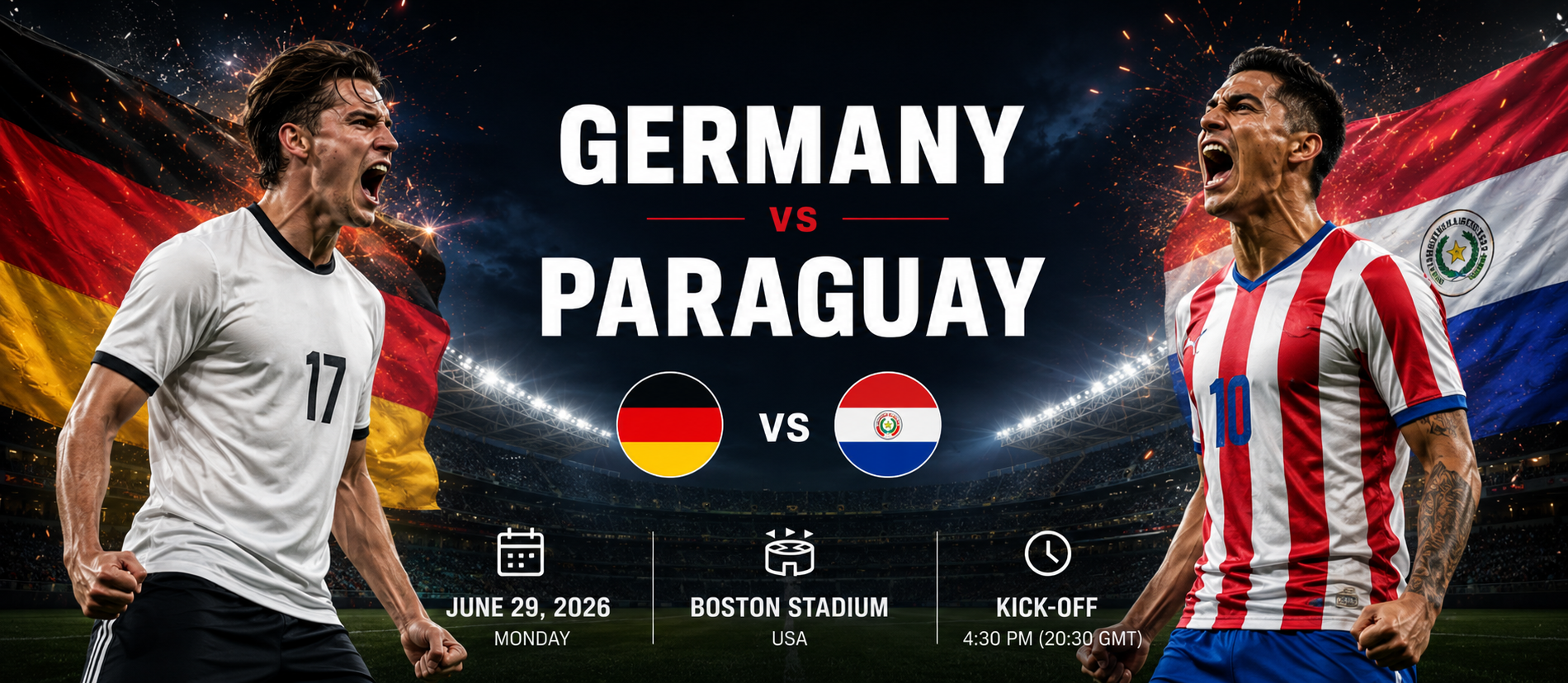
Germany vs Paraguay
Germany vs Paraguay World Cup 2026 Round of 32 preview: team news, tactics, predicted lineups, key matchups and score prediction for the Boston clash on June 29.
- June 29, 2026 Mon
- Gillette Stadium Foxborough
- Kick-Off 4:30 PM ET
A note on how we work at Fanorate.
This preview is researched and written using publicly reported facts, statistics and tactical commentary drawn from match reports, squad announcements and analysis published during the 2026 World Cup. We do not attend matches or conduct first-hand interviews, and we are open about the fact that our editorial process is AI-assisted. Where a detail is uncertain or unconfirmed, we say so. See the Fact-Check Notes at the end.
Everything you need at kickoff
- Stage
- Round of 32 Match 74
- Date
- Mon, June 29, 2026
- Kickoff
- 4:30 p.m. ET Local
- Venue
- Gillette Stadium Foxborough, MA (Boston)
- Referee
- Jalal Jayed Morocco · with Brinsi & Akarkad
- Weather
- High-70s °F ~25–26°C, humid afternoon
- At Stake
- Winner → Round of 16 Not a quarterfinal
- Head-to-Head
- Met once at a World Cup 2002 R16: Germany 1-0
Both sides last played on June 25 — Germany lost 2-1 to Ecuador, Paraguay drew 0-0 with Australia — so both arrive in Boston on three days’ rest, a level playing field on recovery. Heat management has been a recurring storyline at this tournament, even in the northern host cities.
The asymmetry of consequence
The winner advances to the Round of 16. Pre-tournament bracket projections frequently flagged a potential last-16 meeting with France as Germany’s looming obstacle — a far sterner test than Paraguay. For Germany, this is therefore a game to win efficiently and without injury or suspension cost, preserving energy for the genuine heavyweights ahead. For Paraguay, the Round of 16 would be uncharted modern territory and pure profit; reaching it would be among the great results in their World Cup history. The asymmetry of consequence — survival-and-prepare for Germany, glory-or-go-home with no downside for Paraguay — frames the entire occasion.
Germany: very high. As four-time champions and pre-tournament contenders who have failed at the group stage in two straight World Cups, anything short of the latter rounds is a crisis. Losing to a side ranked around 40th in the world would be a national catastrophe. The weight sits entirely on them.
Paraguay: very low. Nobody outside Asunción expects them to win. They have already exceeded expectations by reaching the knockouts for the first time since 2010. They play with house money — the single most dangerous state for an underdog.
This asymmetry is Paraguay’s biggest non-tactical weapon.
Momentum, fatigue, and four ways it breaks
Momentum: Germany cooling
An 11-match winning run ended against Ecuador, and the manner of the defeat — disjointed, leaking transitions, losing Schlotterbeck — dented the feel-good factor. But group-winners’ status and a rested first XI mean the dip is recoverable.
Momentum: Paraguay rising
From the depths of a 4-1 humbling to two clean sheets and a knockout berth, the arrow points up. Confidence in the system is high, and underdog freedom is a real psychological asset. Edge on pure momentum: marginally Paraguay. Edge on quality and freshness of best XI: clearly Germany.
Fatigue: a level field, with a German edge
Both teams played their final group game on June 25 and meet on June 29: three days of rest each, so neither has a recovery edge. But Germany rotated heavily for the Ecuador defeat, meaning their first-choice XI is relatively fresh — a quiet advantage. Paraguay expended enormous energy defending against Australia and may need to repeat it for 120 minutes. The deep New England heat at a 4:30 p.m. kickoff favours the side with more rotation depth — clearly Germany.
Scenario A — Germany break the block
Most consistent with form. Germany dominate the ball, struggle for an hour, then Nagelsmann’s bench changes the picture. A second striker or a moment of Wirtz/Musiala magic unlocks the door, and Germany add a second late as Paraguay are forced to push up. A controlled, slightly nervy 2-0 type win.
Scenario B — the grind and the late goal
A tight, low-event game in the heat. It stays scoreless deep into the second half until a single German moment — a set piece, a deflected effort, a penalty — settles it. Germany edge through 1-0 with Paraguay agonizingly close to a shootout.
Scenario C — the upset on the counter
The realistic shock. Paraguay survive the opening, frustrate Germany, and steal a goal through Enciso or Almirón on the break, or via a Gómez set piece. They then defend with everything. Germany throw bodies forward, leave gaps, and either snatch a late equalizer that forces extra time — or run out of time. A Paraguay win or a shootout is squarely in play.
Scenario D — penalties
Neither side blinks; 0-0 or 1-1 after 120 minutes. The tie goes to a shootout where Germany’s superior takers meet Paraguay’s underdog calm. A genuine coin-flip with Germany marginally favoured.
What would surprise nobody
A cagey, low-scoring affair that Germany eventually win 1-0 or 2-0; Paraguay sitting in a back five and barely attacking; Germany needing the bench to break the deadlock; Enciso being Paraguay’s only genuine attacking threat; the match going to extra time given Paraguay’s defensive discipline.
What would shock the tournament
Paraguay winning in 90 minutes, especially comfortably; a high-scoring, open game; a second mouth-covering red card under the new rule; Germany conceding three; Manuel Neuer being substituted for tactical or penalty reasons.
We are deliberately not assigning numeric probabilities; these are reasoned narrative pathways, ordered roughly from most to least likely.
Tale of the tape
Germany topped Group E and reached the knockout stage for the first time since 2014, ending consecutive group-stage exits in 2018 and 2022. They opened with a 7-1 demolition of Curaçao — Nmecha, Schlotterbeck, a Havertz penalty, Musiala, Brown, super-sub Undav and a second Havertz strike — with 40-year-old Manuel Neuer returning in goal for his first Germany appearance since Euro 2024. A 2-1 win over Ivory Coast followed: trailing to a Franck Kessié goal, Nagelsmann’s triple change just after the hour brought on Undav, who volleyed in an Amiri cross on 68 minutes and snatched a 94th-minute winner. With top spot secured, a heavily rotated side then lost 2-1 to Ecuador — Sané scored inside two minutes amid VAR controversy before Angulo levelled and Gonzalo Plata struck the 77th-minute winner — ending an 11-match winning run and costing Schlotterbeck to a tournament-ending ankle injury.
Paraguay reached a World Cup knockout stage for the first time since 2010, qualifying as one of the eight best third-placed teams from a brutal Group D containing the USA, Australia and Turkey. They were thrashed 4-1 by the USA in their opener — 3-0 down at the break — before Maurício pulled one back on 73 minutes. The campaign reignited against Turkey: Matías Galarza scored the tournament’s fastest goal after just 64 seconds, then ten-man Paraguay held on after Miguel Almirón became the first player ever sent off at a World Cup under the new law banning players from covering their mouths during confrontations. A back-three, ultra-compact 0-0 draw with Australia — in which Paraguay produced their first shot only after 37 minutes, their latest opening attempt in a World Cup match since 1966 — sent both teams through.
Nagelsmann’s Germany is a proactive, possession-leaning side that alternates between a 4-2-3-1 and a back-three/3-4-2-1 depending on the opponent. The principles are constant: high pressing, vertical passing, quick combinations through the half-spaces, and aggressive rest-defence. With Wirtz and Musiala both available, Germany carry as much creative quality between the lines as anyone in the tournament.
Alfaro’s Paraguay is built on defensive solidity and rapid transitions. The base is a compact 4-4-2 that becomes a back five against possession-heavy opponents, as it did against Australia. The wide players tuck in, the double pivot (Cubas the heartbeat) screens the back line, and everything funnels into quick breaks for Enciso, Almirón and the strikers.
Germany are resilient (the Ivory Coast comeback) but capable of complacency (the rotated Ecuador display). The key group-stage evolution was Nagelsmann’s willingness to use his bench decisively. Match 1 was a free-flowing 4-2-3-1 against weak opposition; Match 2 showed the same shape can stagnate against a disciplined mid-block until the bench intervenes; Match 3, heavily rotated, showed how dependent the system is on its first-choice spine — the press was disjointed and transitions leaked. The trajectory tells Nagelsmann to revert to his strongest XI and demand sustained intensity. The question is whether the first-choice XI can impose itself for 90 minutes against a side that won’t open up.
Paraguay are hardened — they went from naive in match one to ruthless game-managers by match three, and will be entirely at peace ceding the ball and chasing a single moment. Match 1 was an open, conventional 4-4-2 that got picked apart; Match 2 a more cautious, lead-protecting version that survived a man down; Match 3 the full evolution: a back-three, ultra-compact block that produced almost nothing going forward but conceded almost nothing either. Expect Boston to look like the Australia game — Paraguay defending deep, inviting Germany on, and waiting to spring.
Manuel Neuer (Bayern Munich) remains No. 1 at 40, backed by Baumann and Nübel. Antonio Rüdiger (Real Madrid) and Jonathan Tah (Bayern) anchor the centre; Nico Schlotterbeck (Dortmund) is out for the rest of the tournament with an ankle injury — a significant loss. Captain Kimmich plays right-back; left-back Nathaniel Brown (Eintracht Frankfurt) missed the Ecuador game with an adductor problem but is expected back, with David Raum the alternative. The midfield engine is Kimmich, Pavlović and Nmecha, with Goretzka, Stiller, Groß and Amiri in depth; Wirtz (Liverpool) and Musiala (Bayern) are the advanced playmakers, Sané and Leweling the width. Up front Kai Havertz (Arsenal) is the focal point, with Undav the impact sub and Woltemade and Beier further options. No suspensions reported.
Orlando Gill (San Lorenzo) has emerged as the starter, backed by Gatito Fernández and Gastón Olveira. Captain Gustavo Gómez (Palmeiras) leads the back line alongside Omar Alderete (Sunderland) — a doubt with a knee problem — with Júnior Alonso, Fabián Balbuena, Gustavo Velázquez and others in support. Andrés Cubas (Vancouver Whitecaps) is the defensive anchor and Matías Galarza (Atlanta United) the goalscoring hero against Turkey; Miguel Almirón (Atlanta United) returns from his one-match ban, but Diego Gómez (Brighton) is suspended after picking up his second tournament yellow against Australia. Julio Enciso (Strasbourg) is the creative spark, with Antonio Sanabria and Gabriel Ávalos leading the line.
- Elite individual creators in Wirtz, Musiala and Sané.
- A restored Havertz as a mobile false-nine/striker.
- A genuinely game-changing bench, Undav above all.
- A captain in Kimmich who can dictate from either right-back or midfield.
- High set-piece and crossing quality.
- Organization, discipline and low-block resilience.
- A frightening turn of pace on the counter through Enciso and Almirón.
- One of CONMEBOL’s best defensive records — in qualifying they scored only 14 in 18 games but conceded just 10.
- They held Australia to under 0.6 xG and beat Turkey by defending a one-goal lead.
- Goalkeeper Orlando Gill has grown into the tournament.
- Defensive transition is the recurring soft spot — even when dominating, Germany concede dangerous counters, exactly as Ecuador exploited.
- The Schlotterbeck injury removes a ball-playing left-sided centre-back and tests their depth.
- An ongoing structural debate about the Pavlović–Nmecha double pivot, with Philipp Lahm among those calling for Kimmich to move into midfield to add control.
- Limited creativity when they have to chase a game; the USA opener showed how exposed they are if forced to play open.
- Squad depth is thinner than Germany’s.
- Discipline can betray them — Almirón’s red, plus the Diego Gómez bookings.
- If they fall behind early, their game plan breaks.
Whoever blinks first
Julian Nagelsmann must solve the puzzle every favourite dreads: breaking down a disciplined, deep block without overcommitting into transitions. His group-stage lesson — use the bench early and decisively — is directly relevant; Undav, Beier, Woltemade and Leweling are tools to change a stalemate after the hour. The pre-match talking point is whether he shifts Kimmich into midfield (the Lahm prescription) for more control, or trusts the Pavlović–Nmecha pivot. Nagelsmann’s flexibility is his strength; expect him to be ready to switch to a back three to overload the wide areas if Paraguay sit in.
Gustavo Alfaro has the simpler-sounding but high-wire task: keep it 0-0 as long as possible, stay compact, avoid the early goal that wrecked the plan against the USA, and gamble everything on transitions and set pieces. He will likely mirror the Australia approach — a back five, narrow midfield, and Enciso held just high enough to spring. His sub strategy is the inverse of Nagelsmann’s: fresh legs to keep the block intact for 90-plus minutes, and a late roll of the dice only if the game is still level.
Key duels to watch
Wirtz & Musiala vs Andrés Cubas
Germany’s creators will live in the pockets in front of Paraguay’s back line. Cubas’s screening, tackling and positional discipline are the first line of defence. If he wins this individual battle, Paraguay’s plan holds.
Leroy Sané vs Juan José Cáceres
Against a deep block, Germany’s width and 1v1 pace become crucial. Sané getting in behind or pinning the wing-back is one of the few ways to stretch a five-man defence.
Julio Enciso vs Germany’s defensive transition
This is Paraguay’s entire upside. The moment Germany lose the ball high, Enciso and Almirón want to break. Germany’s rest-defence — already exposed by Ecuador — must be flawless.
Gustavo Gómez vs Kai Havertz
The captain’s aerial and positional duel with Germany’s mobile striker will define how many clean looks Germany get inside the box.
The meta-battle: Nagelsmann’s patience and bench versus Alfaro’s organization and Paraguay’s collective discipline. Whoever blinks first — Germany forcing it and getting countered, or Paraguay cracking under sustained pressure — likely decides it.
The names that decide it
Average. Beaten three times in two starts he’d want back; commanding but 40-year-old reactions tested by Ecuador.
Good. Reliable, two-way driver; the Lahm debate is about where he plays, not whether.
Good. Aggressive leader; will relish a low-block, low-threat opponent.
Good. Steady, dominant in the air.
Average. Scored vs Curaçao but fitness only just restored; a question mark.
Average. Press-resistant on the ball but at the centre of the control debate and the Ecuador VAR controversy.
Good. Opened the scoring vs Curaçao; energetic box-to-box presence.
Good. Scored the early goal vs Ecuador; pace is a weapon against a deep block if he stays disciplined.
Good. Scored vs Curaçao; the dribbler most likely to unlock a packed box.
Good. Germany’s designated star; assist-machine potential, due a defining tournament moment.
Outstanding. Three group goals; restored confidence and Germany’s penalty option.
Good. Two clean sheets in the last two games; growing in stature.
Good. Part of an organized rear-guard.
Outstanding. Tournament-grade leadership and aerial dominance; the spine of the resistance.
Good. Alonso likely if Alderete’s knee keeps him out.
Good. Disciplined wide defending.
Average. Energetic but raw.
Outstanding. The metronome and ball-winner; set up the Turkey goal and bossed midfield vs Australia.
Good. Scored the tournament’s fastest goal; carries a transition threat.
Average. Returning from suspension; explosive on the break but rusty and a discipline risk.
Outstanding. Paraguay’s most dangerous player; the one man who can win this on a moment.
Average. Will see little service in a low block but must be clinical with scraps.
How to read these ratings
Ratings reflect group-stage performance and current standing, not absolute talent.
History and the small print
They’ve met once at a World Cup
In the 2002 Round of 16, Oliver Neuville’s 88th-minute goal sent Germany through 1-0 on their run to the final.
Most recent meeting: a 3-3 friendly
Their most recent meeting of any kind was a 3-3 friendly in 2013.
The fastest goal of the tournament
Matías Galarza scored after just 64 seconds against Turkey, drilling a left-footed effort through Merih Demiral’s legs and past Uğurcan Çakır.
A first under a new rule
Miguel Almirón became the first player ever sent off at a World Cup under the new law banning players from covering their mouths during confrontations.
Paraguay’s latest first shot since 1966
Against Australia, Paraguay produced their first shot only after 37 minutes — their latest opening attempt in a World Cup match since 1966.
The tournament’s first sub-1.0 xG game
Paraguay’s 0-0 draw with Australia finished below 1.0 expected goals between the teams, the tournament’s first such game.
Neuer is back, at 40
Manuel Neuer returned in goal against Curaçao — his first Germany appearance since Euro 2024 — at 40 years old.
An 11-match run ended
Germany’s 11-match winning run ended with the controversial 2-1 defeat to Ecuador.
Best guess at kickoff
Lineups are best-guess and subject to change. If Nathaniel Brown’s adductor isn’t ready, David Raum is the likely left-back, and there is a live debate about moving Kimmich into midfield. Diego Gómez is suspended, and Paraguay are expected to shift to a back five against possession, as they did versus Australia — effectively a 5-3-2/5-4-1 out of possession. Likely changes: Germany may turn to Undav and/or Woltemade for a second striker if chasing a goal, Goretzka or Stiller for midfield control, and Leweling for fresh width; Paraguay may introduce Sanabria as a focal point and fresh wing-backs to preserve the block, with Sosa or Maurício for late energy.
Whoever Nagelsmann introduces around the hour mark has a direct hand in the outcome.
Germany have more than 65% possession but fewer than expected clear-cut chances — the low-block frustration is real. Deniz Undav is involved in a Germany goal again, off the bench. Paraguay register their first shot late and have fewer than eight attempts total. The game features at least one VAR review of note — the tournament has had several, and Germany have been on both sides of controversy already.
How the underdog can win
Paraguay’s path is narrow but real and entirely consistent with what they’ve already done. Survive the first 25 minutes scoreless — the USA game proved an early goal collapses the plan. Defend the box with a back five and force Germany wide, daring them to beat Gómez and Gill in the air and making every German chance a low-percentage one. Win the transition lottery — Paraguay need only one or two clean breaks for Enciso and Almirón, and Germany’s rest-defence is their proven weakness. Steal a set piece with Gómez and a physical defence. And drag it to penalties: a 0-0 after 120 minutes is a win condition that neutralizes the talent gap and turns the tie into a coin-flip.
The realistic underdog script: keep it level, nick one on the break or from a set piece, then defend like their lives depend on it — or hold out for a shootout.
If it goes the distance, the psychological framing flips. Germany’s designated takers were reported as Joshua Kimmich (who converted a qualifying penalty against Luxembourg) and Kai Havertz (who scored both of Germany’s Euro 2024 penalties), with no firm hierarchy confirmed; Neuer brings shootout experience and presence. But Paraguay’s calm, defensive temperament and a goalkeeper in Gill who has grown into the tournament make them a more awkward shootout proposition than their ranking suggests. Slight edge to Germany on quality; genuine jeopardy for them on nerve.
Germany 2-0 Paraguay, after a frustrating, scoreless first hour. Man of the match: Florian Wirtz — backed to deliver the unlocking moment Germany have been waiting for, with a goal or assist. The turning point: a Nagelsmann substitution around the 60–65th minute that adds a second striker or fresh legs and finally stretches Paraguay’s block.
Paraguay are superbly organized and genuinely dangerous on the break, and a shootout is not far-fetched. But Germany’s quality, bench depth and fresher first XI should tell over 90-plus minutes against a side that will struggle to create. The most likely path is a tense, late breakthrough rather than a comfortable cruise. Confidence: medium. Germany should win, but Paraguay’s floor — a low-block shootout — is high enough, and Germany’s defensive-transition flaw real enough, that an upset or extra time is a live outcome.
Germany are favourites for sound reasons: the talent gap is wide, their first-choice XI is fresh thanks to rotation, and they have multiple ways to score — open play through the creators, width and crossing, set pieces, and a penalty taker in Havertz. Crucially, they have the bench depth to win a war of attrition, exactly the kind of game Paraguay want to drag them into. If they avoid the careless transition that undid them against Ecuador, the probabilities sit firmly with Die Mannschaft.
What’s verified, and what isn’t
Verified: Match details (Germany vs Paraguay, Gillette Stadium/Foxborough, June 29, 2026, 4:30 p.m. ET, Round of 32, Match 74); the winner advances to the Round of 16, not a quarterfinal. Germany won Group E (7-1 Curaçao, 2-1 Ivory Coast, lost 2-1 Ecuador). Paraguay finished third in Group D (lost 4-1 USA, beat Turkey 1-0, drew 0-0 Australia) and qualified as a best third-placed team. Managers: Julian Nagelsmann and Gustavo Alfaro. Referee: Jalal Jayed. Schlotterbeck out for the tournament; Diego Gómez suspended; Almirón’s mouth-covering red card and one-match ban now served; the 2002 head-to-head (Germany 1-0, Neuville 88′).
Reported but not fully confirmed: Exact predicted lineups (subject to change); Nathaniel Brown’s fitness; Omar Alderete’s availability (knee doubt); the weather (forecast-based); Paraguay’s precise out-of-possession shape.
Not confirmed / flagged uncertain: Specific yellow-card ‘one-booking-away-from-suspension’ lists for either squad were not comprehensively reported; we did not invent names.
No invented statistics or probabilities: the match-simulation scenarios are reasoned narratives, not modelled percentages; all scorelines are either reported results or clearly labelled forecasts.
Where a detail is uncertain or unconfirmed, we say so.
