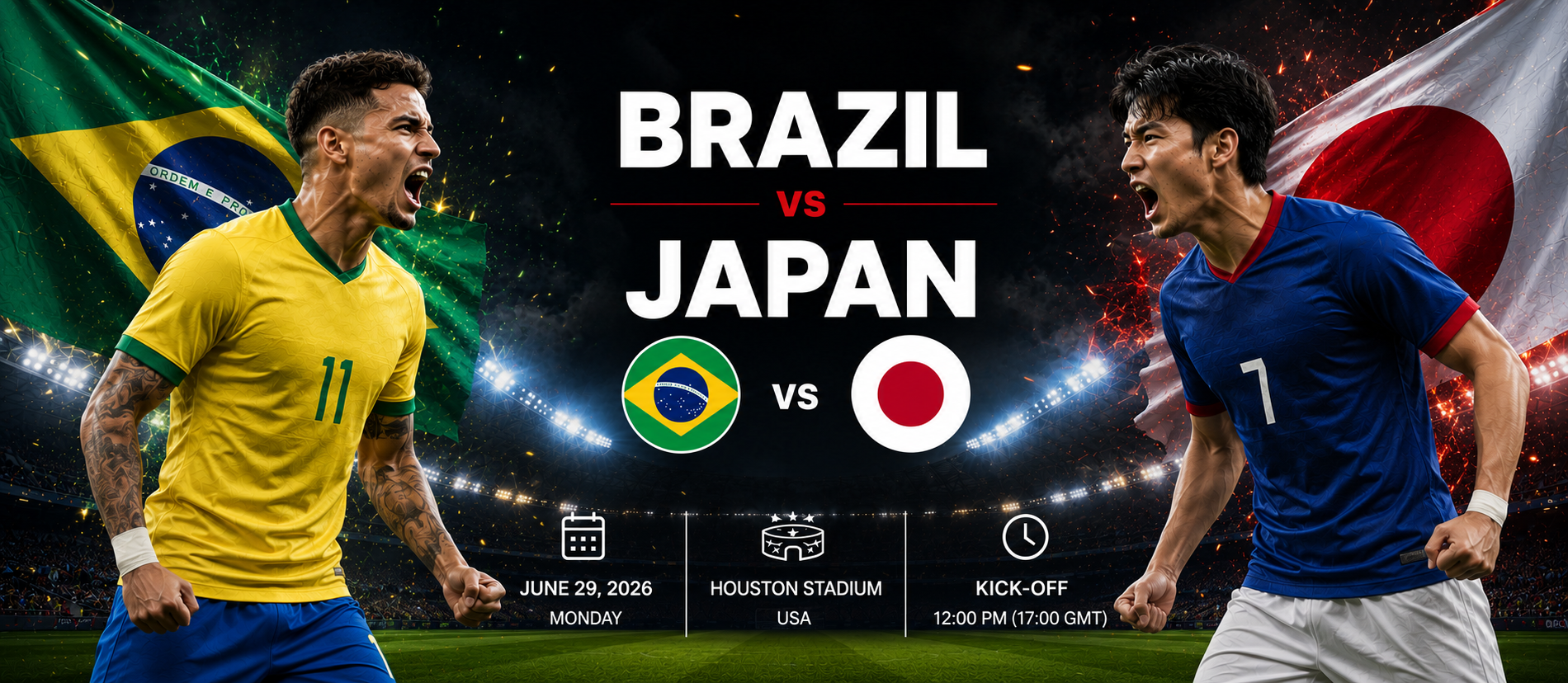
Brazil vs Japan
Brazil vs Japan World Cup 2026 Round of 32 preview — Houston tactics, lineups, key matchups, fatigue, momentum and a reasoned final prediction.
- June 29, 2026 Mon
- NRG Stadium Houston
- Kick-Off 1:00 PM ET
A note on how Fanorate builds these previews.
This is a research-led, AI-assisted analysis produced by the Brillmark team. We have not been inside either camp; everything below is drawn from public reporting, official squad lists and match data verified as of June 27, 2026. Where a detail could not be confirmed, we say so rather than guess. No probabilities here are betting models — they are reasoned editorial judgments.
Everything you need at kickoff
- Fixture
- Brazil vs Japan Round of 32 · Match 76
- Date
- Mon, June 29, 2026
- Kickoff
- 1:00 p.m. ET Houston local time
- Venue
- NRG Stadium Houston, Texas, USA (tournament branding: "Houston Stadium")
- Stage
- Round of 32 Opening knockout round of the new 48-team format · winner advances to the Round of 16, not a quarterfinal
- Referee
- Maurizio Mariani Italy — assisted by Daniele Bindoni and Alberto Tegoni; fourth official Sandro Schärer (Switzerland); the only Italian referee at the tournament
- Days of Rest
- Brazil ~5 · Japan ~4 Brazil last played June 24 (vs Scotland), Japan June 25 (vs Sweden) — a marginal but real edge to the Seleção
- Head-to-Head
- Japan won 3-2 Oct 14, 2025 friendly in Tokyo (Ajinomoto Stadium), from 2-0 down — Japan's first-ever win over Brazil; historically Brazil dominate the all-time series
NRG Stadium is a climate-controlled, retractable-roof venue. Late-June Houston is hot and extremely humid; with the roof closed and air conditioning running, on-field conditions should be controlled rather than the brutal open-air heat seen at some other 2026 sites. Treat the exact roof decision as a game-day call by organizers.
The bracket beyond is the real prize
The winner of Brazil vs Japan (Match 76) advances to the Round of 16. Here the reporting is not fully consistent, and we flag it rather than assert: one bracket reading has the Match 76 winner facing the winner of Germany vs Paraguay (Match 74), while another framing pointed toward a path involving Norway or Ivory Coast (Match 78). Adding intrigue, Germany were upset by Ecuador in the group stage and finished as a Group E runner-up, which scrambles assumptions about that side of the draw. The safe, verified statement is this: the winner goes to the Round of 16 against a fellow knockout qualifier from the adjacent ties, with Germany/Paraguay the most-cited bracket-neighbor pairing. For Japan, advancing would itself be historic — their first-ever trip beyond the Round of 16 would be one step closer.
For Brazil, the bracket beyond is the real prize: a deep run toward a record-extending sixth title.
How the night could go
Momentum Meter
Brazil: Rising. Two clean 3-0 wins to close the group, Vinícius and Cunha scoring freely, Neymar back in the picture — momentum and confidence are clearly trending up. Japan: Steady-positive. Unbeaten, a historic 4-0, and through with belief intact — but the Sweden draw was a reminder that they ride pressure rather than dominate; momentum is good, not surging. Edge: Brazil, but Japan carry no scars.
Pressure Meter
Brazil: Maximum. A five-time champion with the world’s most expensive attacker and a legendary coach is expected to brush Japan aside; anything less than a competent win is treated as a crisis at home, and that weight is a genuine factor in a tight knockout. Japan: Liberating underdog status — but with one specific psychological burden: the Round of 16 ceiling. The pressure is not to beat Brazil; it is to finally break their own glass ceiling. Pressure sits heavier on Brazil, which is precisely the lever Japan must pull.
Fatigue Report
Both sides come in reasonably fresh after a three-match group stage in the expanded format. Brazil have the marginal edge: one extra day of rest (last played June 24 vs Japan’s June 25) and a manager who rotated and managed minutes, easing Neymar back gradually. Japan’s intensity-based model is more physically demanding over 90 minutes, and the Houston heat/humidity — even with the roof managed — taxes a high-pressing, high-transition side more than a possession-based one. Japan’s deep squad and disciplined rotation (notably in the Sweden game) mitigate this. Net: a slight physical advantage to Brazil, magnified if the game goes to extra time.
Why the favorite should win
Brazil should win because the talent gap in the final third is enormous and knockout football tends to be decided by individual quality. Vinícius Júnior is the best attacker in the tournament; Cunha is in form; Raphinha, Neymar, Martinelli and Endrick wait on the bench. Brazil concede little (one goal in three group games), have an elite goalkeeper, and possess the transition speed to punish Japan the moment the Samurai Blue commit to attacking. Add the extra day of rest and the deeper bench, and Brazil have more ways to score and more ways to win late. If the game opens up at all, Brazil’s ceiling is far higher.
How the underdog can win
This is not a fantasy — Japan beat Brazil 3-2 eight months ago. The route is specific: win the Casemiro zone by getting Kubo and Kamada turning in the space ahead of and beside Casemiro, breaking the line before Brazil’s recovery runners arrive; make Brazil’s full-backs choose by baiting them high and then attacking the vacated channels with Maeda’s pace and Ito’s width; defend the cutback, not the cross, keeping Vinícius and Cunha shooting from low-percentage angles; use set pieces as equalizers (Ito’s delivery and Ueda’s heading have already produced goals); Suzuki must be the best player on the pitch; and take it to a shootout if you can’t win it in 90.
Penalty shootout analysis
If this goes to a shootout, the picture is genuinely closer than the 90-minute matchup. Japan’s case: Zion Suzuki is a top-class shot-stopper in form, and Japanese teams are renowned for composure and technical penalty-taking; their psychological freedom helps. Brazil’s case: a wealth of elite, ice-cold takers (Vinícius, Raphinha, Paquetá, Neymar if on the pitch) and Alisson, himself an excellent penalty goalkeeper — but Brazil also carry shootout scar tissue, with knockout exits on penalties part of recent Seleção history. Verdict: Brazil have the superior individual takers; Japan have the freer minds and an in-form keeper. A shootout is close to a coin flip and represents Japan’s single best path to the upset.
Scenario 1 — Brazil controls and wins comfortably
Most likely overall. Japan respect the ball, Brazil find an early-to-mid goal through Vinícius or Cunha, Japan have to open up, and Brazil’s transition game adds a second. Final in the region of 2-0 or 3-1. Likelihood: high — the single most probable outcome.
Scenario 2 — Tight, low-scoring Brazil win
Very plausible. Japan’s block frustrates Brazil for long spells; a moment of individual brilliance or a set piece decides it 1-0 or settles it late. Likelihood: moderate-high.
Scenario 3 — Japan takes it to extra time / penalties
Real upset path. Suzuki excels, Japan defend the cutback, nick a goal on a transition or set piece, and the game reaches 90 or 120 minutes level. A shootout becomes a coin flip. Likelihood: moderate — the most credible route to a shock.
Scenario 4 — Outright Japan win in 90
The upset that would echo October 2025. Japan win the Casemiro zone repeatedly, punish Brazil’s high full-backs on the break, and Suzuki keeps a clean-ish sheet. They have literally done a version of this within the past year. Likelihood: low-to-moderate — unlikely, but far from absurd.
No fixed percentages are offered; these are reasoned editorial likelihoods.
Tale of the tape
Carlo Ancelotti’s first World Cup in charge of the Seleção began with a stress test and ended with a statement. Match 1 — Brazil 1-1 Morocco (June 13, East Rutherford): Ismael Saibari put Morocco ahead around the 21st minute, exposing the weakness analysts had flagged under Ancelotti — a midfield screen, anchored by Casemiro, that can be turned and run at by direct, athletic opponents; Vinícius Júnior equalized midway through the first half and Brazil controlled territory without finding a winner against a disciplined, deep-defending Morocco. Best player: Vinícius Júnior. Tactical lesson: the double pivot needs press-recovery legs; Casemiro can be isolated against vertical teams. Match 2 — Brazil 3-0 Haiti (June 19, Philadelphia): Matheus Cunha scored twice in the first half (around the 23rd and 36th minutes) and Vinícius added another before the break; Brazil were ruthless in transition and comfortable in possession. Best player: Matheus Cunha. Tactical lesson: with space to attack, Brazil’s front line is among the most lethal in the tournament. Match 3 — Brazil 3-0 Scotland (June 24, Miami): Vinícius produced a first-half brace and Brazil sealed top spot in Group C, finishing ahead of Morocco on goal difference (one outlet referred to a “3-3 triumph,” but the verified scoreline is 3-0); Neymar featured from the bench, easing back into match minutes. Tactical lesson: Brazil are most dangerous attacking a team that has to open up. Brazil scored seven group-stage goals across the three matches and conceded one — confidence is high, the Vinícius–Cunha axis is humming, and Ancelotti has the luxury of options.
Hajime Moriyasu’s Samurai Blue arrived in Houston having lost nobody’s respect. Match 1 — Netherlands 2-2 Japan (June 14, Arlington): Japan went toe-to-toe with the Group F winners and came away with a point, twice matching the Dutch, announcing that their transitional, compact-then-vertical model could trouble elite European opposition. Best player: the midfield collective — Endo’s screening and the creative drift of Kubo. Tactical lesson: Japan can absorb and counter against possession-heavy sides. Match 2 — Japan 4-0 Tunisia (June 21, Monterrey): Daichi Kamada scored Japan’s quickest-ever World Cup goal in the fourth minute, Ayase Ueda struck a brace (around the half-hour and the 83rd), and Junya Ito added the third in the 69th — the largest World Cup win in Japan’s history, the first time an AFC side scored four in a World Cup match, and the 1,000th match in World Cup history. Best player: Ayase Ueda. Tactical lesson: given a lead to protect and space to break into, Japan are clinical and merciless. Match 3 — Japan 1-1 Sweden (June 25, Arlington): Daizen Maeda finished a Ritsu Doan pass in the 56th minute, Anthony Elanga equalized for Sweden six minutes later, and Zion Suzuki made a string of late saves, including a crucial injury-time stop. Best player: Zion Suzuki. Tactical lesson: Japan can ride out pressure, but the back line will concede chances against quality movement. Japan finished with seven goals — their most ever in a single World Cup group stage — and are through to the knockouts for the third consecutive tournament and the fifth time in seven attempts since 2002. The ceiling, as ever, is the Round of 16: Japan have never gone further.
This is a Brazil rebuilt around clarity rather than chaos. Ancelotti has imposed structure on a squad of individualists, leaning on a recognizable 4-3-3 (with shades of a 4-2-3-1) and asking Vinícius Júnior to be the decisive, repeatable threat rather than an occasional spark. The mentality is the familiar Brazilian paradox: enormous expectation, a nation that accepts nothing but a sixth star, paired with a generation that has not yet won a knockout World Cup tie of real weight.
Japan are the tournament’s model of organization. Their identity is a disciplined mid-block that compresses the center, denies the cutback, and then springs vertical, fast transitions through intelligent movers. Mentally they are unflappable — three group games, no defeats, and a refusal to be intimidated by the Netherlands.
Match 1 (Morocco): a cautious, slightly reactive 4-3-3 — Casemiro shielded but was repeatedly bypassed by Morocco’s directness; full-backs were conservative early; Brazil dominated the ball after equalizing but lacked penetration against a deep block. Match 2 (Haiti): Ancelotti loosened the handbrake — higher full-backs, quicker ball circulation, and the Vinícius–Cunha pairing given license to rotate, with a more aggressive press. Match 3 (Scotland): the most balanced version — Brazil pressed selectively, controlled tempo, and let Vinícius isolate the Scottish right side; Neymar’s introduction hinted at managing minutes and keeping a game-changer in reserve. The throughline: Ancelotti is still experimenting, but the team is trending toward a controlled, transition-ready 4-3-3 that wants the opponent to commit bodies forward.
Match 1 (Netherlands): a compact, disciplined block — most commonly a 3-4-2-1 / 3-4-3 hybrid — absorbing Dutch possession and breaking through Kubo and the wide channels; resilience over dominance. Match 2 (Tunisia): with Tunisia forced to chase, Japan’s structure became a launchpad — Kamada’s early goal flipped the game into the open, transition-friendly contest Japan thrive in, and Ueda punished the spaces. Match 3 (Sweden): back to control and management — Japan took the lead through a worked move, conceded to a moment of quality, then defended the result with Suzuki excelling; Moriyasu rotated minutes with the knockout in mind. The throughline: Moriyasu trusts a back-three system that flexes between a deep mid-block and rapid vertical breaks. Against Brazil, expect the conservative version of that identity.
- Elite individual attackers
- Transition speed
- Goalkeeping depth led by Alisson
- Cohesion and work rate
- Set-piece delivery
- A top-class goalkeeper in Suzuki
- A clinical edge when given space
- A midfield base that can be turned
- Full-backs who push high and leave the center-backs exposed
- The open question of whether this group handles a tight, low-scoring knockout night
- A center-back group that can be pulled around by elite movement
- The absence of injured talisman Kaoru Mitoma (hamstring)
- A historical mental hurdle they have never cleared — the Round of 16
Structure vs resources
Carlo Ancelotti vs Hajime Moriyasu. Ancelotti owns the bigger trophy cabinet and the deeper bench; his edge is the ability to change a game with elite substitutes (Neymar, Raphinha, Endrick, Martinelli) and his serene knockout experience. Moriyasu’s edge is conceptual: he has built the more clearly defined system, and his side knows exactly what it is.
The chess problem for Ancelotti is patience — can Brazil resist over-committing against a team that wants them to? The chess problem for Moriyasu is points of contact — when do you press, when do you sit, and can you spring enough transitions to actually win rather than merely survive?
Key player matchups
Vinícius Júnior vs Japan’s right-side wing-back/center-back cover
The single most important duel. Japan’s back three must avoid being dragged into isolated one-v-ones with the tournament’s best attacker. Whoever shadows Vinícius — likely a combination of wing-back and a shifting center-back — has to stay patient and refuse to dive in.
Matheus Cunha vs Itakura/Ito
Cunha’s movement between the lines and direct running is exactly the threat Japan’s center-backs have looked least comfortable against. If Brazil get him turning toward goal in transition, danger follows.
Casemiro vs Kubo/Kamada
Japan’s creative drift is designed to find the space Casemiro vacates. This is where Japan’s game plan lives or dies — can their playmakers turn and break before Brazil’s recovery speed arrives.
Zion Suzuki vs Brazil’s shot volume
Brazil will create. Suzuki’s shot-stopping has already swung one group game; against a barrage he is Japan’s lifeline and their best hope in a shootout.
Brazil’s high full-backs vs Japan’s vertical counter
If Brazil’s full-backs commit, Japan’s wide breaks through Maeda, Ito and Kubo are the most plausible source of an upset goal.
On balance the tactical edge is even-to-slight-Moriyasu in structure, but Ancelotti in resources — and resources usually decide tight knockout ties.
Form index — ratings reflect group-stage output and current trajectory
Outstanding. Tournament’s standout attacker with four goals; the decisive force.
Outstanding. Three goals including a brace vs Haiti; in-form and direct.
Good. Solid, untested by volume given Brazil conceded just once.
Good. Calm organizer; the spine’s leader.
Good. Aggressive, aerially strong center-back.
Good. Reliable progressor and energy in midfield.
Good. Creative width and end product when used.
Average. Useful in transition; not yet at his ceiling this tournament.
Average. Anchors the side but exposed against vertical opponents; the structural concern.
Average (small sample). Easing back from the bench; high upside, low minutes.
Outstanding. Match-saving displays, especially vs Sweden; Japan’s biggest asset against Brazil.
Outstanding. Brace vs Tunisia; clinical, leads the line and the scoring charts.
Good. Creative hub; the player most likely to unlock Brazil on the break.
Good. Scored the quickest goal of the group; tempo and quality in midfield.
Good. Disciplined screen; the captain who makes the block work.
Good. Pace and pressing, scored vs Sweden.
Good. Wide threat and set-piece delivery; scored vs Tunisia.
Good. Direct creator; assisted Maeda.
Average. Steady but part of a back line that will be stretched by Brazil’s movement.
Average. Solid, will be tested defensively.
Full Squad Analysis
Squad note: Multiple reputable outlets published Brazil’s 26 with internal inconsistencies (for example, two different “Ederson” entries — goalkeeper Ederson and midfielder Ederson — and varied club labels reflecting the volatile transfer market). We list the consensus names below and flag the soft spots; treat individual club affiliations as best-available rather than gospel.
Brazil — Goalkeepers: Alisson (Liverpool), Ederson (Fenerbahçe per one squad list; previously Manchester City), Weverton (Grêmio). Alisson is the clear No. 1.
Defenders: Marquinhos (PSG, captain), Gabriel Magalhães (Arsenal), Bremer (Juventus), Éder Militão (returning to fitness), Danilo, Alex Sandro, Douglas Santos, Léo Pereira, Ibañez. Goal.com’s likely XI listed names such as “Beraldo,” “Bruno” and “Henrique” in defense that do not all match the widely reported 26 — we treat the headline center-back pairing as Marquinhos and Gabriel, with the rest as competition.
Midfielders: Bruno Guimarães (Newcastle), Casemiro (Manchester United), Lucas Paquetá, Éderson (Atalanta), plus depth options. Bruno Guimarães is central to ball progression; Casemiro anchors but is the most-targeted structural question mark.
Forwards: Vinícius Júnior (Real Madrid), Matheus Cunha (Manchester United), Raphinha (Barcelona), Gabriel Martinelli (Arsenal), Neymar (Santos), Endrick, Luiz Henrique, Igor Thiago, Rayan. Vinícius is the talisman; Cunha the in-form scorer; Neymar the wildcard reintroduced gradually.
Brazil — Injuries: No major sidelined players publicly confirmed (per pre-match reporting); Militão’s match sharpness is the watch item. Suspensions: None publicly confirmed. One yellow away: No widely reported Brazil player is confirmed to be carrying a single yellow into a suspension risk; treat as “none confirmed.”
Japan — Goalkeepers: Zion Suzuki (No. 1, outstanding group stage), Keisuke Osako, Tomoki Hayakawa.
Defenders: Ko Itakura, Hiroki Ito, Tsuyoshi Watanabe, Yukinari Sugawara, Junnosuke Suzuki, Ayumu Seko, Shogo Taniguchi, Takehiro Tomiyasu (back from long injury layoff), Yuto Nagatomo (39 — first Asian player at five different World Cups).
Midfielders: Wataru Endo (Liverpool, captain), Daichi Kamada (Crystal Palace), Ao Tanaka (Leeds), Takefusa Kubo (Real Sociedad), Ritsu Doan (Eintracht Frankfurt/transfer-market dependent), Keito Nakamura, Kaishu Sano, Junya Ito.
Forwards: Ayase Ueda (Feyenoord — Eredivisie top scorer this past season, team-leading 16 international goals), Daizen Maeda, Koki Ogawa, Keisuke Goto, Kento Shiogai, Yuito Suzuki.
Japan — Injuries: Kaoru Mitoma (Brighton) ruled out of the tournament entirely with a hamstring injury suffered before the World Cup — the headline absence and a genuine blow to Japan’s one-on-one wide threat; Tomiyasu is back in the squad but his match minutes should be managed. Suspensions: None publicly confirmed. One yellow away: No specific Japan player is confirmed in public reporting as one booking from suspension; we flag this as unconfirmed rather than invent a name.
The expected and the seismic
A one- or two-goal Brazil win
Brazil winning by a one- or two-goal margin.
Vinícius the decisive figure
Vinícius being the decisive figure.
Japan defend, then quality tells
Japan defending superbly for an hour before quality tells.
A late Brazil sub changes it
A late Brazil substitute (Neymar/Endrick) changing the game.
Suzuki makes three-plus saves
Suzuki making three or more high-quality saves.
Japan win in 90 and become a dark horse
Japan winning in 90 minutes and becoming a genuine dark horse — eliminating a five-time champion and Vinícius.
Brazil out on penalties
Brazil being knocked out on penalties, reviving every old Seleção shootout ghost.
A Japanese clean sheet
A Japanese clean sheet against the tournament’s most prolific attack.
Brazil fail to score
Brazil failing to register a single goal.
Best guess at kickoff
Neither manager confirmed an XI pre-match; these are best-available projections drawn from group-stage selections and reporting, and we present a corrected, consensus-leaning Brazil XI given some non-standard names in published projections. Brazil bench/options: Ederson, Weverton (GK); Bremer, Militão, Alex Sandro, Léo Pereira; Éderson (Atalanta); Neymar, Gabriel Martinelli, Endrick, Luiz Henrique, Igor Thiago, Rayan — with Neymar and/or Martinelli likely for fresh legs in attack, Endrick a late game-changer, and Bremer/Militão to close out a lead. (Goal.com’s alternative projection had Souza in goal and a front line including Luiz Henrique alongside Vinícius and Martinelli, with Paquetá deeper — reflecting genuine selection uncertainty across the forward line.) Japan bench/options: Osako, Hayakawa (GK); Tomiyasu, Seko, Taniguchi, Nagatomo, Junnosuke Suzuki; Kamada, Tanaka, Doan; Maeda, Ogawa, Goto — with Maeda likely for pace and pressing, Kamada to add midfield quality and goals, and Doan as a wide creator to chase a goal.
Vinícius Júnior scores or assists — extending his claim on the Golden Boot conversation.
Zion Suzuki finishes as one of the busiest, highest-rated goalkeepers of the entire round. Japan score at least once — their structure and set pieces are too good to be shut out entirely. Neymar is introduced from the bench and influences the closing stages. The match produces at least one VAR check on a penalty/offside call given the stakes and Mariani’s by-the-book reputation.
Man of the Match: Vinícius Júnior (with Zion Suzuki the likely standout for Japan). Turning point: a Brazil goal in the second half forcing Japan to chase, opening the transition lanes Brazil punish for a decisive second.
Brazil to win, with Japan landing a blow.
Far from a procession
Japan’s structure, Suzuki and recent history (3-2 in October 2025) make this far from a procession, and they should score. But over 90 minutes the gap in attacking quality, Brazil’s extra rest, deeper bench and Ancelotti’s knockout nous tilt the result. Japan’s best realistic outcome is dragging it to penalties — a genuine coin flip — and that remains their clearest route to a shock.
Confidence level: Medium. The result (Brazil to advance) we hold with reasonable confidence; the exact scoreline and margin are low-confidence. The biggest uncertainties are whether Japan can keep it level deep into the game (raising the shootout risk) and the unconfirmed final XIs for both sides.
