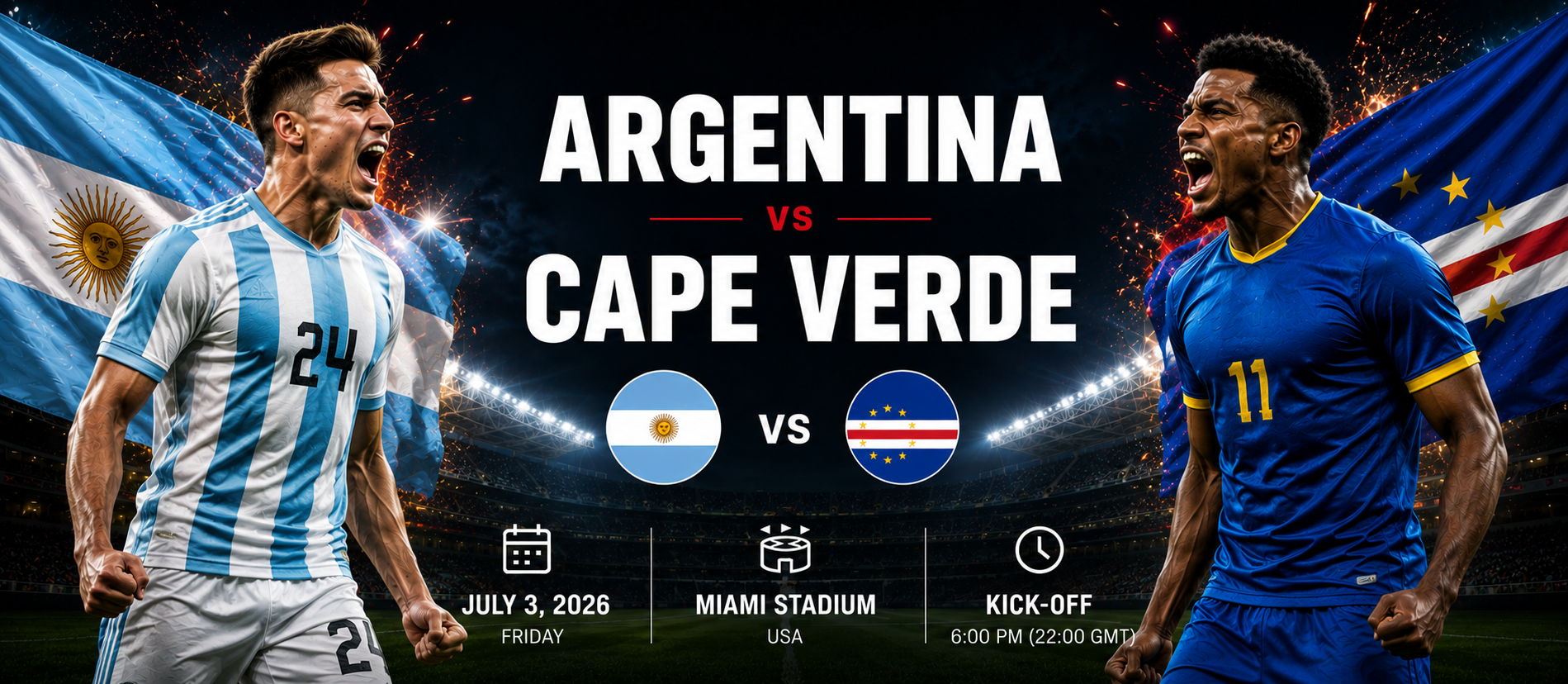
Argentina vs Cape Verde
Argentina vs Cape Verde Round of 32 preview — World Cup 2026 at Miami’s Hard Rock Stadium, July 3. Lineups, tactics, Messi, the Blue Sharks fairytale.
- July 3, 2026 Fri
- Hard Rock Stadium Miami Gardens
- Kick-Off 6:00 PM ET
The tournament’s signature David-and-Goliath tie
The reigning world champions, carried by a Lionel Messi who is rewriting the World Cup goalscoring record book, against the smallest country by population ever to reach a men’s World Cup knockout stage — a 525,000-person Atlantic archipelago that has not lost a game and has conceded only twice.
This is the tournament’s signature David-and-Goliath tie, and David has already toppled one giant.
Everything you need at kickoff
- Date
- Fri, July 3, 2026
- Kickoff
- 6:00 p.m. ET
- Venue
- Hard Rock Stadium Miami Gardens, Florida
- Stage
- Round of 32 Winner advances to Round of 16
- Match
- Match 86 48-team knockout format
- Referee
- Not yet confirmed Flagged as uncertain
- Rest
- ARG 5 days · CPV 6 days Cape Verde know Hard Rock
- Weather
- Hot & humid High 80s–low 90s °F · seasonal
The Round of 32 is the first knockout round in the 48-team format — the winner advances to the Round of 16, not a quarterfinal. The match referee had not been officially confirmed at the time of writing. Early-July Miami is reliably hot and humid, with afternoon-into-evening thunderstorm risk and heat in the high 80s to low 90s Fahrenheit; Hard Rock Stadium has a canopy roof that shades most seats but the pitch is open to the elements, and FIFA has used cooling/hydration breaks in hot venues, so treat the specific forecast as a seasonal expectation. On rest: Argentina finished Group J on Saturday, June 27 (vs Jordan) and Cape Verde finished Group H on Friday, June 26 (vs Saudi Arabia), giving Argentina five clear days and Cape Verde six; Argentina’s reported base camp is in the Kansas City area, and Cape Verde played their middle group game (vs Uruguay) at this same Hard Rock Stadium, so Miami is familiar ground for the Blue Sharks. Bracket path: as Group J winners, Argentina meet the Group H runners-up, and the winner goes into a Round of 16 tie against the winner of the bracket pairing the Group H winners (Spain) against the Group J runners-up (Algeria or Austria).
Pressure, momentum and what’s at stake
The pressure is overwhelmingly on Argentina. As reigning champions facing a 525,000-person debutant, anything but a win is a catastrophe and a global story; even a labored win invites scrutiny. Cape Verde, by contrast, are playing with house money — they have already overachieved beyond anyone’s wildest projection, and every minute from here is a bonus. That asymmetry is the underdog’s greatest asset: freedom.
Emotionally, the needle tilts toward Cape Verde, who ride the high of a historic qualification confirmed only days earlier with a nation and a continent behind them. Competitively, momentum sits firmly with Argentina: three wins, eight goals, a record-breaking Messi, and the quiet confidence of a team that has won without needing its best player to start. Momentum wins underdogs single moments — it rarely wins them ninety minutes against a side this good.
Both teams are reasonably fresh. Cape Verde have a full six days since their last match and rotated heavily against Saudi Arabia; the concern for Bubista is squad depth and the cumulative toll of three high-intensity defensive shifts on a small player pool, plus Logan Costa’s ACL-return conditioning. Argentina have five days’ rest and the deepest squad in the tournament, with Scaloni actively managing minutes — if anything, they enter fresher in their key men than almost any contender.
The stakes stretch beyond this tie. The winner advances to a Round of 16 meeting with the winner of the bracket pairing Spain (Group H winners) with the Group J runners-up (Algeria or Austria) — which is precisely why minutes-management against Cape Verde matters so much for Argentina. For Cape Verde, the Round of 16 is uncharted, almost unimaginable territory; reaching it would extend the single greatest debut campaign in World Cup history.
If Cape Verde keep it level into the final 20 minutes, the pressure on Argentina becomes a tangible, on-field weight.
Four reasoned scenarios
Argentina control and pull away (most likely)
Argentina dominate the ball, Cape Verde sit deep, and the breakthrough comes through Messi’s invention or a set piece. Once ahead, Argentina’s quality tells and a second (and possibly third) follows as Cape Verde chase the game and the gaps appear. A comfortable, professional 2-0 or 3-0 with Messi central to the goals.
The grind (very plausible)
Cape Verde defend superbly, Vozinha makes two or three big saves, and Argentina labor for an hour before a single moment — a Messi free kick, a deflected finish, a scrappy goal from a corner — breaks the deadlock. A tense 1-0 or 2-0 that flatters the margin; Argentina win without ever feeling fully safe.
The scare (the upset on the table)
Cape Verde steal a goal — a Pina set piece or a Varela/Livramento transition off an Argentine error — and the low block plus Vozinha hold a lead deep into the second half. Argentina pile on pressure, the pressure meter spikes, and either they rescue it late (1-1, into extra time / penalties) or, in the genuine shock, they don’t.
All the way to penalties (the underdog’s dream)
Vozinha is unbeatable, Cape Verde frustrate Argentina for 120 minutes, and the tie goes to a shootout. Argentina’s pedigree and Dibu Martínez make them favorites even here — but Vozinha’s form and Cape Verde’s freedom make it the live coin-flip the Blue Sharks crave.
No fake percentages — these are qualitative, evidence-based pictures of how the night could unfold.
Tale of the tape
Argentina arrived in North America as defenders of the crown they won in Qatar and won all three Group J matches, scoring eight. Match 1 — Argentina 3-0 Algeria: Messi opened the tournament with a hat-trick, drawing level with Miroslav Klose’s all-time World Cup tally, having come into camp managing left-hamstring fatigue. Match 2 — Argentina 2-0 Austria: Messi scored both, moving past Klose to stand alone as the all-time leading World Cup goalscorer, in a controlled, low-scoring win over Ralf Rangnick’s side. Match 3 — Argentina 3-1 Jordan: with the group already won, Scaloni rotated and started Messi on the bench; Lautaro Martínez and Giovani Lo Celso scored and a substitute Messi added a trademark free kick (reported 80th minute), taking his tournament tally to six. The wider takeaway: Argentina are deep, professional and pacing themselves, with a manager who will rest his captain when the math allows.
Cape Verde’s group stage is one of the great World Cup debut stories: three matches, three draws, zero defeats, two goals conceded, two clean sheets, and a second-place finish above two-time world champions Uruguay and a Saudi Arabia side that beat Argentina at the last World Cup. Match 1 — Spain 0-0 Cape Verde (Atlanta): Spain fired 27 shots and Cape Verde had just 25.7% possession, yet did not concede, thanks to 40-year-old goalkeeper Vozinha, credited with seven saves (six from inside the box). Match 2 — Uruguay 2-2 Cape Verde (Hard Rock Stadium, Miami): the Blue Sharks scored their first-ever World Cup goals — Kevin Pina with a long-range free kick (reported around the 21st minute), then substitute Hélio Varela equalizing after a loose ball off a poor Olivera pass (reported 61st minute) — twice refusing to fold against a two-time world champion. Match 3 — Cape Verde 0-0 Saudi Arabia (NRG Stadium, Houston): with qualification on the line they dominated, 51% possession, 15 shots to seven and 1.39 xG to 0.39 per Opta, missing chances (Laros Duarte denied by Mohammed Al Owais around 74 minutes) but securing the point that locked second place as Spain beat Uruguay.
Against Algeria, Argentina were front-foot and direct, riding Messi’s individual brilliance to blow the game open early. Against Austria they were more controlled and patient, content to manage a low-scoring game and protect the lead. Against Jordan, with the group secured, Scaloni went full rotation, started Messi on the bench, and still won 3-1 — proof the system works without its talisman from minute one. The evolution is one of escalating game-management: blow them away if you can, control if you must, rotate when you’re able.
The arc is even clearer than Argentina’s. Match 1 vs Spain: pure survival — 25.7% possession, a deep, narrow block, and heroics from Vozinha. Match 2 vs Uruguay: still reactive (34.8% possession, outshot 17-12) but now carrying a genuine attacking threat and the resilience to come from behind. Match 3 vs Saudi Arabia: a transformed posture — 51% possession, 15 shots, dominant xG. Against Argentina, expect a reversion toward the Spain template: deep block, compact center, Vozinha as the last line, and a reliance on transitions, set pieces and substitute impact.
Emiliano “Dibu” Martínez is the undisputed No. 1, the penalty-shootout folk hero of Qatar, but he was reported to be carrying a fractured ring finger coming into the tournament. Gerónimo Rulli and Juan Musso back him up.
Vozinha (Chaves), 40, vice-captain, the hero of the group stage with two clean sheets and a seven-save masterclass against Spain. Márcio Rosa (Montana) and CJ dos Santos (San Diego FC) back up.
Nicolás Otamendi and Cristian “Cuti” Romero anchor the center, though Romero was racing to recover from a right-knee ligament sprain. Lisandro Martínez, Leonardo Balerdi and Facundo Medina provide center-back cover. At full-back, Nahuel Molina (right) and Nicolás Tagliafico (left) are first choice, with Gonzalo Montiel the experienced right-back option; both Molina and Montiel were reported to be nursing muscle injuries. Valentín Barco offers a young, attacking left-sided alternative.
Logan Costa (Villarreal), the Paris-born center-back widely rated as Cape Verde’s best player, is the key man, but his fitness is a gamble: he ruptured his ACL in July 2025 and only returned in mid-May 2026 as a late substitute, so his minutes and sharpness are uncertain. Roberto “Pico” Lopes (Shamrock Rovers) and the veteran Stopira (Torreense) bring experience; Wagner Pina (Trabzonspor), Sidny Lopes Cabral (Benfica), João Paulo (FCSB), Steven Moreira (Columbus Crew), Kelvin Pires and Diney complete the unit. Sidny Lopes Cabral was suspended for the Saudi Arabia match after collecting two group-stage yellows, but because cards reset after the group stage, he is available again for Argentina.
The engine room is deep: Rodrigo De Paul, Alexis Mac Allister, Enzo Fernández and Leandro Paredes form the senior core, with Giovani Lo Celso (a scorer vs Jordan) and Exequiel Palacios offering creativity and legs. Nico Paz is one of the brightest young talents in the squad, though he reportedly missed his club’s final pre-tournament match with a knee issue.
Deroy Duarte (Ludogorets) is a key creator linking defense to attack. Kevin Pina (Krasnodar) provides creativity and dead-ball quality — he scored the historic free kick vs Uruguay. Jamiro Monteiro (PEC Zwolle), Telmo Arcanjo (Vitória SC), Yannick Semedo (Farense) and Laros Duarte (Puskás Akadémia) round out a hard-working group; Laros Duarte was one of the best substitutes of the group stage.
Lionel Messi is the captain and the story: six goals already, the all-time World Cup leading scorer, managing a left-hamstring issue with Scaloni controlling his minutes. Lautaro Martínez (scorer vs Jordan) and Julián Álvarez are elite center-forward options. Nicolás González, Giuliano Simeone, Thiago Almada and José Manuel “Flaco” López add pace and width.
Captain Ryan Mendes (İğdır FK), 36, is the all-time face of Cape Verdean football (national records of 94 caps and 22 goals). Dailon Livramento (Casa Pia), 24, is the main striker and qualification hero. Hélio Varela (Maccabi Tel Aviv) scored the Uruguay equalizer off the bench; Willy Semedo, Garry Rodrigues, Jovane Cabral, Nuno da Costa and Gilson Benchimol add depth.
Fitness watch: Messi (left-hamstring management), Dibu Martínez (fractured ring finger), Romero (right-knee ligament sprain), Molina and Montiel (muscle injuries) and Nico Paz (knee) — none confirmed as ruling a player out of the Cape Verde tie at time of writing, but all flagged. Suspensions: none. Per FIFA 2026 rules, group-stage yellow cards were wiped at the end of the group phase, so no Argentina player carries a booking into the Round of 32; the next reset is after the quarterfinals.
Fitness watch: Logan Costa (returning from ACL; match-sharpness the concern); no other major injuries confirmed. Suspensions: none carrying into the Round of 32 — Sidny Lopes Cabral served his ban vs Saudi Arabia and is now available, and cards reset, so the slate is clean.
- They have the tournament’s most in-form player.
- Genuine squad depth, proven by the rotated Jordan win.
- A manager unafraid to rest stars.
- They defend as a unit, control midfield, and let Messi decide tight games.
- Elite-adjacent defensive numbers — two goals conceded in three games, level with the best in the tournament.
- A 40-year-old goalkeeper in the form of his life.
- A set-piece threat in Pina, and match-changing substitutes in Varela and Duarte.
- The ability to control a match when invited to, as the Saudi Arabia game showed — they are not naive.
- The questions are not about quality but about fitness management: Messi’s hamstring, plus a cluster of niggles across the squad.
- They have not yet been seriously tested — Algeria, Austria and a dead-rubber Jordan are a notch below the elite — so we have not seen how they respond to genuine adversity.
- What they have not faced is a player like Messi, or an attack with Argentina’s collective ceiling.
- Squad depth and the cumulative toll of three high-intensity defensive shifts on a small player pool.
- Logan Costa’s ACL-return conditioning.
Key duels and a manager’s chess match
Lionel Scaloni has the deeper deck and the harder discipline: he benched the greatest player of his generation in a live group game and won anyway. His challenge here is not tactics so much as temptation and rhythm — how hard to push, how much to rotate, and how to break a deep block without forcing the game and inviting the one transition that changes everything. Expect patience, width to stretch the block, and Messi deployed to find the seams. Scaloni has publicly refused to underestimate Cape Verde, calling them “a fast team with quality” — that respect is itself a tactical tell.
Bubista, a former Cape Verde captain who has built this team on continuity and trust since 2020, has already out-thought Spain and matched Uruguay. His plan is well-rehearsed: a compact, narrow block, disciplined spacing, Vozinha sweeping behind, and a clear transition/set-piece game plan to steal a moment. His substitutions have been a weapon all tournament — he times changes to inject fresh legs and disrupt rhythm exactly when opponents tire.
Key player matchups
Messi vs the Cape Verde low block (and Vozinha behind it)
This is the match. Cape Verde will pack the central zones to deny Messi space between the lines. If he drifts to the right half-space onto his left foot, someone — likely Pico Lopes or a shuttling midfielder — must pick him up without leaving the box exposed. And if a chance does break through, Vozinha is exactly the keeper you do not want to face when you need one save to matter.
Argentina’s full-backs (Molina/Tagliafico) vs Cape Verde’s wide transitions (Rodrigues, Mendes)
Cape Verde’s best route to a goal is the counter and the wide break. Argentina’s full-backs will push high; the space behind them is Cape Verde’s most realistic attacking lane.
Logan Costa vs Lautaro Martínez/Julián Álvarez
If Costa is fit enough to start, his duel with Argentina’s center-forwards — aerially and in behind — is pivotal. A rusty Costa is a liability against this caliber of movement; a sharp Costa raises Cape Verde’s ceiling considerably.
Kevin Pina’s set pieces vs Argentina’s concentration
Cape Verde have already scored a worldie free kick this tournament. On the rare occasions they win a dead ball in range, Pina is a genuine threat, and set pieces are the great equalizer for underdogs.
Argentina’s midfield press vs Deroy Duarte’s progression
If Argentina’s midfielders smother Duarte and Pina, Cape Verde cannot build and are reduced to long clearances — exactly what Argentina want.
Against Argentina, Bubista will likely keep it tight for as long as possible and trust that one moment — a Pina free kick, a Vozinha-inspired shootout — could be enough.
Expected starters, by form
9.5. Six goals, all-time World Cup top scorer, decisive even off the bench. The hamstring is the only caveat.
7.5. Scored vs Jordan, sharp, leads the line with intensity.
7.5. Versatile, relentless presser, can play wide or central.
7.5. The midfield metronome and Messi’s on-field shadow.
8. Arguably Argentina’s most complete midfielder; controls tempo.
7.5. Progressive passing and energy.
7. Scored vs Jordan; a creative option pushing for a start.
7. Reliable, experienced, gets forward.
6.5. First-choice right-back but managing a muscle issue.
7. Veteran leadership at the back.
6.5 (fitness-dependent). Elite when fit; the knee is a question.
7.5. World-class keeper; finger injury to monitor.
9. The group-stage MVP; two clean sheets, the Spain heroics. In dream form.
6.5 (fitness-dependent). Highest ceiling in the squad, lowest certainty on minutes.
7.5. Dependable, organized, a leader in the block.
7. Veteran calm and positioning.
8. Historic free kick, the team’s dead-ball and creative spark.
7.5. Chief link man between lines.
7. Industrious, had a big chance vs Saudi Arabia.
7.5. Captain, leadership, the emotional heartbeat.
7.5. Main striker and qualification hero; carries the goal threat.
7.5. Outstanding off the bench; pushing to start.
7. Experience and technical quality wide.
How to read these
Ratings are a subjective 1-10 form read based on group-stage output and role, not a power ranking.
Records and long shots
An unbeaten debut
Cape Verde became the first World Cup debutant to go unbeaten through the group stage since Senegal in 2002, and the first debutant of any kind to reach the knockouts since Slovakia in 2010.
Vozinha joins Shilton and Zoff
Vozinha became only the third goalkeeper in World Cup history to keep more than one clean sheet after turning 40, joining Peter Shilton and Dino Zoff.
The smallest nation ever
Cape Verde are the smallest country by population — around 525,000 — ever to reach a men’s World Cup knockout stage.
Messi stands alone
Messi’s hat-trick against Algeria drew him level with Miroslav Klose, and his double against Austria moved him past Klose to stand alone as the all-time leading World Cup goalscorer; he finished the group stage with six goals.
What the model said
The Opta supercomputer had given Cape Verde just a 32.9% chance of escaping the group, and reportedly a 13.7% chance of progressing past the Round of 32 — figures cited as model outputs, not Fanorate predictions.
Why the favourite should win — and how the underdog could
Argentina should win, and probably comfortably, for reasons that go beyond reputation. Cape Verde’s path is narrow but real, and it is built on what they have actually shown, not on hope.
Why Argentina should win
- They have the best player at the tournament in the best form of anyone — a man who has scored six goals and who specializes in exactly the problem Cape Verde will pose: unlocking a deep, compact defense.
- Elite finishers around him in Lautaro and Álvarez.
- Midfield control to dominate possession and territory.
- The squad depth to keep the intensity high for 90-plus minutes.
- Cape Verde have conceded only twice, but they have not faced an attack with Argentina’s combination of individual genius and collective movement.
- Over 90 minutes, the sheer volume and quality of Argentine chances should overwhelm even a heroic goalkeeper.
- And if it goes to penalties, Argentina have Dibu Martínez and a world-title-winning shootout pedigree.
How Cape Verde can win
- Win the Vozinha lottery, again. Their entire group stage was underwritten by a 40-year-old keeper in historic form; beating Argentina almost certainly requires another seven-save night — it has happened twice already this tournament.
- Concede possession, not territory in dangerous zones. Defend the center compactly, force Argentina wide into crosses Vozinha can claim, and refuse to be pulled apart by Messi’s drifting. Discipline in the half-spaces is everything.
- Steal one set piece. They have already scored a 30-yard free kick this tournament through Pina; one dead ball in range is a genuine, evidenced route to a goal.
- Punish a single Argentine error in transition. Varela’s equalizer against Uruguay came from a loose pass at the back; if Cape Verde spring Rodrigues or Livramento into the space behind high full-backs, one clinical break could be worth a goal.
- Survive to the final 20 minutes level — then use the bench. Bubista’s substitutes have changed games; fresh legs against tiring (or over-pressing) opponents is their best window.
- Drag it to penalties. Keep it 0-0 or 1-1, take it to a shootout, and let one save flip a coin’s worth of history; Vozinha gives them a puncher’s chance the run of play would never offer.
The unglamorous truth: Cape Verde cannot out-football Argentina over 90 minutes. They can, however, make the game a coin-flip of moments — and they have spent three matches proving they win coin-flips.
Penalty Shootout Analysis
If this reaches penalties, the psychological edge is split in a fascinating way. Argentina have the superior shootout pedigree — they won the 2022 World Cup partly on Dibu Martínez’s shootout theatrics and have a roster of composed, elite takers (Messi himself, plus the likes of Álvarez, Lautaro and the midfielders), and Martínez’s mind-games and shot-stopping make them favorites in any shootout. Cape Verde, however, have the one thing that scares a favorite: a goalkeeper in transcendent form who has already saved them twice, and a squad with nothing to lose and no scar tissue — they have never been here before, so there is no historic burden of failure. In a shootout, the underdog’s freedom is amplified and the favorite’s pressure is at its peak.
Edge: Argentina, clearly — but a shootout is precisely the scenario in which Cape Verde’s hopes are least irrational.
Predicted, not confirmed
Predicted, not confirmed. Argentina’s XI depends heavily on Scaloni’s rotation calls and the fitness of Romero, Molina and Messi’s exact load; Cape Verde’s hinges on Logan Costa’s fitness (Stopira if not). Argentina’s likely subs include Lo Celso or Paredes to control late, Nico González or Simeone for width and legs, with Julián Álvarez and Lautaro interchangeable; if Scaloni manages Messi’s hamstring, Messi could again start on the bench, as Argentina proved they can against Jordan. Cape Verde are likely to bring Laros Duarte for chance-creation, Hélio Varela as the impact forward (he scored vs Uruguay) and Stopira for defensive solidity, with Bubista holding the shape until roughly the hour before using the bench aggressively.
Cape Verde winning in 90 minutes would be one of the greatest knockout upsets in World Cup history.
Bold predictions: Messi scores or assists, extending his record and his streak as the source of Argentina’s goals; Vozinha makes at least four saves and is named Cape Verde’s man of the match even in defeat; Argentina’s first goal comes after the 30th minute, with Cape Verde’s block making an early breakthrough unlikely; a Cape Verde set piece produces their best chance of the night; and Scaloni empties his bench by the 75th minute to manage minutes for the Round of 16. What would surprise nobody: a comfortable Argentina win by two or more goals; Messi on the scoresheet; Cape Verde defending deep and Vozinha being their best player; a long stretch of Argentine possession with limited clear early chances; and Argentina rotating and managing Messi’s minutes once the game is safe. What would shock the tournament: Argentina being eliminated by the smallest nation ever to reach the knockouts; a Vozinha clean sheet against this Argentina attack; the tie reaching penalties at all; and a red card or major injury to Messi changing the complexion of Argentina’s entire run.
Man of the match: Lionel Messi. Turning point: Argentina’s opening goal arriving in the second half-hour, forcing Cape Verde out of their block and exposing the space their game plan depends on hiding.
Cape Verde’s heroics are real, but they are built on defensive resilience and moments — and Argentina are uniquely equipped, through Messi, to break exactly this kind of opponent, with the finishers and depth to turn one goal into several once the dam breaks. The Blue Sharks’ best hope is a low-scoring grind or a shootout; over a full 90, Argentina’s class should win clearly. Confidence: Medium-High — high that Argentina win, medium on the exact margin, given Cape Verde’s proven capacity to frustrate elite sides and the genuine (if slim) chance of a grind or scare.
