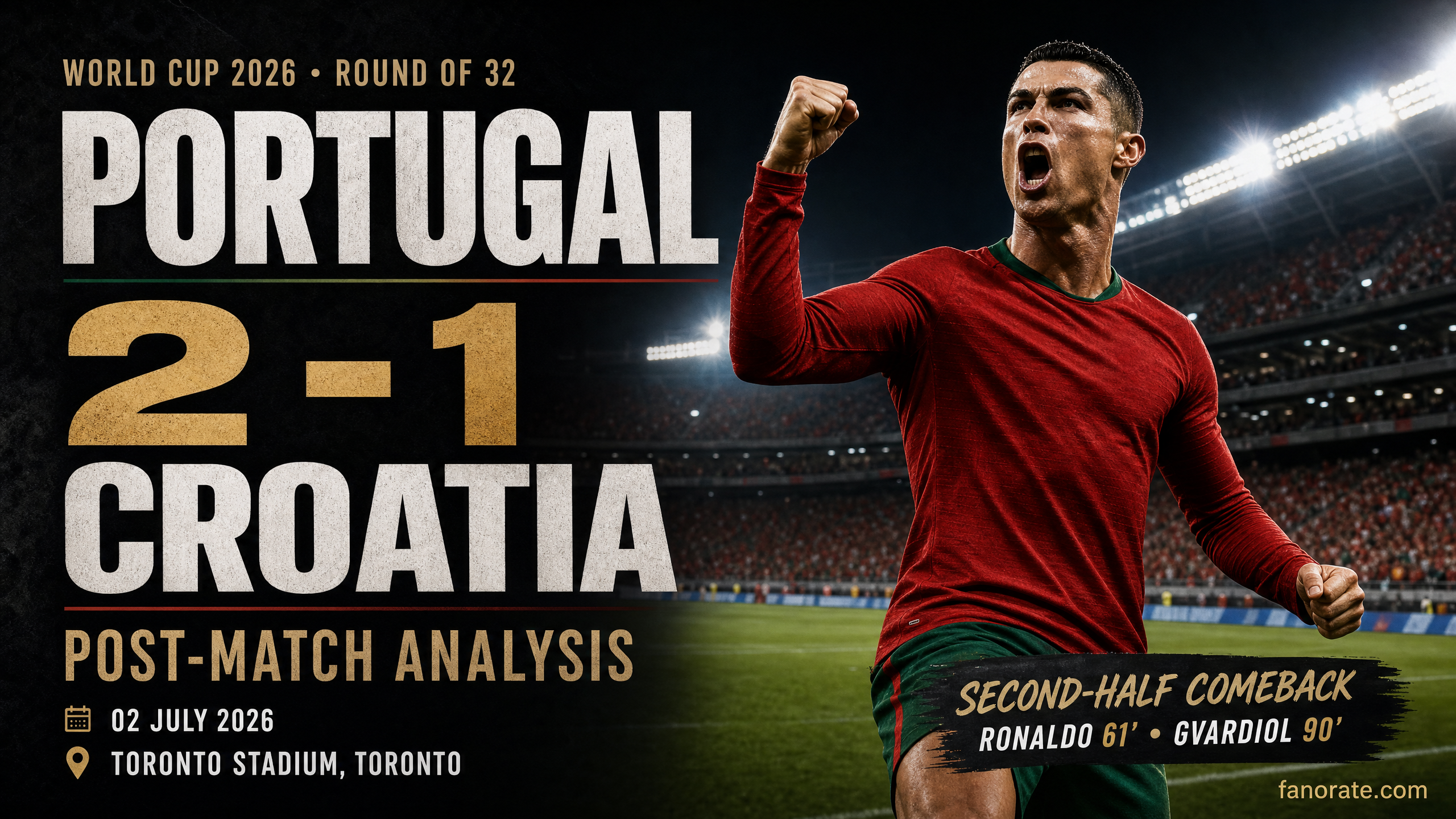
Portugal 2-1 Croatia: Ronaldo Penalty & Ramos Late Strike Send Selecção Into Round of 16 | FIFA World Cup 2026
A goalless first half gave way to an absorbing second-half battle in Toronto as Portugal came from behind to defeat Croatia 2-1 in the FIFA World Cup 2026 Round of 32. Ivan Perišić broke the deadlock before a Ronaldo penalty and a stunning late Gonçalo Ramos finish sent the Selecção through.
Portugal advance to the Round of 16 after coming from behind
What happened
Under a clear Canadian sky at Toronto Stadium, Portugal and Croatia served up a classic World Cup knockout encounter that had everything — VAR drama, a Cristiano Ronaldo penalty, a vintage Ivan Perišić header, and a heart-stopping winner deep in stoppage time. Roberto Martínez’s side were dominant in possession across the 90 minutes but had to dig deep after Croatia stunned them with a 53rd-minute opener, before the Selecção’s bench depth and individual brilliance ultimately proved the difference. Gonçalo Ramos, introduced in the 62nd minute, ghosted in to fire home in the 94th minute and send Portugal marching into the next round. Croatia, ageing and drained, fought valiantly but their World Cup journey ends here.
How it was won and lost
Portugal’s Possession Dominance Masked Early Wastefulness
Portugal controlled 60% of possession and completed 526 of 576 passes at a 91% accuracy rate, but for long stretches their dominance felt sterile. With 15 total shots but only 3 on target before Ronaldo’s penalty, the Selecção struggled to translate territorial control into genuine goalscoring threat. João Félix and Bruno Fernandes drifted centrally, creating congestion in Croatia’s compact mid-block, while Bernardo Silva was asked to carry the burden of unlocking a disciplined backline. Portugal’s 9 corners and 20 crosses told the story of a team probing without precision — until Roberto Martínez tore up the blueprint at the hour mark.
Croatia’s Low Block and Counter-Threat Was Executed With Precision
Zlatko Dalić set Croatia up in a recognizable compact defensive shape, sitting in a 4-4-2 medium block and ceding possession willingly. With just 40% of the ball, Croatia remained dangerous on the break — generating 36 dangerous attacks and hitting the woodwork once. Their 11 shots inside the box and 4 big chances created underlined the efficiency of their counter-attacking structure. Luka Modrić orchestrated from deep, threading long passes into Perišić and Kramarić’s runs with characteristic elegance. Croatia’s defensive resolve nearly held — until Portugal’s fresh legs and individual quality proved impossible to contain.
The Double VAR Controversy That Swung the Tie
Two significant VAR interventions reshaped the match. The first, in the 61st minute, centred on Cristiano Ronaldo — the nature of which led to a penalty being awarded in the 68th minute, with Renato Veiga also checked via VAR at 67′. Ronaldo stepped up and converted with ice-cold composure, levelling at 1-1 and demonstrating that even at this stage of his career, he remains Portugal’s spiritual and practical match-winner in the biggest moments. A third VAR check involving Joško Gvardiol deep in stoppage time added further tension to an already frenetic finale, though it ultimately did not alter the outcome.
Roberto Martínez’s Bold Triple Substitution Changed the Game
With Portugal staring down a 1-0 deficit, Roberto Martínez made one of the most decisive managerial calls of the tournament — withdrawing Pedro Neto, João Cancelo, Bruno Fernandes, and Vitinha simultaneously at the 62nd minute, introducing Francisco Conceição, Gonçalo Ramos, Nélson Semedo, and Bernardo Silva. The tactical reset injected directness, width, and verticality into Portugal’s attack. Ramos’ movement between Croatia’s centre-backs immediately caused problems, and it was the Benfica striker who delivered the decisive blow — meeting a Rafael Leão cross in the 90+4′ to seal progression. It was squad depth and coaching nous winning a knockout tie in real time.
Croatia’s Aerial Threat Proved Portugal’s Defensive Achilles Heel
Ruben Dias earned a yellow card in the 17th minute, and Croatia consistently targeted the channels with long balls and crosses — completing 7 accurate crosses from 22 attempts. Their 3 successful headers and willingness to overload wide areas, particularly through Josip Stanisic on the right, created the space from which Perišić struck. The veteran winger’s goal was a product of deliberate overloading of Portugal’s left channel, and it exposed moments of uncertainty in the Selecção’s defensive shape when pressed high and wide simultaneously.
Who decided it
Gonçalo Ramos
PortugalIntroduced as a substitute in the 62nd minute, Ramos took just over half an hour to become the match’s most decisive figure. His intelligent movement between Croatia’s centre-backs immediately created problems, and his composed finish in the 94th minute — converting a Rafael Leão cross — sent Portugal through and silenced any lingering doubts about Martínez’s substitution gamble.
Ramos gave Portugal a different centre-forward profile — direct, physically combative, and ruthlessly efficient in the box. His introduction shifted Portugal from a possession-heavy but blunt attack to a vertically aggressive one that Croatia simply could not adapt to in the time remaining.
Cristiano Ronaldo
PortugalRonaldo’s impact was both symbolic and functional. Subject to VAR scrutiny in the 61st minute, the Portuguese captain stepped up to convert the resulting penalty in the 68th minute with absolute certainty. Substituted off in the 81st minute, his presence ensured Croatia’s defensive attention never fully shifted — creating the spaces Ramos and Conceição exploited late on.
As a false focal point and penalty threat, Ronaldo commanded Croatia’s defensive structure throughout. His ability to draw fouls and maintain concentration in high-pressure moments remains elite, and his conversion ensured Portugal’s resilience was rewarded at the crucial juncture.
Ivan Perišić
CroatiaPerišić was Croatia’s most dangerous offensive weapon, scoring the 53rd-minute opener with an intelligent run in behind Dalot’s channel, assisted by Josip Stanisic. He continued to press Portugal’s backline aggressively until fatigue set in, earning a late yellow card in the 90+8′ minute in a sign of his relentless competitive commitment.
The veteran winger was the engine of Croatia’s counter-attacking threat, offering direct running, physical presence, and aerial quality in equal measure. His goal gave Dalić’s side belief and forced Portugal into a reactive mode that they handled imperfectly for much of the second half.
Luka Modrić
CroatiaModrić was the heartbeat of Croatia’s midfield, controlling tempo from deep and spraying long passes with elegant precision across 91 minutes. Booked in the 59th minute, the Real Madrid legend gave everything in what could prove to be his final World Cup match.
Modrić’s ability to retain possession under pressure and dictate Croatia’s counter-attacking rhythm was central to their defensive stability. His passing range stretched Portugal’s midfield block and consistently found runners in dangerous positions.
Bernardo Silva
PortugalOne of Portugal’s most persistent creative forces, Bernardo Silva ran tirelessly across the front line before being substituted off at 62 minutes as Martínez reconfigured. His positioning and movement consistently found pockets between Croatia’s midfield and defensive lines, registering key passes and linking the team’s build-up phases effectively.
Silva’s intelligent pressing triggers and positional rotations gave Portugal’s attack its best moments of fluidity in the first half, and his ability to draw defenders out of position helped create the underlying structure for Portugal’s eventual comeback.
Where it sits in history
This was a match laden with history. Portugal and Croatia have met before on World Cup stages, but this Round of 32 tie in the expanded FIFA World Cup 2026 format carried unique weight. For Croatia — semi-finalists in 2018 and runners-up, quarter-finalists in 2022 — this tournament represented the final hurrah for a golden generation. Modrić, Perišić, Kovačić, and Kramarić have carried Croatian football to heights unprecedented in the nation’s history, and their collective farewell in Toronto had the feel of an era drawing to an inevitable close. For Portugal, the result extends a resurgent World Cup narrative — a young, hungry squad that still carries the talismanic weight of Cristiano Ronaldo while building a post-Ronaldo identity through players like Ramos, Conceição, and Leão. The Selecção have not lifted the World Cup trophy, but this generation arrives in 2026 with genuine belief.
Inside the ground
Toronto Stadium, with its 45,700 capacity sold out in a sea of red and white on both sides, produced an electric atmosphere befitting a high-stakes knockout tie. Portugal’s sizable diaspora in Canada made their presence felt from kick-off, with deafening roars greeting every Ronaldo touch and rising tension with every Croatian counter. The VAR delays in the second half and stoppage time created almost unbearable suspense, and Ramos’ winning goal in the 94th minute triggered an eruption of noise that resonated well beyond the stadium walls. For Croatian fans, the final whistle brought a tearful ovation for a generation of players who gave everything on the grandest stage.
Looking ahead
Portugal advance to the FIFA World Cup 2026 Round of 16, where they will face a fresh tactical challenge against an opponent yet to be confirmed. Martínez’s squad now has the confidence of a comeback victory and the tactical flexibility of a deep bench — both qualities that will be essential in the knockout rounds ahead. Questions remain about the balance between relying on Ronaldo’s aura and transitioning to Ramos as the primary striker, but the 94th-minute winner has temporarily silenced that debate. Croatia, meanwhile, face a period of profound regeneration. The golden generation has taken their final bow, and the federation must now entrust their future to younger talents like Baturina and the emergent Gvardiol. A nation in transition, with immense pride to carry forward.
The bottom line
-
Portugal came from behind to beat Croatia 2-1 in the FIFA World Cup 2026 Round of 32 in Toronto
-
Ivan Perišić gave Croatia the lead in the 53rd minute with a precise finish assisted by Josip Stanisic
-
Cristiano Ronaldo converted a VAR-awarded penalty in the 68th minute to level the scores
-
Substitute Gonçalo Ramos scored a dramatic 94th-minute winner from a Rafael Leão cross
-
Roberto Martínez made four simultaneous substitutions at 62 minutes in a decisive tactical masterstroke
-
Portugal dominated possession with 60% but struggled with efficiency, registering only 3 shots on target before the penalty
-
Croatia hit the woodwork once and missed 3 big chances despite their defensive discipline
-
Luka Modrić was booked but remained Croatia’s creative heartbeat in what may be his last World Cup appearance
-
Three separate VAR checks added layers of tension and drama to a gripping second half
-
Croatia’s golden generation — Modrić, Perišić, Kovačić — may have played their final World Cup match together
