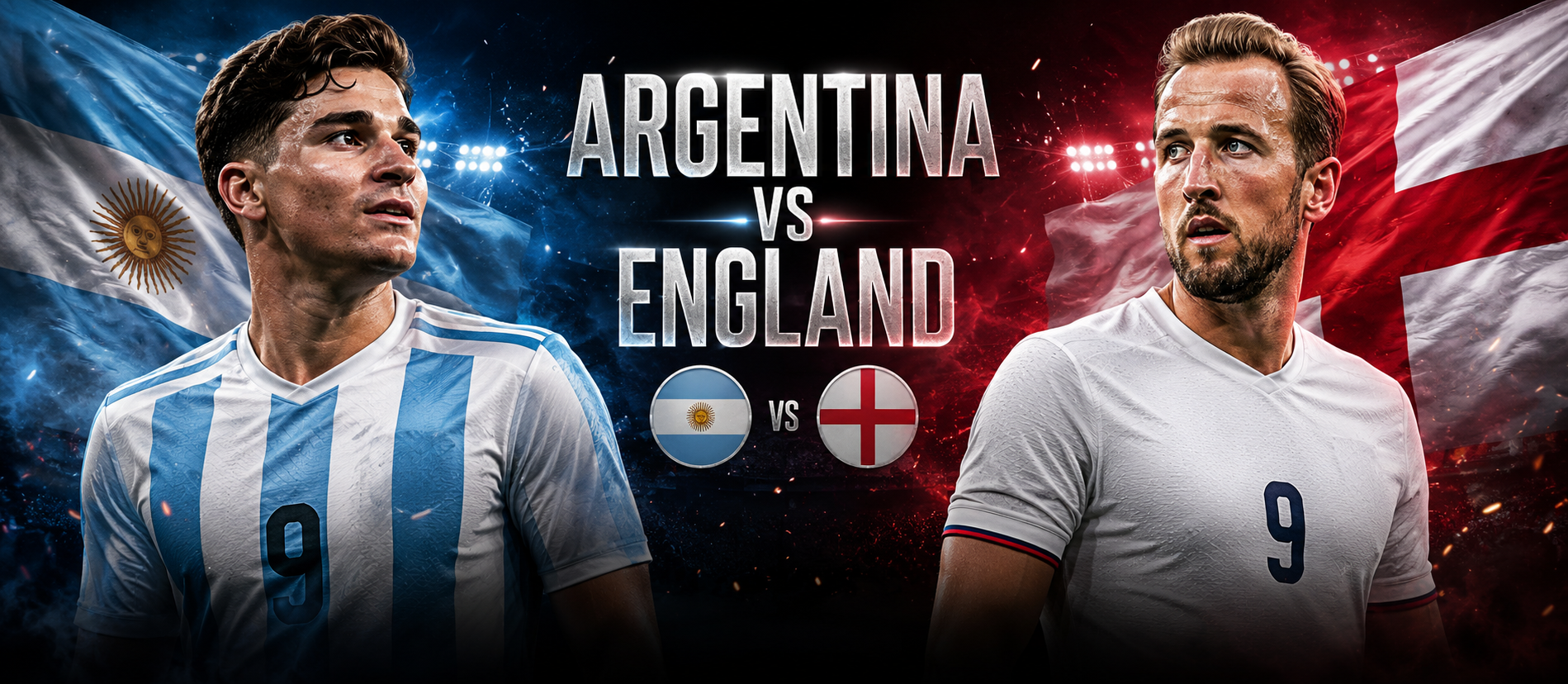
Messi Finally Meets England: The Semifinal 39 Years in the Making
Argentina and England meet in a World Cup semifinal for the first time ever on Wednesday in Atlanta. We break down the predicted lineups, the midfield chess match, the set-piece battle, the shootout scenario and everything else that will decide who reaches the July 19 final.
- July 15, 2026 Wednesday
- Mercedes-Benz Stadium Atlanta
- Kick-Off 3:00 PM ET
The semifinal 39 years in the making
There is a number buried in this fixture that almost defies belief: zero. In 21 seasons of international football, across well over a thousand career matches, through six World Cups, two Copa América titles and a world championship, Lionel Messi has never once played against England. Not in a final, not in a friendly, not for ninety seconds as a teenage substitute. The most documented footballer in history has one blank page left, and it gets filled on Wednesday afternoon under a closed roof in Atlanta, with a place in the World Cup final attached.
England arrive at that page carrying their own unfinished business. They have not stood in a World Cup final since 1966 — the year they beat Argentina in a quarterfinal so bad-tempered that Alf Ramsey stopped his players from swapping shirts. Since then this fixture has produced a handball that became scripture, a solo goal that became a monument, a red card that consumed a 23-year-old David Beckham, and a penalty in Sapporo that redeemed him. What it has never produced is this: a semifinal, the two of them meeting deeper in a World Cup than ever before, with both squads four days removed from 120-minute quarterfinals and running on the same emptying tank.
The defending champions against the tournament’s most balanced challenger. The oldest great in the field against the youngest great in the field. Wednesday, July 15, 3:00 PM Eastern.
Somebody’s wait ends.
Everything you need at kickoff
- Date
- Wednesday, July 15, 2026 Semifinal 2
- Kickoff (US)
- 3:00 PM ET 12:00 PM PT
- Kickoff (UK)
- 8:00 PM BST
- Kickoff (Argentina)
- 4:00 PM ART
- Venue
- Mercedes-Benz Stadium Atlanta, Georgia, USA
- Capacity
- ~71,000
- Surface
- Natural grass Installed over the venue's usual turf
- Roof / Climate
- Retractable roof, closed Climate-controlled indoors
- Weather
- ~70°F indoors Atlanta outside: low-to-mid 90s °F
- TV — USA
- FOX, Telemundo FOX Sports app, FOX One, Peacock
- TV — UK
- BBC One and BBC iPlayer
- TV — Argentina
- Telefe, TyC Sports, TV Pública Mi Telefe, DGO, Disney+ Premium
- Referee
- Appointment pending As of July 12; no English referee
- Winner faces
- France or Spain Final, Sun July 19, MetLife Stadium
- If level after 90
- Two 15-min periods of extra time Then a penalty shootout
- Discipline
- All yellow cards wiped Only a red on Wednesday rules a player out of the final
A final berth, first and foremost
A final berth, first and foremost. The winner plays for the world championship on July 19 at MetLife Stadium. Argentina are attempting to become the first nation to reach consecutive World Cup finals since Brazil (1998 and 2002), and the first to retain the trophy since Brazil in 1962. England are attempting to reach their first men’s World Cup final in 60 years.
The last dance, verified. This is Lionel Messi’s final World Cup — he has said so, and at 39 the tournament reporting treats it as settled fact. He arrives as the leading scorer in World Cup history (21 goals) and the joint-top scorer of this tournament (8). Whatever happens Wednesday, one of football’s longest stories is within two games of its ending.
A generational hinge for England. Jude Bellingham is 23 and has six goals in this World Cup, five of which either levelled a match or put England ahead. Harry Kane, 32, is England’s all-time World Cup scorer and may not get another run this deep. Thomas Tuchel was hired in 2025 for precisely this month. England’s near-misses — the Euro 2020 final, the Euro 2024 final, the 2018 semifinal — form the psychological backdrop to everything they do here.
The rivalry, held at arm’s length. Argentina vs England carries more history per meeting than almost any fixture in international football — 1966, 1986, 1998, 2002 — and some of that history is entangled with genuine geopolitical grief around the Falklands/Malvinas conflict, which shadowed the 1986 quarterfinal. This preview treats that context the way the occasion deserves: acknowledged, and then set aside. Many of Wednesday’s starters share Premier League dressing rooms or face each other weekly in club football; this is a match between colleagues and rivals who know each other intimately, not a proxy for anything else.
The bracket stakes. France have been the tournament’s steamroller — six wins from six — while Spain beat Belgium to set up Tuesday’s Dallas semifinal. Whoever emerges from Atlanta gets the survivor of arguably the best two teams in the world on current form.
Nobody is winning this World Cup the easy way.
Tale of the tape
Six wins from six, but never comfortably since June. The group stage was serene; the knockout rounds have been cliffhangers — Cabo Verde took the champions to extra time, Egypt led 2-0 in Atlanta with 11 minutes left before Argentina scored three, and Switzerland dragged them through 120 minutes again. Two 120-minute matches in eight days is the heaviest workload of any semifinalist. The results column is perfect; the mileage column is a genuine concern.
Six matches, one dropped result — but England have fallen behind twice (DR Congo, Norway) and been pegged back twice more by Croatia; resilience is proven, control is not. Fatigue: one 120-minute match (vs Argentina’s two), but the Azteca game — altitude, ten men, 35 minutes of siege defending — was its own hidden tax. Route: comparable to Argentina’s, with the Mexico tie at the Azteca the single toughest away-environment fixture either semifinalist has faced.
Scaloni’s Argentina build from a settled back four with Leandro Paredes dropping to form the first line of progression. The midfield is a diamond in effect — Paredes at the base, De Paul and Mac Allister as the engines, Enzo Fernández at the tip — with Messi drifting into the right half-space. This is the tournament’s most experienced midfield, and its function is rhythm management: 59% possession against Switzerland, and a willingness to slow games to walking pace. At 39, Messi does not press or run channels; what he does is score, deliver set pieces and create from the right half-space — Argentina in effect play 10-plus-1 out of possession and 11-through-1 in possession.
Where Argentina curate, England surge. Tuchel’s England are built on vertical pace into wide areas, a physically imposing double pivot, and the most productive set-piece operation in the tournament’s final four. The base is a 4-2-3-1: Rice and Elliot Anderson behind Bellingham, with Kane dropping off to link. The width is the point — Saka on the right, Anthony Gordon on the left, both instructed to attack fullbacks early. Bellingham has six goals from the No. 10 position, five of which either levelled a match or put England ahead — he is not decorating wins, he is manufacturing them.
Attacking set pieces are a genuine weapon, and Messi delivers everything: Mac Allister’s header from Messi’s corner opened the quarterfinal; Romero’s header from Messi’s cross and Enzo Fernández’s stoppage-time header beat Egypt. Three of their last six knockout goals have come from headers off crosses or corners — the Messi delivery economy.
Bellingham’s goal against Panama came directly from a Saka corner; Kane’s opener against Croatia was a penalty won from pressure. The delivery menu (Saka, Rice) and the target menu (Kane, Stones or Konsa, Guehi, Bellingham arriving) make dead balls England’s most repeatable route to goal against elite defenses.
- Possession control
- Elite tournament management
- Messi’s delivery and finishing
- Two strikers (Álvarez, Lautaro) in scoring form
- The best shootout goalkeeper of his generation behind it all
- Wide-area speed
- Set pieces
- Midfield physicality
- Depth
- A proven ability to win ugly
- Have conceded twice each to Cabo Verde and Egypt and needed extra time twice
- The fullbacks can be isolated in transition
- Romero’s fitness is managed rather than assured
- The front-line press is light, which lets good opponents build
- Slow starts (behind early against DR Congo and Norway, twice pegged back by Croatia)
- A manager publicly demanding better performances
- Rice’s illness / back issues
- No clean sheet in the knockout rounds
Each team attacks where the other is weakest
Who has the ball? Argentina. Every structural indicator points to Argentina controlling territory, likely in the 55–60% range. Tuchel will not fight that; England’s best moments all tournament have come in the first three passes after winning the ball.
Midfield progression vs the England press-trap. England’s counter under Tuchel has been a mid-block with triggers rather than a permanent high press. If Rice’s illness lingers and his radius shrinks, Argentina’s interiors will find the half-space pockets between England’s lines, which is exactly where Messi lives.
Stopping the central combinations. The single most important England job is to deny the Messi–Álvarez wall passes and third-man runs through the middle. The Azteca match showed England’s answer to central overload — collapse narrow, concede the wings, defend the box — but narrowness invites exactly the crosses Romero, Fernández and Mac Allister have been scoring from.
Argentina defending crosses and set pieces. England’s dead-ball operation against an Argentina side whose quarterfinal ended with a visibly exhausted Romero and 38-year-old Otamendi in reserve is the clearest single mismatch on paper. Kane and Guehi attacking Saka’s deliveries against tired legs in minute 85 is England’s championship scenario.
Transitions. England counter through Gordon and Saka’s raw speed against Molina and Tagliafico — the oldest, slowest part of Argentina’s spine. England’s transition game is the most likely source of the game’s first goal.
After the first goal. If Argentina lead, they will drop Paredes deeper, walk the tempo down and invite England onto the diamond — at which point England’s set-piece volume becomes their lifeline. If England lead, Argentina become more direct and more dangerous, but also more open to Gordon and Saka running at space.
Key individual battles
Messi vs Rice & Anderson (the corridor)
Messi’s 8 goals and both knockout-stage assists have come from the pockets between midfield and defense. Advantage: Argentina if Rice is at 90%, England if he’s at 100% — that’s how fine it is.
Bellingham vs Enzo Fernández & Paredes (the mirror corridor)
Bellingham attacks exactly the zone behind Argentina’s diamond base that Paredes vacates when he steps up. Six goals say what happens when he arrives unmarked. Advantage: England — nobody has solved him yet.
Saka vs Tagliafico (the veteran’s flank)
Saka’s half-time introduction changed the quarterfinal; Tagliafico is dependable but 33 and 120 minutes deep. Advantage: England, growing with every minute past 70.
Álvarez & Messi vs Konsa & Guehi
Álvarez’s channel runs off Messi’s release passes are Argentina’s cleanest route behind England’s line — and Konsa is nursing a hamstring cramp. Advantage: even; Álvarez just scored the goal of the round.
England’s set-piece attack vs Argentina’s box defense
Argentina will end the match defending dead balls with tired or substituted center-backs. Advantage: England — the clearest on-paper edge either side owns.
Emiliano Martínez vs Jordan Pickford (the 120th-minute matchup)
If this reaches penalties, the goalkeepers become the protagonists. Martínez has never lost a shootout for Argentina; Pickford has five saves across four England shootouts. Advantage: Argentina, narrowly.
England’s athleticism vs Argentina’s control (the meta-battle)
England win sprints; Argentina win rhythm. Advantage: whoever scores first gets to play their preferred game.
Three questions decide it: Can Rice and Anderson close the half-space corridor to Messi for 90-plus minutes at less than 100% health? Who defends the box better at a dead ball — because both teams’ most repeatable weapon is the same weapon? Whose fatigue shows first after minute 75 — Argentina’s older spine on its second straight 120-minute cycle, or an England side that has already had to chase two knockout matches?
The names that decide it
8 goals (joint tournament lead), scorer in a record 9 consecutive World Cup matches, all-time World Cup top scorer (21). Had a penalty saved vs Egypt — then scored from open play four minutes after Romero’s header began the comeback anyway.
Opened the quarterfinal scoring; the connective tissue between Paredes’s tempo and Enzo’s verticality. Reported as the midfielder covering the most ground in the team.
Scored the goal that ignited the Egypt comeback; managing fatigue after a three-month injury layoff. His duel with Kane’s drop-off movement is a preview headliner.
The stoppage-time winner vs Egypt; the diamond’s tip; the man England’s pivot must screen.
Has never lost a shootout for Argentina.
Six goals; braces vs Mexico (in 98 seconds) and Norway; five of six goals levelled or won matches. On this evidence, the best big-moment player at the tournament.
The shield, the set-piece deliverer, and the fitness doubt the whole plan leans on.
Ever-present, composed, and the organizing voice of a back line that held Haaland to one team goal across 120 minutes.
Corner that produced Bellingham’s Panama goal; changed the quarterfinal at half-time.
England’s shootout-era No. 1: five saves across his four England shootouts, and publicly “prepared” for another.
Five most likely game-changing subs
Lautaro Martínez (ARG): scored in extra time Saturday; the designated closer.
Phil Foden (ENG): tempo and half-space craft when the wingers tire the fullbacks out.
Thiago Almada (ARG): the direct-running spark Squawka flagged after his Switzerland cameo.
Morgan Rogers (ENG): his spilled shot created the QF winner; physical, arrives late in boxes.
Marcus Rashford (ENG): scored vs Croatia; the extra-time run-in-behind specialist against a high, tired line.
First meeting, deepest stage
Messi has never faced England
Messi has never faced England in his entire international or club career — Wednesday is the first time.
A first-ever semifinal
England and Argentina have never met in a World Cup semifinal; this is their sixth World Cup meeting and first in 24 years (Sapporo, 2002).
Nine games in a row
Messi’s 8 goals include scoring in a record 9 consecutive World Cup matches, and pushed his all-time World Cup record to 21.
Kane passes Lineker and Pelé
Kane passed Lineker’s England World Cup record (10 goals) and then Pelé’s career mark (13) within this single tournament; he now has 14 career World Cup goals.
98 seconds
Bellingham’s brace vs Mexico took 98 seconds — the fastest by an England player in World Cup history.
The top four, all here
This is the first World Cup in which the four semifinalists were the top four teams in the FIFA rankings entering the tournament (Argentina 1, Spain 2, France 3, England 4).
Consecutive finals in sight
Argentina are attempting to become the first nation in consecutive World Cup finals since Brazil (1998, 2002) — and the first repeat champion since Brazil 1958-62.
A first foreign finalist
Tuchel is attempting to become the first foreign manager to take England to a men’s World Cup final; Eriksson and Capello never passed the quarterfinals.
Best guess at kickoff
Projected lineups based on July 12 team news from Squawka and Sports Mole; not confirmed by either federation. Argentina’s decisive call is whether Romero starts; England’s is right-back — Spence’s speed, James’s control, or Konsa there with Stones inside are three different answers to the Messi question.
A 10th-minute Mac Allister-style set-piece goal, 60 minutes of tempo strangulation, and one Messi moment is not an upset scenario anyone needs squinting to see; it is more or less what happened on Saturday.
By both the betting market (England favored to advance at roughly -130/-135) and tournament seeding logic, Argentina — remarkably — are the underdogs, for the first time in this tournament after being favored in six straight matches. Every neutral-site indicator that favors England is rate-dependent — it needs a fast, long, stretched game. Argentina’s championship equity is state-dependent — it needs a lead, or a stalemate deep enough that experience and Martínez’s shootout record become the decisive inputs.
The unexpected heroes nobody is talking about
Nicolás Otamendi (38), Argentina. If Romero can’t finish the match, the old warhorse defends a semifinal box in the 118th minute. He’s done it before — Lusail, 2022.
Morgan Rogers (Aston Villa), England. Two quarterfinal interventions from the bench already shaped England’s run; a semifinal goal would surprise nobody who watched them.
Argentina 2-1 England after extra time (1-1 at 90). Argentina’s game-state control neutralizes England’s rate-dependent strengths for just long enough, and their substitute-driven extra-time scoring pattern repeats once more against a Rice-diminished midfield. Man of the Match: Alexis Mac Allister.
Confidence: 5/10 — the closest to a genuine coin flip we have previewed all tournament; the market leans the other way and is not wrong to. The one factor that breaks this prediction: Declan Rice’s health. A full-strength Rice closes the Messi corridor and flips our lean.
Control or Collision?
Strip away eight goals’ worth of Messi and six of Bellingham, and the tactical thesis of this semifinal is clean: Argentina’s experience and control against England’s physicality, depth and set-piece strength — which force wins?
Our answer, held at 5/10 confidence and against the market’s lean: control, narrowly, because control chooses when the collisions happen. England’s advantages are real but rate-dependent — they need the game fast, long, stretched and aerial. Argentina’s advantage is state-dependent — they need the game slow, and they have spent six matches proving they can make it slow even when it costs them extra time to win it. The one force that reliably breaks tempo-control is a dead ball, which is why England’s corners are the most likely England goal.
If Rice is whole, England’s pivot closes the corridor, the set pieces accumulate, and the physicality thesis wins in 90. If he is even slightly diminished, Messi finds the half-space one time more than England can afford, and the control thesis wins — late, probably, the way Argentina have won everything this month. We think it ends 2-1 to Argentina in extra time.
On Wednesday, we think the champions have one more escape in them.
