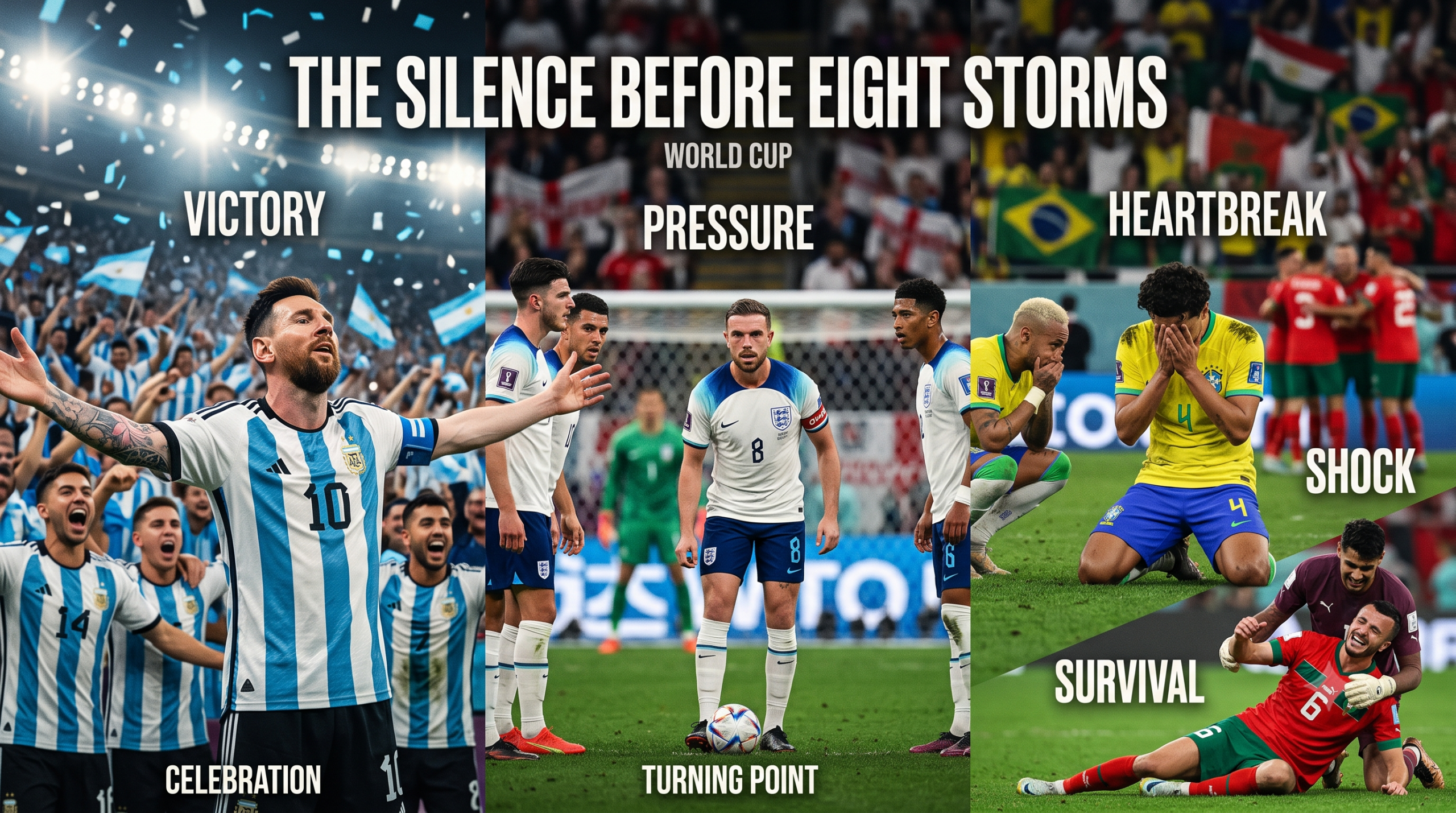
The Silence Before Eight Storms: Why the World Cup’s Quietest Day Might Be Its Loudest
Nobody kicked a ball today. Not one whistle blew across the United States. And somehow, the World Cup has never felt louder.
Twenty-four hours after Lionel Messi turned Mercedes-Benz Stadium into a shrine to his own stubbornness, and less than a full day removed from Switzerland exorcising a 72-year-old ghost in Vancouver, the tournament exhaled. Forty teams are already home, watching from couches instead of touchlines. Eight remain, scattered across a country the size of a continent, each one quietly rehearsing for the biggest ninety minutes of their year. Somewhere in Boston, Kylian Mbappé is stretching a hamstring that has carried him level with Messi in the record books. Somewhere in Rabat, or Casablanca, or wherever Moroccans gather to suffer beautifully in front of a television, someone is rewatching the 2022 semifinal for the hundredth time, hoping this rewatch ends differently.
That’s the strange gift of a World Cup rest day. There’s no scoreline to argue about, so the arguments get bigger. Was Egypt actually robbed? Is Messi’s last World Cup about to end in the shootout he’s never quite trusted? Can Switzerland, of all teams, really do this? The pause doesn’t quiet the noise — it lets it echo.
We’re not going to pretend a match happened when it didn’t. What we’re going to do instead is what any honest football writer does on the one blank square in an otherwise relentless calendar: sit with what just happened, be straight about what it cost the losers, and get everyone ready for the moment this thing turns serious again tomorrow afternoon in Foxborough.
No ball was kicked on July 8, but the Round of 16’s brutal, VAR-scarred finish — Argentina’s 3-2 stomach-churner over Egypt and Switzerland’s shootout escape against Colombia — is still doing all the talking as the sport turns its full attention to four quarterfinals starting Thursday.
At a glance
There are no games to report from July 8 — FIFA built a deliberate gap between the Round of 16 and the quarterfinals, and the schedule stayed empty. For context, here’s what closed out the previous round and set today’s conversation in motion:
Mercedes-Benz Stadium, Atlanta (played July 7)
Egypt led 2-0 into the final quarter-hour before Messi assisted Cristian Romero’s header and then scored himself; Enzo Fernández won it with a stoppage-time header. Meaning: Argentina survive their second straight 3-2 knockout thriller and set up a quarterfinal with Switzerland that nobody in Buenos Aires is treating lightly anymore.
BC Place, Vancouver (played July 7)
Switzerland win 4-3 on penalties, after extra time. A goalless slog decided by a shootout in which both Davinson Sánchez and Manuel Akanji missed before Rubén Vargas sent Switzerland through. Meaning: Switzerland reach a World Cup quarterfinal for the first time since 1954, and their reward is Messi.
Today, July 8 — rest day. No matches. The next ball is kicked Thursday.
The Main Story Of The Day
Here’s the honest version of the story everyone’s telling today: the World Cup didn’t take a day off, it just changed rooms. In one room, Egypt’s manager is still furning about a referee. In another, Switzerland’s dressing room is still somewhere between disbelief and euphoria. In a third, eight federations are running fitness tests on players whose names weren’t on anyone’s bingo card in June.
The dominant thread, though, is Messi — again, still, inevitably. Down 2-0 with Argentina’s World Cup defense on life support, he set up Romero, scored the equalizer himself four minutes later, and watched Enzo Fernández finish the job in stoppage time. It’s the sixth straight World Cup knockout match in which he’s scored, a run no one else in the sport’s history has managed, and it happened in what a growing number of people around that Argentina squad are treating as his farewell tournament. That’s the emotional center of gravity today. The tactical and political center of gravity is messier: Egypt’s disallowed goal, an unreviewed penalty appeal on Mohamed Salah, and an unchecked shirt-pull in the buildup to the winner have left Cairo convinced the result was decided by something other than football. We’ll get into whether that’s fair in the Drama Section below — but the fact that a head coach walked away saying he’s done watching the tournament tells you how raw it still is, a full day later.
What fans will be debating heading into Thursday isn’t really about today at all — it’s about what these two results reveal for the quarterfinals. Can a 30-year-old-average Argentina defense hold up against Switzerland’s counter-attacking wingers? Is Egypt’s fury about officiating going to shape how neutrals watch every close call for the rest of the tournament? And underneath all of it, a subplot with real financial and political weight: the Folarin Balogun red-card reversal, now dragging Gianni Infantino toward a European Parliament ethics probe, keeps bleeding into every conversation about whether this World Cup’s integrity has held up under the pressure of being played, in part, for an American audience and an American president’s attention.
Match-By-Match Recap
Argentina 3-2 Egypt — Mercedes-Benz Stadium, Atlanta
Egypt didn’t just compete with the defending champions, they dominated long stretches of it, and for 79 minutes it looked like the shock of the tournament. A first-half Messi penalty save kept the score level before Egypt broke through and then doubled the lead in the 67th minute, playing with the pace and directness of a team that had clearly done its homework on an Argentina backline built more for control than recovery speed.
- Tactical turning point
- Argentina’s front-foot desperation in the final quarter-hour. Manager Lionel Scaloni threw caution out entirely, and the switch paid off within four minutes — Messi teed up Romero’s header in the 79th minute, then finished his own chance in the 83rd.
- Key player
- Messi, obviously, but Enzo Fernández deserves the harder look — his stoppage-time header, arriving on a Lautaro Martínez cross, was the actual match-winner, arriving after Messi had merely leveled things.
- Biggest missed chance
- Messi’s saved first-half penalty, which he later admitted left him furious with himself and which very nearly cost Argentina the entire tournament.
- Emotional moment
- Messi in tears at the final whistle, lifted by teammates who are increasingly, openly talking about this as his last World Cup — and Egypt’s Hossam Hassan, minutes later, in a confrontation with referee François Letexier that ended with him accusing the official of hiding something.
- What it means
- Argentina survive to face Switzerland with real defensive questions unresolved — this is a team that has now trailed in two straight knockout games. Egypt go home with a legitimate case that the finest details of officiating broke against them at the worst possible moment, and a manager who’s publicly done watching.
Switzerland 0-0 Colombia (Switzerland win on penalties) — BC Place, Vancouver
Not pretty, and Switzerland manager Murat Yakin more or less admitted as much afterward — his team was short on attacking punch for two hours, missing injured breakout winger Johan Manzambi and generally second-best in open play. Colombia had the better of the possession and the sharper half-chances but couldn’t turn control into a goal, and extra time changed nothing.
- Tactical turning point
- Switzerland’s willingness to sit compact and trust the shootout rather than chase a game they weren’t winning cleanly — a pragmatic call that Yakin credited as much as any individual performance.
- Key player
- Goalkeeper Gregor Kobel, whose stop on Cucho Hernández in the shootout was the single biggest moment of the match.
- Biggest missed chance
- Colombia’s volume of second-half pressure at BC Place that never quite produced a clear finish — the kind of game where the box score of chances says one thing and the scoreboard says another.
- Emotional moment
- Captain Granit Xhaka’s reaction pairing satisfaction with an immediate demand for more — goal one achieved, he said, but the hunger only grows from here. Defender Manuel Akanji’s blunt, almost confessional account of his own missed penalty — changing his mind at the last second against his own instincts — added a rare note of vulnerability to a celebration.
- What it means
- Switzerland reach the quarterfinals for the first time since 1954 and finally win a World Cup shootout after a lone, painful defeat to Ukraine in 2006. It’s a genuine fairytale — and it now runs straight into Messi.
Best Moments Of The Day
-
Messi’s 83rd-minute equalizer. The exact moment a shock result turned into a statement.
-
Enzo Fernández’s stoppage-time header. The finishing touch nobody but Argentina saw coming with four minutes left on the clock.
-
Kobel’s save on Cucho Hernández. The single biggest save of the knockout rounds so far, delivered when the entire shootout hinged on it.
-
Rubén Vargas’s winning penalty. A player who’d only been fit enough to come off the bench finishing the job in the biggest moment of Switzerland’s tournament.
-
Messi’s tears at the final whistle. Raw, unscripted, and impossible to fake — the closest thing this tournament has had to a defining image.
-
Akanji’s post-match honesty about his missed spot kick. A refreshing dose of vulnerability in a sport that usually hides behind clichés about “processes.”
-
Xhaka’s captain’s-mentality quote after reaching the quarterfinals. Satisfaction without complacency, exactly what a team facing Messi next needs to hear from its leader.
The Drama Section
The officiating storm around Argentina-Egypt is the tournament’s most combustible subplot right now, and it deserves a clear-eyed look rather than a pile-on in either direction. Egypt had a goal ruled out following VAR review, didn’t get a review on a penalty appeal involving Mohamed Salah, and didn’t get a check on what looked like a shirt-pull by Alexis Mac Allister in the buildup to Argentina’s winner. Any one of those, in isolation, is a defensible officiating judgment call — referees miss fouls, VAR doesn’t review every contact incident, and disallowed goals happen constantly without conspiracy. Stack all three in the same match, against the same team, in the biggest game of that team’s tournament, and you understand exactly why Hossam Hassan reached for words like injustice. We’d stop short of endorsing his suggestion that FIFA wanted Messi kept in the competition — there’s no evidence for that claim, and it’s a serious one to make publicly — but the pattern of missed reviews is real, and it’s fair for Egypt’s camp to be furious about it.
The louder, uglier storm is the one hanging over Gianni Infantino. European Parliament lawmakers, more than three dozen of them now, are pushing for a FIFA Ethics Committee investigation into Infantino’s role in reversing Folarin Balogun’s red-card suspension after Donald Trump personally contacted him. FIFA maintains the reversal was a disciplinary-committee decision, not a political one. We’re not in a position to settle that dispute today, and neither is anyone else outside FIFA’s own process — but the optics of a tournament host’s president intervening in a suspension, followed by that same president receiving a FIFA award, are the kind of thing that erodes trust in the competition regardless of the technical justification. It’s worth watching closely as the knockout rounds continue.
Smaller but real: Belgium’s Amadou Onana is out of the tournament with an ACL injury, a brutal blow for a team that’s already shown fragility defensively. And Switzerland’s Johan Manzambi, arguably their most dangerous individual threat in the final third, remains a fitness doubt for Saturday’s meeting with Argentina after missing the Colombia match with a knee problem.
The Emotional Temperature
Joy
Switzerland’s dressing room and its fanbase, tasting a World Cup quarterfinal for the first time in 72 years.
Relief
Argentina, who trailed 2-0 in the biggest game of their tournament and somehow didn’t need extra time to escape it.
Frustration
Egypt, convinced — with at least some justification — that the finest margins of officiating turned against them at the worst possible moment.
Fear
Belgium fans, watching Amadou Onana’s tournament end on a stretcher and wondering how thin their squad now is heading into a quarterfinal against the tournament’s stingiest defense.
Hope
Morocco, one day from a rematch with France that carries four years of unfinished business, believing — correctly or not — that this is the version of their team built to finish what 2022 started.
Players Who Owned The Day
Lionel Messi
One assist, one goal, a missed penalty he owned publicly afterward. Eight goals and one assist through six matches, a record sixth straight World Cup knockout match with a goal, and 125 international goals across 204 caps. Tournament meaning: he’s the outright Golden Boot leader entering the quarterfinals, and the emotional core of a team increasingly playing like it knows this is his last dance.
Enzo Fernández
The actual match-winner against Egypt, arriving with a stoppage-time header few saw coming. Tournament meaning: the clearest evidence yet that Argentina’s midfield can still produce a knockout blow even when the attack is misfiring.
Gregor Kobel
The shootout save on Cucho Hernández that swung the entire tie. Tournament meaning: Yakin has called his tournament fantastic, and it’s hard to argue — Switzerland’s run to the quarterfinals runs directly through his hands.
Rubén Vargas
Two goals and an assist across his last three appearances, plus the winning penalty against Colombia, despite only being fit enough to come off the bench. Tournament meaning: an X-factor substitute who might now be Switzerland’s most important attacking weapon against Argentina.
Hossam Hassan
Not a player, but impossible to leave off today’s list. His raw, unfiltered fury after the Argentina defeat has become one of the tournament’s most talked-about moments. Tournament meaning: whatever you think of his framing, he’s forced a real conversation about officiating consistency into the knockout rounds.
Erling Haaland
Not in action today, but his tournament is impossible to ignore heading into Saturday: seven goals in four appearances, level with Mbappé and one behind Messi, set up for a Golden Boot showdown with Harry Kane in the quarterfinals.
Kylian Mbappé
Also idle today, also central to tomorrow: seven goals, two assists, and the first crack at extending his tally when France open the quarterfinals against Morocco.
Teams Rising And Falling
Stock rising
- Switzerland, obviously — a team nobody outside its own camp expected in the final eight, now getting a signature test against Messi’s Argentina with genuinely little pressure and everything to gain.
- Norway’s stock is climbing fast too, on the strength of Haaland’s scoring form and a Round of 16 win over Brazil that reshuffled a lot of people’s title fancies.
Stock falling
- Egypt leave with real pride but real bitterness, and a coach who’s publicly checked out emotionally from the rest of the tournament.
- Brazil’s exit at Norway’s hands has triggered a fresh round of questions about the direction of Carlo Ancelotti’s Neymar-centered gamble.
- Colombia’s exit on penalties, without a signature knockout-round goal to show for their possession advantage, will sting for a team that arrived with genuine ambitions.
Tactical Notes For Serious Fans
Argentina’s back line is now averaging one of the oldest starting XIs the country has ever fielded at a World Cup, and it showed against Egypt’s pace on the counter — Switzerland’s wingers, healthy or not, will be licensed to attack that same space on Saturday.
Switzerland’s approach against Colombia — compact, patient, willing to trust penalties over a chaotic chase for a winner — is a template Yakin may lean on again against a more talented Argentina side, betting that a low-event game favors the underdog.
Egypt’s disallowed goal and missed reviews are a reminder that VAR’s “clear and obvious error” threshold still leaves enormous room for inconsistency between matches and officiating crews — worth watching whether the same standard gets applied evenly once the stakes rise again Thursday.
Belgium’s Onana injury forces a defensive reshuffle against a Spain side that hasn’t conceded all tournament — the margin for further defensive error just got even smaller for Rudi Garcia’s side.
Fan Sentiment Pulse
American sports-betting books are reporting some of the largest handle figures in their history across this tournament, and Monday’s USMNT elimination alone reportedly outdrew several major U.S. sports championship broadcasts for wagering volume — a strong signal of how deeply the home World Cup has embedded itself in the country’s sports culture even as the host nation’s team is out. Social reaction to Argentina’s comeback pulled in figures well outside football, with high-profile American athletes publicly reacting to the finish. Switzerland’s fanbase is, understandably, riding the emotional high of a genuine underdog story. Egypt’s supporters are split between pride in a gutsy performance and real anger at the officiating. The host-city buzz is already shifting toward Boston, where Thursday’s opener is expected to draw a heavily split crowd between French and Moroccan supporters given the tournament’s build-up coverage of the rematch angle.
Qualification Picture
All 40 eliminated teams are now settled; the bracket is final and clean. Argentina and Switzerland know they meet Saturday in Kansas City. The four remaining ties are set. Nobody helped themselves today because nobody played — but Egypt’s public complaints put pressure on FIFA and match officials to be demonstrably consistent for the rest of the knockout rounds, and Belgium’s injury situation puts real pressure on their depth heading into a tough quarterfinal draw against Spain. Every one of the eight remaining teams is, at this point, one bad day from going home — which is exactly the tension the rest day has been quietly building toward.
- France vs. Morocco
- Spain vs. Belgium
- Norway vs. England
- Argentina vs. Switzerland
France vs. Morocco kicks it all off Thursday, and it’s loaded with unfinished business — Morocco lost to these exact opponents in the 2022 semifinal, and while only nine players from that squad remain, the emotional charge hasn’t faded. France arrive having ground out four straight knockout-adjacent results without ever looking fully fluent, most recently needing a late penalty to get past Paraguay.
Kylian Mbappé, who gets first crack among the Golden Boot contenders to add to his tally, level with Messi on career World Cup goals and one behind him in this tournament’s race.
Morocco, fielding a heavily rebuilt squad under a head coach who’s only been in the job since March and already nursing an injury to key contributor Ismael Saibari. The pressure isn’t just about winning — it’s about proving that the 2022 run to the semifinal was a floor for this program, not a ceiling it’s already fallen below.
Can Morocco’s defense and goalkeeper Yassine Bounou absorb sustained pressure from Mbappé, Michael Olise, Ousmane Dembélé and whichever of Désiré Doué or Bradley Barcola starts, the way they did in patches during their 2022 run — or does a rebuilt back line without four of that team’s regular starters get exposed early the way it nearly did against Canada?
Morocco again. They’ve already beaten the Netherlands and ground past Canada this tournament using resilience and set-piece efficiency rather than control, and a France side that has looked laborious more often than dominant this tournament is exactly the kind of opponent a well-organized underdog can frustrate.
Gillette Stadium is expecting a genuinely split, high-volume crowd — Morocco’s traveling and diaspora support has been among the loudest of the tournament, and this is the first true test of whether that backing can rattle a favorite on American soil the way it did in Qatar four years ago.
Fanorate Final Whistle
What today taught us is that a World Cup doesn’t actually pause — it just moves the drama from the pitch to the group chat, the press conference, and the injury report. The Round of 16 ended with a coach accusing officials of hiding something and a captain calling a 72-year wait finally broken. Neither of those sentences needed a ball in play today to keep growing.
The defining emotion heading into tomorrow isn’t excitement, exactly — it’s anticipation with an edge of dread, the specific feeling of knowing that eight teams are about to be cut to four and at least one storyline you’ve gotten attached to is going to end badly. The question carrying into Thursday is simple: does Morocco’s emotional case for revenge translate into ninety actual minutes of resistance against a French squad that, for all its stumbling, keeps finding a way through? We’ll have an answer by Thursday evening. Until then, keep half an eye on Boston.
Fanorate is an AI-assisted editorial project from the team at Brillmark. We use AI tools to help research, draft, and structure our World Cup coverage — including this recap — under human editorial direction. We don’t attend matches in person or conduct original interviews; our reporting is built from verified public sources, cross-checked across multiple outlets, and written to be transparent about what we know, what’s disputed, and what’s still unfolding. If you spot an error, we want to hear about it.
