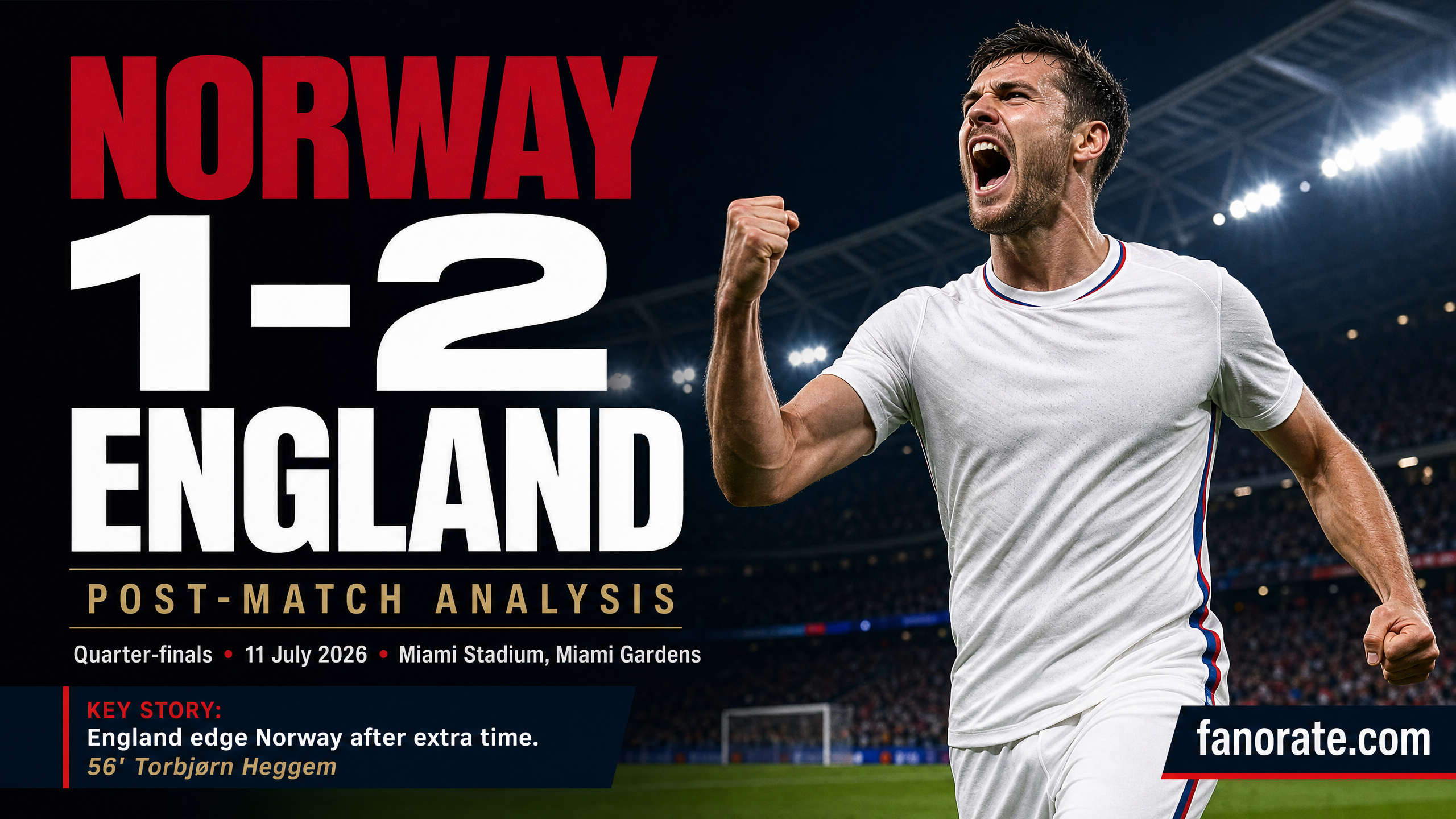
Norway vs England: Jude Bellingham Sends England to World Cup 2026 Semi-Finals After Extra Time Thriller
Jude Bellingham delivered when it mattered most, scoring a dramatic extra-time winner to send England into the FIFA World Cup 2026 semi-finals with a 2-1 victory over Norway in Miami.
England win after extra time
What happened
Under the warm Miami night sky and a gentle drizzle, Jude Bellingham wrote another chapter in his rapidly growing World Cup legend. England survived one of the most physically demanding 120 minutes of their tournament campaign, edging Norway 2-1 after extra time in a quarter-final that swung violently between composed tactical football and breathless, nerve-shredding drama. Norway drew first blood through Andreas Schjelderup’s well-crafted 36th-minute opener, only for Bellingham to equalise moments before half-time. When it seemed the two sides were locked in a genuine war of attrition heading toward penalties, Bellingham struck again in the second period of extra time to send England through. Gareth Southgate’s side survive. Norway’s tournament, magnificent as it was, is over.
How it was won and lost
England’s Possession Dominance Couldn’t Break Norway’s Defensive Discipline
England controlled the ball with authority throughout — 53% possession, 621 passes completed at an extraordinary 91% accuracy rate — yet found Norway’s defensive block surprisingly resilient. Norway sat in a compact mid-block that forced England wide, where their crossing proved only intermittently effective: nine accurate crosses from 21 attempts. England generated 14 total shots and eight on target, including three big chances, but Norway’s goalkeeper Ørjan Nyland made six saves to keep his side in the contest. The passing volume and accuracy underlined England’s technical superiority, but Norway’s discipline in transition and aerial duels — matching England’s ten successful headers despite having less of the ball — limited the damage.
Norway’s Counter-Attacking Threat Exposed England’s High Defensive Line
Despite spending significant portions of the match without the ball, Norway were dangerous on the counter, generating 61 dangerous attacks and hitting the woodwork once. The 36th-minute opener illustrated their method perfectly: a sharp combination through the lines involving Martin Ødegaard, who dissected England’s midfield structure with a precision assist for Schjelderup. Norway completed only 86% of their passes but prioritised directness — 45 long passes attempted — and used the physical presence of Erling Håland to pin England’s centre-backs. Norway’s 24 tackles to England’s 14 reflected how combative and committed their defensive work rate was when off the ball.
Bellingham’s Half-Time Rescue and the Tactical Shift That Changed Everything
England’s most important tactical adjustment came not from the formation sheet but from Southgate’s half-time substitutions — sending on Eberechi Eze for Declan Rice and Bukayo Saka for Chukwunonso Madueke at the start of the second half. The introductions injected creativity and direct dribbling threat into England’s attack. Eze’s ability to operate in tight spaces between Norway’s lines offered a different dimension, while Saka’s directness down the right immediately stretched Norway’s defensive shape. The substitutions preceded a period of increased England pressure, and Norway’s VAR check on Torbjørn Heggem at 56 minutes disrupted their defensive concentration at a critical juncture.
Extra Time: England’s Fitness and Quality Eventually Tell
Despite Norway’s determination, their energy visibly waned as extra time progressed. England maintained their passing structure — 118 total attacks compared to Norway’s 105 — and their superior dribbling success rate of 59% versus Norway’s 31% became increasingly telling in one-on-one situations in wider areas. Bellingham’s winning goal in the 93rd minute of regulation to equalise had already demonstrated his big-game temperament; his extra-time winner at the 101-minute mark — after a VAR review involving substitute Djed Spence — sealed England’s place in the last four. The substitution of Erling Håland off the pitch in the 106th minute signalled that Norway had exhausted their attacking options and accepted their fate.
Who decided it
Jude Bellingham
EnglandTwo goals — a clutch equaliser in first-half stoppage time and an extra-time winner — defined Bellingham’s evening. His goal at 45+2 prevented Norway from carrying a lead into the dressing room, a psychological moment of enormous importance. His extra-time strike completed another transformative World Cup performance.
Bellingham operated as England’s most advanced and dynamic presence in central midfield, making runs beyond Harry Kane and arriving late into the box with the kind of timing that elite box-to-box midfielders produce. His ability to influence massive moments under tournament pressure is what separates him from his peers.
Martin Ødegaard
NorwayNorway’s captain was their most creative force, orchestrating their most dangerous moments in possession and providing the decisive assist for Schjelderup’s opener. His 11 key passes across the night illustrated his central role in Norway’s attacking patterns.
Ødegaard dropped deep to collect possession and played as a deep-lying creative force, linking Norway’s defensive shape to their forward runs. His ability to find pockets of space between England’s midfield and defensive lines was Norway’s primary source of attacking quality before his influence faded in extra time.
Andreas Schjelderup
NorwayThe youngster gave Norway the lead with a composed finish at 36 minutes, capitalising brilliantly on Ødegaard’s through ball. His directness and movement in behind England’s defensive line caused persistent problems in the first half before he was substituted off in the 68th minute.
Schjelderup’s movement between the lines and sharp pressing game forced England’s defenders into several uncomfortable moments early in the match. His substitution in the second half removed Norway’s most dynamic attacking threat and arguably shifted the balance of the game in England’s favour.
Ørjan Nyland
NorwayNorway’s goalkeeper was outstanding, making six saves to keep his side competitive throughout. Without his interventions, England’s superior attacking quality would almost certainly have settled the tie before extra time.
Nyland commanded his box decisively and made several crucial stops from England’s shots inside the box, where England generated eight of their 14 total attempts. His performances were the single most important reason Norway were able to force extra time.
Eberechi Eze
EnglandIntroduced at half-time to replace Declan Rice, Eze immediately altered England’s creative rhythm in the final third, adding quick combination play and unpredictable dribbling in central areas.
Eze’s technical quality allowed England to progress the ball in tighter spaces and unsettle Norway’s compact defensive structure. His presence opened up corridors for Bellingham’s deeper runs, directly contributing to the improved attacking flow that eventually produced the winning goal.
Where it sits in history
England have now reached the semi-finals of a FIFA World Cup for the first time since 2018, when they lost to Croatia in Russia. A quarter-final exit had haunted them across several tournament cycles, making this victory in Miami a milestone of genuine historical significance. For Norway, reaching the quarter-finals of a FIFA World Cup represents a remarkable achievement — the nation had not qualified for a World Cup since France 1998 — making this entire campaign a watershed moment for Norwegian football. Erling Håland’s debut World Cup campaign ends here, but his country’s journey surpassed all reasonable expectations.
Inside the ground
Miami Stadium, bathed in a steady light rain, generated an extraordinary atmosphere as England and Norwegian supporters filled the stands to its 65,326 capacity. The English contingent — vast, vocal, and draped in white and red — broke into thunderous celebrations at each Bellingham goal, while the Norwegian end produced remarkable wall-to-wall noise that belied the nation’s population. Extra time brought a tension that the weather seemed to acknowledge, the drizzle adding a suitably cinematic texture to one of the tournament’s most dramatic quarter-final encounters. When the final whistle sounded, scenes of raw emotion flooded both sets of supporters — devastation in one corner, euphoria in the other.
Looking ahead
England advance to the FIFA World Cup 2026 semi-finals and will now await the outcome of the other quarter-finals to determine their opponent. Gareth Southgate will need to assess the physical toll of 120 gruelling minutes, particularly among key players like Bellingham and Harry Kane, before preparing his side for what could be the defining match of the tournament. Norway return home with their heads held high — a quarter-final appearance at a World Cup for the first time in decades is a foundation upon which Norwegian football can genuinely build for the future.
The bottom line
-
Jude Bellingham scored twice — at 45+2 and in extra time — to send England into the World Cup 2026 semi-finals
-
England won 2-1 after extra time following a tense, evenly contested 90 minutes
-
Norway’s Andreas Schjelderup gave the Scandinavians the lead at 36 minutes with a composed finish assisted by Martin Ødegaard
-
England dominated possession with 53% and completed 91% of 621 passes but were kept at bay by an outstanding Ørjan Nyland in goal
-
Norway hit the woodwork once and generated 61 dangerous attacks, demonstrating their capacity to threaten despite defensive compactness
-
Southgate’s half-time double substitution — Eze and Saka — proved tactically decisive in shifting the match’s momentum
-
Norway’s quarter-final exit ends one of the most surprising and celebrated World Cup campaigns in the nation’s modern football history
-
England’s place in the semi-finals marks their deepest World Cup run since 2018
