Champions meet a historic run
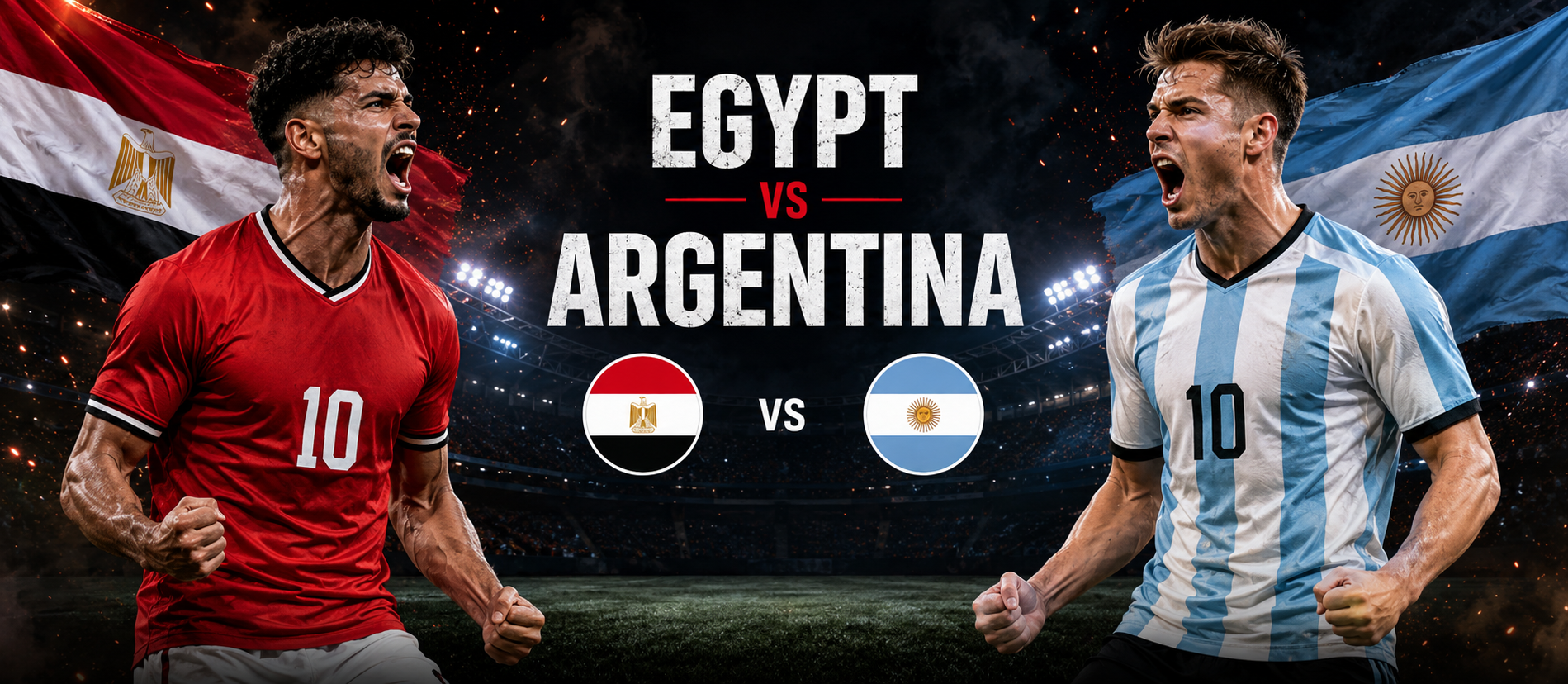
Egypt vs Argentina Round of 16 preview — World Cup 2026 at Atlanta’s Mercedes-Benz Stadium, July 7. Salah vs Messi, tactics, lineups, suspensions and our prediction.
- July 7, 2026 Tue
- Mercedes-Benz Stadium Atlanta
- Kick-Off 12:00 PM ET
Everything you need at kickoff
- Date
- Tue, July 7, 2026 12:00 p.m. ET
- Venue
- Mercedes-Benz Stadium Atlanta, Georgia
- Capacity
- 75,000+ One of the tournament's largest
- Stage
- Round of 16 Winner meets Switzerland–Colombia winner
- Referee
- Not yet confirmed Not yet announced by FIFA
- Weather
- Hot & humid, ~90°F/32°C Retractable roof, climate-controlled
- Rest
- Both teams: 4 days Both went 120 min on July 3
- Bracket
- Argentina won Group J Egypt 2nd in Group G
This is the first-ever World Cup meeting between the two nations. Contrary to a common pre-match assumption, both teams needed a full 120 minutes to win their Round of 32 ties on the same day — Argentina beating Cape Verde 3-2 in extra time, and Egypt beating Australia 4-2 on penalties after a 1-1 draw — so there is no rest-advantage asymmetry at all.
A tested champion, a fearless underdog
Argentina are champions who have, for the first time this tournament, been genuinely tested. Through the group stage they looked imperious — deep, professional, capable of resting Messi and still winning. The Cape Verde tie revealed something new: they can be got at. They conceded twice to a nominally much weaker side, needed extra time, and leaned on contributions beyond Messi (Lisandro Martínez, Romero) to survive. The identity remains elite — control in midfield through De Paul, Mac Allister and Enzo Fernández, individual brilliance from Messi, reliable finishing from Lautaro Martínez — but the match also showed real defensive fallibility.
Egypt are a defense-first, set-piece-and-moments team built around Mohamed Salah’s individual quality and Mostafa Shobeir’s goalkeeping. They have proven they can defend a lead against elite opposition (Belgium), come from behind to win (New Zealand), survive a penalty and a late VAR scare (Iran), and win a knockout shootout under real pressure (Australia). Their attacking ceiling drops sharply when Salah is below full tilt, and their back line has shown genuine fragility, but the collective spirit and game-management have been excellent.
The broader truth of this tie: both teams arrive having just survived their first real test of the tournament, both went to 120 minutes on the same day, and both have specific individual-fatigue and suspension-risk questions hanging over key personnel.
How it could unfold
Argentina control and win comfortably
Egypt sit in a compact block, as they did against Belgium and Iran; Argentina probe patiently, and the breakthrough comes through Messi’s invention, a Lisandro Martínez/Romero set piece, or a Lautaro Martínez finish. Once ahead, their individual quality tells and a second follows as Egypt push forward. A professional 2-0 or 2-1. (Most likely.)
The grind
Egypt defend with real discipline, Shobeir makes two or three key saves, and Argentina labor for an hour before a single moment — a Messi free kick, a deflected finish, a set-piece goal — breaks the deadlock. A tense 1-0 that never feels fully safe, echoing the slow-burn win over Austria.
The scare
Egypt score first — a Salah moment or an Ashour-style set piece — and hold the lead deep into the second half, drawing on the Belgium template. Argentina, still carrying scar tissue from Cape Verde, pile on pressure; either they find a leveler and win late, or — the genuine shock — they don’t.
Penalties
A cagey 0-0 or 1-1 goes to penalties, where Egypt’s freshly proven nerve — a 4-2 win over Australia days ago — makes this a genuinely live scenario rather than a fantasy.
No fabricated percentages — these are qualitative, evidence-based pictures of how the match could unfold.
Tale of the tape
Egypt finished second in Group G unbeaten on five points — a 1-1 draw with Belgium (Emam Ashour, set up by a Salah assist on his 34th birthday), a 3-1 win over New Zealand for their first-ever World Cup victory (Zico, Salah and Trezeguet), and a 1-1 draw with Iran in which Shobeir saved a Taremi penalty. In the Round of 32 they beat Australia 4-2 on penalties after a 1-1 draw — Ashour heading the opener before a Mohamed Hany own goal — for their first-ever World Cup knockout win and a first Round of 16 since 1934.
Argentina won Group J with a perfect nine points — 3-0 over Algeria (a Messi hat-trick), 2-0 over Austria (Messi twice, moving past Klose as the World Cup’s all-time leading scorer) and 3-1 over Jordan with Messi rested to the bench. In the Round of 32 they survived a 3-2 extra-time scare against Cape Verde — Messi’s 20th career World Cup goal, a Lisandro Martínez strike and a Cristian Romero header credited as a Diney Borges own goal — after Cape Verde twice levelled.
Hossam Hassan has generally used a 4-2-3-1 with Salah as a central No. 10 behind Marmoush. Belgium was a disciplined side brave enough to defend an early lead; New Zealand was more proactive with set pieces used as a designed weapon; Iran was pragmatic, protecting a lead and preserving Salah. Against Australia the system was stripped to essentials by injury — Hafez and Rabia replacing Fatouh and Abdelmonem — yet still executed a clear set-piece plan and held a shootout together under pressure.
Match 1 vs Algeria was front-foot and direct, built around unleashing Messi early; Match 2 vs Austria was patient and controlled; Match 3 vs Jordan was full rotation, proving the system functions without Messi in the XI. The Cape Verde tie forced a fourth mode entirely — game management under duress, chasing the match twice and relying on structural threats from set pieces. Expect Scaloni more cautious about game-state than at any previous point; Argentina now know a two-goal cushion is not automatically safe.
Mostafa Shobeir has seized the No. 1 shirt with a penalty save against Iran and a composed shootout against Australia. Yasser Ibrahim was booked in extra time (120′) and is one yellow from missing the quarterfinal; Emam Ashour is the creative heartbeat and Round of 32 scorer, and Haissem Hassan (105′) also carries a caution. Mohamed Salah is the talisman and tactical center; Omar Marmoush leads the line. Injuries: Ahmed Fatouh (hamstring tear) and Mohamed Abdelmonem (ankle bruising) both missed the Australia game and their status for Argentina is unconfirmed — a genuine selection question.
Emiliano Martínez remains the undisputed No. 1 and shootout hero of 2022. Against Cape Verde the back four was Molina, Romero, Lisandro Martínez and Facundo Medina, with Otamendi dropping to the bench; Gonzalo Montiel was booked in extra time (115′) and is one yellow from missing the quarterfinal. The midfield of De Paul, Mac Allister, Enzo Fernández and Almada anchors the side; Messi, at 20 career World Cup goals, is the outright all-time leading scorer with seven this tournament, and Lautaro Martínez leads the line with Julián Álvarez in reserve.
- Defensive discipline and game-management under pressure.
- Set pieces as a designed weapon, feeding Ashour and the defenders.
- Mostafa Shobeir — a penalty-save specialist in form.
- Proven shootout nerve — a 4-2 win over Australia days ago.
- The best individual player in the tournament in Messi.
- A genuine second scoring outlet from set pieces via Lisandro Martínez and Romero.
- Elite finishers in Lautaro Martínez and Julián Álvarez.
- A manager who rotates fearlessly and has already adjusted mid-tie.
- A steep drop in attacking ceiling whenever Salah is below full tilt.
- A back line stretched thin by injuries to Fatouh and Abdelmonem.
- Two players (Hassan, Ibrahim) one caution from a quarterfinal ban.
- Real defensive fallibility exposed by Cape Verde — two goals conceded to a weaker side.
- A veteran core carrying an age-and-workload story after a full 120 minutes.
- Gonzalo Montiel one caution from missing the quarterfinal.
Respect, and the reading of moments
Lionel Scaloni enters this tie for the first time this tournament having actually been tested — Cape Verde showed him his team can be hurt by structured pressing, direct transitions and set pieces, and that a two-goal lead is not safe. His public comment ahead of this tie — “This is a team that hasn’t lost. They aren’t here by accident. We have to respect them, and that is what we will do.” — signals a coach unwilling to treat this as a formality.
Hossam Hassan has built Egypt’s run on collective discipline, defensive shape and maximizing Salah’s touches in central zones. His post-Australia comments — “We do not fear anyone, and no Egyptian fears anyone” — point to a manager who will not let his players freeze against Messi’s Argentina. His tactical dilemma is concrete: with Fatouh and Abdelmonem’s fitness uncertain, he may again be forced into defensive reshuffling just days after his back line was stretched thin.
Key duels to watch
Mohamed Salah vs Argentina’s back line
Salah has created the second-most chances at the tournament and is the one player capable of unlocking Argentina on his own, especially played centrally as a No. 10.
Lionel Messi vs Egypt’s low block and Shobeir
Messi’s ability to drift into the right half-space and combine with Lautaro Martínez is Argentina’s most reliable route through a packed defense — with Shobeir, fresh off a shootout masterclass, standing in the way.
Emam Ashour vs Argentina’s midfield press
Ashour was the difference-maker against Belgium and Australia. If De Paul, Mac Allister and Enzo Fernández smother him, Egypt’s build-up narrows toward individual Salah moments.
Set-piece threat at both boxes
Both teams have scored from set pieces — Argentina via Lisandro Martínez/Romero, Egypt via Ashour’s header from a Salah routine. Whichever side wins the individual battles could decide a tight match.
Emiliano Martínez vs Mostafa Shobeir
Both have shootout pedigree — Martínez from the 2022 final, Shobeir from the Australia tie days ago. If this is as cagey as expected, the goalkeeper could again be decisive.
The pre-match narrative most needs correcting here. It is tempting to frame this as “shattered Argentina vs fresh Egypt” — but both teams played a full 120 minutes on the same day, July 3, and both arrive on exactly four days’ rest. Where the picture diverges is at the individual level: Argentina’s veteran core and 39-year-old Messi carry an age-and-workload story, Egypt’s makeshift back line (Fatouh, Abdelmonem) is a depth question, and Salah’s hamstring held up over 120 minutes but four days is a short window. Net read: close to a wash.
The names that decide it
Created more chances than anyone at the tournament bar one player, scored a composed panenka in the shootout, and played 120 minutes on a recovering hamstring.
Penalty save vs Iran, calm presence in the Australia shootout; among the form goalkeepers of the tournament.
Scored the opener vs Australia and continues to be Egypt’s creative fulcrum.
Reliable secondary goal threat across the tournament.
In for the injured Fatouh, he delivered the assist for Ashour’s goal in his first extended run of the tournament.
In for the injured Abdelmonem, solid and composed under real pressure in a first knockout start.
Steady, but one caution from missing the quarterfinal.
Battling, direct, still searching for his first goal of the knockouts.
Screens the defense reliably.
A goal vs New Zealand and a live bench weapon.
Seven tournament goals, the outright all-time World Cup scoring leader, and still the difference-maker at 39 — though the Man of the Match award vs Cape Verde was debated.
Goal and the pivotal assist for Messi’s opener vs Cape Verde; arguably the game’s best individual performer.
Returned from a knee scare to play a key role in the winning sequence.
Sharp, direct, leads the line with intensity.
Argentina’s most complete midfielder; controls tempo under pressure.
The metronome; Messi’s shadow across the pitch.
Progressive passing, tireless energy over 120 minutes.
Solid at right-back across a tough night.
A rotation option who held up reasonably at left-back in a pressure match.
Conceded twice but organized the defense and remains a world-class shootout weapon in reserve.
Did not start vs Cape Verde but remains a central figure in the squad’s depth.
Momentum Meter
Argentina — confident, but no longer red hot. Three routine wins were followed by a genuine scare that exposed defensive vulnerability. The result (advancing) is positive; the manner (needing extra time and an own goal to beat a nominal minnow) tempers the momentum.
Egypt — confident and rising. Unbeaten through the group, a first-ever World Cup win, a first-ever knockout win, and a shootout triumph despite two enforced defensive changes. Egypt are playing with the freedom of a team that has already exceeded every historical benchmark — arguably the edge on pure momentum sits slightly with them.
What would — and wouldn’t — surprise us
A comfortable Argentina win
A comfortable Argentina win by one or two goals.
Messi decisive
Messi on the scoresheet or with an assist.
Egypt deep, Shobeir busy
Egypt defending deep for long spells with Shobeir their busiest player.
A late decisive moment
A cagey, low-event first half followed by a decisive moment after the hour mark.
A suspension
Either Montiel, Hassan or Ibrahim missing the quarterfinal through suspension.
Champions eliminated
Egypt eliminating the defending champions, extending their historic run into the quarterfinals.
A Cape Verde repeat
A repeat of the Cape Verde pattern: Argentina conceding twice again and needing extra time or penalties.
A Salah masterclass
A Salah masterclass — a goal and an assist — inspiring a statement Egyptian win.
A defensive collapse
Argentina’s makeshift-feeling defensive unit conceding three or more.
An early red card
A red card for either side inside the first half-hour reshaping the entire tie.
How each team wins it
Argentina remain the stronger side on paper by a wide margin — reflected in the betting market, where Argentina opened around -270 on the 90-minute moneyline compared to Egypt’s +800, and in the FIFA world rankings, where the No. 1 side faces a gap of roughly 28 places to No. 29 Egypt. These figures are cited as market and ranking sentiment, not a Fanorate forecast.
Why the favorite (Argentina) should win
- The best individual player in the tournament in Messi, with a tournament-leading seven goals.
- A genuine second scoring outlet from set pieces via Lisandro Martínez and Romero.
- Elite finishers in Lautaro Martínez and Julián Álvarez.
- A manager who has already shown he can adjust when a game plan is not working.
- A higher ceiling: if Egypt’s compact block cracks even once, Argentina can turn one goal into two or three.
How the underdog (Egypt) can win
- Get everything possible out of Salah in the final third, isolating him against a rotated full-back.
- Replicate the Australia set-piece routine — a designed Salah free kick that fed a Hafez cross for Ashour’s header.
- Do not let the makeshift back line be exposed in transition against Messi and Lautaro Martínez.
- Manage the yellow-card risk (Hassan, Ibrahim) without becoming passive.
- Trust Shobeir and the shootout record — a 4-2 win over Australia converting four straight.
- Punish the first sign of Argentina fatigue, keeping the score level into the final 20-30 minutes.
Egypt cannot out-class Argentina’s attacking talent over 90 minutes, but they have already proven, twice in the space of a week, that they can grind out results against superior opposition and win the moments that matter.
Penalty Shootout Analysis
If this tie reaches penalties, the psychological picture is fascinating. Argentina have the deeper shootout pedigree — Emiliano Martínez was the hero of the 2022 final, and their roster of composed takers is elite. Egypt, however, arrive with fresh, live shootout success: they beat Australia 4-2 just four days earlier, converting four consecutive kicks including a composed Salah panenka, while Australia missed twice. Edge: essentially split — Argentina’s pedigree is more decorated, but Egypt’s is more recent and freshly proven under maximum pressure.
Best guess at kickoff
Projected, not confirmed. Egypt’s XI depends heavily on the fitness of Ahmed Fatouh and Mohamed Abdelmonem; Argentina’s depends on whether Scaloni restores his more experienced central-defensive pairing (Otamendi/Tagliafico) after the Cape Verde scare.
Messi is directly involved in Argentina’s opening goal, whether as scorer or provider.
Mohamed Salah is directly involved in Egypt’s best chance of the match, whether or not it results in a goal. At least one of Gonzalo Montiel, Haissem Hassan or Yasser Ibrahim picks up a second caution and is suspended for a potential quarterfinal. Egypt’s makeshift or reshuffled back line concedes at least one clear chance directly from a defensive mix-up. And if the match reaches penalties, expect a nerveless Egyptian performance from the spot, drawing directly on the Australia shootout template.
Where the pressure sits
Argentina carry the pressure of the reigning champions and the outright favorites. Anything short of a comfortable-looking win invites scrutiny, and the Cape Verde scare has already raised questions about squad fragility heading into a run of increasingly dangerous opponents.
Egypt play with the freedom of a team that has already delivered the best World Cup campaign in its history. Every match from here is a bonus — but there is also a real, once-in-a-generation opportunity, with Salah in what may be his final World Cup, that raises the emotional stakes even without any formal expectation of victory. The formal pressure sits with Argentina; the emotional and legacy stakes sit heavily with Egypt.
The turning point: Egypt hold firm for large stretches, potentially even taking a lead through a Salah or set-piece moment, before Argentina’s individual quality — most likely Messi combining with Lautaro Martínez or a set-piece from Lisandro Martínez/Romero — breaks through in the second half. Man of the Match: Lionel Messi.
Egypt have earned every bit of belief from their run, and the corrected fatigue picture (both teams played 120 minutes on the same day) removes what looked like Argentina’s biggest structural advantage. But Argentina’s individual ceiling remains higher than anything Egypt have shown they can sustain against top-five-ranked opposition over 90 minutes. Confidence is medium: high that Argentina progress, given the quality gap in both the betting market and the rankings; medium on the exact scoreline and route, given Egypt’s proven resilience and shootout composure.
Into uncharted territory
The winner advances to face the winner of Switzerland vs Colombia, played the same day at BC Place, Vancouver. Both Switzerland and Colombia reached the Round of 16 unbeaten and won their Round of 32 ties in normal time — meaning the quarterfinal opponent, whoever it is, will arrive noticeably fresher than either Egypt or Argentina, neither of whom needed fewer than 120 minutes to get here.
For Argentina, a fourth-straight physically taxing knockout match in barely two weeks would be a real fitness concern against a rested opponent. For Egypt, reaching the quarterfinal would extend a campaign that is already the greatest in the nation’s World Cup history into genuinely uncharted territory — a milestone that would resonate across Africa and the Arab world. Whichever side survives this tie, expect the fatigue and squad-rotation conversation to intensify heading into the last eight.
