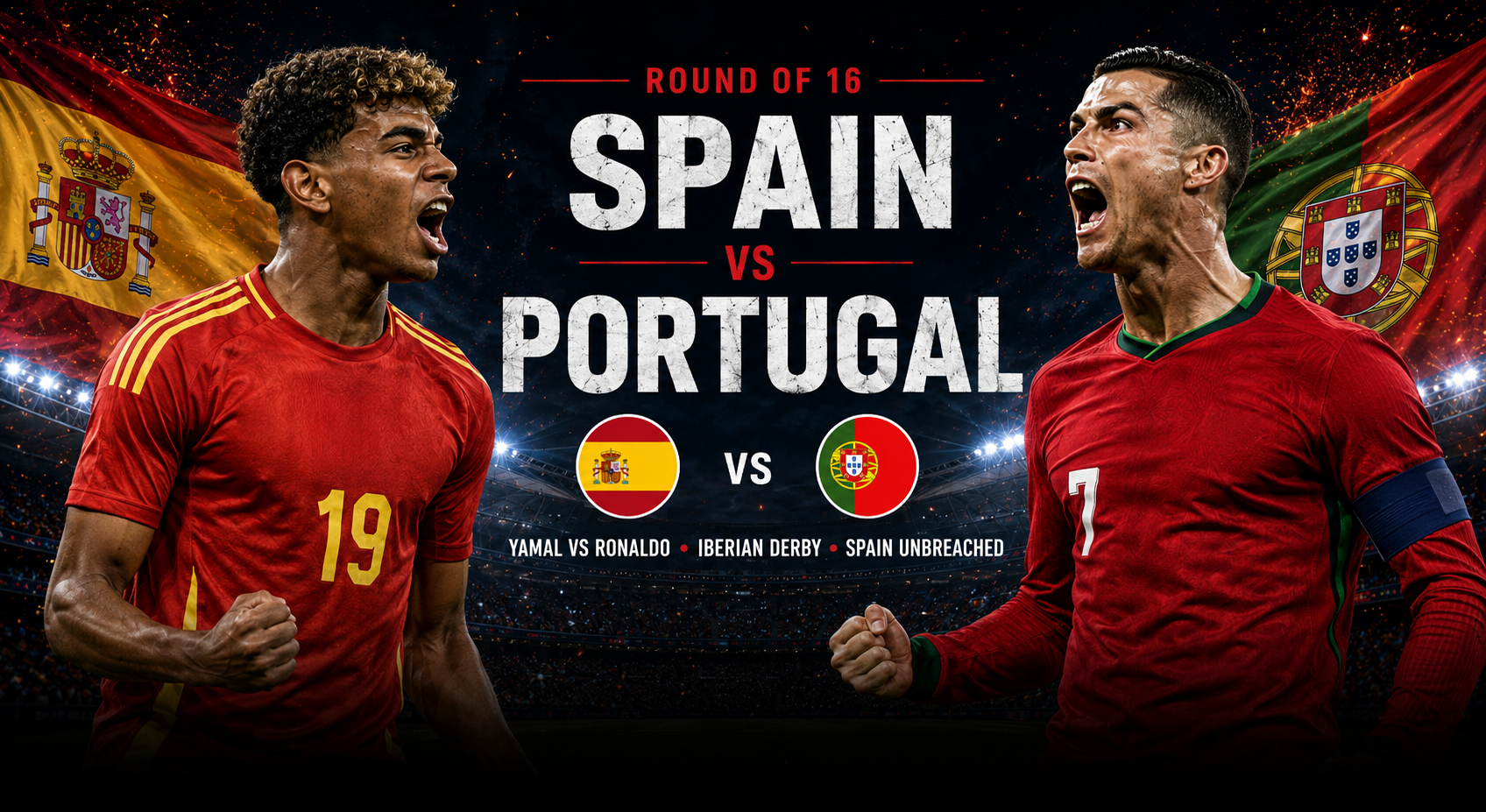
Yamal vs Ronaldo, Tactics, Lineups and Prediction
Spain vs Portugal World Cup 2026 Round of 16 preview: the Iberian derby in Arlington. Tactics, squads, Yamal vs Ronaldo, form index, scenarios and a final score prediction.
- July 6, 2026 Mon
- AT&T Stadium Arlington
- Kick-Off 3:00 PM ET
A note on how Fanorate builds these previews.
This is a research-led, AI-assisted analysis produced by the Brillmark team at Fanorate. Every factual anchor below — match details, group-stage results, scorers, squads, injuries and disciplinary status — was cross-checked against multiple public sources and verified as of July 3, 2026.
Where reporting conflicts or a detail could not be independently confirmed (the referee appointment, the exact roof status, single-sourced goal minutes, and a couple of quotes), we flag the uncertainty rather than guess. Lineups and tactical reads below are informed projections, not insider information.
We do not run physical player testing, and we do not invent statistics or fabricate win probabilities.
Everything you need at kickoff
- Stage
- Round of 16 Winner to Quarterfinal
- Date
- Mon, July 6, 2026
- Kickoff
- 3:00 p.m. ET 2:00 p.m. CT / 12:00 p.m. PT
- Venue
- AT&T Stadium Arlington, Texas · ~70,649
- Referee
- Not yet confirmed FIFA announces 1–2 days out
- Weather
- Retractable roof, A/C ~98°F outside · closed roof likely
- Rest
- Both: 4 days No extra time in Round of 32
The winner advances to the Quarterfinal on July 10, 2026 at SoFi Stadium, Inglewood, California, against the winner of USA vs Belgium (also played July 6, at Lumen Field, Seattle). As of July 3, the USA-Belgium tie had not yet been played — Belgium reached the Round of 16 via an extra-time comeback win over Senegal, while the USA beat Bosnia and Herzegovina, with matchwinner Folarin Balogun sent off and now suspended for the Belgium game. AT&T Stadium (branded “Dallas Stadium” for the tournament) has a retractable roof and is fully air-conditioned; given Arlington highs near 98°F and a flagged “dangerous heat wave,” a closed roof with air conditioning is the strong expectation, though no FIFA announcement confirmed the roof decision for this fixture. Both sides rest four days after July 2 Round of 32 wins — Spain flew from Los Angeles, Portugal from Toronto — and the tie is repeatedly described in the press as an “Iberian derby.”
Title favorites against a final World Cup
The winner of this tie advances to face the winner of USA vs Belgium in the Quarterfinal on July 10, 2026, at SoFi Stadium in Inglewood, California — meaning either Spain or Portugal would be flying back to the West Coast having just flown into Texas. For Spain, advancing here would continue a run built on defensive control that would need to hold up against unfamiliar attacking patterns. For Portugal, advancing would extend what is being treated as Ronaldo’s final World Cup by at least one more match, with all the emotional weight that carries for the Portuguese squad and support.
Spain carry heavy institutional pressure as reigning European champions and one of the tournament’s genuine title favorites; the Cape Verde scare showed how quickly doubt can set in around this group, and anything less than continued progress would be read domestically as underachievement. Portugal carry a different, more personal kind of pressure: this is widely and repeatedly framed in the press as Cristiano Ronaldo’s likely final World Cup — a narrative weight that, on top of the ongoing tribute to the late Diogo Jota, makes this a squad playing with layers of meaning beyond the result itself.
Momentum is lopsided. Spain are red hot — four matches, zero goals conceded, a statement Round of 32 win, and their first World Cup knockout win in sixteen years, with their best attacking threats peaking at the right time. Portugal are steady but tempered by turbulence — a signature win over Uzbekistan bookended by two draws and a Round of 32 victory built on a 68th-minute penalty, a 94th-minute substitute winner and a VAR intervention that went their way. This is a team finding results rather than imposing them.
Spain carry heavy institutional pressure as reigning European champions and one of the tournament’s genuine title favorites.
Narratives writing themselves
The Iberian derby
One of the most anticipated Round of 16 ties of the tournament — repeatedly described in the press as a “blockbuster” and an “Iberian derby” or “Iberian classic.”
Ronaldo’s record-breaking tournament
His brace against Uzbekistan made him the first player ever to score at six different World Cups and moved him past Eusébio as Portugal’s all-time leading scorer; his Croatia penalty was his first-ever World Cup knockout goal and made him, at 41 years 147 days, the oldest player to score in a World Cup knockout match.
Spain’s unbreached defense
Four matches, zero goals conceded — and a Round of 32 win over Austria that was Spain’s first World Cup knockout win since the 2010 final, snapping three straight tournaments without one.
A Nations League rematch
These two exact coaching staffs met just over a year ago in the 2025 UEFA Nations League Final, where Portugal beat Spain 5-3 on penalties after a 2-2 draw in Munich.
Rúben Dias’s card jeopardy
Rúben Dias, booked in the 17th minute against Croatia, is the only player on either side one caution from a Quarterfinal suspension — the clearest, most consequential disciplinary storyline in the entire match.
De la Fuente will know exactly how narrow that margin was, and Martínez will know his side has already shown it can go toe-to-toe with this Spain group in a de facto knockout match.
Tale of the tape
Spain won Group H with seven points and zero goals conceded: a 0-0 draw with World Cup debutant Cape Verde in which they dominated possession (around 75%) but could not break a well-organized low block; a 4-0 rout of Saudi Arabia featuring Lamine Yamal’s first World Cup start and an Oyarzabal double; and a 1-0 win over Uruguay through Álex Baena’s 42nd-minute strike. In the Round of 32 they beat Austria 3-0 — Oyarzabal twice (36′, 89′) and Pedro Porro (66′), both goals created by Marc Cucurella — their first World Cup knockout win since the 2010 final.
Portugal finished second in Group K with five points: a 1-1 draw with DR Congo (João Neves’s early header cancelled out by Yoane Wissa), a 5-0 rout of Uzbekistan in which Cristiano Ronaldo scored twice, and a 0-0 draw with Colombia that cost them top spot. In the Round of 32 they beat Croatia 2-1 — Ronaldo’s 68th-minute penalty (his first-ever World Cup knockout goal) leveled Ivan Perišić’s opener, and substitute Gonçalo Ramos headed a stoppage-time winner (reported 94th minute) off a Rafael Leão cross, with a late Josko Gvardiol equalizer disallowed by VAR.
Spain have built an identity around control, verticality and defensive solidity: four matches, zero goals conceded, and a Round of 32 statement win that snapped 16 years of World Cup knockout frustration. The Cape Verde draw revealed the one failure mode — sterile possession against a packed low block with no natural width — but the fix (a fit Lamine Yamal stretching the pitch, Mikel Oyarzabal pinning center-backs, Marc Cucurella bombing forward from left-back) has been thoroughly road-tested since. Rodri and Pedri give the midfield both steel and tempo.
Portugal remain a team of extremes. At their ceiling (the Uzbekistan demolition) they look like the most talent-dense squad left in the draw; at their floor (DR Congo, Colombia) they are ponderous, over-reliant on individual moments, and prone to letting winnable positions drift. The Croatia win encapsulated both faces in one match: 68 uneventful minutes, a Ronaldo penalty to level it, and then two moments of match-defining substitute quality. The clearest throughline is that their bench — Ramos and Leão — has now twice been the difference-maker.
From sterile (no Yamal, no width against Cape Verde), to explosive (Yamal restored on the right, Oyarzabal as the focal point against Saudi Arabia), to streetwise (a pragmatic 1-0 over Uruguay), to complete (control, patience and clinical goals against Austria). De la Fuente now has the full toolkit and the evidence his side can win in more than one way.
From nominal control that stagnated (DR Congo), to total liberation once ahead (Uzbekistan), to pragmatic damage limitation (Colombia), to a slow, error-prone first hour rescued by the bench against Croatia. Martínez’s Portugal have shown all three faces — fragile, devastating and lucky — without settling on one identity. The bench has increasingly become the plan, not the backup plan.
Fermín López was ruled out of the tournament before it began. Nico Williams picked up an adductor/groin issue after Uruguay but is reported as expected to be available; Yéremy Pino avoided a fracture but his timeline for this match is unclear. Lamine Yamal’s pre-tournament hamstring concern appears fully resolved. No Spain player was booked against Austria, so none carries a caution into this match. Spain’s starting goalkeeper — Unai Simón or David Raya — carries genuine uncertainty across sources.
No significant injuries were reported for the Round of 16; earlier scares around Rúben Dias, Nuno Mendes and João Félix all appear resolved. No Portugal player has been sent off this tournament. But Rúben Dias, booked in the 17th minute against Croatia for serious foul play, is the single Portugal player carrying a caution into this match — a second yellow against Spain would rule him out of a potential Quarterfinal, the clearest, most consequential disciplinary storyline in the match.
- A perfect defensive record — zero goals conceded in four matches, including a Round of 32 knockout tie.
- Two attackers in career-best form: Oyarzabal (four tournament goals) and Cucurella (two Round of 32 assists).
- Squad depth and rest parity — can rotate without losing quality, and have not needed a substitute to rescue a knockout match.
- A cleaner disciplinary sheet: no suspensions, no players one yellow from missing the Quarterfinal.
- Recent tactical clarity — a side that can win comfortably, win ugly, and win a genuine knockout match.
- The most talent-dense squad left in the draw at their ceiling, with a spine of Diogo Costa, Rúben Dias, Vitinha and Bruno Fernandes.
- Game-changing substitutes in Gonçalo Ramos and Rafael Leão, who have twice been the difference-maker.
- Quality set-piece delivery from Bruno Fernandes and Nuno Mendes — the most realistic route to a goal against Spain.
- A very recent penalty-shootout win over this exact Spain team, the 2025 Nations League Final decided 5-3 on spot-kicks.
- Sterile possession against a packed low block with no natural width — the one failure mode the Cape Verde draw revealed.
- A managed Nico Williams knock, and an unclear recovery timeline for Yéremy Pino.
- Genuine uncertainty over the starting goalkeeper, Unai Simón or David Raya.
- Ponderous and over-reliant on individual moments at their floor (DR Congo, Colombia).
- A pattern of needing substitutes to rescue matches rather than add to control already established.
- Rúben Dias one yellow card away from missing a possible Quarterfinal.
Control against chaos
Luis de la Fuente vs Roberto Martínez carries a direct personal subplot: these two exact coaching staffs met just over a year ago in the 2025 UEFA Nations League Final, where Portugal beat Spain 5-3 on penalties after a 2-2 draw in Munich. Ronaldo scored the late equalizer that forced the shootout; Diogo Costa saved a penalty from Álvaro Morata; Rúben Neves scored the winning spot-kick.
De la Fuente has managed his group’s minutes and moods carefully all tournament — resting Yamal in the opener, dialing back to a pragmatic 1-0 for Uruguay, then unleashing a fully-loaded attacking approach against Austria. Martínez, by contrast, has increasingly leaned on his bench to solve problems his starting XI could not — Ramos and Leão have combined for the winning contribution in the biggest moment of the tournament so far. Expect him to again start a slightly more conservative front line and hold Ramos and Leão as his difference-makers for the final 20-30 minutes, precisely as he did against Croatia.
Why the favorite (Spain) should win: a perfect defensive record — zero goals conceded in four matches, including a Round of 32 knockout tie — is the single most important statistic in this preview. Oyarzabal (four tournament goals) and Cucurella (two Round of 32 assists) give Spain multiple, repeatable ways to create and finish chances. Spain can rotate without losing quality and, unlike Portugal, have not needed a substitute to rescue a knockout match. A cleaner disciplinary sheet and recent tactical clarity round out the case.
How the underdog (Portugal) can win: lean on the bench again, earlier if needed — Ramos and Leão have been Portugal’s most incisive weapons in the biggest moments. Win the set-piece battle, the most realistic route to a goal against a Spain defense unbreached in open play. Get Ronaldo one clean look in the box. Use Leão and Nuno Mendes to attack in transition rather than build-up. Manage Rúben Dias’s discipline. And target penalties — Portugal have direct, recent proof they can beat this exact Spain team in a shootout.
Key player matchups
Lamine Yamal vs Portugal’s right-side defense (Cancelo/Dalot/Semedo)
Spain’s clearest route to breaking Portugal down is isolating Yamal in one-on-one situations. If he wins those duels, Spain’s chance quality spikes immediately.
Cristiano Ronaldo vs Spain’s center-backs (Cubarsí and Laporte)
Ronaldo’s threat is now situational rather than constant — crosses, penalty-box instinct, set pieces — against a pairing that has not been breached all tournament. His 2018 hat-trick against Spain is the reminder that he has authored big moments against this exact opponent before.
Vitinha vs Rodri and Pedri
The genuine control battle of the match. If Vitinha dictates tempo the way he has all tournament, Portugal can dictate territory; if Spain’s pivot smothers him, Portugal will be forced into the individual-moment football that has been hit-or-miss all tournament.
Marc Cucurella vs Portugal’s right flank
Cucurella has been Spain’s most incisive attacking presence in the Round of 32; whoever Portugal deploys on that side (likely Nelson Semedo or Diogo Dalot, with Nuno Mendes occupied higher up the other flank) faces a genuine two-way test.
Set pieces: Bruno Fernandes’s delivery vs Spain’s defensive height
Portugal have scored from set-piece-adjacent situations already this tournament (Nuno Mendes’s free kick), and against a defense that has conceded zero goals in open play, a dead ball remains their most realistic route to a goal.
Goalkeepers: Diogo Costa vs Unai Simón/David Raya
Costa has been excellent when tested (Colombia); Spain’s goalkeeper situation carries mild uncertainty over the starter, but either option has been barely tested by volume given the team’s clean-sheet run.
Captains: Rodri vs Cristiano Ronaldo
The Ballon d’Or-winning defensive midfielder against the most decorated individual goalscorer of his generation — a study in contrasting definitions of team leadership.
The contrast is clean: Spain want a low-event, ball-dominant game they can win on control; Portugal are most dangerous in transition and around moments of chaos, but they have also shown they can be strangled by a side that denies them exactly that kind of chaos.
The names that decide it
9.0 — Four goals across the group stage and Round of 32; Spain’s most reliable source of goals and movement.
8.5 — Two assists in the Round of 32 win and the standout individual performer against Austria; De la Fuente’s public praise says it all.
8.0 — A Round of 32 goal and increasingly involved as an attacking outlet from right-back.
8.0 — The tempo-setter in every match Spain has played; Spain’s engine.
7.0 — One goal, flashes of brilliance, but even his own manager conceded post-Austria that the 18-year-old “hasn’t quite arrived” at this tournament yet relative to the hype. Still Spain’s single biggest X-factor if he clicks against Portugal.
7.5 — Full minutes, fully recovered from a serious knee injury, marshaling the pivot as captain.
7.5 — Composed at the heart of a defense that has not conceded all tournament.
7.0 — Experienced organizer alongside Cubarsí.
7.5 — A historic penalty and the emotional/tactical center of the team, but quiet in the two draws (DR Congo, Colombia) and criticized publicly for his link-up play. Still capable of the decisive moment, as the Croatia game proved.
8.0 — Portugal’s most important outfield player, dictating tempo even in the flatter performances.
8.0 — A goal against Uzbekistan and Portugal’s most complete performer across the group stage.
7.0 — Defensive leader, but booked in the Round of 32 and now under real disciplinary pressure.
7.0 — Creative hub and set-piece taker; involved constantly, occasionally wasteful.
7.5 (impact) — The stoppage-time Round of 32 hero off the bench — arguably Portugal’s most decisive attacking sub.
7.5 (impact) — Assisted Ramos’s winner and scored against Uzbekistan; Portugal’s most dangerous attacking substitute.
7.5 — Excellent in the Colombia clean sheet, largely untested behind a goal conceded against Croatia.
History on the line
Six different World Cups
Cristiano Ronaldo’s brace against Uzbekistan made him the first player ever to score at six different World Cups, moved him to ten career World Cup goals, and took him past Eusébio as Portugal’s all-time leading scorer.
Oldest to score in a knockout
Ronaldo’s 68th-minute penalty against Croatia was his first-ever World Cup knockout-stage goal and made him, at 41 years and 147 days, the oldest player to score in a World Cup knockout match — in his sixth World Cup appearance.
Spain’s first knockout win since 2010
Spain’s 3-0 Round of 32 win over Austria was their first World Cup knockout win since the 2010 final, snapping a run of three straight tournaments (2014, 2018, 2022) without a single knockout victory.
The 2018 hat-trick
These sides famously drew 3-3 at the 2018 World Cup in Sochi, when Ronaldo scored a hat-trick including a stoppage-time free kick.
5-3 on penalties in 2025
Just over a year before this tie, Portugal beat Spain 5-3 on penalties in the 2025 UEFA Nations League Final after a 2-2 draw, with Diogo Costa saving from Álvaro Morata and Rúben Neves scoring the winning kick.
Best guess at kickoff
Projections based on group-stage and Round of 32 selections, reported fitness, and pre-match projections circulating as of July 3 — not confirmed team news. Spain’s goalkeeper choice (Unai Simón or David Raya) carries real uncertainty; some widely circulated projections omit Oyarzabal from the front three in favor of Olmo and Williams flanking Yamal; and Portugal are expected to hold Rafael Leão and Gonçalo Ramos as planned attacking substitutes. Neither federation had confirmed an official team sheet as of this writing.
Rúben Dias is booked again and misses a potential Quarterfinal — the single most avoidable, most consequential card risk on the board.
Mikel Oyarzabal extends his tournament-leading goal tally. Rafael Leão or Gonçalo Ramos is directly involved in a Portugal goal off the bench, continuing the pattern from the Croatia match. If the match reaches penalties, the broadcast leans heavily into the 2025 Nations League Final rematch narrative before a ball is kicked in the shootout. And Lamine Yamal has his most heavily-marked game of the tournament, with Portugal specifically double-teaming him rather than defending him individually.
The turning point: Spain break the deadlock through Oyarzabal or Yamal in the second half, forcing Martínez to turn to Ramos and Leão earlier than he’d like — and Portugal get back into it through exactly that substitute pairing, but run out of time to complete the comeback. Predicted after a tense, cagey first hour. Man of the Match: Mikel Oyarzabal.
Four reasoned scenarios frame the match. Most aligned with the form line is the controlled Spanish win: Spain dominate territory and possession, Portugal sit in a mid-block waiting for transitions, and a set piece or individual moment from Oyarzabal or Yamal breaks the deadlock in the second half for a 1-0 or 2-0 that extends the clean-sheet run. Second, the Ramos/Leão rescue again — Portugal struggle to create until Martínez turns to his bench around the 65th-70th minute and Leão or Ramos produces the moment, for a tight, low-scoring Portugal win or a goal that forces extra time. Third, the shootout rematch — both defenses hold and the match repeats the shape of the 2025 Nations League Final, decided on penalties, with Portugal’s very recent history against this exact opponent as the deciding psychological factor. Fourth, the upset via Ronaldo’s moment — Spain dominate the run of play but Portugal ride a Ronaldo set piece, penalty or poacher’s finish, echoing his 2018 hat-trick against this same opponent. No fabricated probabilities are offered — these are qualitative, reasoned scenarios, most to least likely by editorial judgment only.
Not a comfortable call
Spain’s perfect defensive record, superior overall form, and deeper rest-adjusted squad options make them the more complete team on paper. But Portugal’s very specific, very recent penalty-shootout win over this exact opponent, plus Ronaldo’s history of producing moments against Spain when it matters most (the 2018 hat-trick is the clearest precedent), keep this from being a comfortable call.
Confidence is moderate. This is a genuinely close matchup between two in-form (if imperfect) knockout teams, and the shootout precedent between these two exact squads means we would not be surprised by any of the four scenarios modeled above.
What would surprise nobody: a tight, low-scoring Spanish win decided by a moment of individual quality from Oyarzabal, Yamal or Cucurella; Portugal defending in a mid-to-low block and looking to Ramos and Leão off the bench; a cagey first hour; and a refereeing or VAR moment becoming a major talking point. What would shock the tournament: Portugal winning comfortably inside 90 minutes, Spain conceding multiple goals in open play, a red card materially swinging the tie, or Rúben Dias picking up an early second yellow that forces Portugal to play a large chunk of the match a man down.
One factor sets this tie apart: Portugal beat Spain 5-3 on penalties in the 2025 UEFA Nations League Final, just over a year ago, after a 2-2 draw through extra time, with Diogo Costa saving from Álvaro Morata and Rúben Neves scoring the winning kick. No shootout has yet been required by either team in 2026, but purely as editorial judgment, Portugal’s very recent shootout win over this exact opponent is the single strongest argument that an upset is more live in this fixture than the base rate of favorite vs underdog would normally suggest.
We lean Spain to win in regulation, but flag real respect for the scenario in which this goes to extra time or penalties.
