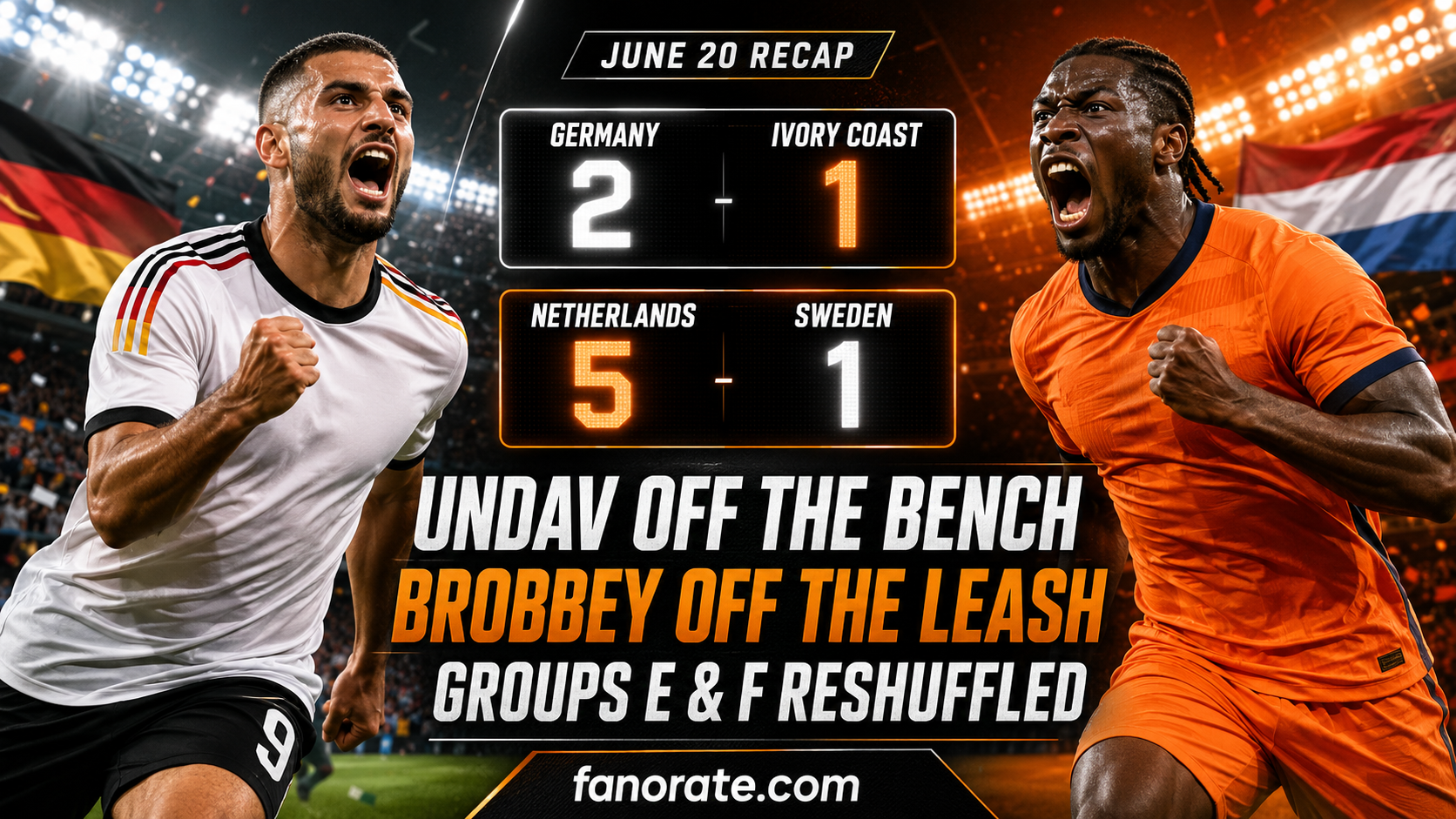
Undav Off The Bench, Brobbey Off The Leash: How June 20 Reshuffled Groups E and F
There are days at a World Cup when the favorites simply do their job and you nod along. June 20 was not one of them. It was a day that made you lean forward, check the clock, and then check it again, because the two headline acts decided to tell completely different stories with the same ending: a big European nation walking off the field with three points and a knockout ticket.
In Toronto, Germany spent an hour looking like a side that had misplaced its swagger somewhere between the airport and the tunnel. Franck Kessié had put Ivory Coast ahead, the Elephants were defending with belief, and Julian Nagelsmann’s team were running into the same wall over and over. Then a substitution changed the temperature of the entire group. Deniz Undav came on, scored twice, and the second one arrived so deep into stoppage time that half of Germany had probably already started rehearsing the post-mortem.
Down in Houston, there was no slow build at all. The Netherlands decided the suspense was optional. Brian Brobbey scored inside five minutes, scored again before the quarter-hour mark, and from there the only question was how lopsided it would get. Cody Gakpo turned the second half into a personal highlight reel, Sweden’s spirit cracked, and a Group F that looked tight 24 hours ago suddenly has a clear shape.
And as the lights came up over Kansas City for the nightcap, Ecuador and Curaçao were walking out for a game that could rewrite the bottom of Group E — a fixture still in front of us as this recap goes live, and one we’re treating honestly as unfinished rather than guessing at a scoreline.
Two of Europe’s heavyweights punched their knockout tickets in wildly different ways — Germany on a stoppage-time rescue, the Netherlands in a first-half landslide — while the Kansas City nightcap left Group E’s survival math hanging.
At a glance
Toronto Stadium, Toronto
Deniz Undav’s 94th-minute winner, his second of the night off the bench, dragged Germany from the brink to the last 32. Meaning: Germany are through with a game to spare; Ivory Coast are left to rue the points that got away.
NRG Stadium, Houston (att. 68,777)
Brobbey twice, Gakpo twice, Summerville late; Elanga’s reply never threatened the result. Meaning: the Dutch announce themselves as a genuine force and seize control of Group F.
Kansas City Stadium, Kansas City
The Group E nightcap kicked off late in the evening; with Ecuador chasing their first win and Curaçao chasing their first goal, the result will decide who, if anyone, can still chase Germany.
The Main Story Of The Day
If you want the emotional core of June 20, it lives in the body language of two managers in the 60th minute.
Nagelsmann was pacing. His Germany side, fancied to stroll through Group E after thumping Curaçao on Matchday 1, were a goal down and out of ideas against an Ivory Coast team that had clearly studied them. Every German attack hit traffic. Every Ivorian clearance landed in space. And the longer it stayed 1–0, the more the conversation shifted from “when will Germany score” to “what happens to Germany if they don’t.”
Then he made the call that defines tournaments. Undav, a striker who has spent much of his international life as a useful option rather than a guaranteed starter, came on. Eight minutes later he met a Nadiem Amiri delivery with a volley that finally beat the Ivorian goalkeeper. And in the depths of stoppage time, with Ivory Coast a single whistle from one of the results of the tournament, Undav got himself a half-yard of turn and finished again. From a draw that would have cracked the group wide open, Germany walked off qualified.
It is the kind of swing that reorganizes a group in 35 minutes. Germany now join the early qualifiers in the comfortable seats. Ivory Coast, who did almost everything right for an hour, are left holding the most painful kind of performance — the good one that ends with nothing.
What fans will argue about tomorrow is whether this was Germany being great or Germany getting away with one. Both can be true. The substitution was decisive and the finishing was clinical, but a team with title ambitions does not usually need a 94th-minute bail-out against a side ranked below it. That tension — relief stacked on top of doubt — is exactly the conversation Nagelsmann will be managing for the next week.
In Houston, the story was simpler and, for Sweden, far more brutal. The Netherlands had arrived under a small cloud after letting a lead slip against Japan, and they answered it by removing all ambiguity inside 20 minutes. Brobbey bullied the Swedish back line, Gakpo carried the second half, and a team that has flirted with under-achievement at recent tournaments looked, for one night, exactly like the version their talent has always promised.
Match-By-Match Recap
Germany 2–1 Ivory Coast — the rescue act in Toronto
For an hour, this was Ivory Coast’s night. Kessié, the captain, pounced on a rebound and smashed it home in the 30th minute, and the Elephants settled into a shape that frustrated Germany’s rhythm and dared them to find a way through. They couldn’t — not until the bench intervened.
- Tactical turning point
- Undav’s introduction around the hour mark. Germany had been static and predictable; the substitution gave them a different movement profile in the box and a finisher willing to gamble on the second ball. Amiri’s involvement in the equalizer mattered too — the supply finally matched the runs.
- Key player
- Deniz Undav. A brace off the bench, including the 94th-minute winner, and a place in a neat slice of history as the first Germany player to score in each of his first two World Cup appearances since Miroslav Klose in 2002.
- Biggest missed chance
- Ivory Coast’s collective failure to find a second when Germany were wobbling. A team that takes its chances at 1–0 in that spell is talking about a famous win, not a heartbreaking loss.
- Emotional moment
- The stoppage-time winner. From Ivorian players sinking to the turf to the German bench emptying, it was the single biggest mood-swing of the day.
- What it means
- Germany are into the last 32 with a match to spare. Ivory Coast are still alive but now need a response, having turned a brilliant hour into zero points.
Netherlands 5–1 Sweden — the demolition in Houston
Some games are decided by a moment. This one was decided by a mood, and the mood was set before many in the crowd had settled. Brobbey scored in the fifth minute, doubled it in the 17th, and Sweden never recovered their footing. Gakpo took over after the break with two goals in the space of eight second-half minutes, Elanga briefly gave Sweden a flicker, and Summerville rounded it off late.
- Tactical turning point
- The opening 17 minutes. By scoring twice so early, the Dutch forced Sweden to chase a game they had planned to control, and the spaces that opened up behind a stretched Swedish midfield were exactly where Gakpo did his damage.
- Key player
- Cody Gakpo. Two goals, a constant threat, and the clearest sign yet that the Netherlands have a player rounding into tournament form at the perfect time. Brobbey’s early brace earns him a share of the spotlight.
- Biggest missed chance
- Sweden’s failure to make Elanga’s goal mean something. At 4–1 there was a five-minute window where a quick second might have created nerves; instead the Dutch tightened up and Summerville punished them.
- Emotional moment
- Gakpo’s second, when the Houston crowd realized this had tipped from a win into a statement.
- What it means
- The Netherlands move to four points and into a commanding position in Group F. Sweden, who looked dangerous in their opener, now have serious defensive questions to answer.
Ecuador vs Curaçao — Group E's unfinished business
We’re not going to invent a scoreline. As this recap publishes, Ecuador and Curaçao were taking the field in the night’s final fixture, a game heavy with meaning for the bottom of Group E. Ecuador, beaten by Ivory Coast on Matchday 1, badly need a win to keep pace. Curaçao — one of the smallest nations ever to reach a men’s World Cup — arrived chasing their first goal of the tournament after a heavy opening defeat. Whatever happens here directly shapes who can still mathematically chase Germany. We’ll cover it fully in tomorrow’s recap.
- Status
- Not yet final at publication.
Best Moments Of The Day
-
Undav’s 94th-minute winner. The latest of late twists, and the one that flipped an entire group on its head. Nothing else today carried that much consequence in a single touch.
-
Brobbey’s fifth-minute opener. A statement of intent that set the tone for the most one-sided result of the day.
-
Undav’s equalizer. Less dramatic than his winner, but it was the goal that gave Germany permission to believe again.
-
Gakpo’s second-half double. Eight minutes of clinical finishing that turned a comfortable lead into a rout.
-
Kessié’s opener for Ivory Coast. For 64 minutes, it looked like the goal that would define an upset.
-
Summerville’s late fifth. The kind of goal that doesn’t change a result but does change a goal difference — and at a 48-team World Cup, goal difference can decide who survives.
-
The Toronto crowd’s hour of belief. Neutral and Ivorian fans sensing a shock, before Germany snatched it away.
The Drama Section
The headline drama was time itself. Germany’s winner deep in stoppage time is the sort of moment that splits a stadium down the middle: ecstasy for one set of fans, a gut-punch for the other. There’s nothing controversial about it — Undav was alive to the chance when defenders switched off — but it reopens the familiar debate about whether elite teams should be relying on last-gasp escapes against opponents they’re expected to beat.
The day’s quieter, simmering storyline carried over from earlier in the tournament: the mandatory hydration breaks. Managers across the tournament have grumbled that the stoppages chop matches into quarters and disrupt momentum, particularly in the climate-controlled stadiums where the heat argument doesn’t apply. It’s a fair gripe and a tricky balance — player welfare in genuinely hot, open-air venues is non-negotiable, but blanket breaks inside cooled arenas feel like a solution searching for a problem. Expect this to keep bubbling as the knockout stakes rise.
On the field, neither headline match hinged on a refereeing flashpoint, which in its own way is a relief after a tournament that has already seen its share of VAR theater. The drama on June 20 came from football, not from screens — and that’s usually the good kind.
The Emotional Temperature
Joy
Houston, comfortably. A 5–1 win with two players scoring braces is the purest form of football joy, and the Dutch traveling support got a night to remember.
Relief
Germany. Make no mistake — this was relief before it was celebration. You could see it in how hard the bench celebrated a stoppage-time goal that “should” have been unnecessary.
Frustration
Ivory Coast and Sweden, for opposite reasons. The Elephants did the hard part and got nothing; Sweden never got going at all.
Fear
Anyone at the bottom of Group E and Group F doing the math. Germany’s win and the Dutch goal difference both raise the bar for survival.
Hope
Ecuador and Curaçao, walking out in Kansas City with everything still to play for as the night closed.
Players Who Owned The Day
Deniz Undav
Two goals off the bench, including the 94th-minute winner, and a place alongside Klose in Germany’s record books for scoring in his first two World Cup appearances. The definition of a tournament super-sub, and suddenly a name in the Golden Boot conversation.
Brian Brobbey
Two goals inside 17 minutes, bullying a Swedish back line and setting the entire tone. The Netherlands have wondered who their reliable No. 9 is; tonight, Brobbey answered.
Cody Gakpo
A second-half brace and a performance that screamed form. If the Dutch are going deep, this is the version of Gakpo that takes them there.
Franck Kessié
On the losing side, but he led from the front, scored the opener, and dragged his team to within a whisker of a famous result. No shame in his night.
Nadiem Amiri
The creative spark behind the equalizer. Germany looked a different team once his passing began connecting with runners.
Crysencio Summerville
A substitute’s goal that padded the scoreline and, just as importantly, the goal difference. Squad depth, made visible.
Anthony Elanga
Sweden’s lone bright spot, the one player who consistently looked like he might make something happen.
Teams Rising And Falling
Stock rising
- The Netherlands look reborn. The Japan draw raised eyebrows; the Sweden demolition put them away. A team with this much attacking talent finding its rhythm early is a problem for the rest of the bracket.
- Germany, too, rise — not in style, but in standing. They’re through, and a side that can win ugly when it’s playing badly is a dangerous animal in knockout football.
Stock falling
- Sweden tumble. Conceding five, with the defense pulled apart repeatedly, is the kind of result that lingers.
- Ivory Coast fall in points if not in pride; performances like theirs deserve more than a stoppage-time heartbreak, but the table doesn’t deal in moral victories.
Tactical Notes For Serious Fans
Germany’s problem for an hour was predictability. With their first eleven, the attacks were too central and too slow, and Ivory Coast comfortably condensed the space. The fix wasn’t a system overhaul — it was personnel. Undav’s willingness to attack the back post and gamble on rebounds gave Germany a different kind of finisher, and Amiri’s introduction to the rhythm of the game added the disguise their passing had lacked.
The Netherlands won the game in transition and on the first ball. By scoring early, they flipped Sweden from a compact defensive block into a chasing team, and the second-half goals came in the gaps that a stretched midfield always leaves. Brobbey’s physicality occupied the center-backs and created the lanes Gakpo exploited.
Sweden’s defensive line struggled badly with runners attacking the channels. The early concessions forced them into a shape they didn’t want, and they never found the discipline to reset. Elanga’s threat was real but isolated — one outlet is not a plan against a team in this mood.
A broader point for the neutral: at a 48-team World Cup, goal difference is doing heavy lifting. Summerville’s late goal and Germany’s narrow margin will both matter when the tiebreakers are tallied, and smart teams are already playing with that in mind.
Fan Sentiment Pulse
- Happiest fan base
- Dutch supporters, no contest. A 5–1 win flips anxiety into belief overnight, and the conversation online shifted from “can this team finish anything” to “how far can this go.”
- Most nervous
- Germany fans, oddly, despite qualifying. The relief was real, but so was the unease about needing a 94th-minute rescue. The mood is “through, but not convinced.”
- Most frustrated
- Ivory Coast supporters, who watched their team out-play expectations for an hour and walk away with nothing.
- Neutrals' favorite moment
- Undav’s late winner — the pure drama of it transcended allegiance.
- Host-city atmosphere
- Houston’s NRG Stadium hummed with nearly 69,000 in, and Toronto delivered a genuinely tense, big-occasion feel as the upset loomed. The North American host cities continue to bring volume and color.
- Social mood
- Energized and slightly argumentative — the best kind of World Cup evening. Germany’s escape and the Dutch statement dominated timelines, with the hydration-break debate flaring again in the background.
Qualification Picture
- Helped themselves
- Germany are through to the last 32 with a game in hand. The Netherlands took control of Group F, sitting on four points with momentum and a healthy goal difference.
- Under pressure
- Sweden, after a five-goal hammering, suddenly have work to do and a goal difference to repair. Ivory Coast remain alive but can no longer afford slip-ups after letting a winnable game escape.
- Still alive, awaiting answers
- Group E’s bottom two, Ecuador and Curaçao, head into their unfinished business in Kansas City knowing the night could either keep their hopes breathing or end them. Group F’s Japan and Tunisia still have everything to play for.
We’ll resist a firm prediction here — too much was still moving as the day closed. But the direction of travel is clear: the heavyweights are pulling away, and the chasing pack is running out of road.
Sunday, June 21
A full slate, headlined by a milestone.
- Tunisia vs Japan
- Spain vs Saudi Arabia
- Belgium vs Iran
- New Zealand vs Egypt
Tunisia vs Japan. History on the line and a group that just got more urgent makes this the can’t-miss kickoff.
Whoever Spain hand the attacking keys to in Atlanta — Saudi Arabia have a habit of making favorites uncomfortable, and Spain will need someone to break the game open.
Japan. After surrendering a lead to the Netherlands, they need a result against Tunisia before Group F runs away from them.
Can Iran’s low block frustrate Belgium the way Ivory Coast frustrated Germany — and is there a Belgian super-sub waiting to be the Undav of June 21?
Saudi Arabia over Spain. It’s happened before on this stage, and they’ll fancy it again.
SoFi Stadium for Belgium–Iran — expect a loud, partisan Iranian following to make the Inglewood crowd one of the day’s most vivid.
Fanorate Final Whistle
What June 20 taught us is that this World Cup isn’t going to hand the big teams anything for free. Germany are through, but they had to be rescued. The Netherlands look frightening, but they only looked that way after being doubted. The gap between the favorites and everyone else is real — and it’s also one substitution, one early goal, one missed chance wide.
The defining emotion of the day was the swing: from belief to heartbreak in Toronto, from doubt to dominance in Houston. That’s the World Cup working exactly as it should.
The question we carry into Sunday is whether the chasing pack can land a blow before the heavyweights disappear over the horizon — and whether the 1,000th match in World Cup history will be remembered for the milestone or for the football. Keep watching. Days like this are why we don’t look away.
A note on how this is made: Fanorate is an AI-assisted editorial project from the team at Brillmark. We at Fanorate use AI to research, draft, and edit our coverage, and a human-and-AI workflow shapes what you read. We don’t attend the matches and we don’t run physical tests; our reporting is built from publicly available match data and reputable sources, cross-checked where we can. Where a result wasn’t final by the time we published — like tonight’s Kansas City nightcap — we say so plainly rather than guess. We’re open about the method because we think you deserve to know how the work is done.
