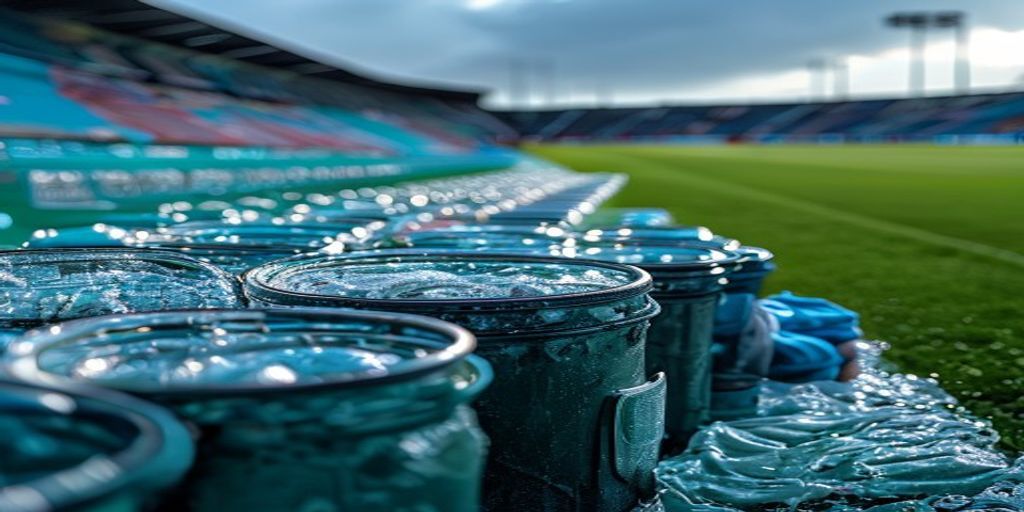
World Cup’s Hidden Foe: Heat Crisis Grips US Venues
Soaring temperatures at US host venues have turned the 2026 World Cup’s heat problem into the tournament’s most dangerous subplot.
When 28°C Becomes the Red Line
The stadiums are full, the goals are flying in, and the drama is relentless — but there is a villain at the 2026 World Cup that no defender can mark. Heat. Across the United States’ summer landscape, players are battling temperatures and humidity levels that FIFA itself has been forced to take seriously. Mandatory three-minute cooling breaks are now a fixture of every match, while squads from Europe’s cooler climates arrive at training sessions armed with ice collars and water misters. This is not a background story. For some players, it is the difference between competing and collapsing on the pitch.
Climate scientists use the Wet Bulb Globe Temperature index to measure the combined impact of heat and humidity. At 26°C WBGT, athletic performance deteriorates meaningfully. At 28°C, FIFPRO — the global players’ union — recommends matches be postponed outright. Current projections put five of the tournament’s 104 fixtures at or above that threshold, with Miami and Houston carrying the highest combined risk and around 26 games total pushing or exceeding the 26°C danger marker. For evening fixtures, temperatures ease but fans sitting in direct sun for hours before kick-off remain vulnerable. FIFA’s three-minute hydration breaks are now mandatory in every half regardless of conditions — the first time such measures have been enforced at a World Cup in the sport’s history.
Players and Fans Fighting the Invisible Opponent
For players, exertional heat stroke — core temperature rising above 40°C — is the clinical danger. For supporters, the risk accumulates differently: sitting two hours or more in intense sun with limited shade triggers fainting, heat exhaustion, and cardiovascular stress at far lower internal temperatures. European squads are feeling the adjustment hardest. Images have shown shirtless players sprawled flat on training pitches between sessions, while Norway’s squad were photographed wearing ice collars around their necks during warm-ups. At each venue, medical teams have scaled their readiness to real-time conditions. The July 19 final at MetLife Stadium — ranked among the highest-risk of all 16 venues — will be the ultimate test of those preparations.
FIFA has acted — cooling breaks, ice infrastructure, medical cover. But the elephant in the room remains scheduling. Evening kickoffs in the South and East reduce the risk; they do not eliminate it. The final at MetLife looms on the calendar like a flashing warning light. When the world’s biggest sporting event meets a heating planet, good intentions alone are not enough. Players competing on the grandest stage deserve protection proportional to that stage. Three minutes of water between them and a stretcher does not yet feel like enough.
