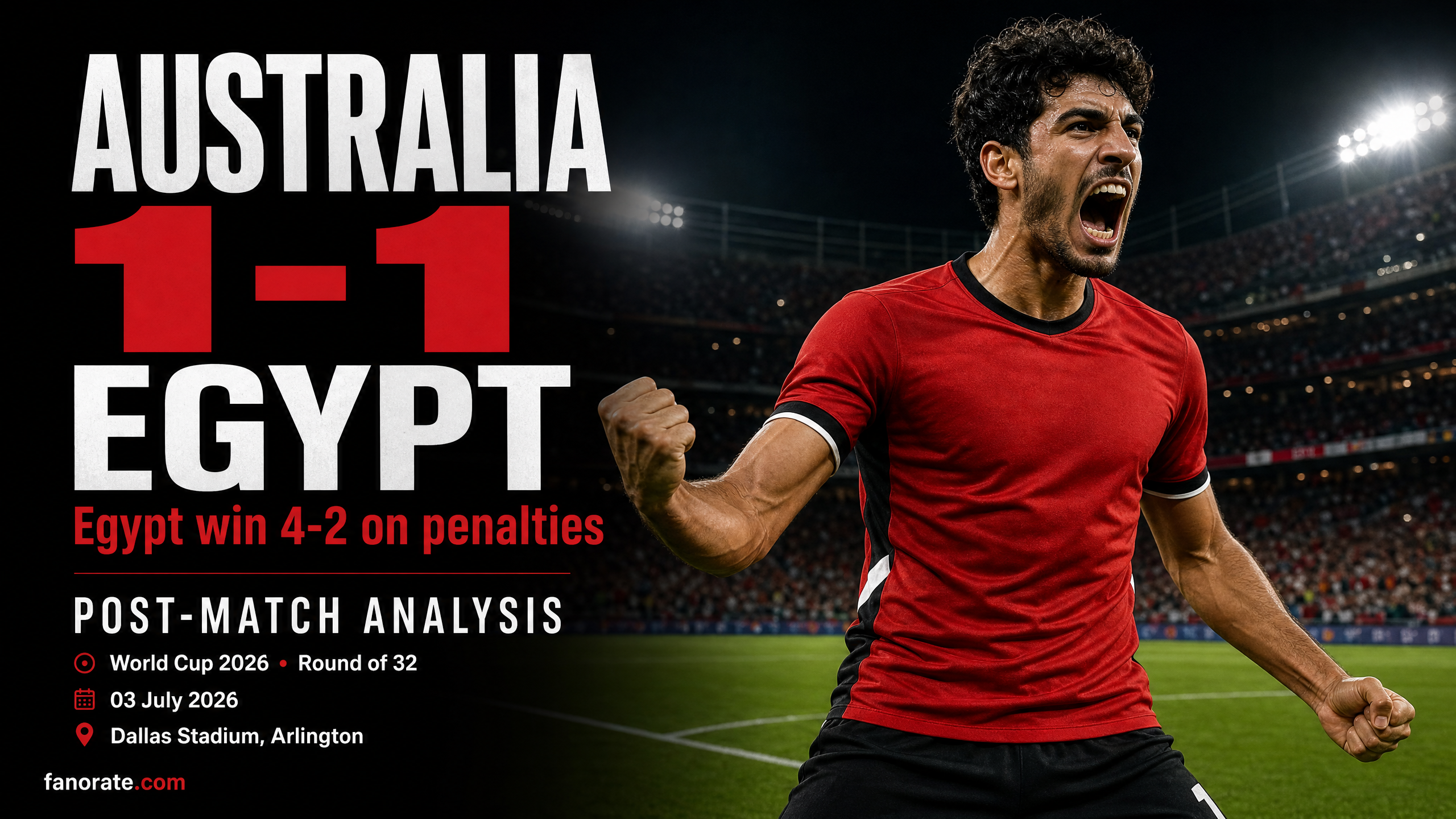
Australia vs Egypt: Socceroos Eliminated on Penalties in World Cup 2026 Round of 32 Heartbreak
Egypt advance to the Round of 16 after eliminating Australia on penalties at Dallas Stadium, with the Socceroos’ World Cup dream ending 4-2 in the shootout following a 1-1 draw after extra time.
Egypt win 4-2 on penalties
What happened
Australia’s FIFA World Cup 2026 campaign ended in heartbreak at Dallas Stadium as Egypt eliminated the Socceroos 4-2 in a penalty shootout after a gripping 1-1 draw that survived 120 minutes of football. Emam Ashour’s early strike gave the Pharaohs the lead, before Mohamed Hany Eldemerdash’s unfortunate own goal levelled proceedings in the second half. Neither side could find a winner across extra time, and when Harry Souttar and Lucas Herrington both missed from the spot, Egypt’s clinical executors sealed a famous passage to the last 16 under the Texas sky.
How it was won and lost
Egypt’s Possession Dominance Sets the Tone
Egypt dictated the tactical tempo throughout, finishing the match with 58% possession and an extraordinary 723 passes at an 85% accuracy rate — figures that dwarfed Australia’s 507 passes at 80%. The Pharaohs operated with a structured, patient build-up through their back line and midfield, using Emam Ashour and Hamdi Fathi as the engine room to circulate the ball and draw Australia into defensive shape before probing centrally. Their 130 attacks to Australia’s 128 tells only part of the story — Egypt created three big chances to Australia’s zero, illustrating the quality edge in their approach play even if clinical finishing proved frustratingly elusive.
Australia’s Low Block and Transition Threat
Without the ball, Australia sat in a disciplined mid-to-low defensive block, attempting to frustrate Egypt’s technical superiority and hit on the counter. With only 42% possession, the Socceroos were comfortable being second in the ball — but the structure broke in the 13th minute when Ashour punished them from range. Australia’s transition game had moments of promise, generating 16 shots in total and hitting the woodwork once, but their lack of a single big chance created underlines how rarely they threatened to genuinely hurt Egypt. A shots-on-target tally of just one in open play is damning.
Set-Piece Vulnerability and the Own Goal Turning Point
The match’s defining moment came not from open play creativity, but from an Egyptian defensive misfortune. Mohamed Hany Eldemerdash’s own goal on 55 minutes — the result of Australian pressure from a set-piece or cross situation — handed the Socceroos an equaliser they had done little to earn through chance creation. Australia did win 30 successful aerial duels compared to Egypt’s 26, suggesting their physical aerial presence was a genuine threat from dead-ball situations, and it ultimately produced the goal that kept them alive. Egypt’s eight shots blocked by their own bodies points to Australian pressure, though the xG quality wasn’t there.
Egypt’s Substitutions Tighten the Contest
Egypt’s coaching staff made five substitutions with precision, introducing Hossam Abdelmaguid and Haissem Hassan on 67 minutes to freshen the midfield and preserve energy for extra time. The late introduction of Hamza Abdel Karim for Omar Marmoush just after the 105-minute mark added fresh legs in attack. Australia’s six substitutions included the bold late entry of goalkeeper Mathew Ryan at the 119th minute — an extraordinary moment suggesting preparation for the penalty shootout — though Patrick Beach had kept the Socceroos in contention throughout. The move underlined Tony Popovic’s tactical awareness heading into the shootout.
Penalty Shootout: Egypt’s Composure Proves Decisive
Egypt converted four of their five penalties with cool authority — Mahmoud Saber, Rami Rabia, Mohamed Salah Ghaly, and Hossam Abdelmaguid all scoring — while Australia could only convert two through Jackson Irvine and Awer Mabil. Harry Souttar’s miss to open proceedings and Lucas Herrington’s subsequent failure gave Egypt the momentum they never relinquished. Australia’s inexperience at this stage of tournament football, combined with the weight of expectation, proved too great a burden when it mattered most.
Who decided it
Emam Ashour
EgyptThe Egyptian midfielder opened the scoring in the 13th minute with a decisive contribution assisted by Karim Hafez Ramadan Seif El Din, setting the tone for Egypt’s controlled performance. Ashour was a constant presence in the engine room, helping to dictate the tempo with intelligent movement and sharp passing throughout the 90 minutes before being withdrawn.
Ashour’s early goal forced Australia into a reactive posture for long periods, allowing Egypt to dictate the pace and structure of the match. His ability to press and circulate the ball made him central to Egypt’s possession dominance.
Jackson Irvine
AustraliaOne of Australia’s most experienced and composed performers, Irvine stepped up in the penalty shootout to convert calmly when the pressure was at its most intense. His leadership across the 120 minutes was vital in holding the Socceroos’ structure together as Egypt dominated the ball.
Irvine’s dynamism from midfield gave Australia their best moments in transition. His penalty conversion kept Australia alive in the shootout before Herrington’s miss ended their dreams.
Awer Mabil
AustraliaIntroduced as a substitute in the 91st minute, Mabil injected pace and directness down the flank that Australia had been lacking in the closing stages of normal time. He also converted his penalty in the shootout, showing nerves of steel on the biggest stage.
Mabil’s width and direct running gave Egypt’s defence problems in the dying moments of extra time, providing an outlet that Australia had been missing through the more congested central areas.
Mathew Ryan
AustraliaThe veteran goalkeeper’s dramatic introduction in the 119th minute — replacing Patrick Beach with penalties looming — was the most emotionally charged moment of the match. Ryan’s experience in shootouts was deemed essential by the coaching staff, though he was unable to conjure a save to keep Australia alive.
Ryan’s late appearance underscored Australia’s tactical preparation and psychological approach to the shootout. It also highlighted the enormous trust the Socceroos have in his leadership at critical moments, even if the outcome was ultimately heartbreaking.
Hossam Abdelmaguid
EgyptIntroduced as a substitute on 67 minutes, Abdelmaguid made an immediate impact with his energy in midfield and then delivered the decisive final penalty in the shootout, coolly slotting home to send Egypt into the Round of 16.
His introduction provided Egypt with fresh energy in the second half and extra time, and his nerve in the shootout exemplified the squad depth and collective confidence that carried the Pharaohs through.
Where it sits in history
This result marks Egypt’s progression to the Round of 16 at the FIFA World Cup 2026, a tournament where African nations have been making significant strides. For the Socceroos, it represents another agonising chapter in their penalty shootout history — Australia have now lost shootouts at multiple major tournaments, making spot-kicks something of a recurring nightmare for a nation whose players perform admirably across 120 minutes only to falter when the format becomes a lottery. Egypt, who last appeared at the World Cup finals in 1990 before their 2018 return, are building genuine tournament momentum under their current generation of talent, with Mohamed Salah Ghaly and Omar Marmoush representing a new wave of technically gifted players capable of impacting games at this level.
Inside the ground
The 80,000-capacity Dallas Stadium provided a cauldron-like setting for this last-32 clash, with significant Egyptian and Australian diaspora communities across the United States ensuring a vibrant, passionate atmosphere throughout. The Socceroos’ faithful — many draped in gold — were in full voice during the second-half equaliser, daring to dream of a famous result. When the penalty shootout began, the atmosphere reached fever pitch, with every spot-kick greeted by waves of noise that reverberated around the Arlington venue. Souttar’s opening miss silenced the Australian sections, and when Abdelmaguid’s final penalty flew in, the Egyptian supporters erupted in scenes of pure jubilation — a testament to the emotional rollercoaster these World Cup knockout fixtures deliver.
Looking ahead
Egypt advance to the Round of 16 of FIFA World Cup 2026, where they will face a fresh challenge as the tournament enters its most intense phase. The Pharaohs will need to build on this penalty shootout resilience and find greater clinical efficiency in open play if they are to progress further — three big chances created but only one goal from open play is a pattern they must address. For Australia, the Socceroos return home after a campaign that showed genuine competitive quality but ultimately fell short at the most pressurised moment. The experience of this tournament will be invaluable for the next generation of Australian talent, particularly the younger players who featured across the squad.
The bottom line
-
Egypt eliminated Australia 4-2 on penalties after a 1-1 draw at Dallas Stadium, Arlington in the FIFA World Cup 2026 Round of 32.
-
Emam Ashour’s 13th-minute opener gave Egypt an early advantage, before Mohamed Hany Eldemerdash’s own goal levelled the match on 55 minutes.
-
Egypt dominated possession with 58% and completed 614 of 723 passes at 85% accuracy, but could not find a winner across 120 minutes of football.
-
Australia created zero big chances despite generating 16 shots, underlining a persistent lack of cutting edge throughout the match.
-
Harry Souttar and Lucas Herrington both missed penalties in the shootout, while Egypt converted four of five through Mahmoud Saber, Rami Rabia, Mohamed Salah Ghaly, and Hossam Abdelmaguid.
-
Mathew Ryan’s dramatic 119th-minute introduction for Patrick Beach highlighted Australia’s tactical preparation for the shootout, though it ultimately couldn’t alter the outcome.
-
Egypt advance to the Round of 16 while Australia’s FIFA World Cup 2026 campaign ends in heartbreak at the spot-kick stage.
