Estadio BBVA: Monterrey’s Mountain-Backed Football Masterpiece
Estadio BBVA hosts FIFA 2026 in Monterrey. Inside guide to the Cerro de la Silla view, seats, transit, Norte food and matchday tips for World Cup fans.
Full Match Schedule
4 matches at Estadio BBVA
| Match | Stage | Group | Result / Kickoff | Host City |
|---|---|---|---|---|
| Group Stage | F |
5 – 1
Full Time
|
Monterrey Mexico | |
| Group Stage | F |
0 – 4
Full Time
|
Monterrey Mexico | |
| Group Stage | A |
1 – 0
Full Time
|
Monterrey Mexico | |
|
Netherlands
vs
Morocco
|
Round of 32 | — |
1 – 1
Full Time
|
Monterrey Mexico |
Some stadiums earn their reputation. Others earn it from the moment they open.
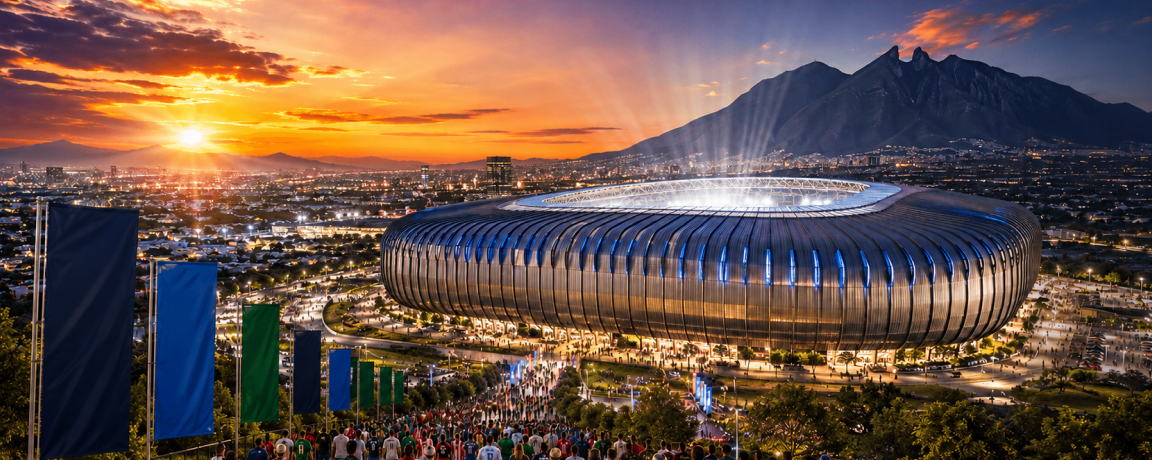
Estadio BBVA — home of Liga MX’s CF Monterrey, popularly known as Rayados — is in the second category. From the day it opened in 2015, it has been routinely ranked among the most beautiful football stadiums in the world. Multiple international architecture awards. Constant appearances on “world’s best stadium” lists from European and South American publications. A bowl that frames the iconic Cerro de la Silla mountain so dramatically that visiting players have stopped mid-warm-up to photograph it.
In the summer of 2026, that bowl will host four matches of the FIFA World Cup. The most cosmopolitan, business-forward, design-conscious city in Mexico is about to welcome the world to one of the most photogenic matchday environments in the entire tournament.
Here’s the full guide.
Everything at a glance
- Stadium
- Estadio BBVA also "El Gigante de Acero" · Guadalupe
- City / Region
- Guadalupe, Nuevo León Greater Monterrey metropolitan area
- Capacity
- ~53,000
- Opened
- 2015 Designed by Populous + VFO Architects
- Primary tenant
- CF Monterrey (Rayados) Liga MX
- FIFA 2026
- 4 matches Group-stage games
- Surface
- Natural grass
- Location
- Guadalupe ~10 km east of central Monterrey
- Roof
- Open-air canopy Seating covered; pitch open to sky
- Climate
- Hot, dry summer Daily highs above 95°F (35°C)
- Altitude
- 540 m 1,770 ft — relatively low altitude
- Transit
- Rideshare / car Limited public transit near stadium
Limited public transit options near the stadium. Most fans arrive by car, rideshare or matchday shuttle.
Oriented to frame the Cerro de la Silla
CF Monterrey, founded in 1945, is one of the most successful clubs in Mexican football. By the 2000s, the team had outgrown their previous home — the historic Estadio Tecnológico on the campus of Monterrey Institute of Technology — and decided to build a purpose-built modern venue.
The result, Estadio BBVA, was designed by Populous in collaboration with VFO Architects and opened in 2015. The most defining design decision was orientation: the bowl was specifically oriented so that the open end of the stadium would frame the Cerro de la Silla — Monterrey’s iconic saddle-shaped mountain that dominates the city’s skyline. The result is one of the most photographed stadium views in all of world football.
Other design choices reinforced the architectural ambition. The exterior is wrapped in a steel skin that gives the building its “Steel Giant” nickname. The seating bowl is tight to the field. The canopy is engineered to provide shade for fans without obstructing the mountain view. The integration of premium clubs, indoor lounges and concourse design represents some of the most thoughtful modern stadium architecture in the Americas.
Since opening, Estadio BBVA has hosted multiple Liga MX championship runs, Concacaf Champions Cup matches, Mexican national team fixtures, international friendlies, and major concerts. CF Monterrey’s recent dominance in CONCACAF — including multiple regional titles — has been built largely at this venue.
For FIFA 2026, the four-match assignment will be the venue’s most prestigious international football showcase to date.
The view is the headline
The view is the headline.
Cerro de la Silla, framed perfectly through the open end of the stadium, transforms every matchday photograph. Sunset matches produce some of the most spectacular sports broadcasting imagery of any venue in the world. The mountain rises 1,820 meters above sea level — visible from kilometers away — and the architects designed the entire bowl orientation around it.
- The steel-skinned exterior gives the building its “El Gigante de Acero” nickname and a visually distinctive presence.
- The seating bowl wraps tight to the field for an intimate matchday environment despite the venue’s significant capacity.
- The canopy is engineered to provide shade without obstructing the mountain view from upper-tier seats.
- The premium clubs and indoor lounges feature large glass walls that look out toward both the mountain and the surrounding precinct.
- The exterior plaza was designed to integrate with the broader surrounding parkland.
The building has won multiple international design awards and is routinely listed among the most beautiful stadiums in the world.
Three reasons
The venue
Estadio BBVA is one of the most modern, well-designed and operationally mature football stadiums in the Western Hemisphere.
The football culture
CF Monterrey has been one of the most successful Mexican clubs of the past two decades, with multiple Liga MX titles and several CONCACAF Champions Cup victories. The supporter culture is loyal, organized and theatrical. Tigres UANL, the city’s other major club, has its own deep fan base. Monterrey’s broader football culture is mature.
Geographic balance
Monterrey is in northern Mexico — roughly 700 kilometers from Mexico City and within a few hours’ drive of the U.S. border. Including Monterrey in the host roster balances the Mexican leg of the tournament geographically and brings the tournament close to American fans in Texas and the broader Gulf region.
The four-match schedule will give Monterrey a solid role in the tournament. Expect matches to feature beautiful broadcast imagery, intense Mexican fan culture and substantial cross-border attendance.
Liga MX, CONCACAF and beyond
- CF Monterrey’s multiple Liga MX championships since the stadium’s opening in 2015.
- CONCACAF Champions Cup victories including high-stakes home leg matches.
- Mexican national team fixtures with capacity crowds and Rayados-style supporter atmospheres.
- The 2019 FIFA Club World Cup matches featuring CF Monterrey has represented the region at FIFA Club World Cup tournaments, while Estadio BBVA itself has hosted Liga MX, Concacaf, national-team, friendly and concert events.
- Major international friendlies including European clubs on summer tours.
- Concerts and major civic events since the venue’s opening.
The 2026 World Cup matches will be the venue’s most significant FIFA-sanctioned matches to date.
Monterrey has one of the most polarized and intense football cultures in Mexico.
The Clásico Regiomontano
CF Monterrey (Rayados) and Club de Fútbol Tigres de la Universidad Autónoma de Nuevo León (Tigres UANL) are the city’s two major Liga MX clubs and have built a rivalry — known as the Clásico Regiomontano — that ranks among the most heated derbies in Mexican football. The two clubs split the city’s fan loyalty along economic, social and geographic lines.
Supporter culture
Supporter culture at both clubs is deeply theatrical. Rayados’ “La Adicción” and Tigres’ “Libres y Lokos” produce some of the most coordinated, sustained vocal support in CONCACAF. The Clásico Regiomontano matches are events that effectively shut down the surrounding neighborhoods.
Youth football
Beyond the clubs, Monterrey’s youth football pipeline is strong, with the Rayados and Tigres academies producing Liga MX and Mexican national team players regularly. The CFMP (Club de Fútbol Monterrey Premier) program and other youth tournaments operate continuously.
What to expect
-
Morning in central Monterrey or San Pedro Garza García
Coffee, breakfast, exploring the city’s commercial district.
-
Travel to Guadalupe and the stadium
Rideshare or driving is the most common path. About 20–30 minutes from central Monterrey on a matchday.
-
Pre-match in the stadium precinct
Food stalls, supporter group meetups, jersey vendors.
-
Entry
Security is firm. Allow extra time for high-profile matches.
-
Inside the bowl
Find your seat early. The mountain view at sunset is one of the most spectacular matchday moments in world football.
-
Concessions
Norteño cuisine traditions are reflected in concession options.
-
Post-match
Pre-arrange your departure. Rideshare or driving back to central Monterrey or San Pedro.
Where to sit
Lower bowl behind the goals
Rayados supporter sections traditionally cluster here.
Mid-tier sideline
The clearest read on shape and movement across the pitch.
Closed end looking toward the mountain
Seats on the closed end of the bowl looking out toward the Cerro de la Silla. This is one of the most photographic stadium views in world football.
Mid-bowl, off the noise
Mid-bowl seats away from the most vocal sections.
Upper-deck end zone
The most affordable entry point in the building.
Field-level clubs & indoor lounges
Field-level clubs and indoor lounges, many with mountain views.
A Monterrey-specific tip
The open end of the bowl frames Cerro de la Silla. If you can choose seats on the opposite end looking out toward the mountain, do it.
Getting here
- From Monterrey International Airport (MTY)
- Roughly 30–45 minutes by car. Rideshare or pre-arranged transport is typical.
- From Central Monterrey
- About 20–30 minutes by car on a matchday.
- From San Pedro Garza García
- About 30–40 minutes by car.
- From the U.S. border (Laredo, Texas)
- Roughly 3–4 hours by car. Monterrey is one of the most accessible Mexican host cities from the U.S.
- Driving
- Parking lots are available around the stadium. Pre-paid parking is recommended.
- Rideshare
- Uber and DiDi operate. Surge pricing post-match.
- Public transit
- Metrorrey Line 1 connects to Exposición station, where fans can use a dedicated pedestrian route toward Estadio Monterrey. Check official Monterrey 2026 updates for any shuttle or route changes.
- Walking
- Not realistic from outside the immediate area.
- Accessibility
- Accessible routes and seating available. Coordinate accessibility services with FIFA in advance.
Neighborhoods
San Pedro Garza García
Upscale district with luxury hotels, restaurants and shopping. Considered one of the wealthiest neighborhoods in Latin America.
Central Monterrey (Centro)
Historic downtown with cathedrals, museums and government buildings.
Valle Oriente
Modern commercial district with hotels and restaurants.
Cumbres
Residential area with hotel options.
Guadalupe
Closest to the stadium, with growing hotel inventory.
Apodaca
Closer to the airport, with business-oriented hotels.
If you’re staying for multiple matches and want upscale amenities, San Pedro is the choice. For a more historic experience, Centro Monterrey is the classic option.
Norteño traditions with international ambition
Monterrey’s food scene reflects northern Mexican (Norteño) culinary traditions with strong international influences.
- Cabrito al pastor — roasted young goat. A Monterrey specialty.
- Carne asada — grilled beef. Northern Mexican grilling traditions are some of the most sophisticated in the country.
- Norteño tacos — beef-forward, flour-tortilla traditions distinct from central Mexican corn-tortilla styles.
- Machaca — dried beef preparation, often served at breakfast.
- Frijoles charros — bean stew with chorizo, bacon and chiles.
- Tequila and mezcal — strong scene, with bars across San Pedro and Valle Oriente.
- Italian and international cuisine — strong scene in San Pedro, with high-end Italian, French, Japanese and Spanish restaurants.
- Coffee — growing third-wave scene in San Pedro and Valle Oriente.
Bars & viewing parties
Bars across San Pedro, Valle Oriente, and the Barrio Antiguo district run early-morning international matches.
Monterrey’s summer is hot and dry
35–40°C. Heat waves above 105°F (40°C) happen.
Moderate by Mexican Gulf standards but the heat is intense.
Limited rain in June and July compared to central or southern Mexico.
The bowl can be hot during day matches.
Practical kit
- Reusable water bottle and electrolyte plan
- Light, breathable clothing
- High-SPF sunscreen
- Wide-brim hat
- Sunglasses
- Cooling towel for outdoor pre-match plaza time
Bragging rights
Designed to frame a mountain
Estadio BBVA’s orientation was specifically designed to frame the Cerro de la Silla mountain through the open end of the bowl.
Routinely ranked among the world’s most beautiful
The stadium has won multiple international architecture awards and is routinely ranked among the most beautiful stadiums in the world.
The Steel Giant
The “Steel Giant” nickname references the building’s distinctive steel-skinned exterior.
CONCACAF Champions Cup powerhouse
CF Monterrey has won multiple CONCACAF Champions Cup titles, putting them among the most successful clubs in regional history.
One of the wealthiest municipalities in Latin America
Monterrey’s San Pedro Garza García is considered one of the wealthiest municipalities in Latin America by per-capita income.
Cerro de la Silla reaches 1,820 meters
Cerro de la Silla, the iconic mountain framed by the stadium, rises to 1,820 meters above sea level and is one of the most recognized natural landmarks in Mexico.
One of Latin America’s most respected universities
The Monterrey Institute of Technology is one of the most respected universities in Latin America, with deep ties to the city’s industrial and football history.
Rayados and Tigres are some of the highest-spending clubs in CONCACAF, with player budgets that rival mid-tier European leagues.
Monterrey is Mexico’s industrial and corporate capital — home to global multinationals, banks, manufacturing giants and one of the highest concentrations of wealth in Latin America. That economic profile has produced a football culture distinct from the rest of Mexico. The 2026 World Cup matches at Estadio BBVA will be played in front of one of the most globally-traveled, business-connected Mexican fan audiences in the country. Many of the Rayados and Tigres regulars in the stadium have watched Champions League matches live in Europe earlier the same week.
Rayados supporter culture is among the most theatrical in CONCACAF
Rayados supporter culture is among the most theatrical in CONCACAF. La Adicción produces sustained chants, coordinated tifos and theatrical pre-match rituals. Clásico Regiomontano matches against Tigres are some of the most contested derbies in world football.
For 2026, expect Monterrey matches to feature intense Mexican supporter culture combined with significant cross-border American attendance, particularly Texas-based fans. The visual broadcast quality from Estadio BBVA will be exceptional.
The visual broadcast quality from Estadio BBVA will be exceptional.
Designed with explicit sustainability goals from the start
Estadio BBVA was designed with explicit sustainability goals, including water-efficient field maintenance, on-site renewable energy elements, and integrated waste management. The steel-skinned exterior was engineered for heat management in the city’s hot climate.
Technology: high-density Wi-Fi, mobile-app ticketing, modernized broadcast infrastructure, and integrated video board systems.
Accelerating Monterrey’s already significant football identity
The 2026 World Cup matches at Estadio BBVA will accelerate Monterrey’s already significant football identity. CF Monterrey and Tigres UANL will benefit from the tournament’s global reach. The investment in youth football, women’s football and broader soccer-specific infrastructure across Nuevo León will continue. Monterrey’s role as the most internationally connected northern Mexican football city will become more visible.
One of the most visually spectacular venues of FIFA 2026
A Monterrey World Cup is going to be one of the most visually spectacular and economically distinctive experiences of FIFA 2026.
If you’re going, fly into MTY or drive from south Texas. Stay in San Pedro for upscale amenities or Centro Monterrey for the historic experience. Eat cabrito at a respected restaurant. Watch a sunset from a Cerro de la Silla viewpoint. Visit Fundidora Park. Get to Estadio BBVA well before kickoff. Sit on the closed end facing the mountain. Stay through the sunset.
Four matches at one of the most beautiful stadiums in the world. The broadcast imagery alone will make this one of the most photographed venues of the entire 2026 tournament.
