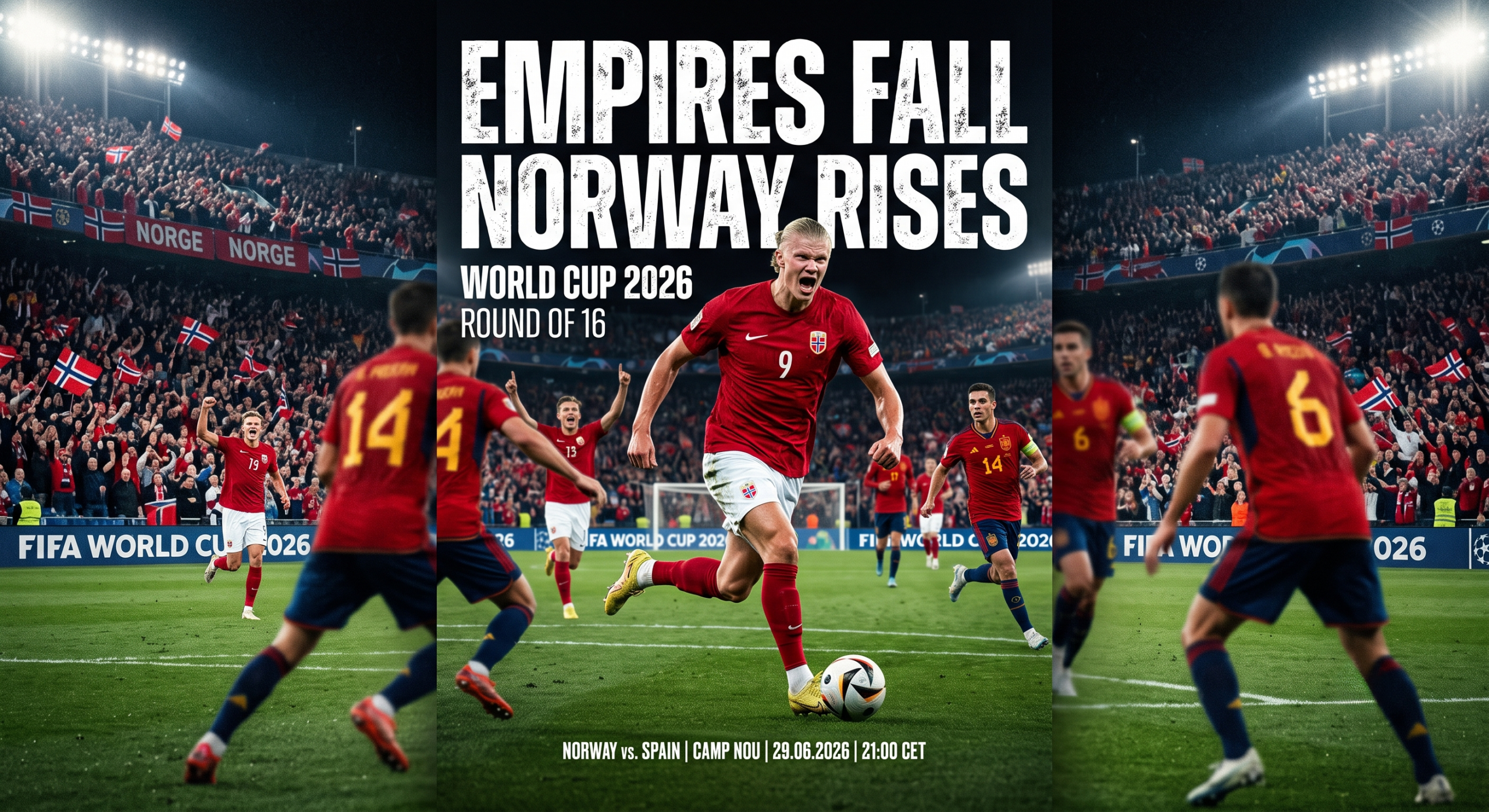
Empires Fall, Norway Rises, and a Trophy Race That Now Runs Through Buenos Aires: Inside World Cup 2026’s Round of 16
A note on how this is made: Fanorate is an AI-assisted editorial project from the team at Brillmark. We use AI research and drafting tools to help us cover a 48-team World Cup at the pace fans deserve, with human editorial direction shaping every piece. We’re not on the ground reporting from these stadiums — we’re synthesizing what’s been reported, verified, and confirmed across trusted outlets, and we say so plainly. If we get something wrong, tell us and we’ll fix it.
Opening Hook
Four days. Eight matches. A five-time champion eliminated for the first time since 1990. A co-host dismantled on its own soil. A 41-year-old icon walking off a pitch for the last time in his career. And, running underneath every one of those storylines like a live wire, a growing, uncomfortable question that fans in half a dozen countries were asking by the time the round finished: is this World Cup’s biggest prize being contested on a level field, or is it quietly tilting toward the team wearing sky blue and white?
The Round of 16 is supposed to be where a tournament finds its final shape. This one found something closer to its conscience — and its temper.
Norway shocked Brazil, England survived Mexico with ten men, Ronaldo’s career ended in Dallas, the USMNT was dismantled by Belgium amid a swirling political controversy, and Argentina completed an eleven-minute, three-goal comeback against Egypt so contentious that the losing manager accused the tournament itself of being rigged in the champions’ favor — closing out a round that leaves eight teams standing and one clear storyline dominating the conversation heading into the quarterfinals.
At a glance
NRG Stadium, Houston, July 4
Azzedine Ounahi’s brace and a Soufiane Rahimi stoppage-time goal ended the co-hosts’ historic run.
Lincoln Financial Field, Philadelphia, July 4
Kylian Mbappé’s 70th-minute penalty, awarded after a pitchside VAR review, was enough against a physical Paraguay side.
MetLife Stadium, East Rutherford, July 5
Erling Haaland scored twice in the final eleven minutes; Neymar’s stoppage-time penalty came four minutes too late.
Estadio Azteca, Mexico City, July 5 (delayed an hour by storms)
Jude Bellingham’s 98-second double and a Harry Kane penalty saw England through despite a Jarell Quansah red card — the first time England have ever beaten Mexico at the Azteca.
Dallas Stadium, July 6
Mikel Merino’s 91st-minute strike, on as a substitute, ended Cristiano Ronaldo’s international career.
Lumen Field, Seattle, July 6
Charles De Ketelaere’s brace and goals from Hans Vanaken and Romelu Lukaku routed the co-hosts.
Mercedes-Benz Stadium, Atlanta, July 7
Enzo Fernández’s second-minute stoppage-time header capped a three-goal, eleven-minute comeback after Argentina trailed 2–0.
BC Place, Vancouver, July 7
(Switzerland win 4–3 on penalties) Rubén Vargas, playing through his own fitness concerns, scored the winning kick.
The Main Story: Norway’s Miracle, and Brazil’s Uncomfortable Mirror
Start with the result that will be replayed for a generation. Norway had not reached a World Cup knockout round since 1998. They had never, in their history, made a quarterfinal. And on July 5, at MetLife Stadium, they beat Brazil — five-time champions, the most decorated program in the sport’s history — by playing exactly the kind of patient, disciplined, counter-punching football that turns talented individuals into a genuinely dangerous collective.
For 78 minutes, this looked like business as usual for Carlo Ancelotti’s side. Bruno Guimarães had a penalty saved, but Brazil created the better chances, tested Ørjan Nyland repeatedly, and looked the likelier winners on the balance of play. Then Norway’s halftime substitutions — Ståle Solbakken bringing on Oscar Bobb and Andreas Schjelderup — finally clicked. Schjelderup’s cross found Haaland’s head in the 79th minute. Eleven minutes later, Haaland’s low finish from the edge of the box ended it. Neymar’s stoppage-time penalty, won after a foul on Casemiro, was a beautiful, futile coda.
This deserves to be said plainly and defended clearly, because the pile-on that followed wasn’t entirely fair: Brazil were not outclassed on July 5. They were, for the better part of eighty minutes, the better team on the pitch — dominant in territory, sharper in individual moments, unlucky with a saved penalty that could easily have changed the emotional arc of the entire match. What beat them wasn’t a collapse. It was a Norwegian side that has spent this entire tournament proving that Haaland, Ødegaard, and Sørloth clicking together in a five-minute window is one of the most lethal weapons left in the competition, deployed by a coaching staff that made the single best in-game decision of the round. Ancelotti’s tactical setup — patient buildup through midfield, width from the full-backs, Vinícius and Martinelli stretching the back line — created more clear-cut chances than Norway managed across the full ninety. Football, at the elite level, does not always reward the team that deserved it more. Norway took two chances. Brazil didn’t take enough of the many more they created. That is a razor-thin margin, not a structural indictment.
What fans will keep arguing about is Ancelotti’s own postgame framing. Asked directly about the result, he called it a “new adventure” rather than an ending and admitted, without prompting, that Brazil’s midfield needs an overhaul before the next cycle. Read uncharitably, that sounds like a manager conceding defeat on more than one match. Read fairly — and this is the read Fanorate thinks the evidence actually supports — it’s a veteran coach doing exactly what a five-time champion’s federation should want from him: refusing to hide from a result, naming the real problem (a midfield that controlled territory without controlling the game’s key moments) instead of blaming penalty luck or Norway’s approach, and drawing a clear, honest line toward 2030. Ancelotti was brought in specifically to modernize a talented but occasionally disjointed squad, and one bad afternoon against a Norway team playing the best football of its own history doesn’t erase what he built across four matches of an entirely restructured qualification and group-stage process. The raw materials — Vinícius, Martinelli, Endrick, Guimarães — are still there, still young, and still his to shape. If Ancelotti’s promise of a rebuilt midfield and a sharper collective identity by the next World Cup sounds familiar, it’s because it’s the same promise every serious coaching appointment makes after an honest defeat. The measure of whether it means anything won’t come from this tournament. It’ll come in 2030.
Argentina, Egypt, and the FIFA Bias Question That Won’t Go Away
If Norway’s win was the round’s purest story, Argentina’s escape in Atlanta was its most divisive. Egypt led 2–0 with barely twenty minutes to go, playing the better football for the better part of ninety minutes against a champion squad that looked, for long stretches, exactly as mortal as a team built around a 39-year-old captain eventually must. Then came the eleven minutes that will define this round: Romero’s header, Messi’s own leveler off the underside of the bar, and Enzo Fernández’s stoppage-time winner.
Here’s the part that has genuinely inflamed half the football world. Nine minutes before Egypt’s second goal, a near-identical strike had already been chalked off by VAR for a marginal foul in the buildup — a review Egypt’s camp accepted, grudgingly, as at least defensible. Then, in the buildup to Argentina’s stoppage-time winner, replays appeared to show Alexis Mac Allister tugging an Egyptian shirt with no VAR check at all. Same category of contact. Two different outcomes, at two different ends of the same must-win match, in the two moments that decided the entire result.
Egypt’s head coach did not mince words afterward, calling the outcome an “injustice” and directly suggesting the reigning champions received preferential treatment throughout the tournament — not just in this match, but as a pattern. That’s an explosive accusation for any manager to make on the record, and it landed on fertile ground: this is now the second straight Argentina knockout match in which a marginal, uncalled contact incident has directly preceded a decisive Argentina goal, following whispers (never substantiated, but widely discussed) about the extra-time header that beat Cape Verde in the round before. Add in the fact that Argentina is the defending champion, headlined by the sport’s most commercially important remaining player in what is very plausibly his final tournament, and the incentives for FIFA’s biggest matches to bend gently in the champions’ favor are exactly the kind of thing supporters of nine other nations are primed to notice.
Fairness requires saying the other side of this clearly, too: Egypt was the better team for most of the match and still produced the two goals that put them ahead — a fact that complicates any version of this story built purely around officiating grievance. Argentina’s comeback also featured a legitimately brilliant individual sequence from Messi that had nothing to do with any whistle. Both things can be true at once. But the pattern — Argentina repeatedly finding the benefit of the doubt in the exact ninety seconds that matter most, across consecutive knockout rounds, in a tournament where their captain’s storybook farewell is by some distance the single most valuable commercial narrative FIFA has to sell — is not something serious fans should simply wave away as sour grapes. Scrutiny of officiating consistency around Argentina’s remaining matches is now warranted, not paranoid.
It wasn’t the round’s only officiating flashpoint, either. Croatia’s manager had already complained about VAR consistency in the previous round. Thomas Tuchel openly criticized refereeing standards after Jarell Quansah’s red card against Mexico. And the loudest non-Argentina controversy of the entire round belonged to the United States: Folarin Balogun’s Round of 32 red card suspension was reversed midweek after, according to multiple reports, a personal intervention from the White House directly to FIFA’s leadership — reportedly the first time since 1962 a player has been cleared to play in a World Cup match immediately after a sending-off the game before. Belgium’s manager objected furiously to both the substance of the decision and the timing. It barely mattered on the pitch — Belgium beat the Americans 4–1 regardless — but it added an entire second track of “is this tournament being managed fairly” conversation running in parallel to the Argentina questions, and it’s fair to say FIFA enters its post-tournament officiating review with considerably more to answer for than usual.
The Rest Of The Round
Morocco’s win over Canada confirmed that 2022’s semifinal run was no fluke — Azzedine Ounahi’s second-half brace turned a tight, Canada-dominated first half into a comfortable statement, sending an African nation back-to-back into the quarterfinals for the first time in history. France ground past a physical, well-organized Paraguay side that had already eliminated Germany, with Mbappé’s penalty enough to settle a match his team didn’t dominate — a result complicated by Aurélien Tchouaméni’s groin injury, which now threatens France’s midfield structure heading into a quarterfinal against exactly the kind of side built to exploit it.
England’s win at the Azteca deserves to be remembered as one of the gutsiest results of the tournament regardless of what comes next — the first time in history England have beaten Mexico at that stadium, achieved with ten men for the better part of an hour after Jarell Quansah’s red card, in front of a crowd that had spent the previous night trying to keep England’s players awake with drums and air horns. Jude Bellingham’s 98-second double was the difference; England’s defensive discipline down a man was the story.
Cristiano Ronaldo’s international career ended on July 6 in Dallas, beaten 1–0 by a Spain side he never quite found a way to unlock — the sixth and final World Cup of a career that made him the only man to score at six different editions of the tournament. It was a quiet, almost gentle ending for a career defined by anything but quiet moments, and both sets of fans applauded him off. Hours later in Seattle, the USMNT’s tournament ended in exactly the opposite tone: a 4–1 humbling by Belgium that exposed real gaps in midfield control and goalkeeping composure, sending Mauricio Pochettino’s expensive rebuilding project into immediate, uncomfortable scrutiny just as the political controversy around Balogun was supposed to be fading.
And in Vancouver, Switzerland’s win over Colombia on penalties was the round’s quietest classic — 120 goalless minutes settled by Rubén Vargas, playing through his own fitness scare, sending Switzerland to a first World Cup quarterfinal since they hosted the tournament in 1954.
The Drama Section
The round’s controversies, ranked by how loudly they’ll still be discussed in a decade: Argentina’s uncalled shirt-pull in the buildup to Fernández’s winner, paired with Egypt’s disallowed goal nine minutes earlier, is the story with the most staying power — a genuine, defensible grievance from an eliminated side that fed directly into a broader, tournament-long conversation about whether the champions are getting whistled differently than everyone else. The Balogun-Trump-FIFA saga is the loudest short-term story, dominating conversation across an entire day’s news cycle regardless of the football, and it raises real questions about political interference in disciplinary process that have nothing to do with who actually won the USA-Belgium match. Quansah’s red card, and Tuchel’s pointed criticism of refereeing standards afterward, sits a tier below both — a legitimate complaint that didn’t ultimately change the outcome. None of these controversies invalidate the football that produced them. All of them deserve real scrutiny in FIFA’s post-tournament review, especially the pattern around Argentina, given how much commercial and narrative weight the tournament’s organizers have riding on exactly the outcome that keeps, so far, going their way.
Emotional Temperature Of The Round
Joy
Norwegian fans, watching a program with no knockout pedigree reach a first-ever quarterfinal; English fans, watching their team win somewhere it never had before, shorthanded.
Heartbreak
Brazilian fans, watching a talented squad fall in the round of 16 for the first time since 1990; Mexican fans, watching a golden opportunity to finally beat a European heavyweight at the Azteca slip away in the closing minutes.
Fury
Egyptian supporters, who largely backed their manager’s “injustice” framing after watching two similar incidents get treated completely differently in the same match; Belgian officials, still furious about the Balogun reversal days after the fact.
Grief, tinged with pride
Portuguese fans, saying goodbye to Ronaldo; American fans, watching a program that had built real belief across the group stage get dismantled in front of a home crowd.
Unease
Neutral fans everywhere, increasingly vocal about whether Argentina’s path through this tournament is being smoothed by more than talent alone.
Players Who Defined The Round
Erling Haaland
Two goals in the final eleven minutes against Brazil, taking him level with Messi atop the tournament’s scoring race and turning a very good striker into a genuine World Cup legend in real time.
Lionel Messi
A missed one-on-one, a goal off the underside of the bar, and an assist, in a performance that will be remembered as one of the signature nights of his career — however contested the circumstances around his team’s winning goal remain.
Jude Bellingham
A goal in the 36th minute and another 98 seconds later, the definition of a knockout-game-winning burst.
Carlo Ancelotti
Not for a result, but for a response: an honest postgame accounting of what went wrong and a clear-eyed commitment to fixing it before 2030, delivered with the credibility of a manager whose team was the better side on the pitch for most of the match it lost.
Enzo Fernández
The stoppage-time header that will headline every recap of this round for years, delivered in the middle of the tournament’s most contentious few minutes.
Mohamed Salah, Mostafa Shobeir, and Egypt's entire squad
For playing the better football for most of ninety minutes against the defending champions and still finding themselves on the losing side of a result that will fuel debate long after this tournament ends.
Teams Rising And Falling
Stock rising
- Norway, from perennial nearly-men to bona fide quarterfinalists on the back of a defense that bends without breaking and a front line that can settle a match in five minutes.
- England, for proving they can win shorthanded, on the road, in one of football’s most hostile buildings.
- Morocco, confirming 2022 was a floor, not a ceiling.
Stock falling
- Brazil, eliminated earlier than at any World Cup since 1990 — a result that stings, but comes with a clear, credible plan for the next cycle rather than a program in crisis.
- The United States, whose group-stage promise curdled into the tournament’s most one-sided elimination.
- Portugal, entering a post-Ronaldo era with no obvious like-for-like successor.
- Argentina’s on-pitch stock rises with every result — but their off-pitch credibility, in the eyes of a growing number of neutral fans, is taking real damage.
Tactical Notes For Serious Fans
Norway’s halftime double substitution against Brazil is the round’s single best piece of proactive coaching — Solbakken didn’t wait to be behind before changing his attacking shape, and both introduced players had a direct hand in the winning sequence. Ancelotti’s insistence on Guimarães as Brazil’s designated penalty taker, defended afterward on statistical grounds, will get revisited all winter given how costly the miss proved — but it’s worth noting that data-driven penalty selection failing once doesn’t retroactively make it the wrong process. Argentina’s defensive line dropping deep for long stretches against Egypt is now a two-match pattern dating back to the Cape Verde tie, and it’s the single clearest tactical vulnerability left for Switzerland to target in the quarterfinal. England’s willingness to sacrifice a forward for a fourth defender after going down to ten men, rather than simply retreating with the same personnel, reflects the kind of specific, modern game-management thinking that separates teams built to win knockout football from teams that just have good players.
Fan Sentiment Pulse
Norwegian social channels shifted from cautious optimism to full belief within seconds of Haaland’s second goal — the biggest moment in the program’s football history, by consensus. Brazilian sentiment, watched closely given Ancelotti’s high-profile appointment, leaned toward disappointment rather than fury, with a widely shared sense that Norway had deserved it more than Brazil had failed to deserve it — a genuinely healthy reaction from a fanbase that could easily have turned on its manager and largely chose not to. Egyptian fans and a meaningful slice of the wider neutral audience have coalesced around the “the tournament favors Argentina” narrative, fueled as much by the pattern across two rounds as by any single incident. Argentine fans, for their part, experienced the full emotional arc of relief-to-delirium and have mostly waved away the controversy as sour grapes from a beaten opponent — though even some within that fanbase have quietly admitted the shirt-pull non-call was a stretch.
The Quarterfinals
The eight teams left standing: Argentina, Switzerland, Morocco, France, Norway, England, Spain, and Belgium.
- France vs. Morocco
- Spain vs. Belgium
- Norway vs. England
- Argentina vs. Switzerland
Predictions: Who Reaches The Semifinals, And Who Lifts The Trophy
Taking the four quarterfinals in turn: France’s superior top-end quality should be enough to get past Morocco, but Tchouaméni’s injury makes this closer than the seeding suggests, and Morocco’s shootout pedigree makes extra time a live possibility. Spain’s spotless defensive record — six consecutive World Cup clean sheets — should see off a dangerous but slightly less complete Belgium side. Norway’s newfound belief and Haaland’s scoring record make them a credible threat to England, but England’s greater squad depth and knockout experience should be enough to advance, provided their makeshift back line holds. And Argentina, despite the defensive fragility on display in the last two rounds, should have too much individual quality for a tiring Switzerland side that has already played 120 minutes and a shootout to get this far.
Fanorate’s projected semifinals: Argentina vs. England, and France vs. Spain.
From there, the picture that makes the most sense given everything this tournament has shown us: Argentina’s combination of individual brilliance, veteran know-how, and — fairly or not — the benefit of the doubt in tight moments gives them the edge over an England side that has been superb but has needed late goals and a man advantage to get through every test so far. On the other side, Spain’s control-based approach and defensive solidity should be enough to edge a France team still searching for its best attacking rhythm without a fully fit Tchouaméni.
That sets up Argentina vs. Spain in the final — and if it happens, don’t be surprised if it plays out as a spiritual rematch of Argentina’s 2022 triumph in miniature: Spain dominating longer stretches of possession and territory, Argentina waiting, absorbing, and finding the moment that matters through Messi, in what would be a fitting, if endlessly debatable, final chapter to the best individual World Cup career of this generation. Fanorate’s call: Argentina retain the trophy, likely by the smallest possible margin, in a final that will reignite every question this round has already raised about whether the world’s oldest football tournament still finds a way to hand its biggest star the ending everyone in a marketing meeting would have written for him. Confidence level: medium — this tournament has punished every confident prediction so far, and a Haaland-inspired Norway or a rejuvenated Spain side both have credible, if longer, paths to spoiling that script entirely.
Fanorate Final Whistle
The Round of 16 gave us a genuine changing of the guard — Brazil out, Ronaldo retired, the USMNT’s project under real scrutiny — and also gave us the loudest fairness debate this tournament has produced, one that isn’t going away just because Argentina keeps winning. Ancelotti leaves this round with his reputation, and his rebuilding plan, intact; Egypt leaves it with a legitimate grievance and no way to do anything about it but watch. The quarterfinals start Thursday. If the pattern of the last two rounds holds, they will not be calm, and at least one of them will end with somebody insisting, loudly, that the result wasn’t entirely decided on the pitch.
We at Brillmark built Fanorate as an experiment in what AI-assisted sports journalism can look like when it’s done with real editorial care — every score, quote, and storyline in this recap was researched and cross-checked against what’s been reported, not generated from thin air, and our predictions are clearly labeled as editorial judgment rather than fact. We’ll be back with the quarterfinals.
