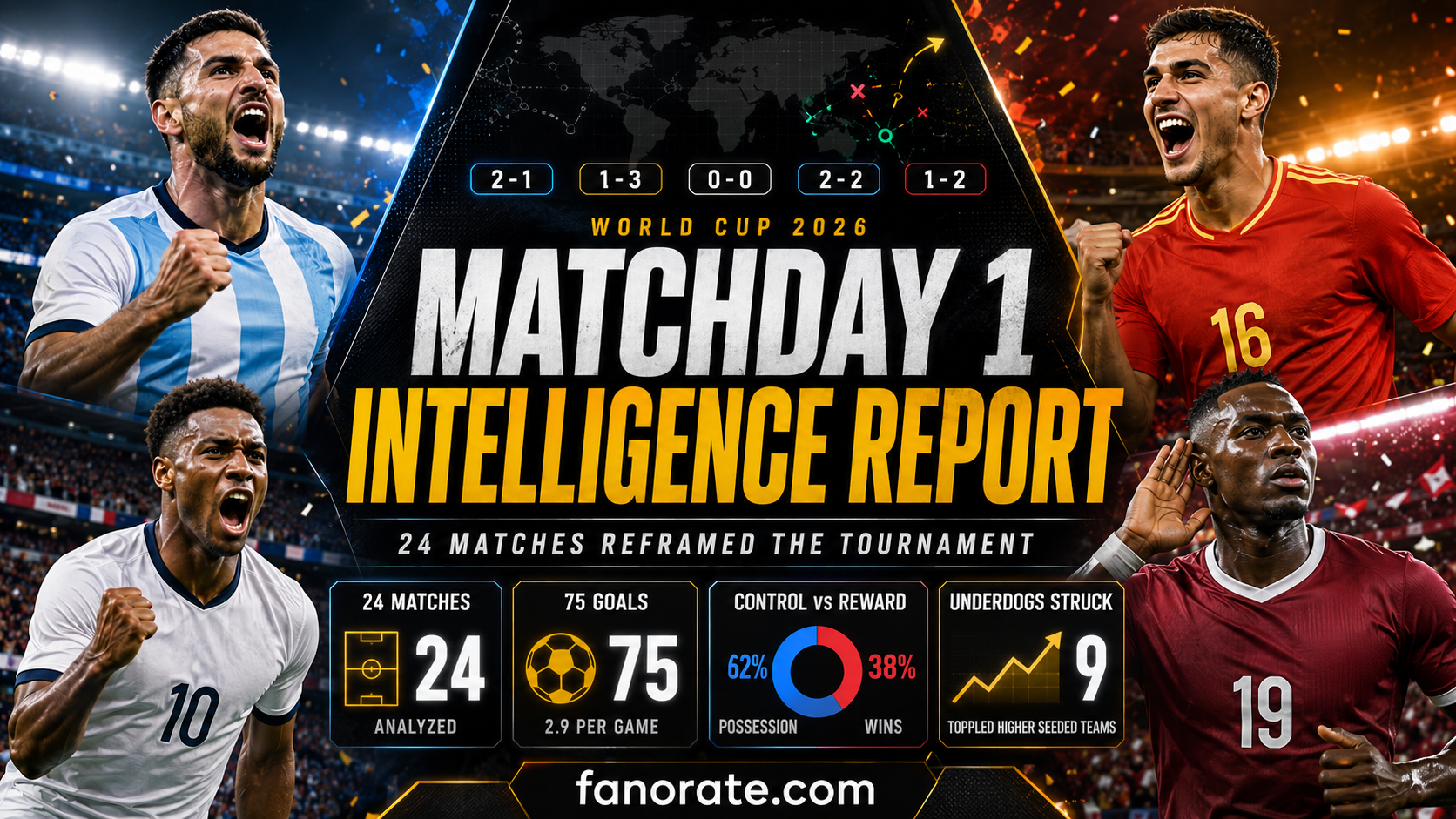
World Cup 2026 Matchday 1 Intelligence Report: The 24 Matches That Reframed The Tournament
A Fanorate analytical review. This report is built from event data, team statistics and expected-goals models from all 24 Matchday 1 group-stage fixtures. It explains what the opening round revealed — not what it predicts. Our methodology is research- and data-led, and we flag clearly where the dataset does not support a claim.
Executive Summary
Matchday 1 produced 75 goals across 24 matches — an average of 3.12 per game — yet that headline number hides the real story. This was not a round defined by goals. It was defined by the growing gap between control and reward.
The biggest surprise was Spain. A side that registered 27 shots, 800 passes, 74% possession and an expected-goals figure of 2.72 walked away from Atlanta with a 0-0 draw against tournament debutants Cape Verde. It was the single clearest example of a theme that ran through the entire round: dominance was everywhere, but conversion was scarce.
The biggest tactical revelation was that possession, on its own, settled almost nothing. Of the five teams who held 67% of the ball or more — Spain, Portugal, Switzerland, Türkiye and Uruguay — not one of them won. Four drew and one lost. The teams that won did so through transition, set pieces and ruthless finishing.
The biggest underdog story is shared. Cape Verde’s goalless hold of Spain, Australia’s 2-0 win over a Türkiye side that took 30 shots, and Qatar’s 1-1 escape against a Switzerland team that generated 3.41 xG all belong in the same conversation. Each was a masterclass in defending a low block and surviving an xG storm.
The most impressive individual was Lionel Messi, who scored all three goals in Argentina’s 3-0 win over Algeria — and did so while his team had less of the ball (48%). The most impressive team was England, whose 4-2 win over Croatia was backed by a colossal 3.11 xG and seven big chances created.
The most entertaining match was England 4-2 Croatia: six goals, two lead changes inside the first half, and a second half that England eventually controlled. The most unexpected statistic belongs to Switzerland, who out-shot Qatar 26 to 6, took ten corners to three, and still failed to win.
What Matchday 1 told us is that the modern international game has tightened defensively and grown more clinical in transition. The sides that thrive will be those who can finish the few chances elite opponents concede — and the sides who hoard the ball without an edge in the final third are already on notice.
The Numbers That Defined Matchday 1
- Goals: 75 in 24 (3.12 per match)
- A healthy figure, but inflated by a handful of blowouts — Germany 7-1 Curacao, England 4-2 Croatia, Sweden 5-1 Tunisia, Norway 4-1 Iraq and USA 4-1 Paraguay. Strip those five outliers out and the remaining 19 matches averaged a far more cautious 2.2 goals. The round was bimodal: a few floods, and a lot of carefully managed trickles.
- Draws: 9 of 24 (37.5%)
- That is a high draw rate for an opening round, and almost all of the draws followed the same script — a possession-heavy favourite failing to break down a compact opponent. Belgium-Egypt, Brazil-Morocco, Portugal-Congo DR, Qatar-Switzerland, Saudi Arabia-Uruguay and Spain-Cape Verde were all variations on that theme.
- Clean sheets: 8
- Defences started the tournament ahead of attacks. Argentina, Australia, Côte d’Ivoire, Ghana, Scotland and Mexico kept clean sheets in wins, and the Spain-Cape Verde stalemate delivered two more. In several of those games the shut-out came despite heavy pressure — Australia conceded 30 shots and still kept Türkiye out.
- Shot efficiency and conversion
- This is where the round revealed its character. Türkiye took 30 shots for zero goals. Switzerland took 26 for one. Spain took 27 for none. Uruguay took 27 for one. Four of the highest-volume attacking displays of the round produced a combined two goals. Meanwhile Sweden scored five from 13 shots and an xG of just 1.54, Japan scored twice from 0.53 xG, and Germany turned 3.92 xG into seven goals. Finishing quality, not chance creation, separated the round’s winners from its frustrated favourites.
- Expected goals tell the cautionary tales
- The biggest xG-to-goals shortfalls — Switzerland (3.41 xG, 1 goal), Spain (2.72, 0), Türkiye (1.98, 0) — were all dominant sides who could not finish. The biggest overperformances — Germany, Sweden, England, the USA, Japan — were sides who took their moments. Expected points models loved Switzerland (2.76 xPTS) and Spain (2.75 xPTS); both collected one actual point.
- Possession trends
- Possession was abundant and frequently meaningless. Portugal had 75% against Congo DR and drew. Spain had 74% and drew. Türkiye had 72% and lost. The correlation between possession and result this round was, at best, weak — and at the top of the possession table, negative.
- Pressing and transition
- The cleanest wins came from sides that defended deep and struck fast. Australia (28% possession), Ghana (38%), Scotland (46%) and Argentina (48%) all won with the minority of the ball, leaning on organised blocks and incisive transition. Counter-attacking and set-piece efficiency, not territorial dominance, were the round’s currency.
- Set pieces
- Set plays were decisive in tight games. Canada generated more than a full expected goal from set pieces alone against Bosnia (xGSP 1.02). Five own goals were recorded across the round — by Egypt, Jordan, Iraq, Switzerland and Paraguay — and several were decisive, including Switzerland’s stoppage-time own goal that handed Qatar a point. Four penalties were awarded and all four were converted.
The overarching message of the numbers: defences and goalkeepers won the opening round. The attacks that prospered were vertical and clinical; the attacks that stalled were patient and toothless.
15 Things We Learned
-
Possession is no longer a result in itself. The five biggest possession shares of the round produced zero wins. Teams have learned to cede the ball, sit in a block and wait. Control of territory has been decoupled from control of outcomes.
-
Finishing quality is the real differentiator. Sweden (5 goals from 1.54 xG), Japan (2 from 0.53) and Germany (7 from 3.92) thrived; Türkiye, Spain and Switzerland created plenty and scored almost nothing. The margin between joy and frustration was the quality of the final touch.
-
The low block is alive and effective. Cape Verde, Qatar, Australia and Saudi Arabia all survived sustained sieges. Goalkeepers made nine saves (Saudi Arabia), eight (Australia) and seven (Cape Verde) respectively. Organised, deep defending remains a viable path to points against superior opponents.
-
Goalkeepers were the round’s quiet MVPs. The shot-stopping totals above kept three favourites from winning. In a round where chances were spurned, the keepers who weren’t beaten shaped the table as much as any striker.
-
Africa punched up consistently. Morocco drew with Brazil, Egypt drew with Belgium, Congo DR drew with Portugal, and Cape Verde drew with Spain. Four African sides took points off four heavyweight European or South American teams. This was the most striking regional pattern of the round.
-
Stoppage time was lethal. Decisive goals arrived at 90’+5 (Ghana), 90’+8 (USA), 90’+9 (Colombia), 89′ (Japan’s equaliser) and 90’+6 (Sweden), while Austria converted a penalty at 90’+12. Long added-time periods repeatedly reshaped results; games are not over until deep into the clock.
-
Elite individuals still decide tight games. Messi’s hat-trick, Mbappé’s brace, Haaland’s brace and Kane’s brace all turned competitive matches into comfortable ones. When systems cancel out, the difference-makers still differentiate.
-
The penalty and VAR economy is busy. Every penalty was scored, and VAR was involved repeatedly — disallowing goals (Algeria, Austria), cancelling and awarding penalties (France, Austria), adjusting cards (Mexico’s Themba Zwane upgraded to a red) and reviewing offsides. Officials leaned heavily on technology from day one.
-
Transition beats build-up right now. The most efficient attacking outputs came on the counter. Sweden’s five counter-attacks, the USA’s 158 attacks and 22 successful dribbles, and Australia’s smash-and-grab all outscored slower, possession-based approaches.
-
Set pieces are a genuine weapon, not a bonus. Canada’s set-piece xG against Bosnia and the round’s five own goals — many from crosses and dead-ball situations — show that the aerial and restart battle is producing real goals.
-
The host nations all started unbeaten. The USA beat Paraguay 4-1, Mexico beat South Africa 2-0, and Canada drew with Bosnia. All three co-hosts avoided defeat on home soil.
-
Asia arrived in strong form. South Korea and Australia won, while Japan, Iran and Saudi Arabia all drew with higher-ranked opposition. The confederation’s depth, not just its top sides, looked competitive.
-
Discipline can sink a game plan. South Africa played most of their match against Mexico down to ten and then nine men after two red cards, and managed just three shots. Paraguay collected five yellow cards in a 4-1 loss. Indiscipline compounded difficult days.
-
Big possession without penetration is a trap. Portugal’s 783 passes and 75% possession produced one goal and one shot on target. Volume of the ball without verticality created the illusion of control and the reality of a dropped point.
-
The gap between “minnows” and the elite has narrowed. Cape Verde, Curacao (who scored against Germany), Jordan and Panama all competed for long stretches. Several debutants and lower-ranked sides looked organised and unintimidated.
Tactical Trends Across The Tournament
Most successful shape: the compact mid-to-low block with a transition outlet
The winning template of the round was not a possession 4-3-3 but a disciplined defensive structure that absorbed pressure and broke quickly. Australia, Ghana, Scotland and Argentina all won this way, conceding the ball but not the game.
Most successful pressing systems
The most productive pressing wasn’t the highest — it was the most coordinated. Germany and the USA pressed with intensity and were rewarded with turnovers in dangerous areas (the USA generated 92 dangerous attacks against Paraguay). But the round also showed that a poorly executed high press is dangerous: sides that pushed up without compactness were repeatedly exposed in transition.
Most effective defensive structures
Deep, narrow blocks that protected the penalty area while conceding wide territory were the round’s standout defensive model. Cape Verde recorded 15 interceptions and lived almost entirely in their own third (94 “ball safe” actions) and survived. The lesson: deny the central, high-value zones and force opponents into low-percentage wide shots.
Most dangerous counterattacks
Sweden (five counter-attacks in a five-goal display) and the USA were the cleanest transition teams. Australia’s 2-0 win was effectively two transition moments converted from a defensive posture. Counter-attacking efficiency was the single most reliable route to a comfortable scoreline.
Set-piece trends
Restarts mattered. Canada threatened repeatedly from corners against Bosnia, the round produced five own goals largely from crosses and dead balls, and every penalty was scored. Teams with aerial presence and rehearsed routines extracted value that open play often denied them.
Build-up trends
Patient build-up was widely neutralised. The data is unkind to slow, horizontal possession: the teams who built methodically (Portugal, Spain, Türkiye) created chances but struggled to score, while direct sides converted. Build-up that lacked a vertical, penetrative final pass became a liability.
Transition trends
The defining tactical signature of Matchday 1 was the speed of the first pass after winning the ball. The most dangerous teams attacked space before defences reset. The slowest, most controlled teams gave organised blocks time to recover.
Emerging innovations
Two patterns are worth tracking: first, the willingness of strong sides (Australia, Argentina) to deliberately surrender possession and win through transition; and second, the use of late, fresh-legged substitutes to attack tiring low blocks — several decisive goals came from substitutes in the final 15 minutes.
Teams Exceeding Expectations
England
The most complete attacking display of the round: 22 shots, 20 of them inside the box, seven big chances and 3.11 xG in a 4-2 win over a credible Croatia side. Even allowing for the two goals they conceded, England’s chance creation was in a class of its own.
Australia
Winning 2-0 with 28% possession while conceding 30 shots is a remarkable feat of game management. Their goalkeeper made eight saves and their two transition moments were taken expertly. It was the round’s best example of a result achieved against the run of play by design.
Cape Verde
A goalless draw with Spain, achieved through relentless defensive discipline and seven goalkeeper saves, is one of the standout team performances of the round regardless of the opponent’s name.
Sweden
Five goals from 1.54 xG is the most clinical attacking return of the round. Isak and Gyökeres combined ruthlessly, and Sweden took virtually every meaningful chance they manufactured.
Morocco, Egypt and Congo DR
Each took a point from an elite opponent — Brazil, Belgium and Portugal respectively — through organisation and counter-punching. Morocco’s 14 shots against Brazil and Congo DR’s resilience in Houston were particularly impressive.
Teams Raising Questions
- Spain
- A 0-0 draw despite 2.72 xG and 27 shots points to a finishing problem, not a creative one. The chances were there; the composure was not. This is a profligacy concern, not a structural one — but it cost two points.
- Switzerland
- 3.41 xG, 26 shots, ten corners — and one goal, then a stoppage-time own goal conceded for a 1-1 draw with Qatar. Six big chances created and five missed is a damning conversion line.
- Türkiye
- 30 shots and zero goals in a 2-0 defeat to Australia. A staggering amount of territory and pressure with nothing to show for it. The creation is elite; the cutting edge is missing.
- Portugal
- 75% possession, 783 passes, one shot on target. A dropped point against Congo DR that exposed a lack of penetration despite total control of the ball.
- Brazil
- Held 1-1 by Morocco at home in New Jersey, with a modest xG return. Not a crisis, but a reminder that the margins against well-drilled opposition are thin.
Per our editorial standard, this section evaluates performance quality only and makes no claims about qualification.
Players Who Announced Themselves
Elijah Just (New Zealand)
Two goals in a 2-2 draw with Iran, both created by Chris Wood. A direct, opportunistic forward who took his chances against a physical, header-heavy Iran side (25 successful headers). Fans should watch a player who delivered on the biggest stage with cold efficiency.
Caleb Yirenkyi (Ghana)
Scored the 90’+5 winner against Panama, having earlier been booked. A young midfielder who shouldered the decisive moment in a tight, rain-affected game in Toronto — and held his nerve when Ghana had just 38% of the ball.
Abbosbek Fayzullaev (Uzbekistan)
Scored against Colombia and was a constant outlet for a debutant nation that, despite a 3-1 defeat, did not look out of place. A creative talent worth tracking.
Martin Baturina (Croatia)
Scored against England and showed the kind of close-control and shooting quality that suggests a player ready to step into Croatia’s storied midfield lineage.
Folarin Balogun (USA)
A two-goal haul against Paraguay, both created by Christian Pulisic, in a confident home performance. He looked like a striker who has settled the host nation’s most-debated position.
Established Stars Who Delivered
- Lionel Messi (Argentina)
- A hat-trick against Algeria — left foot, right foot, left foot — while Argentina had less of the ball. His was the rare elite performance that didn’t require territorial dominance; it required three moments of genius, and he provided them. The structural point: Argentina built their entire approach around giving Messi the freedom to decide the game, and it worked.
- Erling Haaland (Norway)
- A brace in a 4-1 win over Iraq, supplied in part by Martin Ødegaard. Haaland’s penalty-box presence dragged Norway’s attack into its most threatening shape and set the tone early.
- Kylian Mbappé (France)
- Two goals against Senegal in a game that was scoreless until the 66th minute. France were patient, then lethal once Mbappé found space — his movement broke a stubborn Senegal block.
- Harry Kane (England)
- A penalty and a header in England’s six-goal thriller. Kane’s leadership of the line and his ability to score from both open play and set pieces anchored England’s record-breaking chance creation.
- Virgil van Dijk (Netherlands)
- Opened the scoring against Japan and marshalled a back line that, while it eventually conceded twice, dominated the aerial duels (20 successful headers). His influence on Dutch structure was total even on a frustrating night.
Hidden Gems Of Matchday 1
Cape Verde's goalkeeper
Seven saves to deny Spain. Whatever the name recognition, this was an elite shot-stopping performance and the foundation of the round’s biggest shock result.
Saudi Arabia's goalkeeper
Nine saves against Uruguay’s 27-shot barrage to earn a point. A performance of stamina and concentration that single-handedly changed a game.
Livano Comenencia (Curacao)
Scored against Germany in a 7-1 defeat — the kind of goal that defines a debutant’s tournament regardless of the scoreline.
Romano Schmid (Austria)
Opened the scoring against Jordan and provided the creative spark in a hard-fought 3-1 win, underlining his tactical value as a connector between midfield and attack.
Maxi Araújo (Uruguay)
His 80th-minute strike rescued a point against Saudi Arabia and was a reward for persistence in a game Uruguay should have won more comfortably. A technically clean finish from a player who keeps finding the right areas.
Most Entertaining Matches
-
England 4-2 Croatia (Dallas). Six goals, momentum swings, and a first half in which Croatia twice responded to England pressure. England’s 22 shots and Croatia’s refusal to fold made this the most watchable match of the round.
-
Iran 2-2 New Zealand (Los Angeles). Four goals, lead changes, and a genuine end-to-end contest. New Zealand’s Elijah Just twice levelled the game, and the xG (1.52 to 1.40) confirms how evenly balanced it was.
-
Netherlands 2-2 Japan (Dallas). Japan, twice behind, equalised in the 89th minute through Daichi Kamada. A tactical and emotional swing match, with Japan scoring twice from just 0.53 xG.
-
United States 4-1 Paraguay (Los Angeles). A high-energy home win with an early own goal, a Balogun brace and a 90’+8 flourish from Giovanni Reyna. The atmosphere of a host-nation opener carried it.
-
Austria 3-1 Jordan (Santa Clara). A game that swung on a disallowed goal, an own goal, and a penalty converted at 90’+12. Chaotic, dramatic and decided in the longest of long stoppage times.
These stood out for the same reason: each combined goals with genuine uncertainty about the result deep into the match.
Matchday 1 Statistical Discoveries
- Most efficient attack: Sweden
- Five goals from 1.54 xG — a +3.46 finishing overperformance, the largest of the round.
- Most wasteful attack: Switzerland
- 3.41 xG for a single goal, plus five big chances missed. Türkiye (1.98 xG, 0 goals) and Spain (2.72 xG, 0 goals) are close behind.
- Strongest defensive performance: Australia
- Conceded 30 shots and kept a clean sheet in a win — a feat of blocking (12 Türkiye shots blocked) and goalkeeping.
- Highest pressing/territorial intensity: Spain
- 187 attacks and 139 dangerous attacks against Cape Verde, the highest territorial output of the round — and zero goals to show for it.
- Most vertical/direct team: Australia
- 28% possession, 58 long passes, and a willingness to bypass midfield entirely.
- Most possession-heavy team: Portugal
- 75% against Congo DR, narrowly ahead of Spain’s 74%.
- Most resilient team: Qatar
- Absorbed 26 shots and 3.41 xG from Switzerland and escaped with a point via a stoppage-time own goal.
- Busiest dribbling team: United States
- 35 dribble attempts and 22 completed against Paraguay — a 63% success rate that drove their transition game.
- Aerial monsters: Bosnia and Herzegovina
- 43 successful headers against Canada, the most extreme aerial profile of the round.
Regional Football Report
- Europe
- A round of extremes. Germany (7-1), England (4-2), Sweden (5-1) and Norway (4-1) delivered statement wins, while Spain, Portugal, Belgium and Switzerland all dropped points to lower-ranked opposition. The continent’s elite attacking talent is obvious; so is the vulnerability of its possession-based sides to disciplined defending. France, Austria, Scotland and Croatia (in defeat) showed varying degrees of control.
- South America
- Mixed and intriguing. Argentina (with Messi) and Colombia won; Brazil and Uruguay were held; Paraguay and Ecuador lost. The common thread was that the continent’s biggest names were made to work hard, with Brazil pegged back by Morocco and Uruguay denied by a heroic Saudi goalkeeper.
- North America (hosts)
- A clean start. The USA and Mexico won, Canada drew. All three co-hosts began unbeaten, with the USA’s transition play and Mexico’s resilience (a 2-0 win while finishing with ten men) the standouts. Among the smaller CONCACAF sides, Panama, Haiti and Curacao all lost but competed in patches.
- Africa
- The story of the round. Morocco, Egypt, Congo DR and Cape Verde all took points from elite opposition, while Côte d’Ivoire and Ghana won. The continent’s defensive organisation and counter-attacking discipline were the most consistent regional traits on display. Senegal, Tunisia and South Africa endured tougher openings.
- Asia
- Quietly excellent. South Korea and Australia won; Japan, Iran and Saudi Arabia drew with higher-ranked sides. The AFC contingent looked organised, athletic and difficult to beat across the board.
- Middle East
- Resilient but largely pointless in the win column. Qatar (vs Switzerland) and Saudi Arabia (vs Uruguay) earned creditable draws through defensive grit, while Jordan and Iraq were beaten despite moments of promise. The common theme was strong goalkeeping and deep defending.
This section evaluates style and performance only; it does not address future qualification.
Stadium And Atmosphere Report
A transparency note in keeping with Fanorate’s methodology: our Matchday 1 dataset is built from match-event and statistical feeds. It records venues, capacities and weather, but it does not contain verified attendance figures or crowd-sentiment data, so we will not invent them.
What the data does show is the geographic sweep of the opening round. Matches were staged across at least 16 venues spanning all three host nations — from Vancouver, Seattle and the San Francisco Bay Area in the west, through Kansas City, Houston, Dallas and Atlanta, to New York/New Jersey, Philadelphia, Boston and Miami in the east, plus Toronto in Canada and Mexico City, Guadalajara and Monterrey in Mexico. The largest-capacity hosts on the schedule were Mexico City (listed at 87,523) and New York/New Jersey (82,566), both of which staged marquee fixtures.
Weather was a genuine variable. Several matches were played in rain — moderate rain in Mexico City (Mexico vs South Africa) and Miami (Saudi Arabia vs Uruguay), and light rain in Houston (Portugal vs Congo DR) and Toronto (Ghana vs Panama). In a round already defined by cautious, defensive football, wet surfaces in those fixtures plausibly reinforced the low-scoring, transition-led pattern we observed.
For standout venue experiences, the host-nation openers in Mexico City and Los Angeles, and the high-capacity Dallas and New York/New Jersey fixtures, were the natural focal points of the schedule. We will report verified attendance and atmosphere details separately once reliable figures are available.
Host Nation Snapshot
- United States
- A confident, high-tempo 4-1 win over Paraguay in Los Angeles. The data paints a picture of a dominant home performance — 65% possession, 158 attacks, 92 dangerous attacks and a thriving dribbling game (22 successful dribbles). Balogun’s brace and Reyna’s late goal gave the night a celebratory finish. Operationally and visually, a marquee opener delivered.
- Mexico
- A 2-0 win over South Africa in a rain-soaked Mexico City, the tournament’s highest-capacity venue. Mexico controlled the game (61% possession) and won it with quality (Quiñones and a Jiménez header) even as the match descended into a card-strewn affair that left both sides reduced in numbers. The home crowd’s marquee fixture produced the right result.
- Canada
- A 1-1 draw with Bosnia in Toronto. Canada dominated territory (61% possession, nine corners, 134 attacks) and led the expected-goals count, but were pegged back by a Bosnian header and an aerial rearguard. An unbeaten, if slightly frustrating, start on home soil.
All three co-hosts avoided defeat — a clean collective start to the home tournament.
Matchday 1 Winners
- Best Team Performance: England
- 3.11 xG, 22 shots, seven big chances. The most dominant attacking display of the round in a competitive 4-2 win.
- Best Individual Performance: Lionel Messi
- A hat-trick to win a game his side didn’t control.
- Best Tactical Display: Australia
- A 2-0 win on 28% possession — the round’s finest piece of game management.
- Best Goal: Lionel Messi's opener vs Algeria
- A left-footed strike from outside the box into the top corner, the standout strike of an evening of fine finishes.
- Best Atmosphere (qualitative): the host-nation openers
- in Mexico City and Los Angeles, as the marquee home fixtures of the round. (Attendance unverified in our dataset.)
- Best Underdog Performance: Cape Verde
- A goalless draw with Spain, built on seven goalkeeper saves and total defensive discipline.
Matchday 1 Disappointments
- Most Underwhelming Team: Türkiye
- 30 shots, 72% possession, zero goals — and a 2-0 defeat. A staggering disconnect between control and result.
- Most Wasteful Attack: Switzerland
- 3.41 xG and five big chances missed for a single goal, then a 1-1 draw. Spain (2.72 xG, 0 goals) ran them close.
- Biggest Tactical Failure: Portugal's possession trap
- 75% of the ball and 783 passes produced one shot on target and a dropped point — control without penetration.
- Biggest Missed Opportunity: South Africa's discipline collapse
- Two red cards turned a competitive trip to Mexico City into a damage-limitation exercise and just three shots.
The Stories Fans May Have Missed
Beyond the goals and the headlines, several quieter developments shaped the round.
The own-goal epidemic — five in 24 matches — was unusually high and frequently decisive. Switzerland’s stoppage-time own goal cost them two points; an own goal opened the scoring for the USA; Austria’s path to victory ran through one too. Set-piece and cross-heavy attacking is producing deflected and own goals as a feature, not an accident.
The goalkeeping subplot is the round’s most under-discussed story. Three favourites failed to win specifically because of standout shot-stopping (Cape Verde, Saudi Arabia, Qatar’s goalkeepers). In a low-conversion round, the keepers who weren’t beaten were as influential as any forward.
The stoppage-time inflation is real and tactically significant. Goals at 90’+8, 90’+9 and a penalty at 90’+12 reflect long added-time windows that are changing late-game management. Teams defending narrow leads are facing far more than the traditional few minutes of jeopardy.
Finally, the debutant and minnow competitiveness deserves note. Curacao scored against Germany, Cape Verde held Spain, and Jordan pushed Austria deep into stoppage time. The floor of the tournament has risen.
Fanorate Analyst Corner
Ten observations that the final scores do not reveal:
-
Argentina won the “anti-possession” game. They had 48% of the ball against Algeria and still won 3-0 — their npxG (0.82) was modest, but their xG-on-target (2.48) was elite, meaning they hit the target with venom when it mattered.
-
Switzerland’s xG-on-target (1.90) dwarfed Qatar’s, yet they drew. The story wasn’t just volume — it was that even Switzerland’s good shots met a goalkeeper in form.
-
Japan are the round’s overperformance kings on a per-shot basis. Two goals from 0.53 xG against the Netherlands is the most clinical finishing-to-chance ratio of Matchday 1.
-
Bosnia’s 43 successful headers is an outlier that reveals a deliberate strategy: turn the Canada game into an aerial contest and neutralise Canada’s ground-based territorial edge.
-
Uruguay attempted 47 crosses against Saudi Arabia — a vast number — and it produced one goal. A reminder that crossing volume without aerial superiority in the box is inefficient.
-
Portugal’s 783 passes generated just one shot on target. Possession that never reaches the final third’s high-value zones is statistical noise, not threat.
-
The USA’s transition profile is built on dribbling. 35 attempts, 22 completed — they break lines by carrying the ball, not just passing through them.
-
Germany’s 21 shots inside the box vs Curacao show a side committed to entering the area rather than shooting from range — a high-quality shot-selection signature even in a blowout.
-
Norway’s Haaland-Ødegaard axis is already humming. Ødegaard’s involvement in Norway’s later goals points to a creator-finisher relationship that didn’t need time to warm up.
-
The round’s draws were not even contests. Most featured a clear xG favourite (Switzerland, Spain, Uruguay, Portugal) who failed to convert. These were dropped wins, not honest stalemates — which suggests the underlying performances were more lopsided than the points implied.
Final Verdict
- What surprised us most
- That dominance was so consistently unrewarded. Spain, Switzerland, Türkiye, Portugal and Uruguay combined for over 130 shots and a handful of goals. The opening round was a referendum on the limits of control, and control lost.
- What impressed us most
- The defensive and goalkeeping quality of the so-called lesser nations. Cape Verde, Australia, Qatar and Saudi Arabia turned in performances of discipline and resilience that reshaped the round’s results. Add England’s attacking masterclass and Messi’s individual brilliance, and the round had elite performances at both ends of the reputation spectrum.
- What concerns emerged
- Finishing. Several of the tournament’s most fancied attacking sides showed they can create but not convert. In a round where chances were rationed, profligacy was punished with dropped points.
- The biggest lesson from Matchday 1
- The international game has tightened. Compact defending, sharp transitions, set-piece value and ruthless finishing are the winning ingredients — and possession, on its own, is no longer one of them.
- The most fascinating storyline so far
- The rise of the resilient underdog. Cape Verde’s goalless wall against Spain is the image of the round: an elite team with everything but the goal, and a debutant with nothing but the result they came for. Whether that pattern holds is the question the rest of the tournament will answer.
Per our editorial standard, this report deliberately makes no predictions about knockout rounds, qualification or individual award races. It reflects only what the Matchday 1 data revealed.
