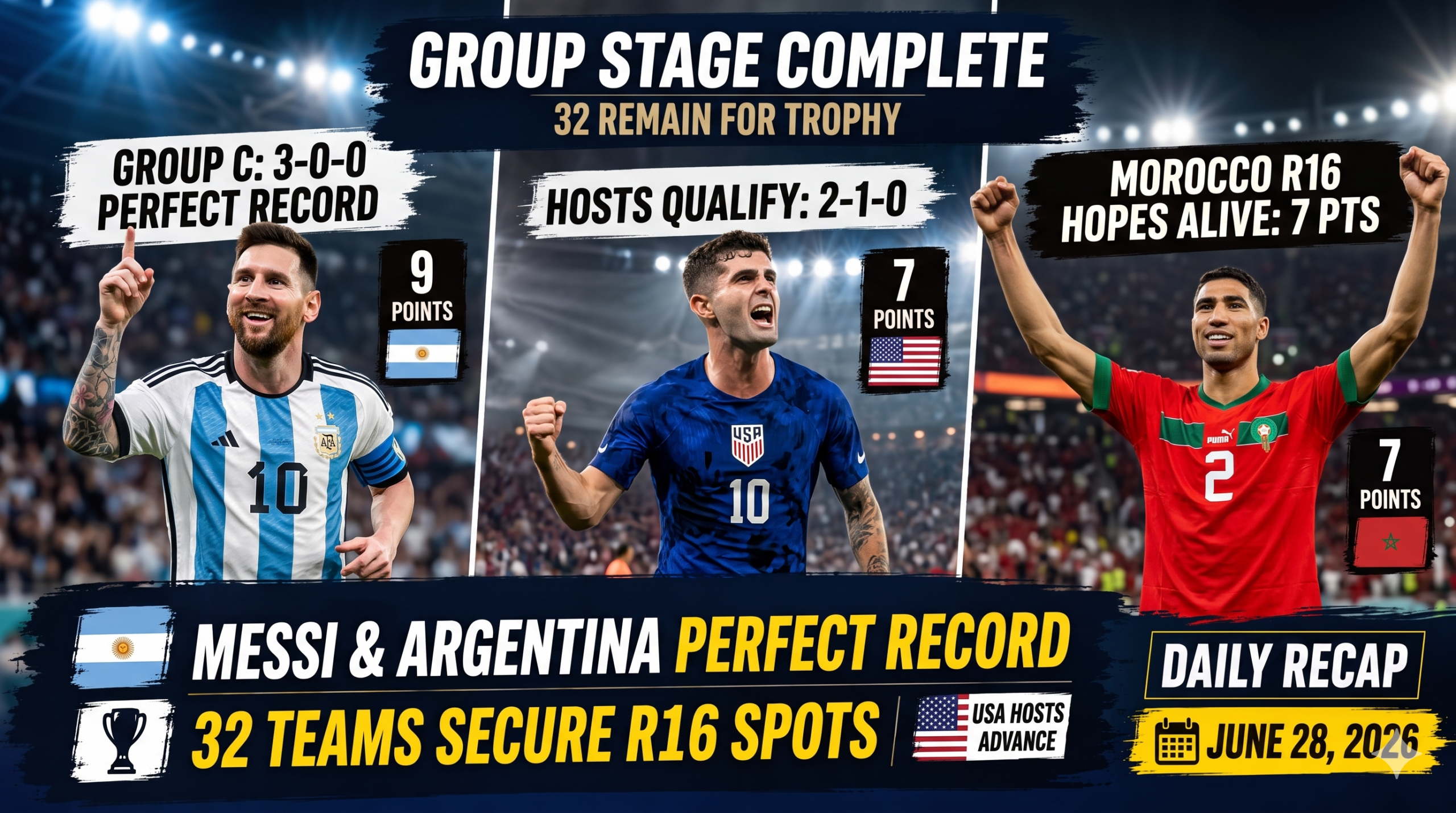
World Cup 2026 Group Stage Wrap: Who Qualified, the Full Round of 32 Bracket and the Award Races
For seventeen days the first 48-team World Cup let teams make mistakes and live to tell the tale. A bad night could be survived. A dropped point could be recovered. A favourite could stumble out of the blocks, regroup, and still walk through. That grace period is over. As of Saturday night in Atlanta — where DR Congo turned a likely exit into the comeback of the tournament — the field of 48 became a field of 32, and the safety net was rolled up and carried out of the building.
The arithmetic that tormented half a dozen nations for a week has resolved into cold, clean facts. Twelve groups produced twelve winners and twelve runners-up. Eight third-placed teams survived a brutal sorting process decided, in the end, by goal difference and a single Senegalese rout. Sixteen nations are going home, several of them with names that were supposed to be here in July. And the Round of 32 — the first knockout round this expanded format has ever staged — is locked, seeded and scheduled, beginning today with co-hosts Canada in Los Angeles.
This is the Fanorate state-of-play report for the moment the tournament changes its nature. We rebuilt every group table from the verified results, confirmed the bracket, ranked the award races and identified which final-round outcomes will echo deepest into the knockouts. Win or go home starts now. Here is exactly what the group stage decided.
For the full story of how we got here, see our Matchday 1 Intelligence Report and Matchday 2 Intelligence Report, plus the Matchday 2 qualification forecast whose scenarios this article now resolves into their final, decided form.
About this analysis
This is a research-and-data piece produced by the Fanorate editorial desk at Brillmark. We rebuilt all 12 final group tables by hand from verified match results, cross-checked every standing and the Round of 32 bracket against multiple outlets and official FIFA competition rules, and layered our own editorial judgment on top. We disclose openly that this report is assembled with AI-assisted research; the qualification outcomes and bracket below are settled fact, while award “races” and knockout leans are our estimates. Where a scoreline is reported differently across sources, we flag it in the data-caveats note at the end. This piece deliberately stays away from controversy, social-media noise and host-nation emotion — those live in a separate article.
Executive summary
- Teams qualified (all 32 into the Round of 32)
- Group winners — Mexico, Switzerland, Brazil, United States, Germany, Netherlands, Belgium, Spain, France, Argentina, Colombia, England. Runners-up — South Africa, Canada, Morocco, Australia, Côte d’Ivoire, Japan, Egypt, Cape Verde, Norway, Austria, Portugal, Croatia. Best third-placed teams (8) — DR Congo, Sweden, Ecuador, Ghana, Bosnia & Herzegovina, Algeria, Paraguay, Senegal.
- Teams eliminated (16)
- Czechia, South Korea, Qatar, Scotland, Haiti, Türkiye, Curaçao, Tunisia, Iran, Uruguay, Saudi Arabia, Iraq, Jordan, Uzbekistan, Panama — and the cruellest of all, Iran, who missed the eight-best-third cut by a single goal-difference place.
- Biggest qualification shock
- DR Congo. A nation that last appeared as Zaire in 1974 — eliminated then without a point — came from a goal down against a stubborn Uzbekistan to win 3-1 and reach the knockouts for the first time in its history. Honourable mention to Cape Verde, the smallest country ever (population under half a million) to reach a World Cup knockout round, and South Africa, through to the last 32 for the first time as a non-host.
- Most impressive team after the group stage
- France. A perfect nine points, a +8 goal difference, and a Dembélé first-half hat-trick against Norway that read like a warning shot. Spain (also unbeaten, three clean sheets) and Argentina (nine points, squad depth) are right behind.
- Most vulnerable favourite heading into the knockouts
- Germany. Group winners on paper, but a dead-rubber 2-1 loss to Ecuador exposed a flickering concentration and a high line that brave opponents can attack. Portugal, blunt in a goalless draw with Colombia and lumbered with a Croatia tie, run them close.
- Most likely dark horse
- Morocco. The 2022 semifinalists advanced level with Brazil on points, carry knockout-grade defensive structure, and project a winnable path. Croatia and Ecuador are the floaters nobody wanted to draw.
- Current Golden Boot leader
- Lionel Messi (Argentina), 5 goals — all scored in the first two rounds; rested on the bench for the dead-rubber against Jordan.
- Current Golden Ball favourite
- Messi, with France’s collective brilliance making Kylian Mbappé and the in-form Ousmane Dembélé the chasing pack.
- Most anticipated Round of 32 fixture
- Portugal vs Croatia in Toronto (July 2) — Cristiano Ronaldo against Luka Modrić, one more time, in sudden death. Spain vs Austria and Argentina vs Cape Verde complete the marquee billing.
Tournament snapshot after Matchday 3
All 72 group-stage matches are complete. Every one of the 48 teams has played three times, and the numbers describe a tournament that was wildly open early, hardened in the middle, and signed off with a final round full of both housekeeping and genuine drama.
- 72
- Matches played
- 207
- Goals scored across the group stage
- 2.88
- Average goals per match
- 66
- Matchday 3 specifically
- 3
- Clean sheets
- 6-goal
- Biggest wins of the group stage
- 6
- Highest-scoring match of Matchday 3
- 3-2
- Most dramatic finish
- 3-1
- Biggest comeback
- 0
- Best defensive team
- 10
- Best attacking teams
(group stage complete).
(75 on Matchday 1, 66 on Matchday 2, 66 on Matchday 3).
across the group stage — comfortably above the 2.69 of Qatar 2022, confirming this as a more open, front-foot competition even after the defences woke up.
goals in 24 games (2.75 per match), the same rate as Matchday 2 — proof that the tournament’s mid-stage hardening held into the finale rather than reverting to the free-scoring chaos of the opening round.
the defensive trend that defined Matchday 2 persisted. Mexico (three clean sheets, 300+ minutes without conceding), Spain (three clean sheets) and the USA’s pre-final record all underline that the best teams closed out the group stage by not conceding.
Germany 7-1 Curaçao and Canada 6-0 Qatar (both six-goal margins on Matchday 2) remain the headline routs; Matchday 3’s biggest were Belgium 5-1 New Zealand and Senegal 5-0 Iraq.
Belgium 5-1 New Zealand (six goals), narrowly ahead of Senegal 5-0 Iraq and France 4-1 Norway (five each).
Türkiye’s last-kick 3-2 win over a heavily rotated USA, and — for sheer cruelty — Iran’s stoppage-time “winner” against Egypt chalked off by VAR for offside, followed seconds later by Saeid Ezatolahi striking the crossbar. That single passage decided who finished where in the third-place race.
DR Congo 3-1 Uzbekistan, a goal down at the hour and rampant by full time, and Ecuador 2-1 Germany, behind inside two minutes and ahead by the 77th.
Spain and Mexico, tied — both conceded zero goals across three group games.
Germany and the Netherlands (10 group goals each), with France (10) right alongside them.
What the numbers reveal: the polarisation we flagged after Matchday 2 held all the way to the line. Goal difference was banked in the mismatches — Germany, the Netherlands and France all finished on double-figure goals against weaker opposition — while qualification among the serious sides was decided in tight, low-scoring contests (Spain 1-0 Uruguay, Colombia 0-0 Portugal, Paraguay 0-0 Australia). Matchday 3 looked a lot like Matchday 2: the same goal rate, the same defensive discipline, the same reward for clinical finishing over sterile possession. The opening round, it turns out, was the outlier. This is what the tournament actually is.
A rules reminder, because it shaped several outcomes. When teams finish level on points within a group, FIFA’s first tiebreaker this year is the head-to-head result between them (head-to-head goal difference, then head-to-head goals), and only after that does overall goal difference apply, then goals scored, then a team-conduct (fair-play) score, then FIFA ranking. For the race to be one of the eight best third-placed teams, the ladder is simpler and applies across all 12 groups: points, then overall goal difference, then goals scored, then team conduct, then FIFA ranking. Both ladders mattered: Germany’s head-to-head win over Côte d’Ivoire secured top spot in Group E, and overall goal difference decided the entire third-place cut.
Group-by-group final breakdown
Group A
Mexico perfect; South Africa make history
| Pos | Team | Pts | GD | GF | Result that decided their fate |
|---|---|---|---|---|---|
| 1 | Mexico (H) | 9 | +6 | 6 | 3-0 vs Czechia — perfect group, three clean sheets |
| 2 | South Africa | 4 | −1 | 2 | 1-0 vs South Korea — Maseko's 63rd-minute winner |
| 3 | South Korea | 3 | −1 | 2 | Lost 0-1 to South Africa — eliminated |
| 4 | Czechia | 1 | −4 | 2 | Lost 0-3 to Mexico — bottom |
Group narrative. The co-hosts were the first team in the world to qualify and finished the job in style: nine points, six goals, and not a single one conceded across three matches — more than 300 minutes of clean sheets, capped by Álvaro Fidalgo’s stoppage-time curler and a sentimental cameo from 40-year-old Guillermo Ochoa in a sixth World Cup. Behind them, the story was South Africa, who turned a final-day eliminator into the first knockout berth in the nation’s history. South Korea’s gamble — leaving Son Heung-min on the bench for a must-not-lose game, then introducing him at half-time — backfired as Bafana Bafana seized the initiative during the reshuffle. Czechia never laid a glove on the hosts.
How it was decided. Mexico won the group at a canter. South Africa’s 1-0 win over South Korea was a straight shoot-out for second, and they took it, advancing while South Korea (third, identical −1 GD but fewer points) went home. Czechia finished bottom.
Group B
Switzerland win it; Canada survive a bruising
| Pos | Team | Pts | GD | GF | Result that decided their fate |
|---|---|---|---|---|---|
| 1 | Switzerland | 7 | +4 | 7 | 2-1 vs Canada — Vargas & Manzambi early in the second half |
| 2 | Canada (H) | 4 | +5 | 8 | Lost 1-2 to Switzerland but advanced on prior results |
| 3 | Bosnia & Herzegovina | 4 | −1 | 5 | 3-1 vs Qatar — third, and a long wait that paid off |
| 4 | Qatar | 1 | −8 | 2 | Lost 1-3 to Bosnia — bottom |
Group narrative. The group-deciding heavyweight bout went Switzerland’s way: two goals early in the second half through Rubén Vargas and Johan Manzambi flipped a tight contest, and a late Promise David strike for Canada wasn’t enough. The co-hosts lost the battle but won the war — they reached the knockout rounds for the first time in their history regardless, their +5 goal difference (built on the 6-0 demolition of Qatar) a cushion the defeat couldn’t erase. Bosnia, on captain Edin Džeko’s 150th cap, did their part with a 3-1 win over Qatar and then waited anxiously on the third-place math.
How it was decided. Switzerland topped the group on seven points. Canada finished second despite losing — their superior goal difference (+5 vs Bosnia’s −1) held them ahead of a Bosnia side level on four points. Bosnia’s four-point haul ultimately proved enough to sneak into the eight best third-placed teams. Qatar exited bottom.
Group C
Brazil edge it on goal difference; Morocco motor on
| Pos | Team | Pts | GD | GF | Result that decided their fate |
|---|---|---|---|---|---|
| 1 | Brazil | 7 | +6 | 7 | 3-0 vs Scotland — Vinícius brace, settled top spot |
| 2 | Morocco | 7 | +3 | 6 | 4-2 vs Haiti — came from behind twice |
| 3 | Scotland | 3 | −3 | 1 | Lost 0-3 to Brazil — third, eliminated |
| 4 | Haiti | 0 | −6 | 2 | Lost 2-4 to Morocco — out after a 52-year wait, heads high |
Group narrative. A genuinely competitive group settled by goal difference at the top. Brazil needed seven minutes against Scotland — a McKenna error gifted Vinícius Júnior the opener — and cruised, with Neymar getting his first minutes of the tournament off the bench. Morocco were given a fright by a fearless Haiti, trailing twice before Soufiane Rahimi’s 78th-minute strike and a late Gessime Yassine goal sealed a 4-2 win. Both Brazil and Morocco finished on seven points; Brazil’s +6 goal difference edged Morocco’s +3 for top spot.
How it was decided. Brazil first on goal difference, Morocco second — both safely through. Scotland’s heavy final-day defeat left them third on three points with a damaged −3 difference, and they missed the third-place cut. Haiti exited with their reputation enhanced rather than diminished.
Group D
USA stumble over the line; Australia and Paraguay grind through
| Pos | Team | Pts | GD | GF | Result that decided their fate |
|---|---|---|---|---|---|
| 1 | United States (H) | 6 | +4 | 8 | Lost 2-3 to Türkiye but top spot already banked |
| 2 | Australia | 4 | 0 | 2 | 0-0 vs Paraguay — second on goal difference |
| 3 | Paraguay | 4 | −2 | 2 | 0-0 vs Australia — third, and through on the margins |
| 4 | Türkiye | 3 | −2 | 3 | Beat USA 3-2 — too little, too late; eliminated |
Group narrative. The United States had already won the group, so Mauricio Pochettino rotated nine starters — and watched a second string concede three, including Kaan Ayhan’s winner on the final kick, to an eliminated Türkiye playing free. The far more valuable American moment was Christian Pulisic’s return from a calf problem. Australia and Paraguay, meanwhile, played out the 0-0 both could live with, a result that sent the Socceroos through in second and left Paraguay clinging to third.
How it was decided. USA top despite the loss. Australia and Paraguay finished level on four points; Australia’s goal difference (0 vs −2) secured second, and Paraguay’s four points in third proved enough for a best-third berth. Türkiye’s final-day win was a consolation that left them fourth.
Group E
Germany top it, but Ecuador land the blow
| Pos | Team | Pts | GD | GF | Result that decided their fate |
|---|---|---|---|---|---|
| 1 | Germany | 6 | +6 | 10 | Lost 1-2 to Ecuador but topped group on head-to-head/GD |
| 2 | Côte d'Ivoire | 6 | +2 | 4 | 2-0 vs Curaçao — Pépé brace seals second |
| 3 | Ecuador | 4 | 0 | 2 | 2-1 vs Germany — third, and through with belief |
| 4 | Curaçao | 1 | −8 | 1 | Lost 0-2 to Côte d'Ivoire — out, but proud debutants |
Group narrative. Germany came to MetLife already qualified and already top, and lost to an Ecuador side that abandoned its defensive instincts and went for the throat — Nilson Angulo’s thunderbolt and Gonzalo Plata’s scruffy 77th-minute winner completing the comeback of the round. Germany still topped the group (their 7-1 demolition of Curaçao and head-to-head win over Côte d’Ivoire saw to that), but the manner planted a seed. Côte d’Ivoire eased past Curaçao 2-0 behind a Nicolas Pépé brace to take second cleanly.
How it was decided. Germany and Côte d’Ivoire both finished on six points; Germany’s head-to-head win (2-1 in Matchday 2) and superior goal difference (+6 vs +2) gave them top spot. Ecuador’s four points in third comfortably made the best-third cut. Curaçao went home but looked like they belonged.
Group F
Netherlands cruise; Japan second; Sweden survive a "mutual draw"
| Pos | Team | Pts | GD | GF | Result that decided their fate |
|---|---|---|---|---|---|
| 1 | Netherlands | 7 | +6 | 10 | 3-1 vs Tunisia — two goals inside seven minutes |
| 2 | Japan | 5 | +4 | 7 | 1-1 vs Sweden — a draw that suited both |
| 3 | Sweden | 4 | 0 | 7 | 1-1 vs Japan — third, through on a strong goals tally |
| 4 | Tunisia | 0 | −10 | 2 | Lost 1-3 to Netherlands — winless, bottom |
Group narrative. The Netherlands flexed early and coasted to top spot, Brian Brobbey and an own goal effectively ending Tunisia inside seven minutes. Japan and Sweden played out a cautious 1-1 that both knew would send them both through — Daizen Maeda’s opener cancelled by Anthony Elanga’s long-range reply. The optics won’t please purists, but it was within the rules and it worked.
How it was decided. Netherlands first, Japan second. Sweden’s third-place four points, boosted by a healthy seven goals scored, ranked them comfortably inside the eight best thirds. Tunisia exited winless having shipped ten goals.
Group G
Belgium rescue their tournament; Iran's agony
| Pos | Team | Pts | GD | GF | Result that decided their fate |
|---|---|---|---|---|---|
| 1 | Belgium | 5 | +4 | 6 | 5-1 vs New Zealand — Trossard double, Lukaku's record goal |
| 2 | Egypt | 5 | +2 | 5 | 1-1 vs Iran — the draw that locked up second |
| 3 | Iran | 3 | 0 | 3 | 1-1 vs Egypt — third, and agonisingly eliminated |
| 4 | New Zealand | 1 | −6 | 4 | Lost 1-5 to Belgium — bottom, but a goal to treasure |
Group narrative. The pre-tournament favourites who had sat third after two draws roared back to life: Belgium hammered New Zealand 5-1, Leandro Trossard scoring twice and Romelu Lukaku heading in his sixth career World Cup goal to become Belgium’s all-time leading scorer at the finals. Egypt’s 1-1 with Iran was enough for second — and the night’s cruelty fell entirely on Iran, whose stoppage-time “winner” was ruled out by VAR for offside before Ezatolahi rattled the crossbar in the dying seconds.
How it was decided. Belgium topped the group on goal difference (+4 to Egypt’s +2), both on five points. Egypt second. Iran finished third on three points with a level goal difference — and, as it turned out, that was the exact spot that missed the cut. They were an inch and a flag from controlling their own fate.
Group H
Spain serene; Cape Verde write history
| Pos | Team | Pts | GD | GF | Result that decided their fate |
|---|---|---|---|---|---|
| 1 | Spain | 7 | +5 | 5 | 1-0 vs Uruguay — Baena's first-half winner |
| 2 | Cape Verde | 3 | 0 | 2 | 0-0 vs Saudi Arabia — the draw that made history |
| 3 | Uruguay | 2 | −1 | 3 | Lost 0-1 to Spain — eliminated |
| 4 | Saudi Arabia | 2 | −4 | 1 | 0-0 vs Cape Verde — needed a win; out |
Group narrative. Spain did what Spain does — controlled, economical, and unbeaten, with Álex Baena’s goal enough to see off Uruguay and confirm top spot without conceding all group stage. The fairy tale belonged to Cape Verde: a goalless draw with Saudi Arabia made the nation of under half a million the smallest ever to reach a World Cup knockout round. Uruguay’s generational transition questions grew louder as they exited in the group stage.
How it was decided. Spain first comfortably. Cape Verde needed only to avoid defeat and did, advancing as runners-up to a date with Argentina. Uruguay (third, two points) and Saudi Arabia (fourth) both went home.
Group I
France perfect; Senegal's late statement saves them
| Pos | Team | Pts | GD | GF | Result that decided their fate |
|---|---|---|---|---|---|
| 1 | France | 9 | +8 | 10 | 4-1 vs Norway — Dembélé first-half hat-trick |
| 2 | Norway | 6 | +1 | 8 | Lost 1-4 to France — second, but flat without Haaland |
| 3 | Senegal | 3 | +2 | 8 | 5-0 vs Iraq — third, and through on goal difference |
| 4 | Iraq | 0 | −11 | 1 | Lost 0-5 to Senegal — bottom, pointless |
Group narrative. The standout group winner of the round. France, already through, treated Norway like a statement audition — Ousmane Dembélé completing a hat-trick before half-time, two of the goals laid on by a generous Kylian Mbappé. Norway rested Erling Haaland and were duly overrun, advancing as runners-up but short of rhythm. Senegal’s five-goal dismantling of ten-man Iraq (a 13th-minute red card cracked it open) was the most consequential third-place result of the entire tournament.
How it was decided. France first with a perfect nine and +8. Norway second. Senegal’s 5-0 win lifted them to a +2 goal difference on three points — and that margin, manufactured on the final day, was precisely what edged them ahead of Iran for the eighth and final best-third place. Iraq finished bottom without a point.
Group J
Argentina rotate and win; Austria edge Algeria
| Pos | Team | Pts | GD | GF | Result that decided their fate |
|---|---|---|---|---|---|
| 1 | Argentina | 9 | +6 | 7 | 2-1 vs Jordan — won with Messi starting on the bench |
| 2 | Austria | 4 | 0 | 5 | 2-2 vs Algeria — second on goal difference |
| 3 | Algeria | 4 | −2 | 4 | 2-2 vs Austria — third, and a nervous wait that paid off |
| 4 | Jordan | 0 | −4 | 3 | Lost 1-2 to Argentina — out, but a debut goal to keep |
Group narrative. The reigning champions closed the group resting Lionel Messi and still won comfortably, a sign of squad depth that says more about the knockouts than the scoreline. Jordan’s Moussa Tamari supplied a debut-tournament keepsake. The runner-up race carried the long shadow of the 1982 “Disgrace of Gijón” between Algeria and Austria; on the day, the two genuinely went for it and drew 2-2, Riyad Mahrez scoring for Algeria.
How it was decided. Argentina top with nine points. Austria and Algeria finished level on four; Austria’s goal difference (0 vs −2) took second and a heavyweight tie with Spain, while Algeria’s four points in third survived the best-third reckoning. Jordan exited bottom.
Group K
Colombia win it; Portugal stutter into second; DR Congo make history
| Pos | Team | Pts | GD | GF | Result that decided their fate |
|---|---|---|---|---|---|
| 1 | Colombia | 7 | +3 | 4 | 0-0 vs Portugal — the calmer, sharper side |
| 2 | Portugal | 5 | +5 | 6 | 0-0 vs Colombia — second, and a Croatia tie awaits |
| 3 | DR Congo | 4 | +1 | 4 | 3-1 vs Uzbekistan — third, and into the knockouts for the first time |
| 4 | Uzbekistan | 0 | −9 | 2 | Lost 1-3 to DR Congo — bottom on debut |
Group narrative. Colombia were quietly excellent all group and outplayed a cautious, heavy-legged Portugal in a goalless draw that flattered Ronaldo’s side. The story, though, was in Atlanta: DR Congo, a goal down to Uzbekistan inside ten minutes, roared back through a Yoane Wissa penalty, a Fiston Mayele strike and Wissa’s stoppage-time second to reach the knockout rounds for the first time in the nation’s history.
How it was decided. Colombia top on seven points; Portugal second on five (their +5 goal difference comfortably clear of third). DR Congo’s four points and +1 difference in third sailed into the best-third places. Uzbekistan went home from their debut bottom of the group.
Group L
England top it without convincing; Croatia and Ghana both survive
| Pos | Team | Pts | GD | GF | Result that decided their fate |
|---|---|---|---|---|---|
| 1 | England | 7 | +4 | 6 | 2-0 vs Panama — Bellingham & Kane break a low block |
| 2 | Croatia | 6 | 0 | 5 | 2-1 vs Ghana — Šućić & Vlašić swing it |
| 3 | Ghana | 4 | 0 | 2 | Lost 1-2 to Croatia — third, but did enough across the group |
| 4 | Panama | 0 | −4 | 0 | Lost 0-2 to England — bottom, goalless |
Group narrative. England topped the group but the attack is still clearing its throat — they needed two set-piece-flavoured goals (a Jude Bellingham improvisation and a Harry Kane header, his third of the tournament) to break down an eliminated Panama. Croatia beat Ghana 2-1 in a swinging contest decided by their set-piece threat, with a contested VAR call letting a Ghana equaliser stand briefly before Vlašić’s winner. Ghana lost but had banked enough across the group to qualify as a best third.
How it was decided. England first. Croatia second on six points. Ghana third on four points with a level goal difference — enough, ultimately, to claim a best-third berth. Panama exited bottom without a goal.
The third-place race
The eight-best-third-place system is where the 48-team format earns its keep. The top two from each of the 12 groups advance automatically (24 teams); the final eight Round of 32 places go to the eight best third-placed finishers across all groups, ranked by total points, then overall goal difference, then goals scored, then team conduct, then FIFA ranking. This race went to the wire and was decided, fittingly, by goal difference manufactured on the final day. Here is the final third-place table, all 12 teams, with the cut line marked.
| Rank | Team | Group | Pts | GD | GF | Status |
|---|---|---|---|---|---|---|
| 1 | DR Congo | K | 4 | +1 | 4 | ✅ Qualified — drew England |
| 2 | Sweden | F | 4 | 0 | 7 | ✅ Qualified — drew France |
| 3 | Ecuador | E | 4 | 0 | 2 | ✅ Qualified — drew Mexico |
| 4 | Ghana | L | 4 | 0 | 2 | ✅ Qualified — drew Colombia |
| 5 | Bosnia & Herzegovina | B | 4 | −1 | 5 | ✅ Qualified — drew USA |
| 6 | Algeria | J | 4 | −2 | 4 | ✅ Qualified — drew Switzerland |
| 7 | Paraguay | D | 4 | −2 | 2 | ✅ Qualified — drew Germany |
| 8 | Senegal | I | 3 | +2 | 8 | ✅ Qualified — last team in (drew Belgium) |
| — | — | — | — | — | — | — CUT LINE — |
| 9 | Iran | G | 3 | 0 | 3 | ❌ Eliminated — first out, the cruellest near-miss |
| 10 | South Korea | A | 3 | −1 | 2 | ❌ Eliminated |
| 11 | Scotland | C | 3 | −3 | 1 | ❌ Eliminated |
| 12 | Uruguay | H | 2 | −1 | 3 | ❌ Eliminated |
Note on the Ecuador/Ghana tie: both finished on four points, level goal difference and equal goals scored; under FIFA’s ladder they are separated only by team-conduct (fair-play) score and then FIFA ranking. Their precise 3rd/4th ordering did not affect qualification — both were safely inside the eight — and the bracket slots them by group letter via FIFA’s predetermined third-place matrix.
The cut line. Seven teams finished third on four points and all advanced. The eighth and final place came down to the four teams who finished third on three points — and Senegal’s +2 goal difference, built almost entirely on that 5-0 final-day rout of Iraq, lifted them clear of Iran (0), South Korea (−1) and Scotland (−3). The historical benchmark held to the letter: four points always advanced, three points was a coin flip, and only the best-positioned three-point team survived.
The cruellest near-miss: Iran. No team will replay this group stage more painfully. Iran needed only to hold their nerve against Egypt and instead saw a stoppage-time goal disallowed by VAR for offside and a follow-up effort strike the crossbar. A single goal — at either end, in any of their three matches — would have flipped them above Senegal. Instead they finished third on three points with a level difference and missed the cut by one place. Football has rarely been so precise in its cruelty.
Left half of the draw
The bracket is locked. The Round of 32 runs June 28 to July 3, and below is the full, confirmed draw. Third-placed teams are assigned to group winners via FIFA’s predetermined matrix based on which groups supplied the eight thirds (B, D, E, F, I, J, K, L), which is why the pairings are now fixed rather than projected. Dates and venues are from the official FIFA match schedule.
| Match | Tie | Date | Venue |
|---|---|---|---|
| M73 | South Africa (2A) vs Canada (2B) | Jun 28 | SoFi Stadium, Inglewood |
| M74 | Germany (1E) vs Paraguay (3D) | Jun 29 | Gillette Stadium, Foxborough |
| M75 | Netherlands (1F) vs Morocco (2C) | Jun 29 | Estadio BBVA, Monterrey |
| M77 | France (1I) vs Sweden (3F) | Jun 30 | MetLife Stadium, East Rutherford |
| M81 | United States (1D) vs Bosnia & Herzegovina (3B) | Jul 1 | Levi’s Stadium, Santa Clara |
| M82 | Belgium (1G) vs Senegal (3I) | Jul 1 | Lumen Field, Seattle |
| M83 | Portugal (2K) vs Croatia (2L) | Jul 2 | BMO Field, Toronto |
| M84 | Spain (1H) vs Austria (2J) | Jul 2 | SoFi Stadium, Inglewood |
Right half of the draw
| Match | Tie | Date | Venue |
|---|---|---|---|
| M76 | Brazil (1C) vs Japan (2F) | Jun 29 | NRG Stadium, Houston |
| M78 | Côte d’Ivoire (2E) vs Norway (2I) | Jun 30 | AT&T Stadium, Arlington |
| M79 | Mexico (1A) vs Ecuador (3E) | Jun 30 | Estadio Azteca, Mexico City |
| M80 | England (1L) vs DR Congo (3K) | Jul 1 | Mercedes-Benz Stadium, Atlanta |
| M85 | Switzerland (1B) vs Algeria (3J) | Jul 2 | BC Place, Vancouver |
| M86 | Argentina (1J) vs Cape Verde (2H) | Jul 3 | Hard Rock Stadium, Miami Gardens |
| M87 | Colombia (1K) vs Ghana (3L) | Jul 3 | GEHA Field at Arrowhead, Kansas City |
| M88 | Australia (2D) vs Egypt (2G) | Jul 3 | AT&T Stadium, Arlington |
Tie-by-tie: why each one matters
- South Africa vs Canada (M73, opener).
- The tournament’s first knockout match, and a co-host carrying home-continent noise against a South Africa side already making history. Storyline: Canada’s wide overloads versus Bafana Bafana’s counter-punching organisation. Early lean: Canada, but only just — South Africa have shown they live in tight moments.
- Germany vs Paraguay (M74).
- Germany’s attacking firepower against the most stubborn block among the third-placed sides. Storyline: can Paraguay’s deep, disciplined defending exploit the flickering concentration Ecuador exposed? Early lean: Germany, with a warning label.
- Netherlands vs Morocco (M75).
- Arguably the best runner-up-versus-runner-up tie in the round. Storyline: Dutch positional control against Morocco’s knockout-grade structure and Achraf Hakimi’s transitions. Early lean: coin-flip — this could go to extra time.
- France vs Sweden (M77).
- The form team of the group stage against a third-placed side that mostly drew its way through. Storyline: Dembélé and Mbappé’s fluid front line against a Sweden team that defends deeper than its goals tally suggests. Early lean: France, comfortably.
- USA vs Bosnia (M81).
- The co-hosts, freshly reunited with Pulisic, against a Bosnia side riding Edin Džeko’s farewell tour. Storyline: whether the American defensive softness exposed by Türkiye resurfaces under knockout pressure. Early lean: USA, with nerves.
- Belgium vs Senegal (M82).
- A golden generation that rediscovered its teeth against the team that snuck in last. Storyline: Belgium’s restored attacking edge (six goals in the finale) versus Senegal’s pressing intensity. Early lean: Belgium.
- Portugal vs Croatia (M83) — the headline act.
- Ronaldo versus Modrić, one last knockout meeting of two all-time greats. Storyline: Portugal’s blunt attack against Croatia’s set-piece threat and tournament know-how. Early lean: genuinely too close to call — and nobody at Portugal wanted this draw.
- Spain vs Austria (M84).
- The tournament’s best defensive side against a plucky, organised Austria. Storyline: can Austria’s compactness frustrate a Spain attack that wins by control rather than overwhelming force? Early lean: Spain.
- Brazil vs Japan (M76).
- A glamour tie. Storyline: Brazil’s pressing and Vinícius’s threat against Japan’s slick, clinical transition play — Japan’s inability to press home a lead is exactly what Brazil will target. Early lean: Brazil, but Japan are live.
- Côte d'Ivoire vs Norway (M78).
- Two runners-up, both with questions. Storyline: Pépé’s rediscovered form against a Haaland-led Norway short of competitive rhythm after resting their talisman. Early lean: Norway, if Haaland is sharp.
- Mexico vs Ecuador (M79).
- Home-soil intensity at the Azteca against the team that just dumped Germany. Storyline: Mexico’s airtight defence (zero conceded) against an Ecuador side that can now win both ugly and on the front foot. Early lean: Mexico, with respect.
- England vs DR Congo (M80).
- The feel-good story of the round meets a stuttering favourite — and they’ve already met Atlanta. Storyline: England’s reliance on set pieces against DR Congo’s second-half intensity and Wissa’s finishing. Early lean: England, but the romance is real.
- Switzerland vs Algeria (M85).
- Group winners against a third-placed side carrying genuine attacking talent. Storyline: Swiss pragmatism and bench depth against Mahrez-led flair. Early lean: Switzerland.
- Argentina vs Cape Verde (M86).
- The reigning champions against the tournament’s smallest fairy tale. Storyline: whether Messi and Argentina’s depth simply prove too much for a heroic Cape Verde block. Early lean: Argentina, comfortably — but the world will be watching Cape Verde.
- Colombia vs Ghana (M87).
- Group winners who looked a class apart against Portugal, versus a Ghana side that scraped through. Storyline: Colombia’s midfield control against Ghana’s athleticism. Early lean: Colombia.
- Australia vs Egypt (M88).
- Two runners-up, two well-drilled sides. Storyline: Australian game management against Egypt’s Salah-led transitions. Early lean: Egypt, narrowly.
Knockout pressure / watch index
Ranked by how much intrigue, danger and upset potential each side or tie carries into the Round of 32.
-
Portugal (vs Croatia). The most uncomfortable favourite-versus-floater tie in the round. Portugal looked blunt against Colombia; Croatia are the streetwise survivors nobody wanted. One player who must step up: Cristiano Ronaldo — Portugal need their talisman to find a knockout gear.
-
Germany (vs Paraguay). Group winners with a concentration problem freshly exposed. Must step up: the centre-back pairing, with Nico Schlotterbeck out injured and the high line a target.
-
Brazil (vs Japan). Settled and balanced, but Japan are precisely the kind of clinical side that punishes a loose half-hour. Must step up: Vinícius Júnior, to turn dominance into early goals.
-
USA (vs Bosnia). Co-hosts who limped over the line and leaned on a just-returned captain. Must step up: Christian Pulisic’s fitness and the first-choice back line’s composure.
-
Mexico (vs Ecuador). Airtight at the back, but drew the team that just beat Germany. Must step up: the Mexican forward line, to reward a defence that hasn’t conceded.
-
Norway (vs Côte d’Ivoire). A gamble in resting Haaland leaves them without a sharp competitive 90 from their best player. Must step up: Erling Haaland, cold-started into sudden death.
-
England (vs DR Congo). Top of the group, but creating only from dead balls. Must step up: the open-play creators behind Harry Kane.
-
Argentina (vs Cape Verde). The safest favourite, but a banana-skin narrative awaits if they’re sloppy. Must step up: nobody, ideally — but Messi’s return to the XI will settle nerves.
Suspensions and returns to watch: Christian Pulisic is back for the USA after a calf problem. Germany remain without Nico Schlotterbeck (tournament-ending ankle injury). Several teams that picked up bookings in tight final-round games will be one yellow from a knockout ban — discipline is now a live currency.
Golden Boot race
The group stage closed with the Golden Boot still firmly in one man’s grip, but a tightly packed chasing group forming behind him as the knockouts begin.
| Player | Country | Goals | Notes |
|---|---|---|---|
| Lionel Messi | Argentina | 5 | Hat-trick vs Algeria, brace vs Austria; rested vs Jordan |
| Kylian Mbappé | France | 4 | Two braces in the group stage; turned provider (2 assists) vs Norway |
| Erling Haaland | Norway | 4 | Two braces; benched for the France finale |
| Ousmane Dembélé | France | 4 | First-half hat-trick vs Norway hauled him level |
| Vinícius Júnior | Brazil | 4 | Brace vs Scotland added to his earlier two |
| Harry Kane | England | 3 | Header vs Panama, his third of the tournament |
| Jonathan David | Canada | 3 | Hat-trick vs Qatar still standing |
Contender breakdown
- Favourite
- Messi. Five goals, penalty duties, and an Argentina side built to go deep means more matches and more chances. The only brake is rotation when Argentina are comfortable, as we saw against Jordan.
- Best-value contender
- Mbappé. Level on four with two others but takes France’s penalties and plays for the team most likely to reach the final. If France go the distance, he has the platform to overhaul anyone — even while playing provider.
- Dark horse
- Ousmane Dembélé. From outside the conversation to four goals in one afternoon. If France’s attack keeps purring, his movement makes him a genuine threat to ride their run into contention.
- Late surger
- Vinícius Júnior. Four goals and Brazil’s primary outlet; a deep Brazilian run would give him the volume to climb fast.
Editorial probability of winning the Golden Boot: Messi 28%, Mbappé 24%, Dembélé 12%, Vinícius 11%, Haaland 9%, field 16%.
Golden Ball race (best player) — top 10
-
Lionel Messi (Argentina). Five goals, the all-time World Cup scoring record broken in this tournament, and the gravitational centre of the reigning champions. The runaway leader.
-
Kylian Mbappé (France). Four goals, two assists in the finale, and the captain of the team that looks most complete. Selflessness against Norway only burnished his case.
-
Ousmane Dembélé (France). The form forward of the group stage’s final round; if France go deep, his trajectory is steep.
-
Lamine Yamal (Spain). Teenage creative engine of the tournament’s best defensive side, already shaping games for a genuine contender.
-
Vinícius Júnior (Brazil). Four goals and Brazil’s spark; a deep run puts him squarely in the frame.
-
Achraf Hakimi (Morocco). The two-way engine of the dark-horse pick, decisive in a chaotic group finale.
-
Cody Gakpo (Netherlands). Driving a free-scoring, unbeaten Dutch side that won its group at a canter.
-
Jude Bellingham (England). A goal and an assist to rescue England’s stagnant finale; the player most likely to drag England deep.
-
Yoane Wissa (DR Congo). Two goals to author a nation’s first-ever knockout qualification — the breakout star of the group stage’s final day.
-
Pedri / Mikel Merino tier (Spain). Spain’s midfield control is a collective; whoever conducts it deepest into July climbs this list.
Knockout potential is the decisive variable: this award almost always goes to a player whose team reaches at least the semifinals, which is why Messi, Mbappé and Yamal sit so high.
Golden Glove race
The clean-sheet picture is decisive and clear at the top after three rounds.
- Unai Simón (Spain)
- the front-runner. Spain conceded zero goals across the group stage; three clean sheets and a back line marshalled by teenager Pau Cubarsí give him both the numbers and the team trajectory the award rewards.
- Luis Malagón (Mexico)
- level on the headline metric: Mexico also conceded zero in the group stage, more than 300 minutes without a goal against. Home-soil momentum keeps him squarely in contention.
- Emiliano Martínez (Argentina)
- the 2022 Golden Glove holder and a perennial big-moment goalkeeper; Argentina’s deep-run potential keeps him relevant even without the headline clean-sheet count.
- Mike Maignan (France)
- behind the group’s best attack, and Bart Verbruggen (Netherlands) behind an organised, unbeaten side, round out the contenders.
The winner historically keeps at least three to four clean sheets and rides a long tournament run, so this race will be decided as much by team depth as by individual saves. Simón leads on both counts for now.
Best Young Player race
Eligibility is capped at players aged 21 or under (born on or after January 1, 2005).
| Player | Age | Club | Nation | Role | Group-stage impact |
|---|---|---|---|---|---|
| Lamine Yamal | 18 | Barcelona | Spain | Right wing | Scored and created as Spain’s hub; reigning Euro 2024 young player of the tournament |
| Pau Cubarsí | 19 | Barcelona | Spain | Centre-back | Anchored three clean sheets with composed, line-breaking defending |
| Gilberto Mora | 17 | Club Tijuana | Mexico | Midfield | Host-nation teenager given real minutes in a perfect group |
| Désiré Doué | 20 | Paris SG | France | Forward / AM | Part of France’s deep attacking rotation |
| Gessime Yassine | 20 | — | Morocco | Forward | Finished off the Haiti thriller; a marker for the future |
Front-runner: Lamine Yamal, comfortably. A goal, the creative engine of a title contender, and the best young player at the last Euros. If Spain go deep, this award is his to lose.
Fair Play Award race
With FIFA using team conduct as a live tiebreaker — including in the third-place cut that just decided several fates — discipline is both a virtue and a competitive weapon. The award favours teams that combine clean records with deep runs (a minimum match count is required).
The standout candidates are the controlled, dominant sides that win without resorting to tactical fouling and that also project to play the most matches: Spain, France, the Netherlands, Argentina and Mexico all combined low card counts with comfortable progress. Spain and Mexico, who conceded nothing and largely controlled their games, are natural front-runners. At the other end, sides that absorbed red cards or ran up high counts earlier in the tournament have damaged their cases. Expect the eventual winner to be one of the clean, deep-running favourites still standing in the latter rounds.
Player profiles
Lionel Messi
The story of the group stage. Five goals, the all-time World Cup scoring record, and a reigning champion who could be rested for a dead rubber and still lead every individual race. Why he matters now: simultaneously the Golden Boot leader and Golden Ball favourite, and the reason Argentina look the most inevitable team in the field heading into a winnable tie with Cape Verde.
Ousmane Dembélé
From the margins of the conversation to a first-half hat-trick against Norway that announced France’s attack is peaking. Why he matters now: he gives France a second devastating dimension beyond Mbappé, and he’s hit form at the exact moment the knockouts demand it.
Kylian Mbappé
Four goals and then a two-assist masterclass in which he happily played conductor. Why he matters now: France’s ceiling is the trophy, and a captain willing to make everyone around him better is a frightening prospect for the rest of the bracket.
Yoane Wissa
Two goals, including an ice-cold penalty and a stoppage-time clincher, to drag his nation into the knockouts for the first time in its history. Why he matters now: the breakout figure of the final group day, and the man England must contain in Atlanta.
Lamine Yamal
Eighteen years old and the creative reference point for the tournament’s best defensive team. Why he matters now: the runaway Best Young Player favourite and a top-four Golden Ball contender before he’s old enough to do most adult things in the host countries.
Achraf Hakimi
The engine of the dark-horse pick, decisive in steadying a wobbling side during the Haiti scare. Why he matters now: Morocco are built for knockout football, and Hakimi is the player who makes their transitions lethal — starting against the Netherlands.
Nicolas Pépé
A name that had drifted from the headlines, back with a brace to secure second place. Why he matters now: an in-form match-winner gives Côte d’Ivoire a cutting edge against a Norway side they can genuinely trouble.
Harry Kane
Three goals, including a header to settle a stagnant final-day display, and the calm at the top of an England attack that is still searching for fluency. Why he matters now: England’s deep-run hopes funnel through their captain’s finishing while the team around him stutters.
Romelu Lukaku
His sixth career World Cup goal made him Belgium’s all-time leading scorer at the finals and helped power the 5-1 that rescued their tournament. Why he matters now: the old guard delivering on the biggest stage answers the question of whether Belgium are still good enough.
Jude Bellingham
A goal and an assist in six minutes to rescue England against Panama. Why he matters now: when England look devoid of ideas, he supplies them — the player most likely to lift them out of their group-stage rut.
Gonzalo Plata & Nilson Angulo
The pair who dumped Germany — Angulo with a thunderbolt, Plata with the decisive 77th-minute winner. Why they matter now: they proved Ecuador can hurt you on the front foot as well as grind you down, exactly the dual threat that travels in knockouts.
Cristiano Ronaldo
At 41, the first man to score at six different World Cups, but quiet in the goalless draw with Colombia that confirmed second place. Why he matters now: Portugal need him to rediscover a knockout gear immediately against Croatia and Modrić — one last great-versus-great collision.
Tactical patterns after the group stage
- Trending up across the three rounds
- France (built to a crescendo, peaking with the Dembélé show), Belgium (from two limp draws to a five-goal statement), DR Congo and Ecuador (both finished on the front foot), and Croatia (quietly accumulating the moments around the ball). These are the teams whose trajectory points upward into the knockouts.
- Trending down
- Germany (group winners, but the dead-rubber loss exposed a soft underbelly), Portugal (blunt when it mattered against Colombia), the USA (defensively jittery even in a low-stakes finale), and Norway (a rotated, Haaland-less finale that told us little reassuring).
- Best pressing sides
- Germany and the Netherlands generated the lopsided scorelines that inflated the goal totals; DR Congo’s second-half press buried Uzbekistan.
- Best counterattacking sides
- Norway (when Haaland plays), Egypt (Salah as the outlet), and Côte d’Ivoire on the break.
- Best set-piece teams
- Croatia (both goals against Ghana carried dead-ball DNA) and England (whose two goals against Panama both came from set pieces — increasingly a pattern, not a coincidence).
- Vulnerable favourites
- Germany clearly, Portugal increasingly, and a USA side whose gap between first XI and bench is a real knockout concern.
- Built for knockout football
- Spain (control plus three clean sheets), Argentina (a tournament-tested champion with the world’s form player and genuine depth), France (the most complete attack plus squad rotation), and Morocco (defensive structure plus transition). These are the profiles that historically survive single-elimination pressure.
The headline, though, is no longer arithmetic — it’s matchups. The group stage banked the résumés; the bracket is where they get examined.
The Fanorate verdict
- Which teams look safest?
- France, Argentina, Spain and Mexico. France for their attacking crescendo, Argentina for depth and the world’s form player, Spain for control and a back line that hasn’t conceded, Mexico for home soil and the same defensive record.
- Which favourites are in real danger?
- Portugal, lumbered with a Croatia tie nobody wanted and short of attacking sharpness; Germany, whose concentration flickered at the worst possible time; and the USA, defensively jittery and reliant on a just-returned captain.
- Which Round of 32 game matters most?
- Portugal vs Croatia in Toronto — Ronaldo versus Modrić, a genuine coin-flip, and the tie that could send a heavyweight home in the first round.
- Which third-place qualifier could become a knockout threat?
- Ecuador. A side that can win ugly and win on the front foot — as Germany discovered — is exactly the kind of floater that derails a seeded team.
- Which projected matchup is most exciting?
- Netherlands vs Morocco — two well-built, knockout-ready sides in a tie that could swing either way and go the distance.
- Who is the Golden Boot favourite?
- Lionel Messi, with Mbappé the best-value challenger.
- Who is the Golden Ball favourite?
- Lionel Messi.
- The biggest question entering the knockouts?
- Which of these comfortable group winners can actually handle sudden death. Topping a group is a résumé line; surviving from today onward is a different examination entirely — and the first answers come in Los Angeles tonight.
The group stage told us who these teams are. The knockouts will tell us who they become. There is no safety net left.
Analysis compiled by Fanorate from complete group-stage match data, with all 12 final tables recomputed by hand from verified results and cross-checked against multiple outlets and official FIFA rules. Fanorate is a research-and-data publication from Brillmark; we openly use AI in our editorial process, we did not attend the matches or conduct interviews, and our qualification outcomes and bracket are settled fact while award races and knockout leans are our editorial estimates. This article deliberately avoids controversy, fan sentiment and host-nation emotion, which are covered in dedicated Fanorate features. Spot something we got wrong? Tell us.
