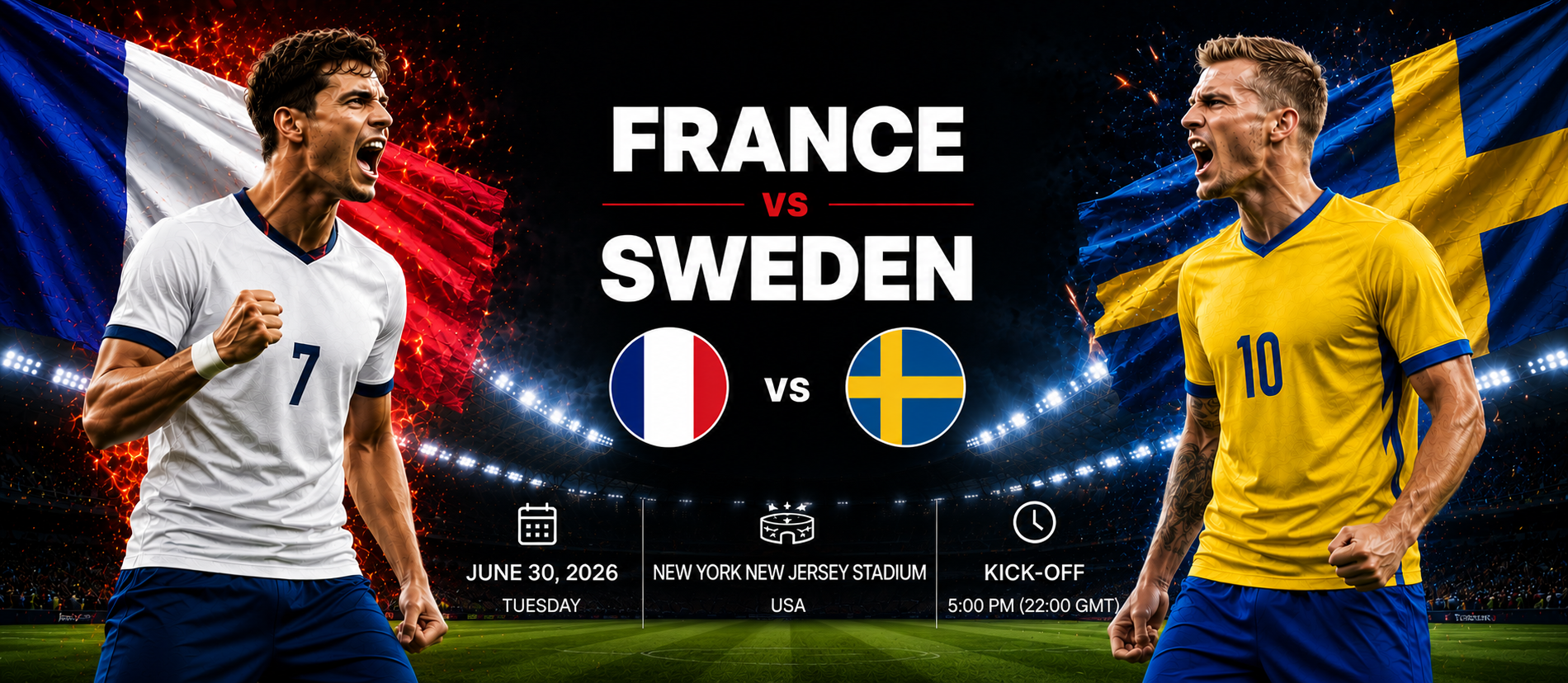
France vs Sweden, Round of 32
France vs Sweden World Cup 2026 Round of 32 preview: tactics, squads, injuries, Mbappe and Gyokeres analysis, lineups and our score prediction for June 30 at MetLife.
- June 30, 2026 Tue
- MetLife Stadium East Rutherford
- Kick-Off 5:00 PM ET
Everything you need at kickoff
- Fixture
- France vs Sweden Group I winners vs best third-placed qualifier (Group F) · Match 77
- Date
- Tue, June 30, 2026
- Kickoff
- 5:00 p.m. ET
- Venue
- MetLife Stadium East Rutherford, NJ · "New York New Jersey Stadium" · largest venue, host of the July 19 final
- Stage
- Round of 32 Single-elimination; the winner advances to the Round of 16
- Referee
- Not yet confirmed Not publicly confirmed at the time of writing — uncertainty flagged
- Weather
- Warm & humid High-70s to low-80s °F with a meaningful chance of showers; a weather delay is plausible (forecast indicative)
- Rest
- France 3 · Sweden 4 days France last played Jun 26 (Norway); Sweden Jun 25 (Japan) — a small edge to the underdog
Bracket implication: the winner moves into the Round of 16 and a likely meeting with a runner-up or third-placed side from a neighbouring bracket. We treat the specific opponent as not yet fixed.
Tale of the tape
France are the more complete side by a wide margin, and they are peaking offensively at the right time. Two forwards in red-hot form (Mbappe with multiple goals, Dembele with a hat-trick), a creative hub in Olise, midfield control through Rabiot, Kone and the returning Tchouameni, and a settled, high-quality back line in front of one of the world’s best goalkeepers in Mike Maignan. Their only soft spots are situational rather than structural: Saliba’s fitness and the uncertainty around Deschamps’ presence and emotional state.
Sweden are a team of moments and individuals rather than a cohesive machine. Their forward line could hurt anyone — Isak and Gyokeres are both proven Premier League-level strikers, and Elanga is in the form of his life. But the spine behind them is fragile, the qualifying record was dreadful, and the Netherlands game exposed a defence that cannot live with pace and quick combinations. Potter has stabilised the mood and found a way through, but “found a way through” is the ceiling of the praise so far.
France won the group with maximum points ahead of Norway, scoring ten and conceding two. Match 1: France 3-1 Senegal (June 16) — Mbappe scored twice, including a 66th-minute opener from a Michael Olise pass and a long-range stoppage-time second, with Bradley Barcola also scoring and Ibrahima Mbaye pulling one back; the brace was reported as taking Mbappe to the top of France’s all-time scoring list. Match 2: France 3-0 Iraq (June 22, Philadelphia) — a professional job through the tournament’s first rain delay, Mbappe twice and Ousmane Dembele adding a third, set up by Olise. Match 3: Norway 1-4 France (June 26) — Dembele’s first-half hat-trick (7′, 20′, 32′), reported as the second-fastest in World Cup history behind Erich Probst’s for Austria in 1954, with Desire Doue’s headed fourth; Didier Deschamps was absent, having flown back to France following the death of his mother, with assistant Guy Stephan in charge and Saliba rested with a sore back.
Tournament Journey — through as a best third-placed team
Sweden qualified for the World Cup without winning a single group game in qualifying, sneaking through via the Nations League play-off path under Graham Potter, who took the job in October 2025 with the team in crisis, then finished third in Group F. Match 1: Sweden 5-1 Tunisia (June 14) — a statement opener, Yasin Ayari twice (7′, 90+6′), Alexander Isak (30′), Viktor Gyokeres (59′) and substitute Mattias Svanberg (84′, roughly 18 seconds after coming on, reported as the second-fastest by a substitute in World Cup history); Isak provided two assists. Match 2: Netherlands 5-1 Sweden (June 20, Houston) — a brutal correction; Brobbey twice, Gakpo twice and Summerville, with Anthony Elanga scoring Sweden’s goal; by one report Sweden became the first team in World Cup history to win their opening game by four and then lose their second by four. Match 3: Japan 1-1 Sweden (June 25) — the escape; Elanga curled a superb equaliser (62′) after Daizen Maeda’s opener to secure the point that confirmed third place.
Across the group Deschamps’ France looked broadly consistent — a 4-3-3 / 4-2-3-1 hybrid with Mbappe leading the line or drifting left, Olise providing the creative spark, and a disciplined double pivot. The evolution was about who supplies the goals: Mbappe carried matches one and two, then Dembele exploded in match three, making France genuinely multi-headed in attack — the hardest kind of team to plan against. The rotation against Norway (Doue, Theo Hernandez, Tchouameni in; Saliba rested) showed Deschamps trusts his depth.
Potter’s side evolved out of necessity. Against Tunisia they were front-foot and aggressive; battered by the Netherlands, they retreated into a more cautious, lower-block, counter-reliant approach against Japan — and it nearly cost them before Elanga’s moment of magic. Expect the Japan game, not the Tunisia game, to be the template for facing France: deep, compact, hoping to spring Isak, Gyokeres and Elanga in transition. The open question is whether Potter trusts a back line that conceded ten goals across the Netherlands and Tunisia games to hold up against this French attack.
Mike Maignan (AC Milan) is the clear number one. First-choice defence: Saliba and Upamecano at centre-back, Kounde at right-back, Digne or Theo Hernandez at left-back. Midfield: Rabiot and Kone started the Iraq game, with Tchouameni returning against Norway. The forward depth is the story of France’s tournament — Mbappe, Dembele (recent Best FIFA Men’s Player), Olise, Doue, Barcola, Cherki, Thuram and Mateta. Injury watch: Saliba rested his sore back against Norway and has admitted playing through pain — the single most important France fitness question. Group-stage yellows were wiped under FIFA’s 2026 rules, so no France player carries a booking into the Round of 32.
Goalkeeping is not a Swedish strength (Nordfeldt, Johansson, Widell Zetterstrom). Captain Victor Lindelof anchors the back line alongside Isak Hien — a unit that conceded ten goals across two of three group games, the clearest weakness in the tie. The midfield (Svanberg, Karlstrom, Ayari, Bergvall, Zeneli) is hard-working rather than controlling. The reason anyone fears Sweden is the attack: Alexander Isak, Viktor Gyokeres and Anthony Elanga, who has two goals in two games and is the form pick. Notable omission: Dejan Kulusevski, out long-term with a knee injury. As with France, group-stage yellows reset, so no Sweden player carries a booking into this match.
- Two genuinely elite attackers in form — Mbappe with multiple goals and Dembele with a hat-trick.
- Creative supply from Olise and midfield control through Rabiot, Kone and the returning Tchouameni.
- A settled, high-quality back line in front of one of the world’s best goalkeepers in Maignan.
- Attacking depth that is the story of their tournament.
- A forward line that could hurt anyone — Isak and Gyokeres are proven Premier League-level strikers.
- Anthony Elanga in the form of his life, with two goals in two games.
- Capable of a spectacular high, as the 5-1 over Tunisia showed.
- Saliba’s fitness — he rested a sore back against Norway and has admitted playing through pain.
- Uncertainty around Deschamps’ presence and emotional state after he left the squad before the Norway game.
- A fragile spine and a defence that cannot live with pace and quick combinations.
- A dreadful qualifying record — through without winning a single qualifying group game.
- Conceded ten goals across the Netherlands and Tunisia games.
Deschamps vs Potter
Didier Deschamps, in his final tournament before stepping down, is a serial winner (2018 champion, 2022 finalist) and a pragmatist who trusts structure and game-management. The complication: he left the squad before the Norway game following his mother’s death, with assistant Guy Stephan taking charge. Whether Deschamps is back on the touchline for June 30, and in what frame of mind, is a genuine and sensitive uncertainty we will not speculate on beyond the reported facts.
Potter, an analytical, possession-friendly coach by reputation, has been forced into firefighting since October 2025, and his achievement in simply getting Sweden here is real. He knows his defence cannot trade blows with France, so the Japan-game blueprint — sit deep, stay compact, spring the front three — is his most logical play. The chess match is really about whether Potter can build a low block disciplined enough to frustrate France for 70-plus minutes.
Key player matchups
Dembele / Mbappe vs Lindelof and Hien
France’s two in-form forwards against a centre-back pair that has been carved open by pace. This is the matchup that could decide the game inside the opening half-hour, just as Brobbey’s early goals did for the Netherlands.
Olise vs Sweden’s left side
Olise’s creativity against whichever full-back Potter deploys on Sweden’s left. If Sweden push high, Olise will find the space behind.
Isak / Gyokeres vs Upamecano and Saliba
Sweden’s one route to hurting France: getting their strikers isolated against the French centre-backs in transition. If Saliba is below full fitness, this becomes more interesting.
Elanga vs Kounde
Elanga is Sweden’s form player and loves cutting in onto his left. Containing him is a specific job for Kounde at right-back.
Tchouameni / Rabiot vs Ayari / Bergvall
Midfield control. France should dominate territory; Sweden need their midfielders to win second balls and launch quick breaks.
Sweden’s most logical play is the Japan-game blueprint — sit deep, stay compact, spring the front three — and the whole tie may turn on whether Potter can build a low block disciplined enough to frustrate France for 70-plus minutes.
Expected starters, rated on form
7.5 — Untroubled but reliable; two goals conceded across the group.
7.5 — Solid defensively, useful going forward.
7.0 (if fit) — Class defender playing through a back issue; fitness is the variable.
7.5 — Pace and aggression; comfortable group stage.
7.0 — Competent; Theo offers more attacking thrust.
7.5 — Steady, experienced, two-way presence.
7.5 — Energetic, progressive; impressed in the group.
7.5 — Returned against Norway; adds control.
8.5 — France’s creative engine, multiple assists.
9.0 — Hat-trick hero against Norway; in sensational form.
9.0 — Multiple goals, France’s record scorer, the tournament’s headline act.
6.0 — Beaten ten times in two games; will be busy.
6.5 — Leadership and composure, but exposed by pace.
6.5 — Athletic; the better of the centre-back pairing on current form.
6.0 — Will be pinned back for long spells.
6.5 — Screening job will be enormous.
6.5 — Goal threat from deep; super-sub against Tunisia.
7.0 — Brace vs Tunisia; the midfield’s most dangerous runner.
6.5 — Talented young tempo-setter.
8.0 — Two goals in two games; Sweden’s in-form match-winner.
7.5 — Elite finisher; one goal so far, needs more service.
7.0 — One group goal; capable of a decisive moment.
Man of the Match: Ousmane Dembele. Turning point: an early France goal — inside the first half-hour — that forces Sweden out of their compact shape and opens the game for France’s attack.
France are the better team in nearly every phase, are in outstanding attacking form, and face a defence that has just been shown, twice, how it can be opened up. Confidence: medium-high — high on the France win, with the medium caveat reflecting two real unknowns (Saliba’s fitness and the Deschamps management and emotional situation), plus the inherent variance of single-elimination football and Sweden’s genuine attacking talent.
Research-led, and honest about what we can’t know
Research-led, AI-assisted analysis produced by the Brillmark and Fanorate team. Every score, scorer, lineup and squad detail above was cross-checked against multiple public reports and verified as of June 27, 2026. Where the facts are unsettled — a referee not yet named, a fitness call still in the balance, a lineup that could change on the morning of the match — we flag the uncertainty rather than guess. We do not invent statistics, and we do not pretend to know a probability we cannot know.
