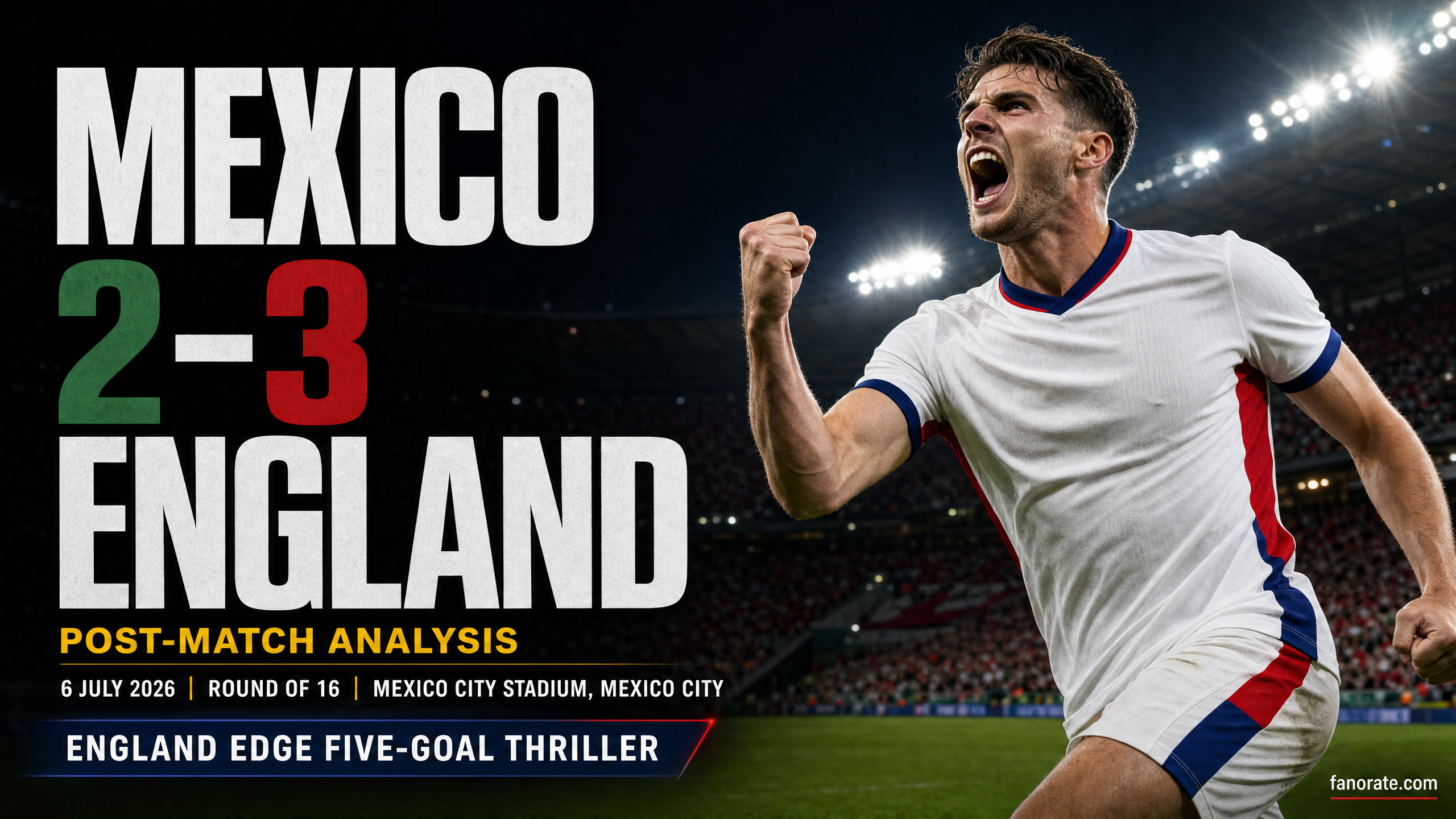
England Survive Mexico Storm to Reach World Cup 2026 Quarter-Finals | Match Analysis
Jude Bellingham scored twice inside 38 minutes before England were reduced to ten men, survived a Mexican onslaught and sealed a dramatic 3-2 World Cup Round of 16 victory through Harry Kane’s penalty in Mexico City.
England won after full-time
What happened
Under light rain and a wall of deafening noise inside the 87,523-capacity Mexico City Stadium, England produced one of the most dramatic Round of 16 performances in recent World Cup memory. Jude Bellingham was otherworldly in the opening half, netting twice to put Gareth Southgate’s successor’s side in command before Julián Quiñones hauled Mexico back into the tie on the stroke of half-time. The second half became a war of attrition after Jarell Quansah’s red card left England a man down, but Harry Kane’s coolly converted penalty on the hour mark ultimately proved the difference. Raúl Jiménez’s spot-kick gave the Estadio the hope it craved, yet England’s ten men dug in magnificently to clinch a 3-2 victory and advance to the World Cup quarter-finals.
How it was won and lost
Bellingham’s Blitz: England’s Clinical Counter-Attacking in the First Half
England set up in a compact mid-block, surrendering the ball deliberately — finishing with just 33% possession — and looking to exploit Mexico’s high defensive line on the counter. It was a strategy that paid spectacular dividends. Bukayo Saka’s incisive run created the first opening for Bellingham to finish at the near post in the 36th minute, and within two minutes Harry Kane played a perfectly weighted through ball for Bellingham to double the advantage. England’s willingness to absorb pressure and punish transitions was textbook, generating three big chances from just 22 dangerous attacks, a ratio that underlined their ruthless efficiency.
Mexico’s Territorial Dominance: All the Ball, Not Enough Goals
Mexico dominated every possession-based metric — 67% ball retention, 455 passes at a 92% success rate, 12 corners, and an extraordinary 49 crossing attempts — yet found England’s low block and Jordan Pickford’s shot-stopping impossible to crack consistently. The attacking width provided by Jorge Sánchez and Julián Quiñones caused problems, but Mexico’s end product in open play rarely matched their volume of possession. Quiñones’s goal just before the break and Jiménez’s penalty were ultimately all they had to show from 82 dangerous attacks and 18 shots — a damning indictment of their conversion.
The Red Card Shift: England’s Ten-Man Rearguard
The match’s pivotal moment arrived in the 53rd minute when centre-back Jarell Quansah received a straight red, confirmed by VAR, leaving England with ten men for the entire second half. Southgate’s coaching staff responded immediately with John Stones’s withdrawal at 57 minutes replaced by a more compact defensive shape, and later Dan Burn added physicality to the backline. England’s structure shifted to a rigid five-man defensive block, with Declan Rice — despite his early yellow card — acting as the sole defensive midfielder screening the back four. The discipline was remarkable: only 14 fouls conceded in the full match, with the ten men winning 49 duels to Mexico’s 37, a statistic that defied the territorial narrative.
Set-Piece Vulnerability and the Penalty Shootout of Emotions
Mexico generated 12 corners and numerous free-kick situations in dangerous areas, leaning heavily on aerial delivery as the game wore on. England’s ten men registered a remarkable ten successful headers — level with Mexico despite the numerical disadvantage — underlining the organizational resilience of Marc Guehi and the makeshift defensive unit. Both penalties were crucial pivot points: Kane’s composed finish restored England’s two-goal cushion at 3-1 in the 60th minute before Jiménez’s converted spot-kick at 69 minutes reignited Mexican hopes. The final twenty minutes were breathless, with England’s bench deploying Djed Spence and Dan Burn to reinforce the flanks and absorb Mexico’s crossing bombardment.
England’s Long Ball Strategy as a Defensive Weapon
With a man down, England intelligently shifted to a direct long-ball approach, completing 22 of 45 long passes — a 49% success rate that kept Mexico’s press honest and helped relieve pressure in their own half. Harry Kane dropped deeper to link play, Morgan Rogers’s late introduction added energy on the break, and England’s transition defending was disciplined enough to restrict Mexico to just five shots on target despite their relentless territorial pressure.
Who decided it
Jude Bellingham
EnglandBellingham was simply irresistible in the first half, scoring twice inside 38 minutes to put England in control of a World Cup knockout tie on the most hostile of stages. His first, assisted by Saka, showed intelligent movement to arrive at the near post; his second, fed by Kane, demonstrated his ability to time attacking runs with precision. He was the difference-maker when it mattered most.
Operating as England’s number ten with licence to drive beyond Harry Kane, Bellingham repeatedly exploited the pockets of space behind Mexico’s high defensive line on transition. His presence created a constant second-phase threat that unsettled Mexico’s structure even as they dominated possession, and his goals effectively set the platform for England’s ten-man survival act.
Harry Kane
EnglandKane combined an assist for Bellingham’s second goal with a nerveless penalty conversion in the 60th minute to make it 3-1 at a critical moment in the tie. His leadership with ten men — dropping into deeper areas to hold the ball and relieve pressure — was as valuable as his direct contributions in the box.
As the focal point of England’s counter-attacking structure, Kane’s intelligent positioning stretched Mexico’s centre-backs and created channels for Bellingham and Saka to exploit. With ten men, his ability to hold play and win duels high up the pitch was vital to England’s game management.
Jordan Pickford
EnglandPickford made three saves against a Mexico side that generated 18 total shots and dominated possession for long stretches, particularly in a second half when England were reduced to ten men. His composure under an aerial bombardment of 49 crosses was critical to England’s passage.
Pickford’s command of his penalty area and ability to organize an increasingly stretched defensive line proved invaluable. His three saves in the second half kept Mexico from completing what would have been a remarkable comeback, and his distribution under pressure helped England relieve siege conditions during the frantic closing stages.
Bukayo Saka
EnglandSaka assisted Bellingham’s opening goal and was England’s primary outlet on the counter-attack, completing successful dribbles and driving forward purposefully in a first half where England looked devastatingly efficient. He was withdrawn at 57 minutes as part of England’s defensive reorganization following the red card.
Saka’s directness on England’s right flank created the first-half momentum that allowed England to build their lead. His willingness to run in behind on transitions repeatedly pinned back Mexico’s left side and created the space for Bellingham’s midfield runs to go untracked.
Julián Quiñones
MexicoQuiñones scored Mexico’s crucial first goal on the stroke of half-time to make it 2-1 going into the break, breathing life into the tie and giving the capacity crowd something to believe in. He was replaced in the 81st minute having given consistent width and threat throughout the game.
Operating on Mexico’s left flank, Quiñones was a persistent danger down the channel, contributing to the crossing-heavy approach that generated 49 attempts from wide areas. His goal, arriving at a psychologically important moment before half-time, changed the emotional dynamic of the match completely.
Where it sits in history
England have a long and complex history with knockout football in Mexico. This was a fixture that evoked memories of iconic clashes at previous World Cups, and winning a knockout game on Mexican soil — in front of nearly 90,000 hostile supporters — represents a genuinely significant achievement for English football. For Mexico, defeat in the Round of 16 extends a painfully familiar pattern: El Tri have now failed to progress beyond this stage in multiple consecutive World Cup campaigns, a recurring heartbreak that will prompt deep reflection ahead of their role as co-hosts of this very tournament. England’s ability to win a World Cup knockout match as ten men for the entirety of the second half is a testament to tactical resilience rarely seen from Three Lions sides in tournament football.
Inside the ground
The Mexico City Stadium was a cauldron of green, white and red as the capacity crowd of 87,523 created one of the most intimidating atmospheres in World Cup football. The noise during Mexico’s second-half siege — when they sensed a comeback — was genuinely extraordinary, waves of sound accompanying every cross and attack. England’s travelling support, outnumbered overwhelmingly, made themselves heard during Bellingham’s two first-half goals but spent most of the second half on edge as Mexico pressed relentlessly under the floodlights in the light rain. The late yellows — Henderson and Vásquez both booked in stoppage time — reflected the raw emotion of a match that neither side could completely control.
Looking ahead
England advance to the FIFA World Cup 2026 quarter-finals, where they will face another heavyweight test having shown they can grind out results through adversity. The red card suspension for Jarell Quansah will be a significant concern for the coaching staff, while the bookings accumulated — including four yellow cards — demand careful management ahead of the next fixture. For Mexico, the tournament ends on home soil in devastating fashion, their Round of 16 ceiling once again proving impossible to break through despite the passionate backing of one of world football’s most devoted fanbases. The tactical conversation will now turn to whether El Tri’s possession-first approach is capable of producing the clinical edge a World Cup knockout stage demands.
The bottom line
-
Jude Bellingham scored twice inside 38 minutes to put England firmly in control in a stunning first-half display
-
England won 3-2 despite playing the entire second half with ten men following Jarell Quansah’s red card
-
Harry Kane converted a penalty in the 60th minute to restore England’s two-goal cushion at a critical moment
-
Mexico dominated possession with 67% ball retention and 18 total shots but could only convert twice
-
Julián Quiñones scored on the stroke of half-time to give Mexico a lifeline heading into the break
-
Raúl Jiménez’s penalty reduced the deficit to one goal at 3-2 but England held firm
-
England advance to the FIFA World Cup 2026 quarter-finals; Mexico’s Round of 16 curse continues
-
Jordan Pickford made three saves in a critical second-half goalkeeping performance under intense pressure
