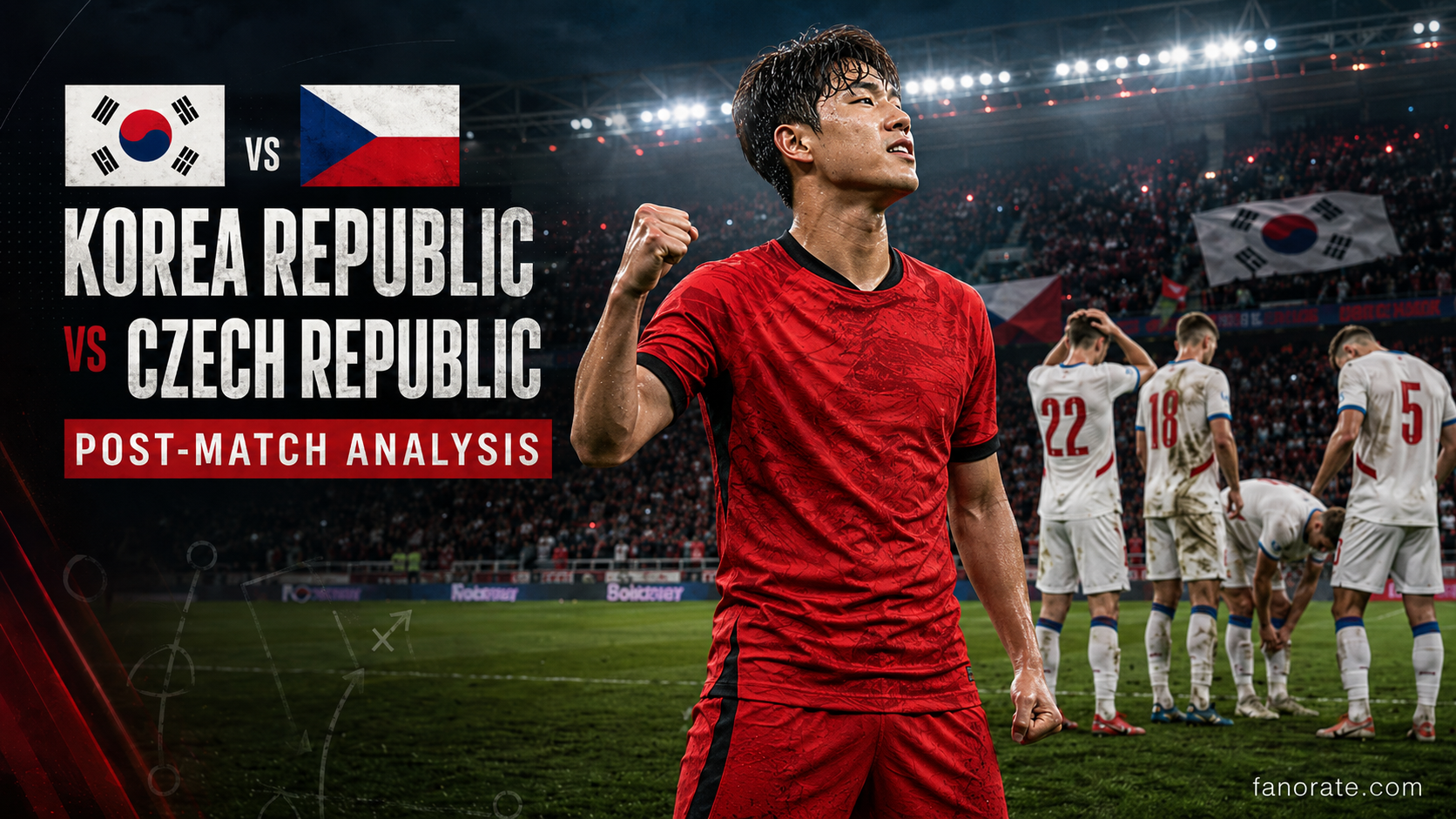
Korea Republic 2-1 Czech Republic: Dramatic Second-Half Comeback Seals FIFA World Cup 2026 Group Stage Victory
Korea Republic produced a composed and clinical second-half comeback at Guadalajara Stadium, overturning a Czech Republic lead through goals from In-Beom Hwang and substitute Hyun-Gyu Oh to claim a vital 2-1 victory in the FIFA World Cup 2026 Group Stage.
What happened
Under scattered clouds in Zapopan, Korea Republic delivered one of the tournament’s early statement performances — absorbing a Czech Republic sucker punch before responding with controlled urgency, tactical intelligence, and genuine quality. The Taeguk Warriors trailed after Ladislav Krejčí’s 59th-minute header, but a double substitution shift in momentum brought two goals in eleven minutes to seal a 2-1 win and send a clear message to the rest of Group Stage rivals. This was a match that had everything: European physicality versus Asian dynamism, a mid-game tactical reset, and a captain’s galvanizing influence that never wavered even when his name wasn’t on the scoresheet.
How it was won and lost
Controlled Possession Base with High Pass Completion
Korea Republic dominated the ball throughout, completing 469 successful passes from 541 attempts — an 87% pass accuracy rate that significantly outpaced Czech Republic’s 70% (230 from 327). The Koreans circulated possession with patience, using midfield triangles through In-Beom Hwang and Kang-In Lee to build play from deep and stretch the Czech defensive block. Heung-Min Son’s movement ahead of the ball created constant reference points while the team’s positional structure provided reliable press resistance when Czech Republic tried to win it back.
Czech Republic’s Set-Piece Threat Pays Off — But Only Briefly
Czech Republic’s most dangerous weapon proved to be their aerial presence from dead-ball situations. Ladislav Krejčí’s 59th-minute header, assisted by Vladimír Coufal, was a well-rehearsed routine exploiting Korea’s vulnerability to second-ball situations in their own penalty area. However, the Czechs struggled to create sustained open-play danger — they managed fewer shots on target and a lower xG (0.87) compared to Korea’s 1.89, suggesting their territorial moments rarely translated into high-quality chances outside of set pieces.
Korea’s Substitution Strategy Unlocks the Game
The pivotal moment of the match came in a ten-minute window between the 62nd and 69th minutes, when Korea manager made four substitutions that fundamentally changed the game’s tempo. Hee-Chan Hwang entered immediately to add direct running, while Ji-Sung Eom and Hyun-Gyu Oh injected fresh legs and cutting edge into attacking positions. The impact was near-instant: In-Beom Hwang levelled at 67′ and Oh added the winner at 80′. Czech Republic’s own triple substitution at 64′ — bringing on Chorý, Hložek, and Sadílek — failed to generate the same decisive impact, with Korea’s defensive structure absorbing the changes comfortably.
Width, Overloads, and Transition Dominance
Korea Republic consistently outnumbered Czech Republic on the flanks, registering 27 attacking entries into the final third compared to Czech Republic’s 16. Their transition from defence to attack was particularly sharp — Korea recorded 14 successful dribbles versus Czech Republic’s 4, and their forward runs through the channels constantly pinned back the Czech full-backs. The 62% territorial pressure (type_45) compared to Czech Republic’s 38% tells the story of a side that had the upper hand in controlling field position for the majority of the contest.
Who decided it
In-Beom Hwang
Korea RepublicThe midfielder was arguably the most influential player on the pitch. Operating as a dynamic box-to-box presence, Hwang scored the equalizer in the 67th minute with a composed right-foot finish assisted by Kang-In Lee, and then turned provider by assisting Hyun-Gyu Oh’s match-winning goal at 80′. His reading of the game and high-intensity work rate were central to Korea’s second-half control.
Hwang’s ability to arrive late into attacking positions while maintaining defensive discipline gave Korea a crucial advantage in central midfield. He effectively linked the creative play of Kang-In Lee to the forward line and was the engine of Korea’s comeback momentum.
Hyun-Gyu Oh
Korea RepublicIntroduced as a substitute in the 69th minute, Oh wasted no time making his mark. Just eleven minutes after coming on, he converted a left-foot finish to give Korea Republic the lead at 80′ — a cold-blooded, match-winning contribution from the bench that validated his manager’s bold second-half gamble.
Oh’s direct running immediately troubled a Czech defence that had settled into a conservative shape. His goal came from movement inside the box — the kind of intelligent late run that well-organized defences struggle to track when fresh attackers enter a tired game.
Kang-In Lee
Korea RepublicThe technically gifted midfielder was Korea’s creative heartbeat, providing the assist for In-Beom Hwang’s equalizer and consistently finding pockets of space between Czech Republic’s defensive and midfield lines. He drew defensive attention that repeatedly opened channels for teammates.
Lee’s ability to receive under pressure and play quickly forward was fundamental to Korea’s rhythm. His partnership with Hwang in the central zone gave Korea a technical and positional superiority that Czech Republic’s midfield could not match.
Ladislav Krejčí
Czech RepublicThe Czech defender was his side’s standout performer, providing the goal that briefly gave Czech Republic the lead with a powerful 59th-minute header from Vladimír Coufal’s delivery. He was composed in possession and won a high number of aerial duels throughout the game.
Krejčí’s goal demonstrated Czech Republic’s genuine threat from set pieces — a weapon that troubled the Korean backline and nearly secured a point. His overall defensive discipline also limited Korean attacking entries down his side in the first half.
Heung-Min Son
Korea RepublicKorea’s captain and talisman didn’t score, but his leadership and intelligent movement were a constant source of anxiety for the Czech defence. He was substituted off in the 69th minute having laid important groundwork — his pressing, link-up play, and off-ball intelligence kept the Czech defence honest throughout.
Son’s runs behind the defensive line forced Czech Republic to hold a high defensive block and prevented them from pressing aggressively. His presence alone shaped the Czech Republic tactical approach and created space for Kang-In Lee and In-Beom Hwang to operate.
Where it sits in history
Korea Republic continue to build on a proud World Cup tradition that includes their extraordinary semi-final run in 2002, co-hosted on home soil. The Taeguk Warriors have consistently punched above their weight on the global stage, and victories from losing positions — like this one — are consistent with their tournament DNA. Czech Republic, meanwhile, are continuing their post-Czechoslovakia independent World Cup journey, a nation that reached the 2006 knockout stages and has produced world-class talent across generations. This result at Guadalajara Stadium adds another chapter to Korea’s reputation as resilient, technically capable performers at the highest level.
Inside the ground
Guadalajara’s Estadio Akron — a venue steeped in Liga MX passion — provided a vibrant backdrop for the FIFA World Cup 2026 encounter. With a capacity of 45,664, the stadium was filled with pockets of passionate Korean support whose noise intensified dramatically as the equalizer hit the net in the 67th minute. The roar that greeted Hyun-Gyu Oh’s winner eleven minutes later was seismic — a wall of red and white erupting in celebration. Czech Republic supporters, organized and vocal in their own section, were silenced by a Korean comeback that had the full neutral crowd on its feet by the final whistle.
Looking ahead
This 2-1 victory gives Korea Republic a strong foundation in FIFA World Cup 2026 Group Stage standings. Three points from their opening match puts them in a commanding position as they look ahead to their next group fixture. Czech Republic will regroup quickly, knowing they were competitive until the final ten minutes — their set-piece threat remains genuine and their squad depth, demonstrated through their second-half substitution waves, gives them tools to bounce back. Both teams’ next matches will be critical in determining qualification routes from a group that now looks very open.
The bottom line
-
Korea Republic came from behind to win 2-1, scoring both goals in a dominant second-half spell between the 67th and 80th minutes.
-
Czech Republic’s only goal came from a 59th-minute header by Ladislav Krejčí — highlighting their set-piece threat as a key weapon.
-
Korea’s substitution strategy was decisive: Hyun-Gyu Oh, introduced in the 69th minute, scored the match-winning goal just 11 minutes later.
-
In-Beom Hwang was the standout performer — scoring the equalizer and assisting the winner in a man-of-the-match display.
-
Korea Republic dominated statistically: 87% pass accuracy (vs 70%), higher xG (1.89 vs 0.87), more shots, and greater territorial control.
-
Kang-In Lee’s creative influence in the middle third was central to Korea’s comeback — his assist for the equalizer was a key turning point.
-
The result gives Korea Republic three crucial points and early Group Stage momentum at FIFA World Cup 2026.
