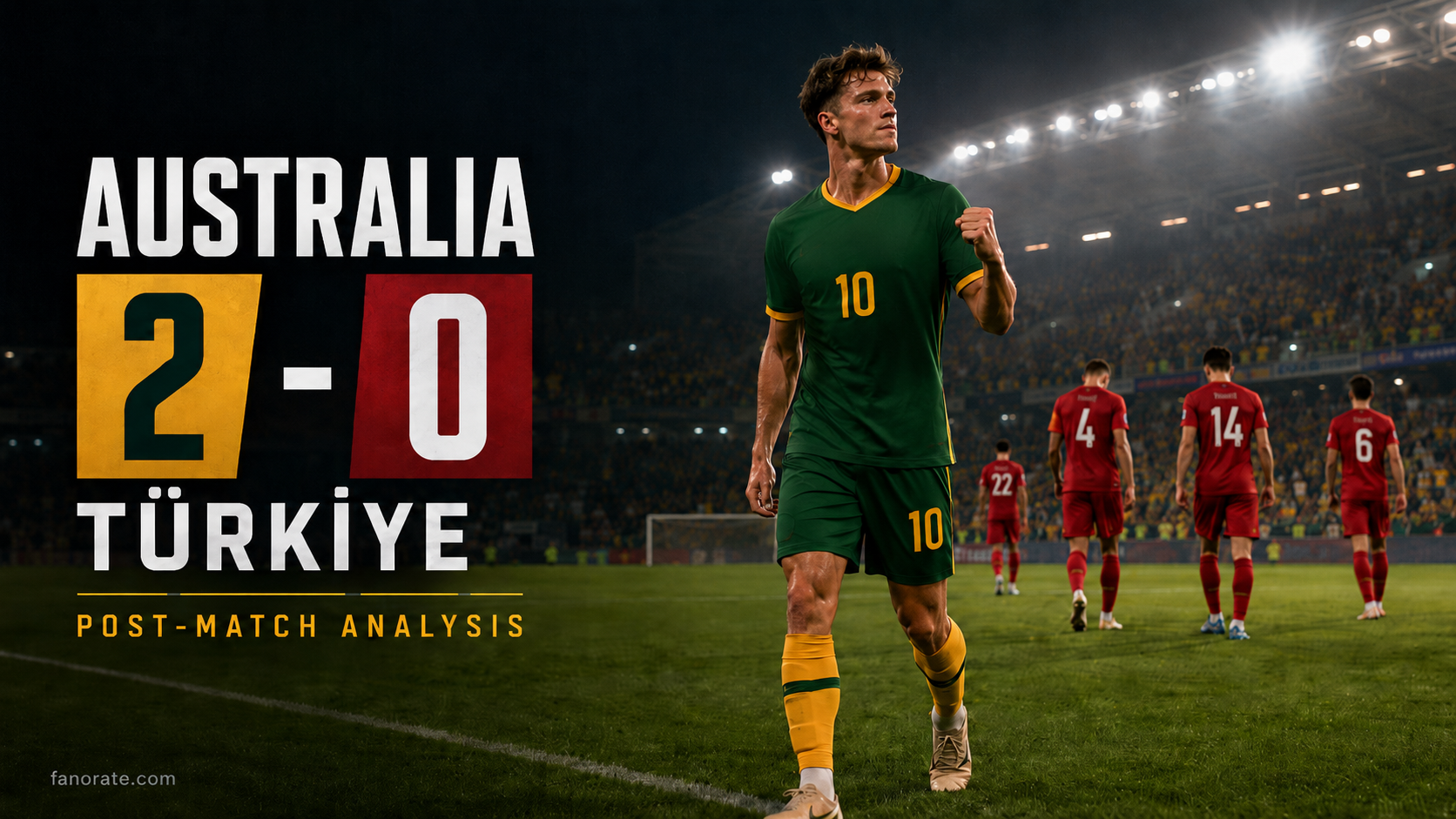
Australia 2-0 Türkiye: Socceroos Stun Crescent-Stars in FIFA World Cup 2026 Group Stage Opener
The Socceroos delivered a statement performance at Vancouver Stadium, beating Türkiye 2-0 in their FIFA World Cup 2026 Group Stage opener. Nestory Irankunda broke the deadlock in the 27th minute before Connor Metcalfe sealed the win with a composed left-footed finish in the 75th. Australia dominated possession in their own half, absorbed Turkish pressure, and struck with clinical precision on the counter.
What happened
Under overcast Vancouver skies, the Socceroos produced one of the most disciplined and effective performances in recent Australian World Cup history. Facing a technically gifted Türkiye side featuring Hakan Çalhanoğlu, Arda Güler, and Kenan Yildiz, Australia sat deep, compressed space with conviction, and exposed their opponents on the break with breathtaking efficiency. Nestory Irankunda’s 27th-minute opener — assisted by Paul Okon-Engstler — set the tone, while Connor Metcalfe’s cool 75th-minute finish against the run of play sealed a remarkable 2-0 victory. The final statistics told the story of two very different teams: Türkiye dominated possession with 702 passes attempted to Australia’s 266, but the Socceroos’ directness, work rate, and tactical discipline ultimately proved decisive.
How it was won and lost
Australia’s Low Block & Counter-Attack Blueprint
Manager Tony Popovic — or whoever directed the Socceroos — set Australia up in a compact, low-to-mid defensive block designed specifically to neutralize Türkiye’s creative midfield trio. With Çalhanoğlu dictating tempo and Güler operating in the half-spaces, Australia prioritized defensive shape over possession, surrendering the ball intentionally and trusting their pace in transition. The numbers back this up starkly: Türkiye attempted 702 passes to Australia’s 266, yet Australia registered more shots on target (6 to 4 for Türkiye per available data) and converted with far greater efficiency. The defensive line held its shape, forcing Türkiye wide and limiting central penetration.
Türkiye’s Possession Dominance Without Reward
Türkiye controlled the ball for extended periods, recording a significant passing volume advantage and generating 22 shots across the 90 minutes compared to Australia’s 9. However, their xG of approximately 1.98 versus Australia’s 0.66 tells a story of chances squandered rather than a tactical failure. Çalhanoğlu and Kökçü attempted to play through the lines repeatedly, but Australia’s compact defensive structure — particularly the discipline of the central midfielders — denied any genuine rhythm. The Turkish wide players, Aktürkoğlu and Barış Alper Yılmaz, found no consistent room in behind, and the halftime substitution of Yildiz for Yılmaz signalled early tactical anxiety from the Türkiye bench.
The Transition Trigger — Australia’s Most Dangerous Weapon
Australia’s two goals were both born from disciplined defensive moments followed by rapid vertical transitions. The first, in the 27th minute, saw Irankunda receive a precise assist from Okon-Engstler and finish clinically, rewarding Australia’s patience in their pressing structure. The second, Metcalfe’s 75th-minute left-footed strike, came against the tide of Türkiye’s second-half pressure — a moment of individual quality finishing a slick counter. Australia’s transition speed exploited the spaces left by Türkiye’s adventurous, possession-heavy approach, particularly as the Turkish full-backs pushed high in search of an equalizer.
Substitution Battles and Second-Half Pressure
Türkiye made ten substitutions across the match — a sign of mounting frustration and tactical reshaping — bringing on Yunus Akgün, Mert Müldür, Salih Özcan, and Deniz Gül in an attempt to inject energy and find a way through. Australia responded with calculated changes of their own, including Jason Kato Geria and Tete Yengi in the 74th minute and the experienced Jackson Irvine shortly after. Rather than chasing the game, Australia’s substitutions were oriented towards holding their shape, managing the clock, and absorbing Türkiye’s renewed pressure. The tactical maturity shown by the Socceroos in the final 15 minutes was a highlight of the performance.
Who decided it
Nestory Irankunda
AustraliaThe young Australian winger was the spark that lit the Socceroos’ World Cup campaign. Irankunda broke the deadlock in the 27th minute, converting a sharp assist from Okon-Engstler with composure beyond his years. He was also involved in creating the platform for Australia’s second goal, earning the assist credit for the move that led to Metcalfe’s strike. Replaced in the 61st minute, his impact on the match was disproportionate to his time on the pitch.
Irankunda’s direct running, sharp movement off the ball, and willingness to drive at the Turkish defensive line on the counter created consistent anxiety for Türkiye’s back four. He was Australia’s primary counter-attacking outlet in the first half, stretching Türkiye’s defensive shape and dragging markers out of position to create pockets for teammates.
Connor Metcalfe
AustraliaMetcalfe delivered one of the most impactful cameo moments of the match with his composed 75th-minute left-footed finish to make it 2-0. His goal, coming at a time when Türkiye were pressing for an equalizer following their wave of second-half substitutions, effectively ended the contest as a competitive fixture.
In a midfield role, Metcalfe contributed to Australia’s defensive compactness throughout the match before producing the decisive moment of quality in front of goal. His ability to arrive late into the box and finish calmly under pressure demonstrated exactly the kind of intelligent off-ball movement that a counter-attacking system demands.
Mathew Ryan
AustraliaAustralia’s captain and first-choice goalkeeper was called upon regularly as Türkiye piled on the pressure, particularly in the second half. Facing a Turkish attack with Arda Güler, Çalhanoğlu, and a parade of quality substitutes, Ryan’s shot-stopping and command of his penalty area were essential to maintaining the clean sheet.
Ryan’s organisation of the Australian defensive line throughout both halves was central to the Socceroos’ game plan. His ability to sweep behind a high line during Türkiye’s build-up and communicate effectively with his back four helped Australia maintain their compact shape even during the most intense Turkish spells of possession.
Hakan Çalhanoğlu
TürkiyeÇalhanoğlu was Türkiye’s creative heartbeat, attempting to unlock Australia’s defensive block with his characteristic deep-lying playmaking. He generated significant ball circulation volume — reflected in Türkiye’s 702 total pass attempts — but was ultimately unable to convert his creative dominance into goalscoring opportunities that were converted.
Despite failing to influence the scoreline, Çalhanoğlu’s deep-lying role was central to everything Türkiye tried to build. His presence allowed Güler and Kökçü to operate higher up the pitch, but Australia’s midfield discipline consistently cut off the passing channels into those advanced areas, reducing his effectiveness considerably in the second half.
Where it sits in history
Australia’s 2-0 victory over Türkiye represents one of the most significant results in Socceroos history at the FIFA World Cup. The result echoes the spirit of Australia’s famous 2006 World Cup campaign in Germany, when the Socceroos reached the Round of 16 for the first time, defeating Japan 3-1 in their group opener. For Türkiye, the defeat is a painful echo of their 2002 World Cup campaign — when they ultimately finished third — beginning with unexpected adversity before finding form. Beating a major European footballing nation with this level of tactical maturity and composure signals a new era of credibility for Australian football on the global stage. This is the first FIFA World Cup hosted in part by Canada, with Vancouver Stadium providing a memorable backdrop to what could be a landmark result for the Socceroos’ group campaign.
Inside the ground
Vancouver Stadium, with a capacity of 54,500 under overcast Pacific Northwest skies, provided a charged and atmospheric setting for the FIFA World Cup 2026 Group Stage opener. Both Australian and Turkish supporters arrived in significant numbers, their colours visible throughout the stands. The Socceroos contingent — bolstered by the large Australian diaspora in Western Canada — generated extraordinary noise at both goals, with Irankunda’s opener sending waves of gold and green into eruption. Turkish fans, expecting their technically superior side to control proceedings, grew increasingly frustrated as the match wore on, their chants shifting from confident to desperate as Metcalfe’s 75th-minute strike effectively ended their hopes of a comeback. The atmosphere captured everything that makes the World Cup unique — a collision of cultures, passion, and footballing identity played out beneath Canadian clouds.
Looking ahead
Australia’s commanding Group Stage opening victory positions the Socceroos as genuine contenders to advance from their group at FIFA World Cup 2026. The three points and a clean sheet represent the ideal platform heading into their remaining group fixtures, with goal difference potentially crucial in a competitive group environment. For Türkiye, the pressure is immediate and significant — a side of their technical quality, boasting players like Çalhanoğlu, Güler, Yildiz, and Aktürkoğlu, will be expected to respond with a performance of greater clinical efficiency in their next outing. The tactical lessons from Vancouver — particularly the need to convert possession dominance into actual goals — must be absorbed quickly. Both teams will know that the margins at a World Cup are unforgiving, and the contrast between Australia’s efficiency and Türkiye’s wastefulness could define where each side’s tournament journey ends.
The bottom line
-
Australia defeated Türkiye 2-0 in their FIFA World Cup 2026 Group Stage opener at Vancouver Stadium.
-
Nestory Irankunda opened the scoring in the 27th minute, assisted by Paul Okon-Engstler.
-
Connor Metcalfe sealed the win with a composed left-footed finish in the 75th minute.
-
Türkiye dominated possession with 702 passes attempted compared to Australia’s 266 but failed to convert their territorial advantage.
-
Australia’s xG conceded was approximately 1.98 — their defensive discipline and Mathew Ryan’s goalkeeping were crucial to maintaining the clean sheet.
-
Türkiye made ten substitutions including Kenan Yildiz, Yunus Akgün, and Deniz Gül but could not find a way through.
-
The result is one of the most significant victories in Australian World Cup history, echoing the spirit of the famous 2006 Socceroos generation.
-
Australia’s counter-attacking tactical blueprint was executed with remarkable discipline and clinical precision throughout.
